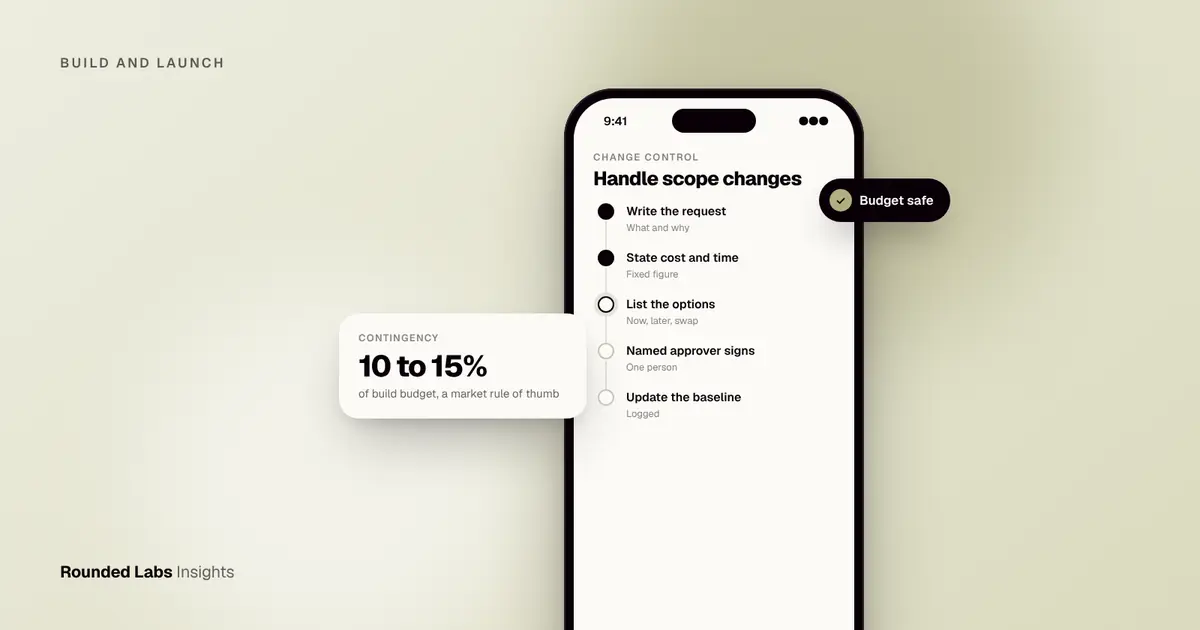
Manage scope changes by agreeing a written baseline, routing every new request through a short change request that states cost, time and trade-offs, and swapping features rather than only adding them. Keep a contingency of 10 to 15% of the build budget for genuine surprises, and approve changes in one place by one named person.
We have shipped apps for Superdry, Next and Waterstones over 19 years, and scope pressure appears on every project, because the people using an app teach you things a plan could not. This guide explains how to welcome good changes without losing control of cost. It sits alongside our wider services and covers the process, the pricing logic, the contract points and several worked examples. Figures are illustrative or market estimates, not quotes, and where contracts are mentioned this is general information, not legal advice.
Key facts
- Scope change is normal. The goal is to make each change a visible, priced decision, not to ban changes.
- A written baseline (features, screens, integrations, exclusions) is what makes a change measurable.
- A fixed price agreed before development starts protects the baseline, and changes are quoted separately.
- Trading a feature out for a feature in often costs far less than adding on top.
- A contingency of 10 to 15% is a common market rule of thumb, not a guarantee.
- One named approver, one log and one baseline document do more for budget control than any tool.
What is scope creep and why does it happen?
Scope creep is the slow growth of a project’s requirements after the plan was agreed, usually through many small “while you are in there” requests, none of which feels expensive alone. It happens for four common reasons:
- The brief was vague. “A booking feature” can mean a calendar, payments, reminders and staff rota tools.
- Real users react. A prototype in front of customers reveals gaps nobody saw.
- Stakeholders arrive late. A finance or legal team asks for requirements in month three.
- Nobody owns the trade-off. Everyone can add to the list and nobody removes from it.
Most of this is avoidable with a proper specification. Our guides on writing an app specification and the app requirements template show how to capture the baseline before work starts.
Scope change is not always a problem
It helps to separate three things that often get lumped together. Scope creep is uncontrolled growth that nobody priced. Scope change is a deliberate, agreed alteration to what will be built. Learning is the discovery that part of the plan was wrong. Only the first is a failure of process. The second is how products improve, and the third is the reason to build in small steps and show working software early.
A project that refuses all change delivers exactly what was written down, on time and on budget, and may still be the wrong product. A project that accepts all change never finishes. The aim is a middle path where every change is a conscious decision with a price attached.
The real cost of a change
Founders often judge a change by how long it takes to type. A new button label is minutes. But most requests are not button labels. A request to “let users save their basket” touches the screens, the database, the sign-in flow, the server code, the tests and possibly the privacy policy. The visible change is small and the work underneath is not. When a supplier gives a figure for a change, ask what it includes: design, build, testing, documentation and any effect on other features.
There are also hidden costs that do not appear on the change request. A change in week eight may force retesting of areas that were already signed off. It may delay a launch date that marketing has already announced. It may pull a developer away from another task, which then slips. A good change request names these effects, so the person approving it sees the whole picture.
What should a scope baseline contain?
A baseline is the document you measure every change against. It should list:
- Features, each with a short acceptance test (“a user can reset a password by email in under two minutes”).
- Screens and platforms (iOS, Android, web admin).
- Integrations, such as payments, CRM or stock systems, and which versions or APIs.
- Explicit exclusions: what is not included, such as a second language or an admin analytics dashboard.
- Assumptions, such as “client supplies final copy and brand assets by week 3”.
Exclusions matter most. Most disputes begin with a feature one side assumed was included. A discovery phase is the cheapest place to settle this, because it turns assumptions into a written plan before build money is spent; see What happens in a discovery phase.
A simple baseline layout
| Section | What goes in it | Example line |
|---|---|---|
| Goal | The one business outcome the release serves | “Let customers book and pay for a service in under three minutes” |
| Users | Named groups and what each can do | “Customer, staff member, administrator” |
| Features | A numbered list with acceptance tests | “F4: Customer can cancel up to 24 hours before a booking” |
| Screens | A list or link to the approved designs | “Design file version 3, signed off in week 2” |
| Integrations | Each system, direction and API version | “Payment provider, create and refund, current version” |
| Exclusions | What is deliberately left out | “No loyalty scheme, no second language, no web version” |
| Assumptions | What the plan depends on | “Brand assets supplied by week 3” |
| Dates | Milestones and the launch window | “Design sign-off week 3, test build week 9” |
The final column of this table, the example text, is a reminder that the best baselines are specific. “Good performance” is not a requirement; “the search results appear in under two seconds on a mid-range phone” is. Specific statements can be tested, and testable statements stop arguments. Our project brief template and the statement of work template give structures you can adapt, and How to write user stories developers understand shows how to write each feature so that its meaning is clear.
Sign-off matters
A baseline that nobody has signed off is a suggestion. Ask the client and supplier to agree it in writing, with a date, and keep it somewhere both can find. Designs should be signed off too, which is why How to sign off a design before build is worth reading before development begins. The reason is simple: when a later argument starts, the dated document ends it, and both sides can move on to the real question of what to do next.
How does the pricing model affect scope changes?
Your contract decides what a change costs you and who carries the risk.
| Model | Who carries scope risk | What a change looks like |
|---|---|---|
| Fixed price | The supplier, within the baseline | Quoted separately as a change request, agreed before work starts |
| Time and materials | The client | Spend rises as work grows, usually with a cap you set |
| Hybrid (fixed phases) | Shared | Each phase is fixed, scope between phases is renegotiated |
Rounded Labs works at a fixed price agreed before development starts, with projects typically £30,000 to £250,000+; see the pricing page. That means the baseline is protected and any addition is a priced change request you can accept or decline. We compare the options in fixed price vs time and materials.
Why a fixed price makes the baseline more important
A fixed price shifts the risk of the agreed work to the supplier, which is a benefit for the buyer, but it only works if both sides know what the agreed work is. The tighter the baseline, the cleaner the change process. If the baseline is loose, the supplier will quote conservatively to cover uncertainty, and the client will feel that every request is being argued over. Investing in the baseline first, through discovery, is what makes the fixed price fair to both parties.
Our fixed price productised services are one way to get there. The Mobile Product Discovery Sprint, at £9,500, turns an idea into a prototype and a costed plan. The Tech Architecture Audit, at £7,500, settles technical unknowns in an existing system. Both create the written baseline that the later project price depends on. See the pricing page for the full list.
Contract points worth checking
This is general information, not legal advice; ask your solicitor to review the actual contract. Points that commonly matter for scope changes include:
- A variation clause. How are changes requested, priced and approved? Changes that are not agreed in writing cause the most disputes.
- Acceptance criteria. How and when is a deliverable accepted, and what happens if it is not?
- Warranty period. Bugs in agreed features should be fixed at no extra charge for a stated period.
- Dependencies. What the client must supply, by when, and what happens to the schedule if it arrives late.
- Ownership. You should own the code and designs you pay for; see Who owns the code?.
- Termination. What happens to work in progress if either side ends the contract.
UK business owners can find general guidance on contracts on GOV.UK, and our guide to 20 questions to ask an app developer before you sign includes the key contract questions in plain English.
What types of change request will you see?
Not every request is the same, and treating them the same wastes time. Sort each one into a type first.
| Type | What it is | Usual treatment |
|---|---|---|
| Bug | Something that does not do what the baseline says | Fix within the agreed price |
| Clarification | The baseline was unclear and both sides read it differently | Decide, document, and price only if the work is beyond a fair reading |
| Client change | A new or altered feature requested by the client | Priced change request |
| Discovery | Testing or users reveal a gap | Priced change request, often high priority |
| External change | A third party changes a rule, price or API | Priced change request, often unavoidable |
| Regulatory | A law or a store policy requires a change | Priced, and check the official source for the rule |
| Supplier change | The supplier proposes a better way | Agreed in writing, usually cost neutral |
Bug or change? A quick test
The line between a bug and a change causes more friction than any other. Use this test. Open the baseline and find the feature in question. If the baseline described the behaviour the client now wants and the software does something else, it is a bug. If the baseline was silent, or described different behaviour, it is a change. If the baseline was ambiguous, it is a clarification, and both sides should agree a reading and write it down.
This is why acceptance tests are so valuable. “A user can reset a password by email in under two minutes” leaves little room for debate. “Password reset works” leaves a great deal. For the wider vocabulary of testing, see App testing explained, and for how to give useful feedback on a build, How to give useful feedback on a test build.
External changes you cannot control
Some changes are nobody’s fault. A payment provider retires an API version. Apple or Google introduces a new requirement for store submissions. A law changes how consent must be collected. These are real costs, and they are the main reason contingency exists. Official sources for platform changes include the Apple developer site and the Android developer site. Our guides on Apple’s yearly developer announcements and Google Play policy changes explain how to plan for them.
How do you run a change request process?
Keep it light enough that people use it. A one-page change request needs:
- What is being asked, in plain words, and why (the user or business problem).
- Impact on cost (a fixed figure), time (days or weeks) and other features (what slips or breaks).
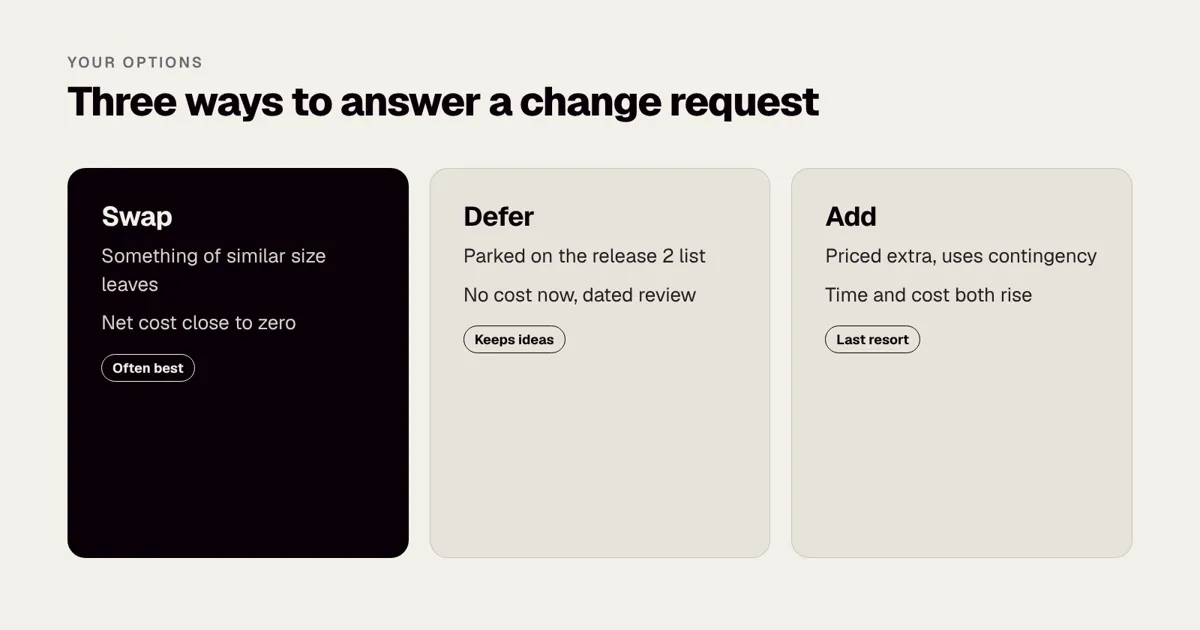
- Options: do it now, do it later, swap it for something, or drop it.
- Decision: a named approver signs, and the baseline is updated.
Use one approver, ideally the product owner, not a committee. If you want a ready format, see the change request form template. Log every request, including rejected ones, so you can see the pattern at the end of the project.
Not sure whether a request is a change or part of the plan? A short conversation usually settles it, and it is cheaper before work starts. Book a 30-minute call with a co-founder and we will talk through your baseline.
What a good change request looks like
Here is a filled-in example for a retail app, to show the level of detail that works.
| Field | Entry |
|---|---|
| Request number | CR-007 |
| Requested by | Head of Marketing |
| Date | Week 6 |
| Request | Show a “back in stock” notification on wishlist items |
| Why | Customers ask by email; it should lift repeat visits |
| Impact on cost | £4,200 fixed |
| Impact on time | 6 working days, no change to launch date if started this week |
| Impact on other features | Uses the existing push notification service; requires one extra test cycle |
| Options | A: build now. B: defer to release 2 at the same cost. C: swap for the planned “recently viewed” list (£3,800 value) |
| Decision | Option C. Net cost £400 |
| Approved by | Product owner, week 6 |
The options row is the heart of it. By offering a swap, the supplier gives the client a way to say yes without spending much more. Many requests become much cheaper when a lower-value item leaves the plan.
Who does what in the process
| Role | Responsibility |
|---|---|
| Requester | Describes the need and the reason, not just the solution |
| Product owner (client) | Decides, owns the budget, signs the request |
| Project lead (supplier) | Assesses impact, prices, proposes options |
| Developers and designers | Estimate their part honestly, flag side effects |
| Finance contact (client) | Confirms how changes are funded and invoiced |
Notice that the requester and the approver are different people. If the approver is also the main requester, the process has no brake. If there are many requesters, a weekly slot where the product owner reviews new requests in one batch prevents interruptions and helps to compare requests against each other.
Turnaround times
A process that takes two weeks to answer a request will be bypassed. Agree a target for the supplier to respond with an impact assessment, for example two working days for small requests and five for large ones. Agree a target for the client to decide, for example three working days. Stating these in the contract or project plan keeps the work flowing and prevents the quiet drift where nobody decides and the work happens anyway without a price.
How do you decide which changes to accept?
Score each request on three questions: does it fix a launch blocker, does it serve many users, and is it cheap relative to its value? Anything that fails all three goes to the “later” list. A simple method is MoSCoW prioritisation: Must, Should, Could and Won’t have for this release.
Most scope pain is fixed by moving a request from “now” to “next release”. This is also the logic behind a minimum viable product: ship the core, learn from real users, then add. Changes found in testing that break the core flow are different: accept and price them quickly, because delaying them costs more.
A scoring grid you can use
For a more structured comparison, score each request from one to five on four measures and add them up.
| Measure | One means | Five means |
|---|---|---|
| Urgency | Nice to have any time | Blocks launch or causes harm now |
| Reach | A handful of users | Almost every user |
| Value | Little effect on goals | Clear effect on the agreed goal |
| Cheapness | Large effort or risk | Small, well understood |
Anything scoring fifteen or more is a strong candidate to accept. Anything scoring ten or less goes to the later list. The scores between are a conversation. The numbers are not magic, but writing them down forces the discussion to be about the product, not about who asked loudest. Our guide to choosing features for version one uses similar thinking, and How to decide between new features and fixes helps after launch.
The “swap” rule
The most effective single habit is to ask, for every new item, what is leaving. The rule is simple: if the project is on budget and on time, then something new means something else goes or waits. This keeps the total effort constant, and it forces the client to rank their own priorities. Often the client discovers that the new idea is less important than a feature they had considered essential.
A swap is not always possible. If every feature is truly essential, then the budget or the timeline must move, and the client should know that clearly and early. Having this conversation in week four is a good experience. Having it in week eleven is not.
What does a worked example look like?
Take a retail loyalty app with a fixed price of £90,000 and a 12 week build, plus a 10% contingency of £9,000 held by the client.
| Week | Request | Decision | Budget effect |
|---|---|---|---|
| 3 | Add Apple Wallet pass for loyalty cards | Accept, quoted at £6,500 | Uses most of the contingency |
| 5 | Add a gift-card scan feature | Swap for “wishlist sharing”, already in scope, moved to release 2 | £0 net |
| 8 | Marketing wants a referral scheme | Park for release 2 | £0 now |
| 10 | Payment provider changes an API version | Genuine external change, quoted at £2,000 | Uses remaining contingency |
Result: the project ships in week 12 for £98,500 in total against a £99,000 ceiling (price plus contingency), and two ideas are on a documented release 2 list. The figures are illustrative, not a quote. The principle is that every change was priced, decided by one person and written down.
Reading the example closely
Several details are worth noticing. The Apple Wallet request was accepted because it served many users and was well defined, and because the contingency existed to absorb it. The gift-card scan was not rejected as a bad idea; it was swapped, which kept the budget stable and gave the client a direct trade. The referral scheme was parked, not refused, which keeps the relationship healthy: the idea is on a visible list with a clear route to being considered later. The payment API change was not the client’s fault or the supplier’s, and it was handled with the same process as any other change.
Also notice that the contingency belongs to the client. At no point did the supplier decide how it was spent. Each use was a signed decision. At the end of the project, the leftover £500 of contingency stays with the client for release 2, and the history shows exactly where the rest went.
A second example: a change that is not worth it
Consider a booking app for a fitness studio, with a fixed price of £60,000 and a ten week build. In week seven, the studio owner asks for live class waitlists with automatic upgrades when someone cancels. The supplier assesses it as £7,500 and two weeks, because it needs new rules in the booking logic, notifications, an admin view and a full retest of booking and payment flows.
The change request lists three options. Option A: build it now, extending the launch by two weeks and using £7,500. Option B: launch on time with a manual waitlist run by staff from a simple admin list, and build the automated version in release two once the real pattern of cancellations is known. Option C: swap it for a planned “class packs” feature of similar cost. The owner chooses option B. Launch happens on schedule, the staff run the waitlist by hand for six weeks, and the data from that period shows that cancellations are rarer than expected, so the automatic version is smaller and cheaper when built. The “no” saved money and produced a better design.
The lesson is that a delay is often better than a rejection, and that real use can answer questions that a meeting cannot.
A third example: a change that is a bug
A client reports that the app lets users book a class that is already full. The baseline’s acceptance test for booking says “the system must not allow a booking when capacity is reached”. This is a bug against the baseline, and it is fixed within the agreed price. No change request is raised, and the client is not charged. The supplier records the issue, fixes it and adds a test so that it does not recur. The same report about a feature the baseline never mentioned, for example a request for two-person bookings, would be a change. Having the baseline lets everyone tell the two cases apart quickly and without hard feelings.
How much contingency should you hold?
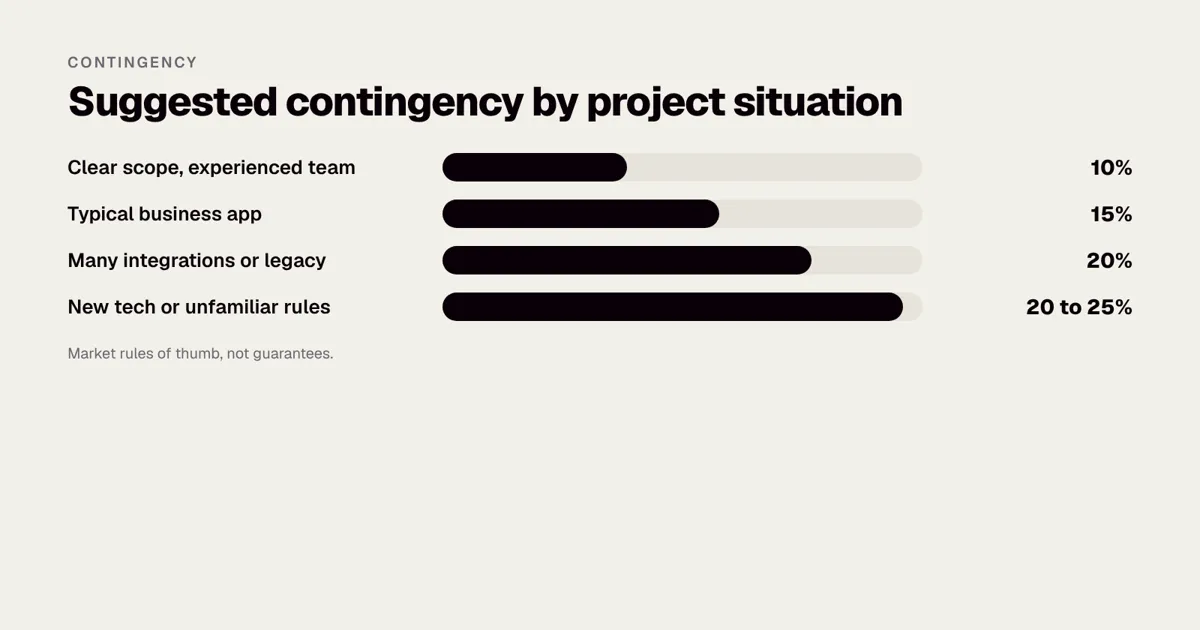
Many teams hold 10 to 15% of the build cost, increasing it to 20% when integrations are many or the requirements are unfamiliar. Keep it under the client’s control, not buried in the supplier’s price, and release it only through the change process. Unused contingency is not wasted; it becomes the budget for release 2. For yearly planning, see how to plan an app budget for the next financial year.
| Situation | Suggested contingency (market rule of thumb) |
|---|---|
| Clear scope, few integrations, experienced team | 10% |
| Typical business app with some integrations | 15% |
| Many integrations or a legacy system | 20% |
| New technology, such as AI features, or unfamiliar regulation | 20 to 25% |
These percentages are rules of thumb used in the market, not guarantees, and they are not a substitute for a good baseline. A well-defined project may need less. A project with unstable requirements may need more, and the right response there is often to shrink the first release and run in phases, not just to add contingency. Our guide to budgeting for AI usage costs shows why AI features in particular call for caution.
What contingency is not for
Contingency should cover genuine surprises: an external change, a requirement found in testing, a legal point discovered late. It should not be a pot for ideas that were left out of the baseline. If contingency is treated as extra budget for wishes, it will be gone by the middle of the project. A useful practice is to reserve a portion, perhaps the last third of it, for the final four weeks, which is when the riskiest surprises tend to arrive.
Showing the budget to the team
Make the budget visible. A single page that shows the fixed price, the contingency, the approved changes, the amount remaining and the “later” list is enough. Share it at every demo. When everyone can see that the contingency is half spent in week six, requests become more thoughtful without anyone needing to say no. See How to read an agency’s weekly report for what a good report contains.
How do you handle scope when the deadline is fixed?
Some projects have a date that cannot move: a trade show, a season, a regulatory deadline or a campaign. In that case, time is fixed and the price is fixed, so scope is the only thing that can flex. The conversation changes from “what do we add?” to “what is the minimum we can ship by that date?”
We delivered the Waterstones app, mobile site and eBooks API in 12 weeks. A short, fixed timeline of that kind forces clear priorities, because every addition has to be paid for by something leaving. The practice that supports it is the same as any other project, only applied more strictly: a written baseline, a fast approval process and a visible list of what is waiting for the next release.
Where a date is fixed, consider three tactics.
- Define a minimum launch set. List the features without which the app should not launch. Everything else is “if time allows”.
- Cut by default. When a request arrives late, the default answer is “after launch” unless it fixes a launch blocker.
- Prepare a fast follow release. Plan a second release four to six weeks after launch for the items that waited. This gives the team a place to put ideas and gives stakeholders a date to look forward to.
Our guide to the first weeks after release, How to plan hypercare after launch, covers how to stay stable once the app is live.
What habits keep scope under control?
- Demo every one or two weeks so surprises appear early, when they are cheap.
- Freeze scope for the last two to three weeks before launch, apart from bugs and launch blockers.
- Keep a “later” list visible to everyone, so ideas feel heard.
- Review the budget weekly against the baseline, not monthly.
- Name the decision maker on day one, and give them the authority to say no.
Demos as a scope tool
Regular demos are the best early warning system. When stakeholders see working software every week or two, they notice gaps while there is still time to adjust. They also feel involved, which lowers the pressure to push for extra features at the end. A good demo shows what changed since last time, what is coming next and where the budget stands. Our guide on how to run a sprint demo and the sprint review agenda offer formats, and How to review app designs as a non-designer helps stakeholders contribute usefully.
Communicating a “no”
Saying no is easier when you say what happens to the idea. Compare two responses to the same request. “We cannot do that” ends the conversation and creates frustration. “We can do it in release two, and here is what it would cost then” keeps the idea alive and shows that the team has listened. The second response is nearly always available. A useful script for suppliers and product owners alike is: acknowledge the need, state the impact, offer options, ask for a decision.
The last three weeks
The final stretch is where scope pressure is highest, because launch is close and everyone becomes aware of what is missing. A freeze helps. In the freeze period, the team accepts only bug fixes and launch blockers, and every other request goes to the later list with a date for review. Announce the freeze date at the start of the project so nobody is surprised. A project that holds the freeze usually launches with less stress and fewer defects, because the team spends its last weeks testing and polishing, not building.
How do you work with stakeholders who keep adding things?
Every project has a person who sends new ideas on a regular basis. They are rarely being difficult; they care about the product. The task is to channel their energy rather than block it.
| Behaviour | Likely cause | Helpful response |
|---|---|---|
| Sends ideas by message at all hours | No agreed channel | Provide a single request form and a weekly review slot |
| Reopens settled decisions | Did not attend the sign-off | Share the dated baseline and invite them to the next review |
| Adds requirements after seeing a competitor | Fear of falling behind | Compare the idea to the goal and to the release 2 list |
| Asks for “small” changes repeatedly | Does not see hidden effort | Show the effort behind a sample small change |
| Escalates to senior leaders | Feels unheard | Make the later list visible, and give a date for review |
Our guide on how to get board approval for an app project and how to build a business case for a mobile app can help align senior stakeholders before the build begins, which is when alignment is cheapest. If the stakeholder group is large, appoint a single product owner, and have that person collect requests from the others, so the supplier sees one voice and the client sees one list.
What if the project is already off track?
Sometimes the baseline was loose, the changes were unlogged and the budget is already stretched. Recovery is possible, and the steps are straightforward.
- Stop and list. Pause new requests for a day or two, and list everything that is built, in progress and requested.
- Rebuild the baseline. Write down what is now in scope, including approved and unapproved additions.
- Price the gap. Work out the cost to finish the baseline and the cost of each outstanding request.
- Reset the plan. Agree what is in the next release, what moves later and what is dropped.
- Restart with the process. Use change requests, one approver and a visible log from now on.
Our guides on how to tell if an app project is off track, How to rescue a failing app project and How to take over an app built by someone else go deeper. If a project is in poor shape, the Legacy App Rescue Assessment, a fixed price service at £6,500, is one way to establish where things stand. For general guidance on keeping a project healthy, How to run a successful app project collects the lessons that last.
What does agile change about scope?
Agile methods are often misunderstood as “scope is open”. In practice, agile teams work in short cycles and reprioritise the list of work at the start of each cycle. The budget and the time box still apply, so adding something still means removing or deferring something else. The Agile Manifesto values responding to change over following a plan, but it does not say that change is free. The Scrum Guide describes a backlog that is ordered and refined continuously, with a product owner accountable for it.
For a client buying software, this means the same rules apply with a lighter rhythm. A baseline can be a ranked backlog with a defined first release. A change request can be a re-ranking decision with a cost note. The principle of one decision maker and a visible record is unchanged. Professional bodies such as the Association for Project Management and the Project Management Institute publish guidance on change control that applies whichever method you use, and Scrum.org offers further reading on backlogs and product ownership.
Fixed price with an agile rhythm
Fixed price and agile can work together when the fixed element is the outcome and the budget, and the order of work within it is flexible. A fixed price project might say: here is the release goal, here is the list of features, and within the budget the client may reorder them, swap them and defer them, provided the total effort stays the same. This gives the client the flexibility to learn as they go and gives the supplier a stable budget to plan against. Anything that increases total effort is a priced change.
What mistakes should you avoid?
These errors appear again and again, and each has a simple remedy.
- Accepting changes verbally. A request in a call that is not written down cannot be priced or recalled. Write it down the same day.
- Treating small changes as free. Many small changes add up to a large one. Log them all, and agree a monthly allowance for trivial items if you wish.
- Letting the supplier carry unspoken risk. If a change is absorbed without a note, the supplier may cut elsewhere, often in testing.
- Hiding contingency in the price. If nobody knows how much remains, nobody manages it.
- Skipping the baseline update. If the baseline is not updated after each approved change, it stops being a baseline.
- Approving by committee. Committees add cost and delay. One accountable owner decides.
- Confusing a bug with a change. This destroys trust on both sides. Use the acceptance test.
- Waiting until the end to review the budget. By then the options are limited. Review weekly.
- Treating the “later” list as a graveyard. Review it after launch, and tell people what happened to their ideas.
- Launching without a release 2 plan. Parked ideas need a home, or stakeholders will push for them before launch.
How do you plan for change from the start?
Some of the best scope control happens before the first line of code is written. The preparation below keeps later changes smaller and cheaper.
Use discovery to find the unknowns
A discovery phase surfaces assumptions, tests ideas with prototypes and gives a costed plan. It is the cheapest place to find out that a feature is bigger than it looks. Our Mobile Product Discovery Sprint costs £9,500 at a fixed price. Whether you use ours or another supplier’s, the output should be a baseline, a prototype and a prioritised list. See How to validate an app idea for a lighter first step.
Prioritise before you build
Use MoSCoW or a similar method to separate must-haves from nice-to-haves before the budget is set. A first release made only of must-haves is smaller and cheaper, and the “should” and “could” items form the natural release 2 list. This also makes the first change conversation easier, because the client has already seen the ranking and agreed it.
Agree the process in the first week
Walk through the change request form with the client in week one. Agree who approves, how quickly each side responds and where the log lives. A process agreed at the start is far easier to follow than one imposed after the first dispute. The discovery workshop agenda includes a slot for this.
Prepare your own side
Many delays attributed to scope change come from the client side: late content, slow feedback or unavailable decision makers. Agree what you must supply and when. Name a deputy for the product owner so decisions do not stop during holidays. Gather brand assets, copy and test accounts early. The first 90 days with an agency guide covers what a good working relationship looks like, and How to brief an app development agency shows how to start well.
How do you close out a project cleanly?
At the end of the build, scope management does not stop; it changes form. Hold a short close-out meeting with these items.
| Item | Purpose |
|---|---|
| Final baseline and change log | A record of what was built and why it differs from the original plan |
| Budget reconciliation | Fixed price, approved changes, contingency used and remaining |
| Release 2 list | Ranked ideas, with rough estimates and owners |
| Lessons learned | What caused the most change requests, and how to prevent them |
| Handover items | Code, documentation, accounts and support contacts |
The change log is particularly useful. If most requests came from late stakeholders, bring them in earlier next time. If many came from testing, add more user testing before build. If many came from external changes, increase contingency or choose providers with more stable APIs. Over several projects, patterns emerge, and your next baseline improves. The post-launch phase has its own concerns, covered in How to choose a maintenance plan and App maintenance costs in the UK.
How should you compare suppliers on scope handling?
When you are choosing a supplier, ask how they handle change, not just what they charge. The answers reveal how the project will feel.
- Can you show a sample change request and a sample baseline?
- How quickly do you respond with an impact assessment?
- Do you offer swap options, or only additions?
- How do you treat bugs found after sign-off?
- Who holds the contingency, and how is it released?
- What happens when an external provider changes something?
- Can we see your last three projects’ change logs, with names removed?
- What is excluded from the price, in writing?
A supplier with a mature process will answer without hesitation. One that has no process may say that change is “no problem” and “we will sort it out as we go”, which is a warning sign. For more on spotting them, see Red flags when hiring app developers, and for comparing prices fairly, App development quotes compared. If your goal is to reduce cost without losing quality, How to cut app development costs without cutting quality offers further ideas.
What should you do next?
If you are starting a project, or are partway through one, work through this checklist.
- Write or update the baseline, including exclusions and assumptions.
- Name one approver for changes, and a deputy.
- Agree a one-page change request form and a response time for each side.
- Set a contingency, hold it on the client side and track it weekly.
- Create a visible “later” list and a plan for release 2.
- Schedule demos every one or two weeks.
- Announce a scope freeze date for the final weeks.
- Plan a close-out review.
If you would like help with any of this, you can talk to a co-founder about your baseline and your budget. Our approach is to agree a fixed price before development starts, so you know what the agreed scope costs and can decide each change on its merits; the pricing page sets out the details.
Frequently asked questions
Is scope creep the supplier's fault or the client's?
Neither, usually. It comes from a vague brief or late discoveries. A clear baseline and a change process protect both sides.
Can I change my mind on a fixed-price project?
Yes. You get a quote for the change before it is built, and you decide whether to accept it, swap it for something else or leave it.
What is the difference between a bug and a change?
A bug is something that does not do what the baseline says it should. A change is something the baseline never asked for. Agreeing acceptance tests early makes the line clear.
How much do small changes really cost?
A small visible change, such as a button label, may take minutes, but a change touching data, payments or several screens can take days. Always ask for the impact before agreeing.
Does agile mean scope is open?
No. Agile lets you reprioritise the backlog each sprint, but the budget and time box still apply, so adding something means removing or deferring something else.
Who should approve changes?
One named person, usually the client’s product owner, with a deputy for absences. A committee slows decisions and blurs responsibility. The approver should have authority over the budget and the priorities.
What should I do if a change request is much more expensive than I expected?
Ask for a breakdown by design, build, testing and effects on other features, and ask for cheaper options such as a simpler version or a later release. A reasonable supplier will explain the figure and offer alternatives. If the explanation does not make sense, ask for a second opinion on the scope, not only the price.
Official sources and further reading
Talk it through with one of our co-founders. 30 minutes, no pressure.