

A minimum viable product (MVP) is the smallest working version of a product that real customers can use, built to test whether the idea solves a real problem before you invest in the full product. It is not a prototype or a demo: people use it for real, and you measure what they do. A good MVP proves or disproves one key assumption as cheaply and quickly as possible.
We have helped founders and established companies launch first versions since 2007, including Dabbl, a stock trading app built to make investing simple for first-timers. This page explains what an MVP is, how it differs from similar terms, and what one costs. All cost figures here are market estimates, not quotes, and real prices depend on scope.
Key facts
- An MVP is used by real users, unlike a prototype.
- It focuses on one core problem and one main user journey.
- Typical cost: £20,000 to £80,000 in the UK, $25,000 to $120,000 in the US, €25,000 to €100,000 in Europe.
- Typical timeline: 8 weeks to 5 months.
- Success is measured by user behaviour, not by feature count.
What does “minimum viable” mean?
- Minimum: only what is needed to test the core idea. Everything else waits.
- Viable: good enough that people actually use it and get value. A broken or confusing product teaches you nothing about the idea, only about the bugs.
- Product: something real users can sign up for and use, not a slide deck.
The term was popularised by the Lean Startup movement, which treats each version as an experiment: build, measure, learn.
How is an MVP different from a prototype or proof of concept?
| Proof of concept | Prototype | MVP | |
|---|---|---|---|
| Question it answers | Can it be built? | Will people understand and want it? | Will people use and pay for it? |
| Who sees it | Internal team | Test users, investors | Real customers |
| Working backend | Sometimes, partial | Usually not | Yes |
| Typical time | 1 to 4 weeks | 2 to 4 weeks | 2 to 5 months |
| Typical cost | £5,000 to £25,000 | £5,000 to £15,000 | £20,000 to £80,000 |
What does a good MVP look like?
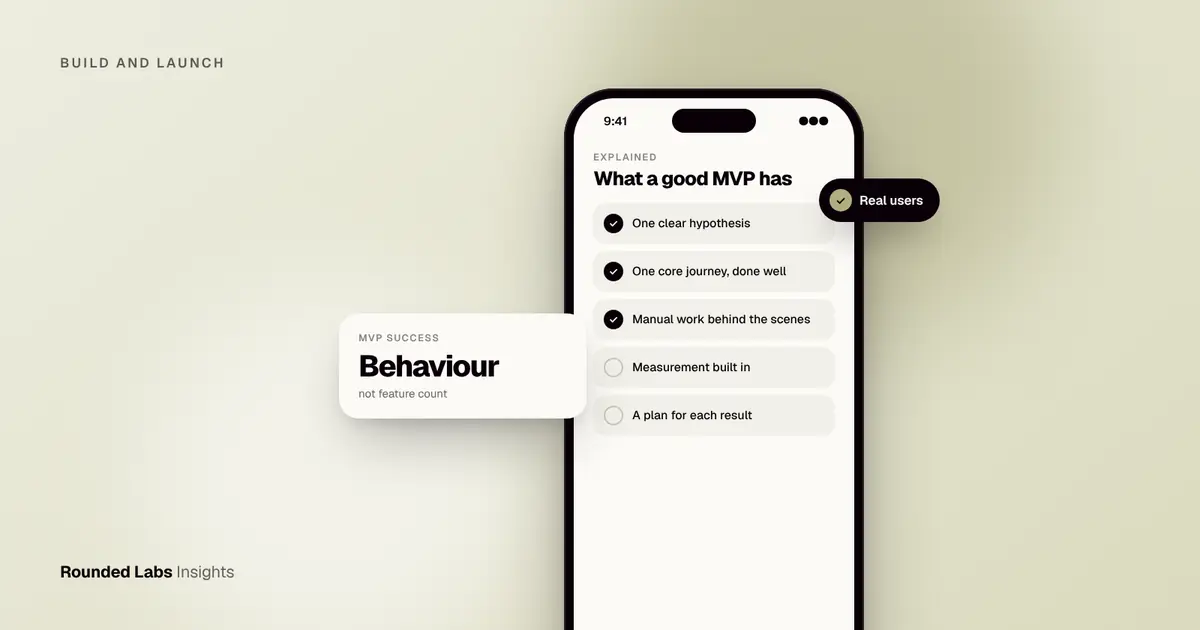
A good MVP has:
- One clear hypothesis. For example: “Busy parents will book and pay for after-school tutoring through an app.”
- One core journey, done well. For the tutoring example: find a tutor, book, pay, attend.
- Manual work behind the scenes where it saves building. An admin might match tutors by hand at first.
- Measurement built in, so you can see sign-ups, completions, repeat use and drop-off (post:F11).
- A plan for what you will do with each possible result.
What should an MVP leave out?
Usually: multiple user roles beyond the essential ones, advanced settings, automation of rare tasks, extra platforms, integrations that can be handled manually, and polish on screens few users see. Keep the polish on the core journey, because a clumsy core journey hides whether the idea works.
Shaping your MVP? We help founders cut their idea to the version that proves it, then build it properly. Book a 30-minute call with a co-founder.
How much does an MVP cost?
| Region | Lean MVP | Standard MVP (accounts, payments, admin) |
|---|---|---|
| UK | £20,000 to £40,000 | £40,000 to £80,000 |
| US | $25,000 to $60,000 | $60,000 to $120,000 |
| Europe | €25,000 to €50,000 | €50,000 to €100,000 |
Our full guides cover MVP costs in the UK and How much does an MVP cost in the US for the US.
What are common MVP mistakes?
- Building too much. Adding “just one more feature” until the MVP becomes version three.
- Building too little. A product so thin that users do not get the value, so the test fails for the wrong reason.
- Skipping validation. Building before checking anyone has the problem (post:F1).
- No measurement. Launching without knowing what success looks like.
- Cheap code that cannot grow. An MVP should be lean, not throwaway, unless you plan to rebuild.
How do you measure whether an MVP worked?
Decide before launch which numbers will tell you the idea is working. Useful MVP measures include:
| Measure | What it tells you | Example target |
|---|---|---|
| Activation rate | Do new users reach the core value? | 40% of sign-ups complete a first booking |
| Week 4 retention | Do people come back? | 20 to 30% for a consumer app |
| Conversion to paid | Will people pay? | 3 to 10% of active users |
| Referral rate | Do users tell others? | Any organic referrals at all is a strong signal |
| Qualitative feedback | Why users stay or leave | Five to ten user interviews a month |
If results are weak, look at where users drop off before you change the idea. Sometimes the problem is the onboarding, not the product. App retention: the metrics that matter after launch covers retention metrics in more depth.
Who should build your MVP?
Founders usually choose between a freelancer, an agency, a technical co-founder or no-code tools. An agency suits founders who need design, engineering and product advice in one place and want a codebase that can grow. App agency vs freelancer vs in-house team compares the options, and Fractional CTO vs app agency for early-stage startups looks at fractional CTOs.
Frequently asked questions
What is an example of an MVP?
A food delivery startup might launch in one neighbourhood with a simple ordering app, a handful of restaurants and drivers dispatched manually by staff. If people order repeatedly, the company invests in automation and expansion.
Is an MVP the same as version one?
Often, but not always. An MVP is defined by its purpose: testing a key assumption with real users. Some companies run several MVPs before committing to a version one.
How long does it take to build an MVP?
A lean MVP takes 8 to 12 weeks; one with payments and an admin panel takes 3 to 5 months. A discovery phase of 2 to 4 weeks usually comes first.
Can an MVP be built with no-code tools?
Yes. No-code tools can be a fast and cheap way to test demand. They become limiting when you need custom logic, performance or scale. See Low-code vs custom app development.
What comes after an MVP?
You review what users did, decide whether to continue, change direction or stop, and plan the next version from evidence rather than guesses.
Official sources and further reading
Talk it through with one of our co-founders. 30 minutes, no pressure.