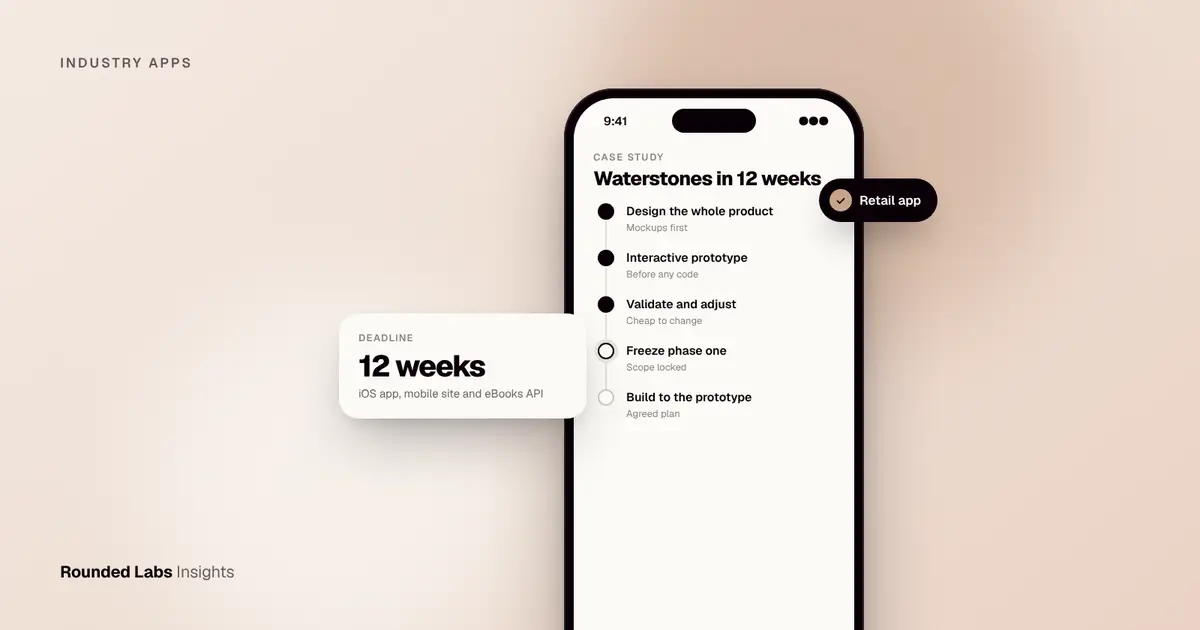
Yes, a bookseller’s iOS app, a dedicated mobile website and an API for a future eBooks service can be built in 12 weeks, and we did exactly that for Waterstones in 2010. It worked because the scope was fixed early, the whole product was designed and prototyped before coding began, and changes were held back for a later phase instead of being squeezed into the first release.
That project began in mid-2010, when iOS development was young and modern frameworks and tooling did not exist. It still shapes how we plan work today. This guide walks through what the Waterstones case study covered, how the 12-week schedule was protected, and what you can apply to a tight timeline of your own, whether you are building a retail app or any other product. For how we price this kind of work, see our pricing page.
Key facts
- Client: Waterstones, the UK bookseller. First approached in mid-2010.
- Phase one: an iOS app, a dedicated mobile website and an API to support a future eBooks initiative.
- Deadline: 12 weeks, agreed up front.
- Method: full end-to-end mockups, then an interactive prototype, before any code was written.
- Outcome: the app, mobile site and API launched with positive customer feedback, and the partnership continued for about three years.
- Later work: an Android eBooks reader, iPad and Windows Phone 7 apps, and a Palm OS app.
What did the Waterstones project involve?
The first phase had three deliverables that had to work together:
| Deliverable | Purpose |
|---|---|
| iOS app | A native shopping and browsing experience for iPhone users |
| Dedicated mobile website | A version of the site for people on other phones and browsers |
| API | A back-end layer that would later support Waterstones’ eBooks plans |
The API was the least visible of the three and the most strategic. Building it in phase one meant that when eBooks arrived, Waterstones could add new apps and devices without rebuilding the foundations. If you are weighing an app against a mobile site, our guide Ecommerce app vs mobile website: when an app pays off explains when each makes sense. This project did both because the audience was split across devices.
Why was 12 weeks so hard in 2010?
The honest answer is that almost everything was new. The iPhone was only a few years old, and the tooling, libraries and shared practice that developers take for granted today were missing. Teams had to build many things from scratch, and every unknown threatened the date.
In that setting, the main risk was not technical difficulty. It was change. Late requests, shifting designs and “one more feature” conversations eat a short schedule faster than any bug. So the plan was built around stopping that drift before it started.
How did we protect the 12-week deadline?
We avoided feature creep and constant last-minute changes by making decisions early and making them visible:
- Design the whole product first. We produced full end-to-end mockups covering the journeys a customer would take, from start to finish.
- Turn the mockups into an interactive prototype. The Waterstones team could hold the prototype, tap through it and see how the app would look, feel and behave before any code existed.
- Validate and adjust on paper. Design changes at this stage cost hours. The same change after coding costs days, because screens, logic and tests all move.
- Freeze phase one. Once the prototype was agreed, it became the scope. New ideas went onto a list for the next phase.
- Build to the prototype. Developers worked from something both sides had already approved, which cut debate about what “done” meant.
For a closer look at the tool at the heart of this approach, see What is a prototype?.
Have a tight deadline and a clear goal? We will tell you in one call whether it is realistic and what would need to be cut or fixed first. Book a 30-minute call with a co-founder.
What made the prototype so valuable?
A prototype turns opinions into evidence. In a meeting, a mockup on a slide can be read many ways. A clickable prototype cannot. The client either likes the flow or does not, and you find out in week two instead of week ten.
For Waterstones this meant the UX was tested while it was still cheap to change. It also gave the client team a shared reference point. When a stakeholder suggested a late tweak, the conversation became “does this belong in phase one or the next phase?” rather than an argument about what had been promised.
A prototype is not the same as a minimum viable product. A prototype shows how something will work; an MVP is a real, live product that real users can use. If you are unsure which you need, read What is an MVP?.
How long does a typical app take today?
Tools are far better now, so the same scope is more achievable than in 2010, but the lessons on scope control still decide whether you hit a date. These are market estimates for planning, not promises:
| Project type | Typical timeline |
|---|---|
| Single-platform app with a focused feature set | 3 to 4 months |
| Cross-platform app with accounts and payments | 4 to 7 months |
| App plus mobile site plus custom API | 5 to 9 months |
| Large retail or marketplace platform | 9 to 14 months or more |
A 12-week delivery of an app, mobile site and API is possible when the feature list is tight, the client can make decisions quickly and the design is settled before development. For our full view of timelines, read How long does it take to build an app? Real timelines from 19 years of projects.
What happened after the first launch?
The first release was a starting point. Over the next three years we continued with Waterstones across multiple platforms, delivering:
- A feature-rich Android eBooks reader.
- Dedicated apps for iPad and Windows Phone 7.
- A Palm OS app, one of the first UK m-commerce apps on the Palm Store.
- Steady improvements to the existing apps and APIs, based on customer feedback.
This is where the early API decision paid off. Because the back end was designed to serve more than one client, each new platform reused it instead of starting again. If you are planning something similar today, our guide on What is an API integration? explains how this layer fits together.
What can you apply to your own project?
You do not need to be a national retailer to use the same approach:
- Decide scope before you build. Write down what is in the first release and what is not, and get sign-off.
- Prototype before you code. Even a simple clickable prototype exposes problems early.
- Keep a “next phase” list. It lets you say yes to ideas without breaking the schedule.
- Build the shared foundation first. If you will need more than one app or channel, a well-designed API saves rework.
- Fix the price against the scope. At Rounded Labs, work is fixed price, agreed before development starts, with projects typically £30,000 to £250,000+. That only works because the scope is clear, which is the same discipline that protects a deadline.
For more on what makes retail apps effective, see Retail app features that drive sales: lessons from Next, Superdry and HMV, and for costs outside the build itself, see The hidden costs of building an app: store fees, hosting and APIs. If you are not sure what to build first, a Mobile Product Discovery Sprint at £9,500 settles scope before you commit to a full project.
Frequently asked questions
Did Rounded Labs really build the Waterstones app in 12 weeks?
Yes. The first phase covered an iOS app, a dedicated mobile website and an API, all delivered within a 12-week deadline, and it launched with positive customer feedback. The details are on the Waterstones case study.
Why build an API for eBooks before eBooks existed?
Building the API in phase one gave Waterstones a foundation for its future eBooks initiative. New apps and devices could then connect to the same back end instead of requiring a rebuild.
Could a 12-week schedule work for my app?
It can if the feature list is focused, the design is agreed before development starts and decisions are made quickly on your side. A short call with a co-founder is the quickest way to test that against your idea.
Is a prototype worth the extra time?
Almost always. Changes made to a prototype cost a fraction of the same changes made to working code, and they replace long arguments with something people can use.
Does Rounded Labs charge by the hour?
No. We work on a fixed price agreed before development starts. See the pricing page for typical ranges.
Official sources and further reading
Talk it through with one of our co-founders. 30 minutes, no pressure.