

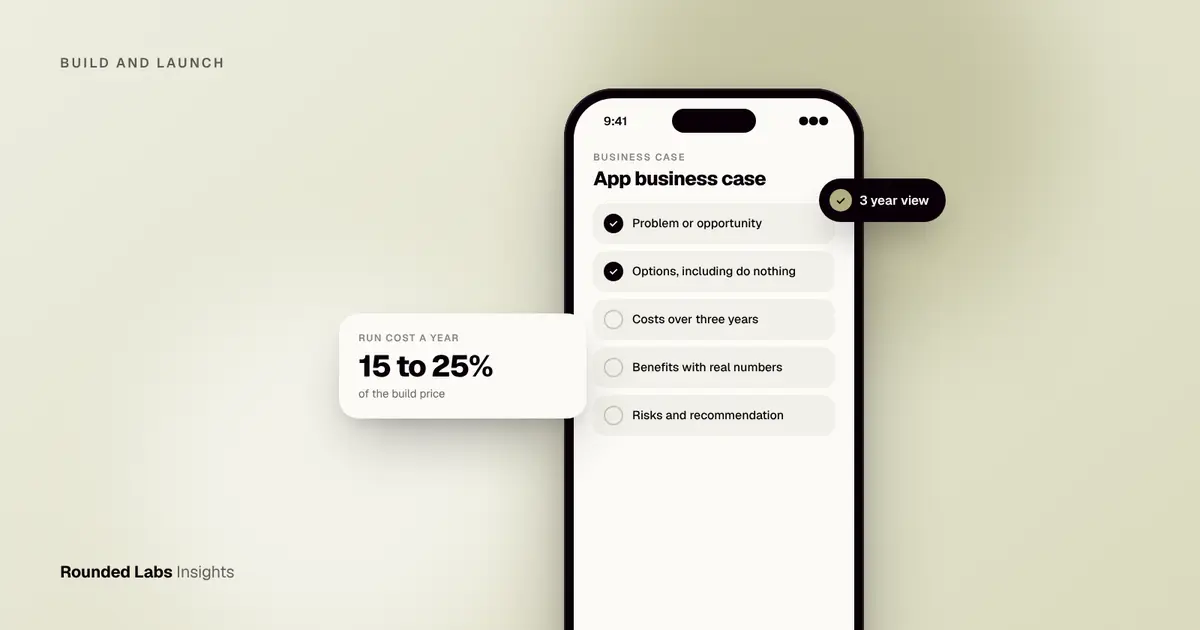
A mobile app business case sets out the problem, the options, the full cost over three years, the measurable benefit and the risks, so that someone can say yes or no with confidence. Keep it to a few pages, and show the payback period in months. Most approvals turn on two numbers: total cost over three years and the date the benefit covers it.
We have written cases like this alongside clients for 19 years, including for Dabbl, a trading app for first-time investors and other products where the audience and scope had to be agreed early. This guide covers how to structure the case, how to estimate costs and benefits honestly, and how to present them. Our services page shows where we can help with the early stages.
Key facts
- A good business case compares at least three options: do nothing, a lighter alternative such as a mobile website, and the app.
- Cost the full three years, not just the build. Run costs often add 15 to 25% of the build price each year.
- Benefits must be measurable: revenue, cost saved, or risk reduced. “Better engagement” is not a benefit until you attach a number.
- Show a cautious, a likely and an optimistic scenario, and base the decision on the cautious one.
- Rounded Labs works at a fixed price agreed before development starts, which removes one big unknown from the cost side.
What should a mobile app business case contain?
Decision makers read these documents quickly, so use a fixed order they can scan:
| Section | What it must answer |
|---|---|
| Problem or opportunity | What is happening today, and what does it cost or miss? |
| Options | What are the alternatives, including doing nothing? |
| Costs | Build, launch, running and internal time over three years |
| Benefits | Which numbers move, by how much, and when? |
| Risks | What could go wrong, and what will you do about it? |
| Recommendation | Which option, what funding, what first milestone? |
Put the recommendation and the headline numbers on page one. The detail sits behind it for anyone who wants to check.
How do you define the problem and the options?
Start with evidence, not a feature list. Good problem statements look like this: “42% of repeat orders arrive by phone, which costs us about £6 per call to handle” or “customers abandon our onboarding form on mobile web at step four”. If you do not yet have the figures, say so and plan a small piece of research. A landing page demand test is a cheap way to get one.
Then list the options fairly. A typical set is:
- Do nothing. Carry on with current costs and current losses. This is your baseline, and the other options are measured against it.
- Improve the mobile website. Often cheaper, and sometimes enough.
- Build a focused first version. A minimum viable product aimed at one clear outcome.
- Build the full app. Only if the evidence supports the scale.
If the honest answer is that a responsive website solves the problem, say so. A case that rules out the app credibly is more trusted when it later recommends one.
How do you estimate the cost?
Cost over three years, not at launch day. The categories finance teams look for:
- Build: discovery, design, development, testing, and store submission. For a first version, projects at Rounded Labs typically range from £30,000 to £250,000+, agreed as a fixed price before development starts. See our pricing page. Other suppliers vary widely, and you should compare like for like.
- Run: hosting, third-party services, app store accounts, monitoring and support. Budget roughly 15 to 25% of the build price per year as a market estimate for planning, not a quote.
- Improve: new features and operating system updates. Both iOS and Android release major versions every year.
- Internal time: product owner, content, customer support and marketing. This is often missing from first drafts and is what auditors notice.
- Launch and promotion: paid acquisition, email to existing customers, in-store signage.
Our guide to estimating an app budget in pounds gives line-by-line ranges, and planning a budget for the next financial year shows how to phase the spending.
How do you put numbers on the benefits?
Pick the two or three benefits that matter most and measure each one in money. They usually fall into three groups:
- Revenue gained: extra orders, higher order value, subscriptions, repeat purchases.
- Cost removed: fewer support calls, less paper, faster staff processes.
- Risk reduced: fewer errors, better compliance records, lower fraud losses.
For each one, write down the baseline today, the change you expect, the source of that expectation and the date it begins. Benchmarks from similar apps, your own website analytics and a pilot are all acceptable sources. A founder’s hope is not. For the method behind the maths, see how to calculate app ROI.
Not sure the numbers will stand up? We can pressure-test your assumptions before you present them. Book a 30-minute call with a co-founder and bring your draft figures.
What does a worked example look like?
This is an illustrative scenario with round numbers and market estimates, not a client result or a quote. A regional retailer with 20 shops wants a loyalty app.
| Item | Cautious scenario |
|---|---|
| Build (fixed price) | £90,000 |
| Run and improve, years 1 to 3 | £60,000 |
| Internal time and launch | £35,000 |
| Total three-year cost | £185,000 |
| Active app members after 12 months | 12,000 |
| Extra yearly spend per member | £18 |
| Yearly gross margin on that spend, at 35% | £75,600 |
| Printed vouchers and mailing saved per year | £14,000 |
| Yearly benefit once at scale | about £89,600 |
At roughly £89,600 a year once the member base is built, the cumulative benefit passes the £185,000 cost late in year three. The likely scenario, with 18,000 members, pays back in about two years. A sentence like that is what a board needs: the cautious case still breaks even inside the review period, and the likely case does so sooner.
If the cautious case had not broken even, the right move would be to cut scope to a cheaper first version, not to adjust the member forecast.
How do you present the risks?
List five to seven real risks with an owner and a response. The common ones:
- Low adoption. Response: launch plan to existing customers, in-app incentives, and a go or no-go review at 90 days.
- Budget growth. Response: a fixed-price contract and a written scope, with changes agreed in writing before work begins.
- Integration trouble. Response: a technical review of your stock, payment or customer systems before build. Our Tech Architecture Audit is a fixed-price £7,500 option for this.
- Store rejection. Response: review against Apple and Google guidelines early.
- Compliance. If you collect personal data in the UK, check the ICO’s current guidance on UK GDPR. This is general information, not legal advice.
Also state what you will stop doing. Naming a kill point, such as “if fewer than 3,000 members by month six, we pause new features”, shows discipline and makes approval easier.
How do you get the case approved?
Match the document to the audience. Finance wants the three-year cash view and the assumptions. A product or operations director wants the problem and the plan. A chief executive wants one page and a clear ask. Our guide to getting board approval for an app project covers the meeting itself.
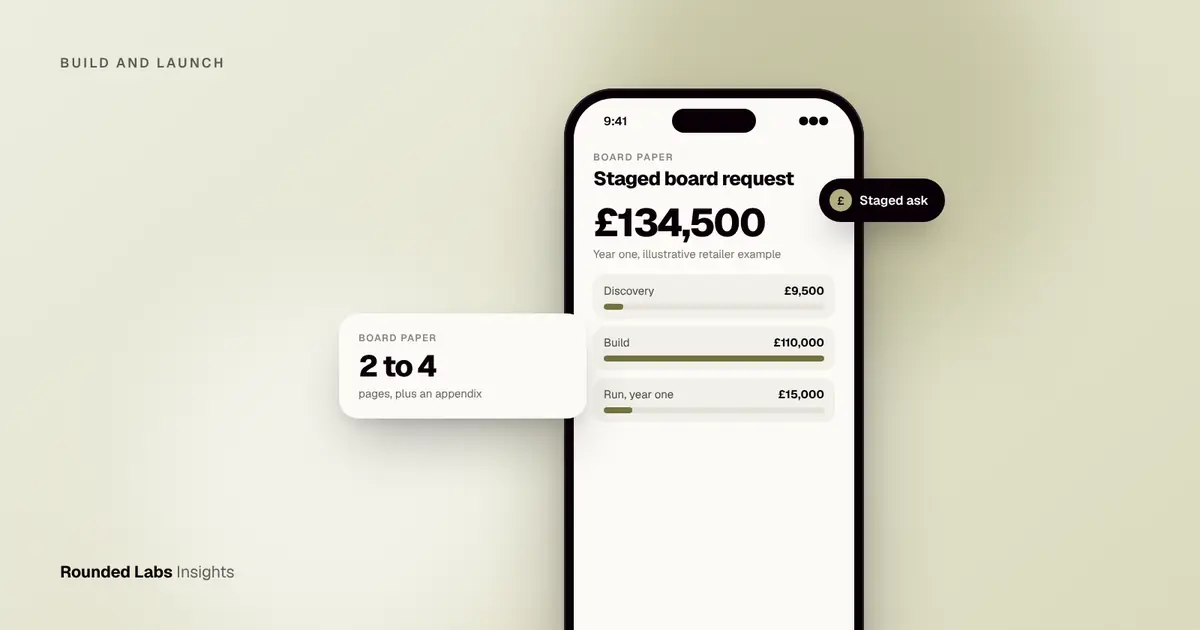
Three habits help. Agree the assumptions with finance before the meeting, not in it. Ask for funding in stages, for example a discovery phase first, then the build. Our Mobile Product Discovery Sprint costs £9,500 and produces the scope and estimate that make the build figure firm. And name one person who owns the benefits after launch, not just the delivery.
Frequently asked questions
How long should a business case for an app be?
Two to six pages is usual, plus an appendix with the calculations. Put the recommendation, three-year cost and payback on page one. Long documents are less likely to be read closely.
What payback period is acceptable?
It depends on your organisation. Many companies look for payback inside 18 to 36 months for software, but some strategic projects are approved on longer horizons. Ask finance what hurdle rate or payback they apply before you write the case.
Can I build a case if the benefits are hard to measure?
Yes, but be honest. Use a proxy such as support calls avoided or conversion rate, and run a pilot or landing page test to get a real figure. If you can only argue for strategic value, say so, and keep the funding small.
Should the case include the cost of doing nothing?
Always. It is the baseline for every other option. If doing nothing costs little, the app needs a stronger argument.
Who should write it?
The product owner, with finance reviewing and a technical adviser checking the estimates. An outside partner can supply realistic cost ranges, but the business owner must own the benefit numbers.
Official sources and further reading
Talk it through with one of our co-founders. 30 minutes, no pressure.