

App ROI is the net gain from the app divided by its total cost over a fixed period, shown as a percentage: (benefits minus costs) divided by costs, times 100. An app that costs £100,000 over three years and returns £160,000 in revenue or savings has an ROI of 60%. The hard part is counting every cost and only the benefits the app causes.
We have spent 19 years helping businesses decide whether an app is worth building, from the Superdry app, which serves a brand with 768 locations in over 100 countries, to Dabbl, a trading app for first-time investors. This guide shows how to build a business case you can defend: the formula, the costs people forget, how to put a number on benefits, and a worked example. Our services page shows how we scope projects once the case is made.
Key facts
- ROI is a ratio. Payback period (how long until the app has earned back its cost) is often more useful to a founder watching cash.
- Build cost is usually 40 to 60% of three-year cost. Maintenance, hosting, store fees and marketing make up the rest.
- Count only incremental benefits: revenue or savings you would not have had without the app.
- Use three scenarios (cautious, expected, strong) rather than one number.
- Rounded Labs prices projects at a fixed price agreed before development starts, typically £30,000 to £250,000+, which removes one big unknown from the cost side. See the pricing page.
What is the formula for app ROI?
The basic formula is:
ROI (%) = (total benefits minus total costs) / total costs x 100
Pick a period first. Three years is a sensible default for most apps, because year one is mostly build and launch, and a one-year view will make almost any app look like a loss. Then work in one currency throughout (this guide uses pounds, with rough conversions at £1 = $1.27 = €1.16).
Two companion measures help:
| Measure | Formula | What it tells you |
|---|---|---|
| Payback period | Total upfront cost / net monthly benefit once live | How many months until you break even |
| Net present value | Future benefits discounted back to today’s money | Whether the app beats leaving the cash in the bank |
| Cost per acquired user | Marketing spend / new users | Whether growth is affordable |
For most small and mid-sized projects, ROI plus payback period is enough. Use net present value if the app is a large internal investment that a finance team will review.
Which costs should you count?
Most business cases undercount cost, and that is where the false optimism comes from. Include all of these:
- Discovery and design. Research, prototypes and specification. A Mobile Product Discovery Sprint is £9,500 and gives you a costed plan before you commit to a build.
- Build. Design, development and testing for iOS, Android and any back end. Market estimates (not quotes) for a serious app run from about £30,000 to £250,000 or more, depending on scope. For how suppliers price, see Fixed price vs time and materials for app projects.
- Running costs. Cloud hosting, push notifications, maps, payment fees, and third-party services, often £200 to £3,000 a month for a growing app.
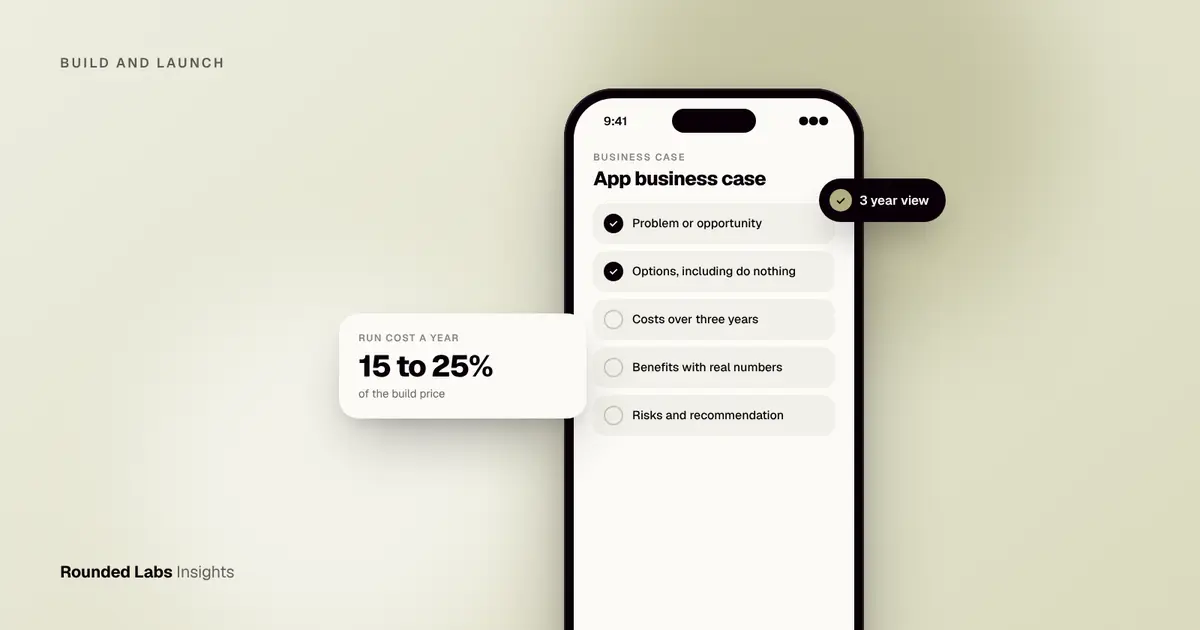
- Maintenance. Operating system updates, bug fixes and security patches. Budget roughly 15 to 20% of the build cost per year; see App maintenance costs in the UK.
- Store fees. Apple and Google take a commission on in-app sales of digital goods, commonly 15 to 30% depending on programme and revenue. Check the current terms on Apple’s and Google’s pages.
- Marketing and acquisition. Paid campaigns, app store optimisation, content. This is often the largest line for consumer apps.
- Your own time. Product owner hours, customer support, content and training for an internal app.
If you leave out items 3 to 7, a plan that looks like 80% ROI can turn out to be 10%.
How do you put a number on the benefits?
The benefits depend on what kind of app it is. Pick the type that fits and be specific.
| App type | Typical benefit | How to measure it |
|---|---|---|
| Consumer app, subscription | Recurring revenue | Paying users x price x retention |
| Retail or ecommerce app | Extra sales, higher repeat rate | Conversion and order value, app users against web users |
| Internal or field-service app | Staff time saved, fewer errors | Hours saved x loaded hourly cost |
| Customer service app | Fewer calls and emails | Contacts avoided x cost per contact |
| Platform or marketplace | Commission or fees | Transactions x take rate |
Two cautions apply to all of them:
- Only count incremental benefit. If customers would have bought on your website anyway, those sales are not an app benefit. Compare app users with a similar group of non-users, or use a staged launch.
- Use evidence, not hope. Take assumptions from your own web analytics, a pilot, or published industry benchmarks, and say where each number came from.
What does a worked example look like?
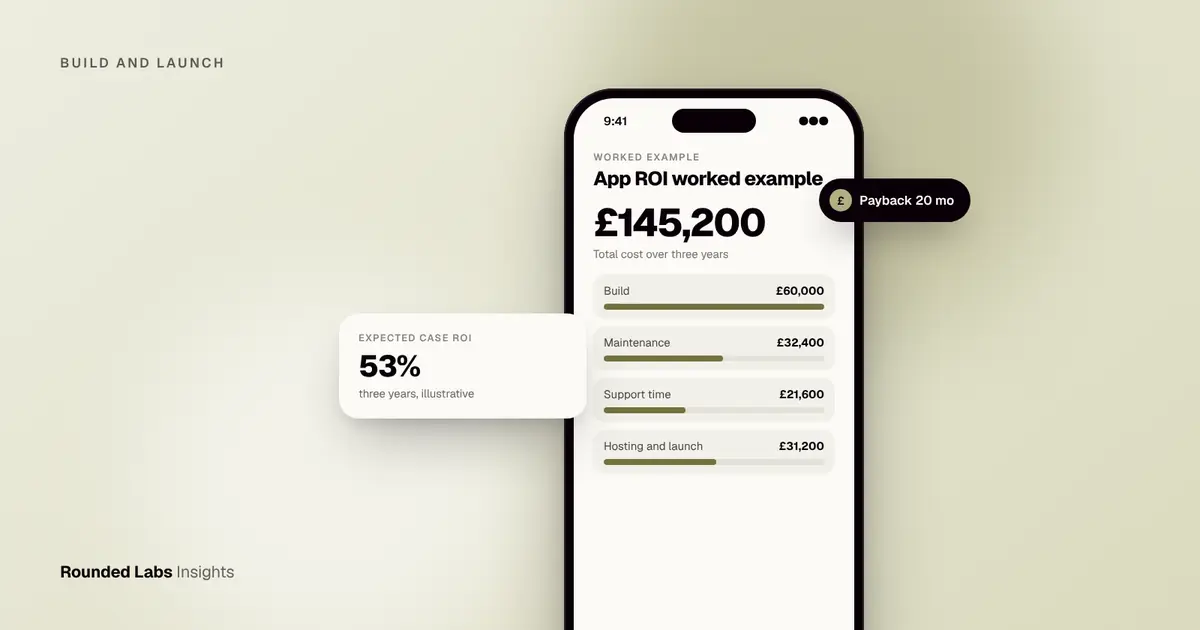
This is an illustrative example with made-up numbers, not a Rounded Labs client result. A regional service business with 12,000 repeat customers plans a booking app at a fixed £60,000 build.
Costs over three years
| Item | Amount |
|---|---|
| Discovery and design (included in the build quote) | £0 extra |
| Build | £60,000 |
| Maintenance, 18% a year | £32,400 |
| Hosting and services, £450 a month | £16,200 |
| Launch marketing | £15,000 |
| Support time, £600 a month | £21,600 |
| Total cost | £145,200 |
Benefits over three years (expected case)
- 1,200 customers adopt the app, 10% of the base.
- Each adopter makes one extra booking a year at a £55 margin: 1,200 x £55 = £66,000 a year at full adoption, or about £150,000 over three years after a slow first year.
- Phone booking time saved: 4,000 hours at £18 loaded cost = £72,000.
- Total benefit, roughly £222,000.
ROI = (£222,000 minus £145,200) / £145,200 x 100 = about 53%.
Now test it. In a cautious case, adoption is 6% and each adopter makes 0.7 extra bookings a year. Benefits drop to roughly £100,000, and ROI becomes negative (about minus 31%). That tells you the app depends on adoption, so you would invest early in onboarding and in a pilot with a small group before committing the full budget.
Want a business case you can show your board or investors? We help founders cost an app, define the benefits and test the assumptions before any build starts. Book a 30-minute call with a co-founder.
How do you calculate payback period?
Payback is often the number that matters most when cash is tight. Work out the net monthly benefit once the app is live, then divide the upfront cost by it.
In the example above, the upfront cost is the £60,000 build plus £15,000 launch marketing, so £75,000. If the app generates about £7,500 a month in benefit once adopted, against £1,650 a month in running and support costs and £900 a month in maintenance, the net is about £4,950. Payback is £75,000 / £4,950, or about 15 months after launch. Add the build period, perhaps 5 months, and the money comes back in roughly 20 months from the start.
If payback is longer than the life you expect from the app before a major rebuild (often 4 to 6 years), reconsider the scope. A smaller first release often shortens payback; see How to validate an app idea before you spend £50k.
What can improve your ROI?
You can move ROI from either side of the equation.
Lower the cost
- Start with a minimum viable product and add features once real usage shows what matters. How to write an app specification helps you decide what to leave out.
- Choose a technology approach that fits; one codebase on two platforms can cut build cost materially. See Native vs cross-platform: what it does to your budget.
- Agree a fixed price before work starts so build cost is not an open variable.
Raise the benefit
- Improve retention, because returning users are the cheapest source of revenue. See App retention: the metrics that matter after launch.
- Choose the right revenue model; see App monetisation: subscriptions, in-app purchases or ads?.
- Measure from day one so you can act on what you learn; see App analytics: what to track from day one.
What mistakes make app ROI estimates wrong?
- Counting gross, not incremental, benefit. The most common error.
- Ignoring ongoing cost. An app is a product, not a one-off purchase.
- A single scenario. One number hides the risk; always show a cautious case.
- Counting vanity metrics. Downloads are not revenue. Active users, repeat usage and retention are.
- Forgetting intangible benefits, or inflating them. Brand and customer satisfaction matter, but give them a number only if you can defend it, otherwise list them separately.
- Measuring too early. Many apps take 6 to 12 months to reach steady usage, so review at set points rather than after one month.
Frequently asked questions
What is a good ROI for an app?
There is no universal figure. Many businesses look for payback inside 2 to 3 years and a positive ROI over three. Internal apps that replace manual work can pay back faster than consumer apps that need marketing.
How long does it take for an app to become profitable?
It depends on build cost, adoption and revenue model. Plan for 12 to 24 months from launch to payback in a typical business app, and longer for consumer apps that depend on paid acquisition.
Should I include the cost of failure?
Yes, by using a cautious scenario and by testing the idea before the main build. A discovery phase or prototype is a cheap way to shrink the chance that the full build misses.
Can I calculate ROI before I have built anything?
Yes, and you should. Use costs from quotes and benefits from your own data, a pilot or industry benchmarks, then update the model as real numbers arrive.
How do I track app ROI after launch?
Set up analytics before launch, tie app usage to sales or time saved, and review the model every quarter against the original assumptions.
Official sources and further reading
- GOV.UK (HM Treasury Green Book guidance on appraisal and evaluation)
- Apple: App Store small business program
- Google Play Console
- Office for National Statistics
Talk it through with one of our co-founders. 30 minutes, no pressure.