

To get board approval for an app project, bring a short paper that states the problem, the fixed cost, the expected return, the main risks and a clear decision request. Boards rarely reject well-framed projects; they defer vague ones. A one-page summary with a three-year cost and benefit view, a staged budget and a named owner usually does more than a 40-slide deck.
We have taken projects through senior sign-off for organisations such as Superdry, where the app served 768 locations in over 100 countries, and Waterstones, so we have seen what makes directors say yes. This guide covers how to frame the request, what to put in the paper, how to handle objections and how to reduce the risk the board is really worried about. For how we scope and price work, see our services.
Key facts
- Boards approve decisions, not ideas: your paper must end with a specific ask, such as “approve £120,000 over two stages”.
- Directors mainly want to know the cost, the return, the risk and who is accountable.
- Staging the money (discovery first, build second) lowers the perceived risk and often speeds approval.
- A fixed price agreed before development starts removes the “open-ended budget” objection. Rounded Labs projects typically cost £30,000 to £250,000+; see the pricing page.
- Expect two meetings: one to socialise, one to decide. Pre-brief each director before the formal session.
What does a board actually want to know?
Most boards test an app proposal against four questions, whether or not they say them aloud:
- Why this, why now? Which strategic goal does it serve: revenue, cost, retention, compliance?
- What will it cost, in total? Build, launch, running costs and internal time.
- What could go wrong? Delivery, security, adoption, supplier dependency.
- Who is accountable? One named executive sponsor, not a committee.
If your paper answers these in the first two pages, the discussion becomes about priorities rather than doubts. Our guide to how to build a business case for a mobile app goes deeper on the numbers.
How should you structure the board paper?
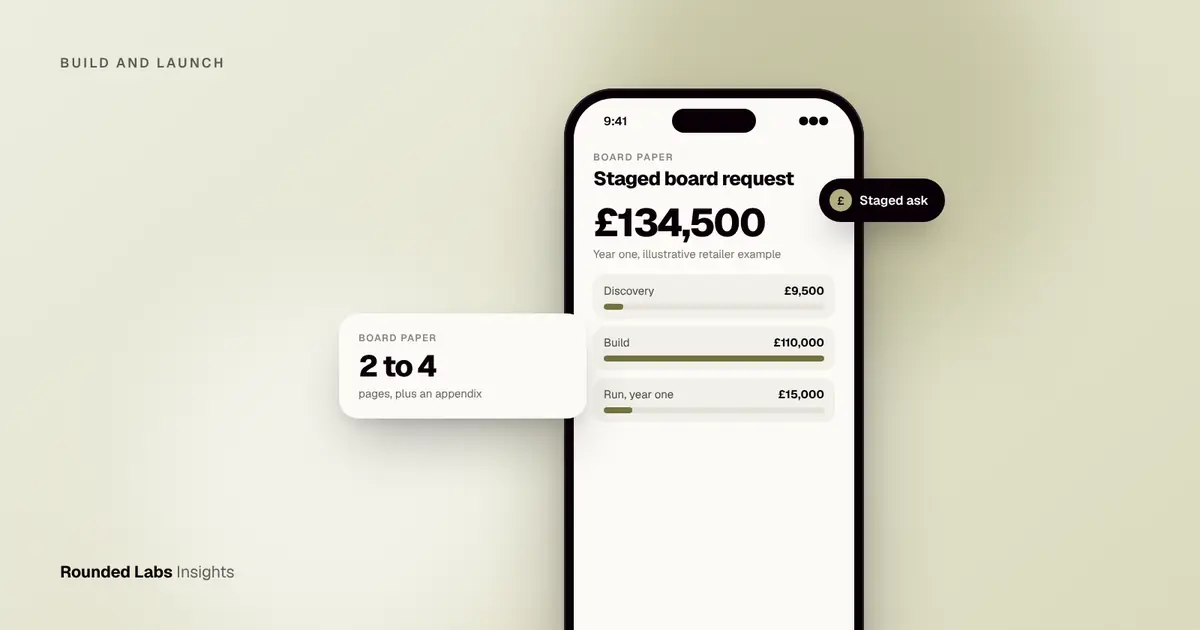
Keep the paper to two to four pages plus an appendix. A structure that works:
| Section | What to include |
|---|---|
| Decision requested | The exact approval and amount, stated up front |
| Background | The problem, with one or two facts from your own data |
| Proposal | What the app does, for whom, and what is out of scope |
| Financials | Cost by stage, running costs, benefits and payback period |
| Risks | The top five, each with an owner and a mitigation |
| Timeline | Stages with decision points, not just a launch date |
| Next steps | What happens the day after approval |
Put the supporting detail, such as feature lists and quotes, in the appendix. Directors read the first page carefully and skim the rest.
How do you put numbers on the benefits?
Boards distrust precise forecasts built on guesses. Use ranges, state your assumptions and link each benefit to something already measured. Three kinds of benefit tend to hold up:
- Revenue: more repeat orders, a new channel or a subscription. Use your current conversion and order value.
- Cost saved: hours of manual work removed, fewer support calls, fewer paper processes.
- Risk reduced: replacing an unsupported system, closing a compliance gap or protecting a contract.
Include a cautious case as well as a target case. If the project still pays back in the cautious case, say so. See How to calculate app ROI for the method.
A worked example: a retailer’s customer app
A regional retailer with 40 stores asks its board to approve an app with loyalty, click and collect and push offers. The sponsor, the commercial director, presents the following staged request (illustrative figures only, market estimates rather than quotes).
| Stage | Scope | Cost | Decision point |
|---|---|---|---|
| 1. Discovery | User research, prototype, fixed quote | £9,500 | Board sees prototype and final price |
| 2. Build | iOS and Android app, loyalty, click and collect | £110,000 | Approved only if stage 1 targets are met |
| 3. Run | Hosting, support, updates (year one) | £15,000 | Reviewed after six months |
| Total year one | £134,500 |
The paper assumes 8,000 app users in year one, a modest uplift in repeat visits and a cautious case at half that. It shows payback in the target case within about two years and, in the cautious case, within about four. The board approves stage 1 on the day and stage 2 conditionally. The sponsor never asked for £134,500 in one go; the staging made the decision easy.
Want a second pair of eyes on your board paper? We will sanity-check the scope, the cost range and the risks before you present. Book a 30-minute call with a co-founder.
How do you reduce the risk the board is worried about?
Directors are mostly afraid of an open-ended budget and a project that drifts. Address both directly:
- Fixed price. Ask suppliers to quote a fixed price before development starts, so the number in your paper is the number you pay unless you change scope. Our guide to fixed price vs time and materials explains the trade-offs.
- Discovery first. A short paid discovery turns a rough idea into a tested scope and a firm quote. What happens in a discovery phase sets out the stages. Our Mobile Product Discovery Sprint is £9,500.
- Validate demand. Evidence from user interviews or a landing page test is more persuasive than opinion. See How to validate an app idea before you spend £50k.
- Reference projects. Show similar work delivered. MoBank, the UK’s first mobile banking app, is the sort of precedent boards recognise for high-stakes, regulated builds.
- Exit points. Make clear where the board can stop or change direction without losing everything already spent.
How do you handle objections in the room?
| Objection | A useful response |
|---|---|
| “Why not buy something off the shelf?” | Show the comparison: what packaged tools cannot do, and what customisation would cost. |
| “Is the budget capped?” | Yes: fixed price per stage, with change control for added scope. |
| “What if the supplier fails?” | Own the code and the accounts, keep documentation current and use staged payments. |
| “Will anyone use it?” | Point to the validation evidence and agree adoption targets reviewed at six months. |
| “Can we wait a year?” | State the cost of delay: revenue or savings not earned and competitor progress. |
How should you prepare before the meeting?
- Pre-brief each director for ten minutes. Surprises in the room lead to deferrals.
- Involve finance early. The finance director should have checked your numbers before the board sees them.
- Ask for the decision you need, and have a fallback, such as approving stage 1 only.
- Bring one page of next steps so approval turns into action the same week.
- Plan for the budget cycle. If your board approves spend annually, read How to plan an app budget for the next financial year before you submit.
What happens after approval?
Report back at each decision point, in the format the board saw. Share a short monthly update: spend against plan, milestones met, risks changed. Boards that receive honest, brief updates tend to approve the next stage faster. For a view of how a good supplier proposal reads, see What a good app development proposal looks like.
Frequently asked questions
How much detail does a board paper need?
Two to four pages with a one-page summary at the front is enough for most boards. Put quotes, feature lists and technical detail in an appendix for those who want it.
Should I ask for the whole budget at once?
Usually not. Asking for a small discovery stage first, then the build, lowers the risk and the approval hurdle. The board still sees the likely full cost, so there are no surprises.
Do I need a firm quote before the board meeting?
A firm range helps, and a fixed quote is better. If you do not have one yet, make a discovery stage the first approval, with the fixed price to follow before the build is released.
What if the board wants an off-the-shelf option compared?
Include one. A fair comparison of cost, fit and long-term ownership strengthens your case, even if the answer is a custom build. Off-the-shelf SaaS vs custom software can help structure it.
How long does board approval usually take?
It depends on your meeting calendar. Many organisations need one to three months from first draft to decision, so build that into your timeline and check when the next meeting date falls.
Official sources and further reading
Talk it through with one of our co-founders. 30 minutes, no pressure.