

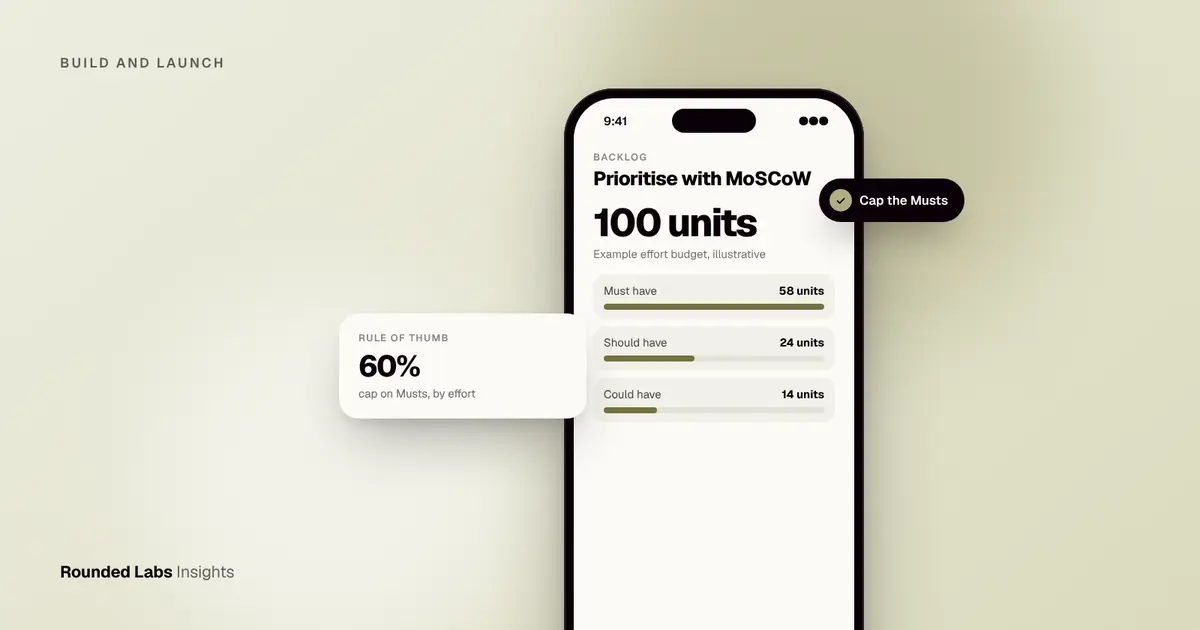
To prioritise a product backlog with MoSCoW, sort every item into Must have, Should have, Could have or Won’t have this time, then cap the Musts at about 60% of your available effort. Musts are what the release cannot ship without. Shoulds and Coulds fill the remaining capacity, and Won’t items are parked, so scope and budget stay honest.
We have shaped scope for apps such as Dabbl, a trading app for first-time investors, where the hard part was never listing features but agreeing which few came first. This guide shows how MoSCoW works, how to run a session with your team, and how to turn the result into a build plan. If you want help applying it to your own product, see our services.
Key facts
- MoSCoW comes from the DSDM agile method, and the letters stand for Must, Should, Could and Won’t (the lowercase o’s are only there to make the word pronounceable).
- A common rule of thumb is to keep Musts to around 60% of effort, Shoulds and Coulds to around 40% combined, so there is slack for surprises.
- “Won’t have this time” does not mean never. It means not in this release.
- It works on a product backlog of any size, but you should size items roughly first, even in T-shirt sizes.
- The result is only as good as the people in the room: product owner, a developer and someone who speaks for users.
What does MoSCoW mean?
Each backlog item gets one label, based on what happens if it is missing at launch.
| Label | Test | Example for a booking app |
|---|---|---|
| Must have | The release is illegal, unsafe or pointless without it | Account sign-up, search, taking a booking, taking payment |
| Should have | Important, with a workaround for now | Email reminders, saved addresses |
| Could have | Nice to have, small upside | Dark mode, referral code |
| Won’t have (this time) | Agreed out of scope for this release | Loyalty points, in-app chat |
The Won’t column is the one teams skip, and it is the most useful. Writing items down as “not now” stops them creeping back in during the build.
Why use MoSCoW instead of ranking by number?
A numbered list from 1 to 80 looks precise but hides the real decision, which is where the cut line falls. MoSCoW forces that conversation early. It is quick to explain to stakeholders who do not work in software, and it maps neatly onto a first release, which is why it pairs well with defining an MVP.
Its weakness is that everything can be called a Must. Without a cap, a team ends up with 90% Musts and no real prioritisation at all. That is why the effort cap matters.
How do you run a MoSCoW session?
A focused session for a backlog of 40 to 80 items takes 2 to 3 hours.
- Agree the goal first. Write one sentence, such as “let 500 users book and pay for a session within 6 months”. Every item is judged against it.
- Check the stories are clear. Vague items cannot be prioritised. See How to write user stories developers understand if yours are not.
- Size roughly. Ask a developer for small, medium or large on each item.
- Sort in silence, then discuss. Everyone labels items alone first, then you only debate the ones that differ.
- Challenge each Must. Ask “what if we launched without this?” If the honest answer is “we would manage”, it is a Should.
- Check the cap. Add up the effort. If Musts exceed about 60%, demote items until they fit.
- Write the Won’t list and share it with everyone.
What does a worked example look like?
Imagine a fitness booking app with a budget that supports about 100 units of effort (a unit is a rough team-week of work, nothing more). The backlog has 24 items totalling 160 units, so something must give.
| Label | Items | Units | Share of capacity |
|---|---|---|---|
| Must | Sign-up, class search, booking, payment, cancellations, admin timetable | 58 | 58% |
| Should | Reminders, saved cards, waiting list | 24 | 24% |
| Could | Dark mode, referral code, class reviews | 14 | 14% |
| Won’t (this time) | Loyalty points, in-app chat, wearable sync | 64 | not planned |
Musts take 58 units, Shoulds and Coulds are planned to fit into the remaining 42, and the team ships the Shoulds first. If a payment integration turns out harder than expected, Coulds go first, then Shoulds, and the launch date holds. The figures here are illustrative only.
Not sure where your cut line should fall? A short conversation often settles a scope debate that has run for weeks. Book a 30-minute call with a co-founder and we will talk through your backlog.
How does MoSCoW connect to budget and timeline?
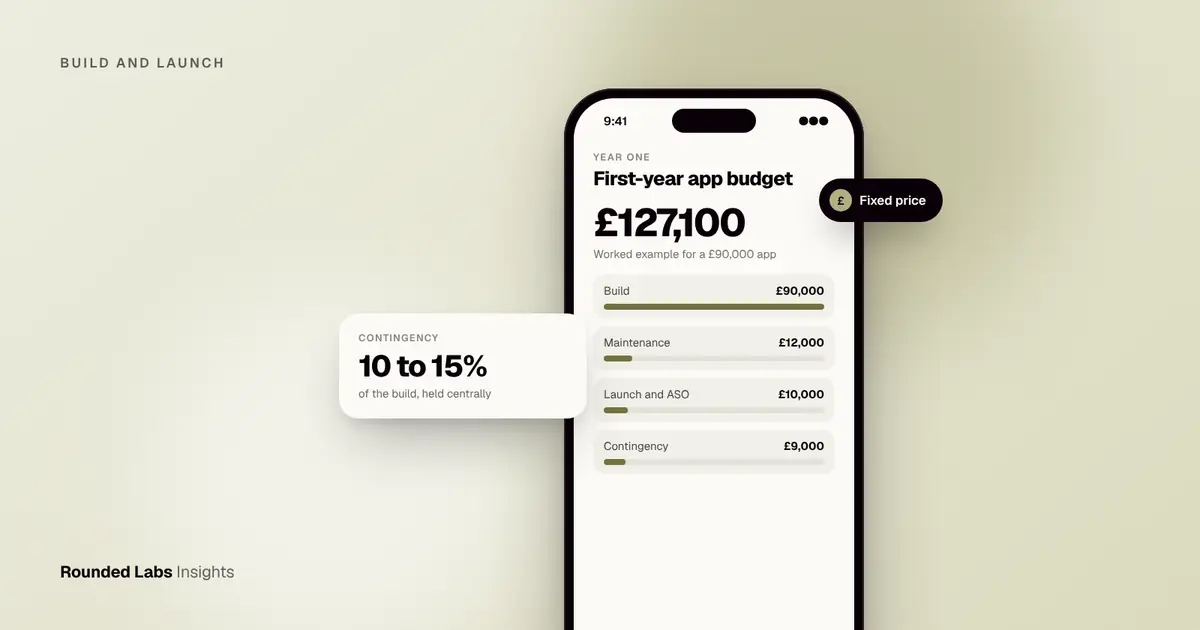
For a fixed-price project, the Must list effectively becomes the contracted scope. Rounded Labs agrees a fixed price before development starts, and projects typically run from £30,000 to £250,000+, so a clear Must list is what keeps that price stable. Details are on our pricing page. When the project begins, a good discovery phase turns a rough MoSCoW into sized, testable stories before a single sprint starts.
Shoulds and Coulds then act as a managed buffer. They are the first things traded away when a surprise lands, which is far cheaper than moving the deadline.
What mistakes should you avoid?
- Everything is a Must. Enforce the 60% cap and make people argue for each Must.
- Prioritising by loudest voice. Bring user evidence, such as interviews or support tickets, not opinions. See How to validate an app idea.
- Treating labels as permanent. Re-run the session before each release. A Could can become a Must when a regulation or competitor changes.
- Ignoring dependencies. A Should that a Must relies on is really a Must.
- Skipping the Won’t list. Unwritten exclusions come back as scope changes mid-project.
How does MoSCoW compare with other methods?
| Method | Best for | Limit |
|---|---|---|
| MoSCoW | Fixing scope for a release or budget | Coarse inside each bucket |
| RICE scoring | Ranking many Should and Could items by reach, impact, confidence and effort | Needs data and takes longer |
| Kano model | Understanding delight versus basics | Needs customer research |
| Value versus effort grid | Quick team workshops | Can hide dependencies |
Many teams use MoSCoW to set the release boundary, then RICE to order items inside it. Once the scope is set, it feeds your roadmap.
Frequently asked questions
What percentage of the backlog should be Must have?
Aim for Musts at around 60% of the effort, not the item count. The DSDM guidance suggests this to leave room for Shoulds and Coulds as contingency. If your Musts are higher, the release is probably too big.
Is Won't have the same as never?
No. It means not in this release, and the item stays on the backlog for later review. Writing it down is what protects the current scope.
Who should decide the priorities?
The product owner decides, with input from developers on effort and from users or stakeholders on value. Developers should not set business priority, and business owners should not set estimates.
Can I use MoSCoW for a whole roadmap?
You can, but it works best per release or per quarter. Over longer periods priorities change too much, so revisit the labels regularly.
How often should we re-prioritise?
Before each release or sprint planning cycle, and whenever something major shifts, such as a new regulation or a failed assumption from user testing.
Official sources and further reading
Talk it through with one of our co-founders. 30 minutes, no pressure.