

To plan an app budget for the next financial year, split the money into four buckets: the build, running costs, maintenance and a contingency of 10 to 15%. Budgeting only for the build is the common mistake: a £90,000 app often needs about £125,000 to £130,000 in year one once hosting, support, store fees and launch are included.
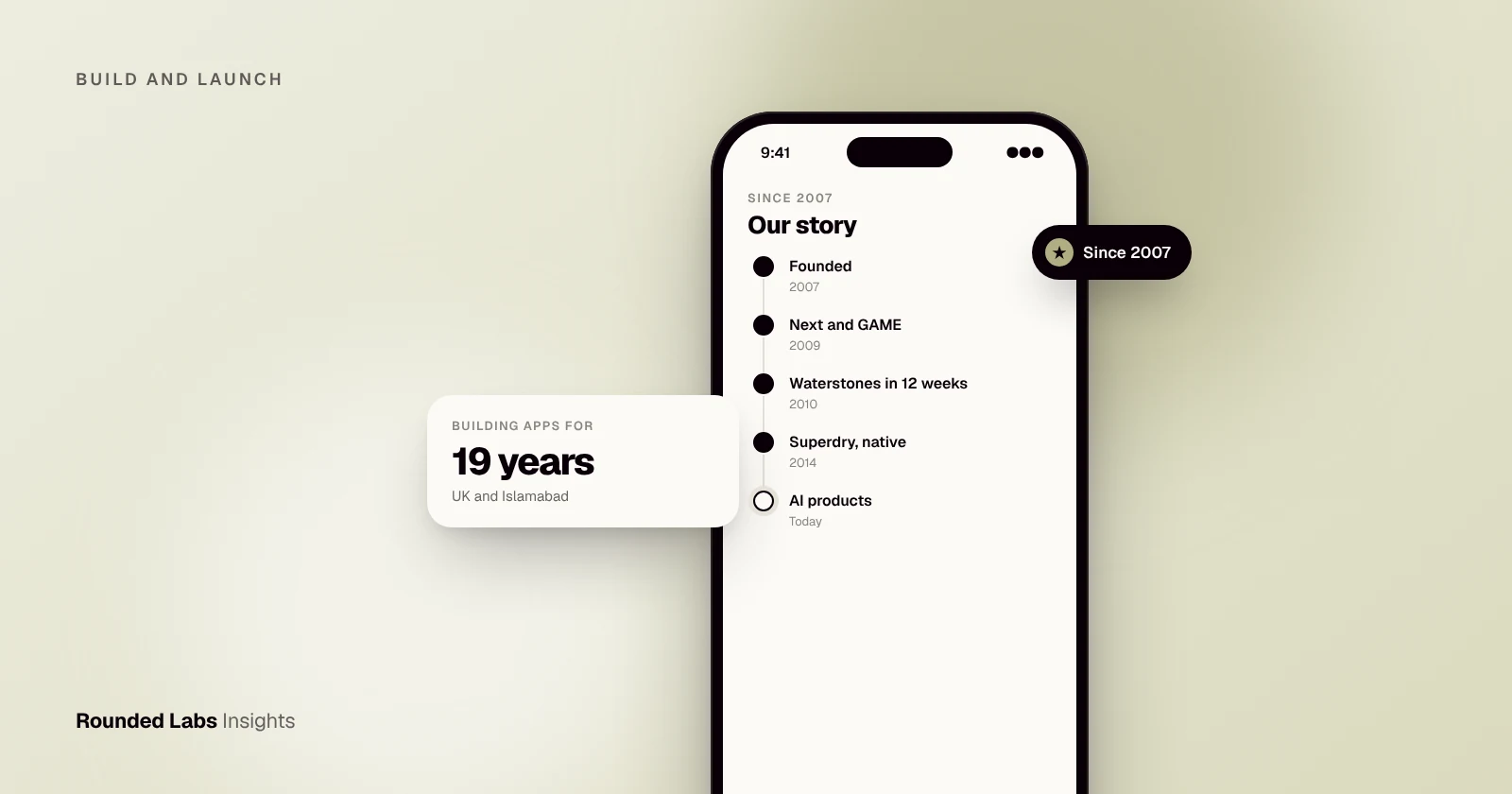
We have helped finance and product teams plan projects since 2007, including the long-running app work for Superdry, which spans 768 locations in over 100 countries. This guide walks through how to build a budget you can defend to a finance director, with a worked example you can copy. Our services page shows what we build, and our projects are agreed at a fixed price before development starts. Other figures here are market estimates, not quotes.
Key facts
- Budget four things: build, running costs, maintenance and contingency.
- Running and maintenance costs usually continue every year after launch, so they belong in the budget even when the build is a one-off.
- A fixed-price build removes the largest source of overspend, but you still need a contingency for scope changes you choose to make.
- Timing matters: build payments fall when milestones are met, not evenly across the year.
- Rounded Labs projects typically run from £30,000 to £250,000+; see the pricing page.
What should an app budget include?
Most budgets fail because they list one line, “app development”, and nothing else. A useful budget has these lines:
- Discovery and design. Research, user flows and screens, before any code is written.
- Build and testing. Front end, back end, integrations and quality assurance.
- Launch costs. Store accounts, release management, marketing and app store optimisation.
- Running costs. Hosting, third-party services and licences.
- Maintenance and support. Fixes, operating system updates and security patches.
- Contingency. Money held back for the unexpected.
- Internal time. Your own staff who will test, give feedback and manage the project.
If you are not sure what the product should contain yet, settle that first. A clear specification makes every number in the budget firmer; see How to write an app specification.
How do you estimate each cost line?
Use ranges, then narrow them as you learn more. Market rules of thumb, which are estimates and not quotes, look like this:
| Cost line | Typical market range | Notes |
|---|---|---|
| Build (first release) | £30,000 to £250,000+ | Depends on features, platforms and integrations |
| Hosting and cloud | £150 to £1,500 a month | Grows with users and data |
| Third-party APIs and services | £100 to £1,000+ a month | Maps, payments, messaging, analytics |
| Store accounts | About £100 a year | Apple charges $99 a year and Google a one-off $25 at the time of writing; check their pricing pages |
| Maintenance | 15 to 20% of build cost a year | Often lower in the first months after launch |
| Contingency | 10 to 15% of the build | Held centrally, not spread across lines |
For feature-level costs, App feature costs: login, payments, chat and maps breaks the build down further, and The hidden costs of building an app covers store fees, hosting and APIs in detail.
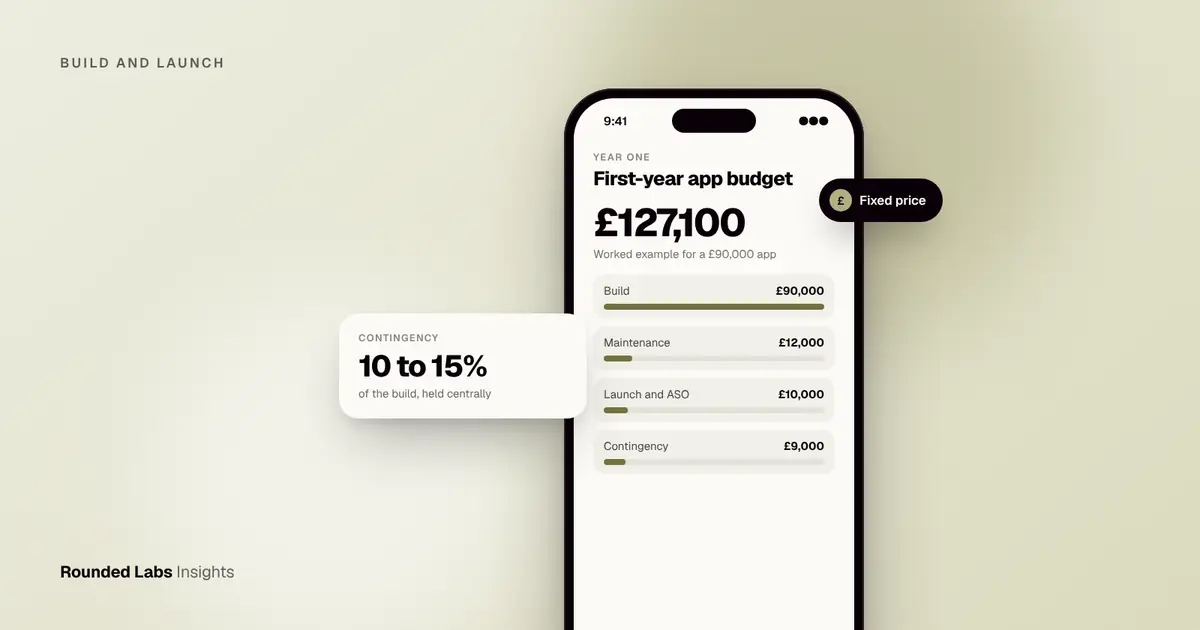
Worked example: a £90,000 app in its first financial year
Suppose a retailer plans a customer app with a fixed-price build of £90,000, launching in month 4 of a 12-month financial year.
| Line | Amount |
|---|---|
| Build, paid by milestone | £90,000 |
| Contingency (10%) | £9,000 |
| Hosting and cloud | £3,600 |
| Third-party APIs | £2,400 |
| Store accounts | £100 |
| Maintenance for the 9 months after launch | £12,000 |
| Launch marketing and ASO | £10,000 |
| First-year total | £127,100 |
Two points stand out. First, the build is about 71% of the first-year cost, not 100%. Second, in year two the build line disappears but maintenance, hosting and APIs continue, so the budget does not fall to zero. For the longer view, see The total cost of owning an app over five years.
When does the money actually leave the account?
Finance teams need cash flow, not just totals. With a fixed-price project, payments are tied to milestones, such as design sign-off, a working build and release. A typical pattern is that a larger share is paid early in the project and the rest as milestones are delivered, but the exact schedule is agreed in the contract.
Map each milestone to a month in your financial year. If a payment slips past the year end because design approval took longer than planned, it moves into the next year’s budget, which can surprise a department that thought it had spent the money. Ask your supplier for a milestone calendar and share it with finance early. Our Mobile Product Discovery Sprint, a fixed £9,500, produces this kind of plan before you commit to a full build.
Need help turning an idea into a number your finance team will accept? We can talk through scope, phasing and the year-one cost. Book a 30-minute call with a co-founder.
How do you protect the budget from overspend?
The biggest risk is not a price rise from a supplier. It is the project growing while it is being built. A few habits help:
- Choose a fixed price. A price agreed before development starts removes open-ended billing. Fixed price vs time and materials for app projects explains the trade-off.
- Phase the scope. Put must-have features in release one, and list the rest as a later phase with its own budget line.
- Hold the contingency centrally. Release it only against a written change request.
- Agree a change process. Every addition gets a price and a decision before work begins.
- Review monthly. Compare spend and milestones with the plan, and update the forecast, not just the actuals.
If the total comes out higher than you hoped, there are legitimate ways to reduce it; see How to cut app development costs without cutting quality.
Can tax relief or grants reduce the budget?
In the UK, some app projects that involve genuine technical uncertainty may qualify for R&D tax relief, and grants such as Innovate UK funding may be available for some projects. Rules and rates change, so check the current HMRC guidance and take advice before you count on any relief in a budget. As a planning habit, show it as a separate line below the total, not as a reduction in the cost, until it is confirmed. More in R&D tax relief and Innovate UK funding for app projects.
How do you get the budget approved?
Finance directors and boards tend to ask the same questions: what is the total, what is the return, what happens if it goes wrong, and what does it cost every year after? Put the year-one total, the run-rate from year two and a clear contingency policy on one page. Name an owner for the budget. Show the phasing, so the board can stop after release one if the results do not justify more. For a full approach, see How to get board approval for an app project, and validate the idea first if the case is not yet proven.
Frequently asked questions
How far ahead should I plan an app budget?
Plan the next financial year in detail, and show years two and three at a high level. Costs after launch are smaller than the build but never zero, so a three-year view avoids surprises.
How much contingency should I include?
10 to 15% of the build is a common planning figure. Use the lower end when the scope is clear and the price is fixed, and the higher end when integrations or third-party systems are uncertain.
What if my financial year ends before the app launches?
Budget by milestone, not by launch date. Work completed and paid in this year is a cost in this year, and the remaining milestones fall into the next, so agree the payment calendar with your supplier and your finance team.
Should the maintenance budget sit with IT or the business?
Whichever team owns the app’s outcomes should hold it, with IT consulted on security and hosting. Giving maintenance no owner is the usual reason apps decay after launch. See App maintenance costs in the UK.
Can I get a firm number before committing to the whole project?
Yes. A paid discovery or specification stage turns a rough range into a fixed price. Many teams use that number for budget sign-off.
Official sources and further reading
Talk it through with one of our co-founders. 30 minutes, no pressure.