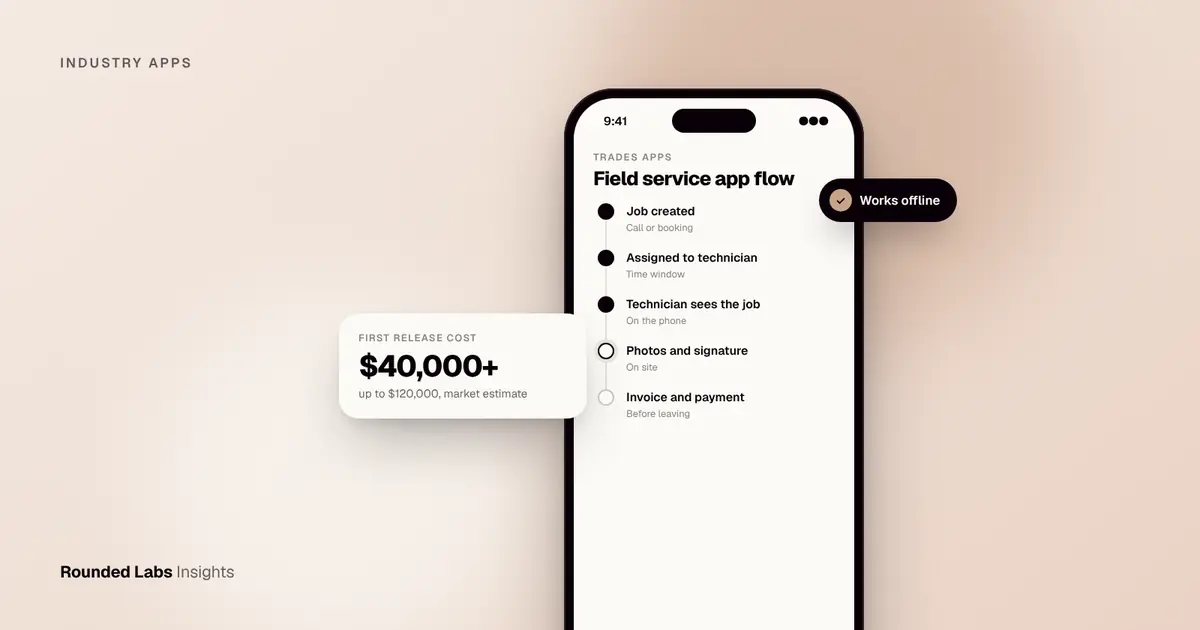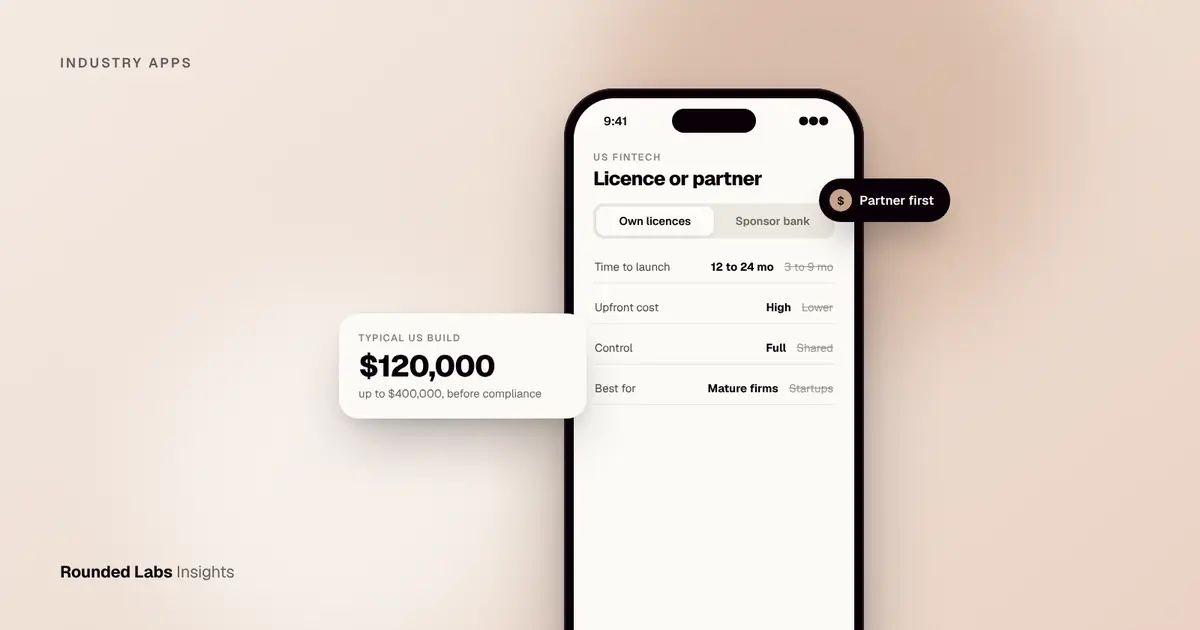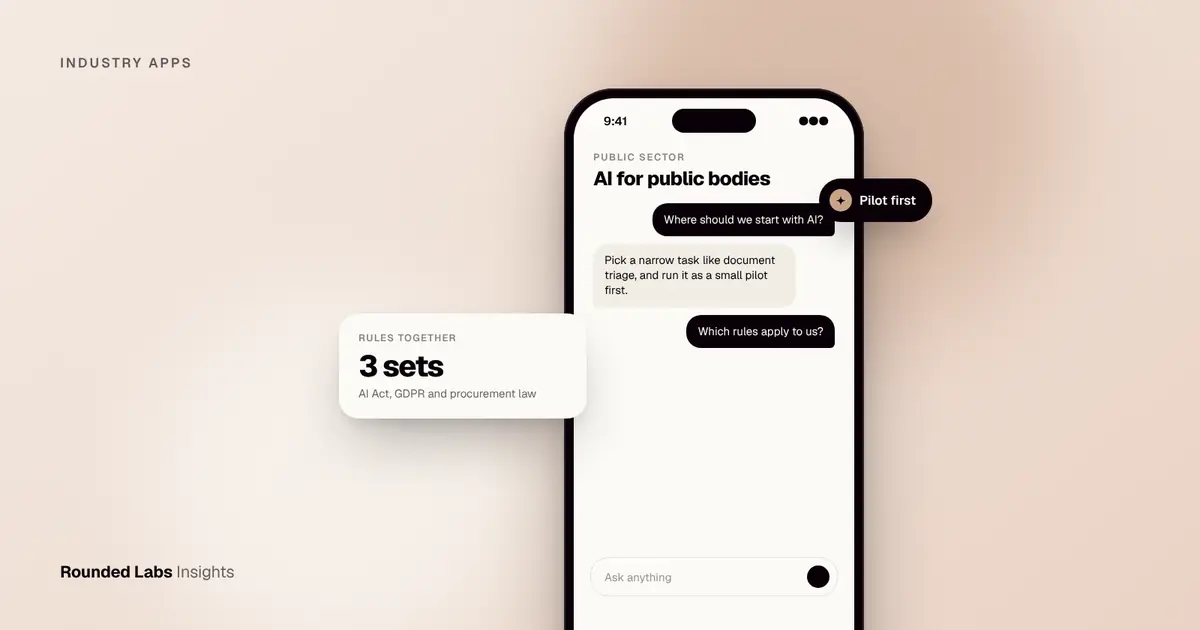
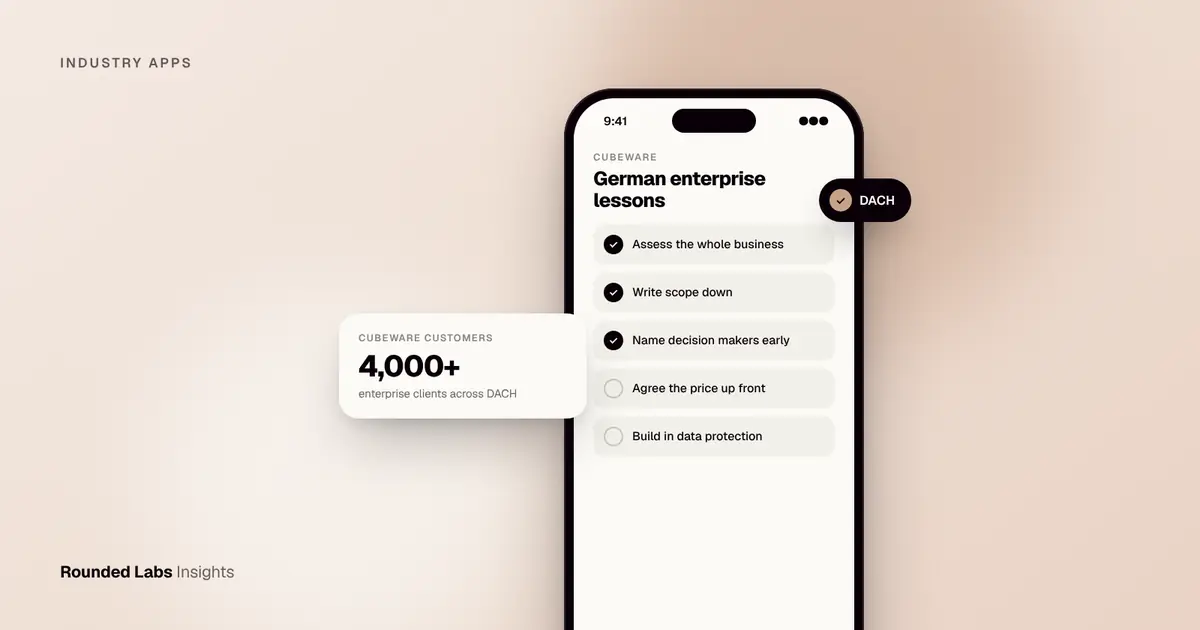
Delivering for German enterprise clients goes best when you assess the whole organisation before you write any code, agree scope and price in writing up front, and build data protection into the design. On Cubeware, a provider serving 4,000+ enterprise customers across Germany, Austria and Switzerland, that approach shaped both the SaaS rebuild and the business around it. The lessons below apply to any studio or product owner working with large German companies.
We worked with Cubeware to move a two-decade-old analytics platform to a modern SaaS architecture, and the project ended with the company being acquired by insightsoftware. This guide sets out what we learned about scoping, decision making, data protection, partners and delivery, and turns those lessons into checklists you can use on your own project. Every large company has its own culture, so treat the advice as habits that worked rather than rules about a country. The legal points are general information, not legal advice, and laws change, so check the official sources linked below. If you are weighing a local supplier against a UK one, read DACH companies: local agency or UK studio? alongside this.
Key facts
- Cubeware serves more than 4,000 enterprise customers across the DACH region and had grown to seven offices before the project.
- The new analytics platform was designed around Apache Spark, a widely used engine for processing large volumes of data.
- The work covered both the product rebuild and the operating model: partners, offices and delivery.
- The in-house consulting office in Darmstadt was replaced by a network of white-label implementation partners.
- A new research and development centre opened in Birmingham, UK, as the hub for the next-generation platform.
- Rounded Labs prices on a fixed basis agreed before development starts, so enterprise buyers know the cost in advance. See the pricing page.
What was the Cubeware project?
Cubeware is an established analytics and planning software provider. Its platform had made the company successful, but the architecture had aged, innovation cycles had slowed, and cloud-native competitors were arriving. The in-house services model also created heavy overhead across several offices.
Leadership had already concluded that small fixes would not be enough. We started with a detailed assessment of the technology and of the wider business, then built a programme with two strands: a product rebuild as SaaS, and an operational transformation. The result was a modern SaaS strategy, a partner-led consulting model and a business that another software company chose to acquire. Read the full Cubeware case study for the detail.
Why is this a useful case for other teams?
Cubeware had the features that make many enterprise software projects hard. It had thousands of customers who depended on the product every day, so change had to be careful. It had a sizeable services business tied to the old architecture, so a technical decision was also an organisational decision. And it operated across three countries with several offices, so any plan had to work across locations, not only at headquarters. If you recognise those conditions in your own business, the lessons below should transfer, whether you are a supplier to a large German company or a German company planning a modernisation.
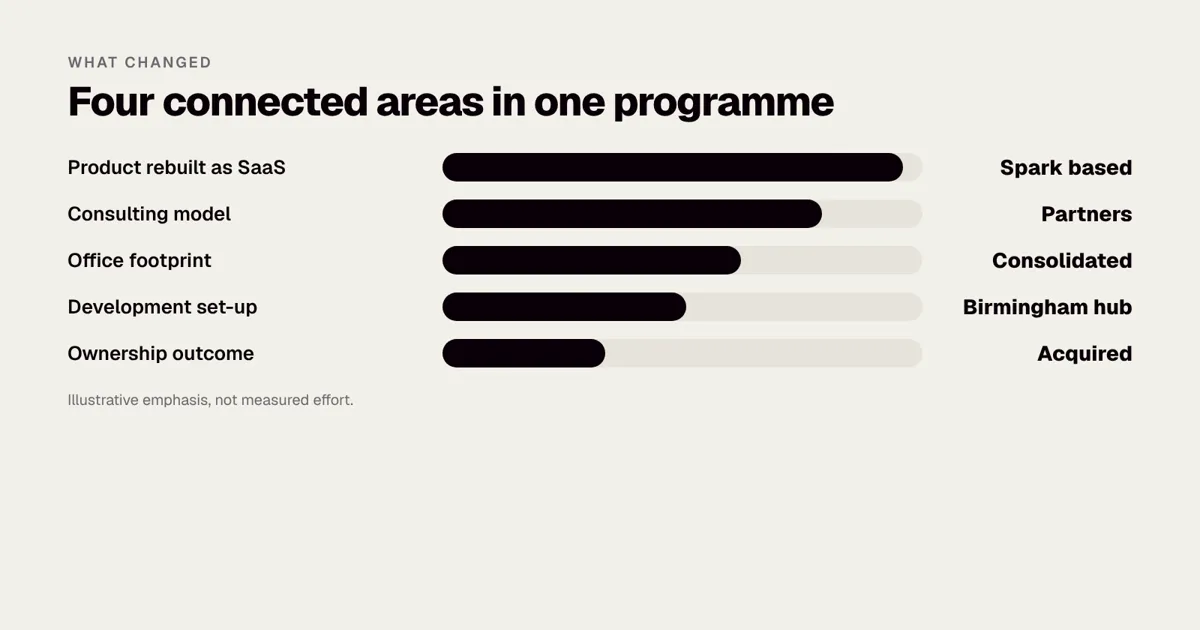
What did the programme change?
| Area | Before | After |
|---|---|---|
| Product | Ageing architecture limiting innovation | SaaS design built on Apache Spark |
| Consulting | In-house BI office in Darmstadt | Network of white-label implementation partners |
| Locations | Seven offices across three countries | Consolidated, headquarters moved to Munich |
| Development | Slowing release cycles | New R&D hub in Birmingham, UK |
| Ownership | Independent software company | Acquired by insightsoftware |
We describe the outcomes at this level because the full detail belongs to the client. The lesson is in the shape: product, people and places were changed together.
Why assess the whole business, not just the software?
The biggest lesson was that the product problem and the business problem were the same problem. A legacy platform is slow to change partly because the organisation around it is built to support it: consultants who implement it, offices that serve it, processes that assume it.
If we had scoped only a rewrite, we would have rebuilt the product and left the cost base unchanged. By looking at both, the programme addressed the product, the consulting model, the office footprint and the development set-up as one connected plan.
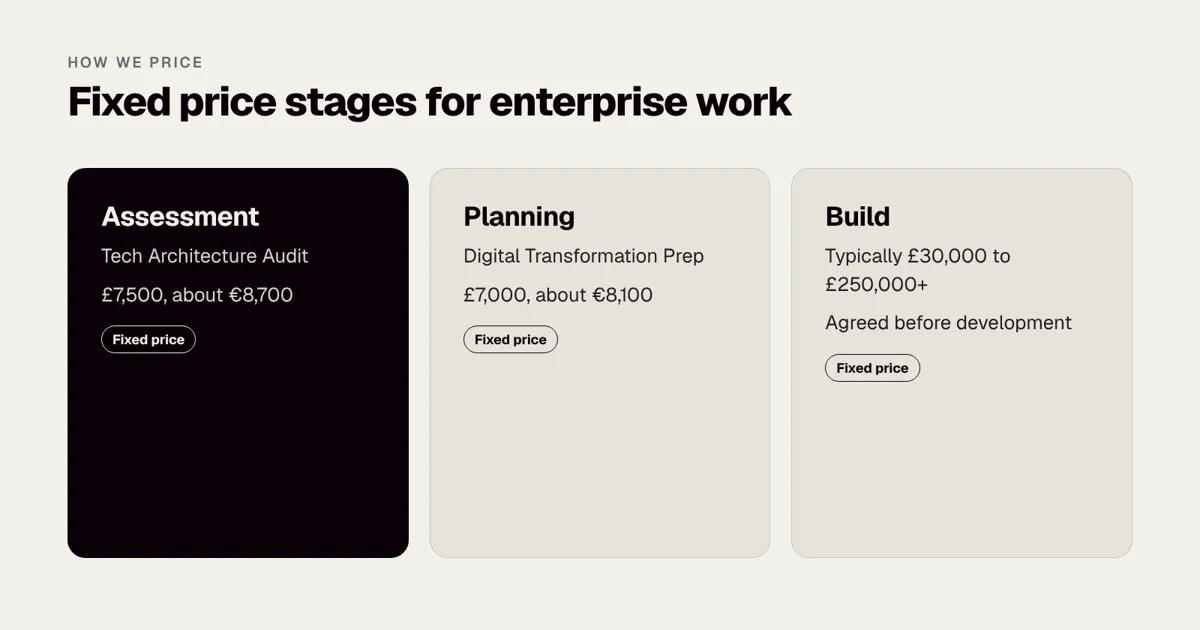
This is why we offer short assessments before large builds: our Tech Architecture Audit costs £7,500 (about €8,700) and our Digital Transformation Prep costs £7,000 (about €8,100). Both are fixed price, and euro figures are approximate conversions that move with exchange rates. For the product side of such a move, see Legacy software to SaaS for German Mittelstand companies and turning legacy software into SaaS.
What does a whole-business assessment look at?
A good assessment asks the same questions of the technology and of the organisation. Use this list as a starting point.
| Question | Technology angle | Organisation angle |
|---|---|---|
| What slows change down? | Tightly coupled code, manual releases, old data stores | Approval chains, separate teams for each customer, custom work per client |
| What do customers actually use? | Feature usage, integrations, reports | Which services customers pay for and why |
| Where is cost trapped? | Hosting, licences, support of old versions | Offices, headcount in services, duplicated roles |
| What must not break? | Core data, security, uptime | Contracts, service levels, key customer relationships |
| What would a new model need? | Multi-tenant SaaS, automated deployment, monitoring | Partners, new roles, new pricing |
Answering these in one workshop series, with both technical and commercial people in the room, tends to expose connections that separate reviews miss. For example, a feature that looks like a technical oddity may exist because one consulting team sold a custom variant years ago. Removing it needs a decision about the customers and the team, not only the code.
How long should an assessment take?
It depends on the size of the estate, but a focused assessment is normally measured in weeks, not months. Its output should be specific: a target architecture, a set of options with costs, a sequence of steps and a list of risks. Our guide on what happens in a discovery phase explains what a good output looks like, and digital transformation prep is our fixed-price way of producing one for a wider business change.
How should you run decisions and scope with a large German company?
Every enterprise has its own culture, so treat these as habits that worked rather than rules about a country. The points that helped us most:
- Write things down. Scope, assumptions and acceptance criteria belong in a shared document, not only in calls. It protects both sides and helps when a new stakeholder joins.
- Name the decision makers early. Large organisations often involve IT, procurement, legal, works councils and data protection officers. Ask in week one who must sign off what.
- Agree the price before work starts. A fixed price, set after discovery, suits enterprise procurement because it can be approved once. Our projects typically run from £30,000 to £250,000+ (roughly €35,000 to €290,000+); see the pricing page.
- Be precise about what is out of scope. Say plainly what a change request is and how it is priced.
- Do not oversell timelines. Give ranges with the reasons behind them, and report early when something moves.
Planning a project with a German or DACH enterprise? We can map your scope, stakeholders and risks in one conversation. Book a 30-minute call with a co-founder.
How do you map stakeholders in a large organisation?
In a large company, the person who asks for the project is rarely the only person who can stop it. Draw a simple map in the first two weeks:
| Stakeholder | What they care about | What they need from you |
|---|---|---|
| Sponsor (often a board or divisional lead) | Business case, timing, risk | Clear milestones and honest reporting |
| IT and architecture | Standards, integration, security | Technical documentation and early reviews |
| Procurement | Contract terms, price certainty | A fixed price, clear scope, standard paperwork |
| Legal and data protection | Compliance, supplier risk | Data maps, processing agreements, sub-processor lists |
| Works council or employee representatives, where relevant | Effects on staff and monitoring | Early, transparent information through the client |
| Business users | Whether the tool helps them work | Demos, feedback sessions, training |
| Existing suppliers | Their own contracts and roles | Respectful handover plans |
The works council point deserves care. In some German companies, employee representatives have rights over systems that can monitor staff or change how work is done. Whether that applies to your project is a question for the client’s legal and HR teams, not for you, but you can help by describing clearly what the system will collect and who will see it. Ask the question early, because it can change timelines.
What does a written scope look like?
A scope document that works for an enterprise client usually has these parts:
- Objectives. The business outcomes, in a few sentences.
- In scope. Features, integrations, environments and documentation, listed one by one.
- Out of scope. What is excluded, including things people might reasonably assume are included.
- Assumptions. What you rely on, such as access to systems, data quality and named contacts.
- Acceptance criteria. How each deliverable is tested and who approves it.
- Dependencies and risks. What must happen elsewhere for the plan to hold.
- Change process. How requests are logged, estimated and approved.
- Price and payment milestones. A fixed total split into stages tied to accepted work.
Our guides on how to write an app specification and how to brief an agency offer more detail, and what a good proposal looks like shows what an enterprise buyer should expect from a supplier.
How should you handle change requests?
Change is normal in a long programme. The aim is to make it visible and priced before work begins. A light process works well: a short change note describing the request, the effect on time and price, and who approves it. Fixed price does not mean no change. It means the baseline is agreed and every departure from it is a conscious decision. For a comparison with other models, see fixed price vs time and materials.
What do data protection and compliance mean for the build?
German enterprise buyers usually expect data protection to be handled properly from the start, and that is sensible because GDPR applies across the EU and the penalties are serious. In practice that means:
- Map the data first. List what personal data the product handles, where it is stored and who can access it.
- Host in the EU where you can. Using EU cloud regions such as Frankfurt keeps most data inside the EU and simplifies transfer questions.
- Sign data processing agreements with every supplier that touches personal data.
- Plan for audits. Enterprise customers often send security questionnaires, so keep logs, access controls and documentation tidy.
- Check AI duties. If the product includes AI features, the EU AI Act may add obligations; see The EU AI Act for app and SaaS owners.
The cost of this work is usually a small share of the build. Our guide to What it costs to make an app GDPR and AI Act ready gives ranges. For the US side of the same rules, see GDPR for US companies launching an app in Europe. Check the current rules with a qualified adviser before launch. The European Data Protection Board publishes guidelines that apply across the EU, and in Germany the Federal Commissioner for Data Protection and Freedom of Information is one starting point for official material. Supervisory authorities in the German states also issue guidance, so ask your client’s data protection officer which ones matter to them.
Which other EU rules might apply to an enterprise software supplier?
Depending on what your software does and who the customers are, several other EU rules may matter. At the time of writing, these are the main ones to check:
| Rule | Why it may matter | Where to read more |
|---|---|---|
| NIS2 | Software and service suppliers to essential and important entities may face security expectations | NIS2 for software suppliers |
| Cyber Resilience Act | Products with digital elements will face security requirements over time | EU Cyber Resilience Act |
| DORA | Financial customers must manage the risks of ICT suppliers | DORA for fintech apps and their suppliers |
| EU Data Act | Rules on access to data from connected products and cloud switching | EU Data Act |
| European Accessibility Act | Accessibility duties for certain consumer-facing products and services | App accessibility |
| EU AI Act | Duties for providers and deployers of AI systems | EU AI Act |
Dates and scope differ for each, and some are still phasing in, so check the official texts on EUR-Lex and the European Commission site. Germany also has its own national cyber security body, the Federal Office for Information Security (BSI), which publishes guidance that many German buyers use as a reference.
What security evidence do enterprise buyers ask for?
Expect a questionnaire, and expect it to be long. Preparing the answers once, and keeping them current, saves time on every deal. Typical requests include:
- A description of your hosting, regions and sub-processors.
- Your approach to access control, encryption and logging.
- Your testing practice, including independent penetration tests; see what penetration testing for apps involves.
- Your incident response process and notification times.
- Your business continuity and backup arrangements.
- Evidence of independent assurance, such as ISO 27001 or SOC 2 reports, where you have them; see SOC 2 for startups for how the US standard works.
- Your policies for staff vetting and training.
If you do not have a certification, be honest, and explain the controls you do have. A clear, truthful answer builds more trust than a vague claim.
Why did partners matter so much on Cubeware?
Cubeware’s consulting model was a large part of its overhead. We helped move it to white-label implementation partners working under the Cubeware brand, with a 25% markup on consulting projects and no consulting overhead left inside the company.
The wider lesson is that a software company with a services-heavy model can sometimes scale faster by letting specialists deliver implementation while it focuses on product. That only works if the product is easy to implement, which is another reason the SaaS architecture and the partner model were designed together.
When does a partner model make sense?
A partner-led model is not right for every company. It tends to suit a business that has:
- A product that is configurable rather than reliant on custom code for each customer.
- A customer base large enough to support independent consultancies.
- Clear documentation, training and certification so partners can deliver to a standard.
- A commercial model in which partners earn a fair return and the vendor keeps the product relationship.
- Strong APIs and integration points, so partners do not need access to the core code. See what an API integration is.
It is a poor fit if the product still needs a lot of bespoke work per customer, because partners will either charge for it or avoid the product.
What must be in place before you move to partners?
| Requirement | Why it matters |
|---|---|
| Product that can be configured, not rebuilt, per customer | Keeps implementation predictable |
| Partner onboarding and training | Protects quality and the brand |
| Clear rules on roles | Avoids disputes about who supports what |
| Transition plan for existing consultants and customers | Protects relationships and trust |
| Commercial terms, such as margins and responsibilities | Gives partners a reason to invest |
| Tooling, such as sandbox environments and documentation | Lets partners work without constant help |
On Cubeware, a markup of 25% on consulting projects was part of the commercial design, but the numbers will differ for every company, and the right model depends on your market, product and customer expectations.
How do you handle the people side?
Moving from an in-house services team to partners affects real people. Plan the communication carefully, involve HR and legal advisers early, and respect local employment law and consultation requirements. It is not a decision for a software supplier to make, but the supplier can help the client sequence technical and organisational changes so that customers do not see disruption.
How do you work across the UK and Germany?
Cubeware’s new development hub in Birmingham shows one version of the answer: a UK team building for a German-headquartered company. Time zones are close (Germany is one hour ahead of the UK), and English is the working language in most software teams. Practical points:
- Agree a single written source of truth for requirements and decisions.
- Hold regular demos so stakeholders see working software, not slide decks.
- Be ready to supply documents or UI text in German when end users need it.
- Keep a named contact on each side who can unblock questions quickly.
For a comparison of the trade-offs, see DACH companies: local agency or UK studio? and, for the wider European picture, UK vs Eastern Europe for European companies building apps. Our guide on running a remote app team across time zones covers day-to-day practice, and UK and EU data transfers for app projects explains the data side of working across the border.
What should a UK team prepare for a German client?
| Topic | What to prepare |
|---|---|
| Language | English for working documents; German for end-user interfaces and training where needed. See multi-language support |
| Contracts | Clear governing law and forum; see contracts, IP and payment for overseas agencies |
| Invoicing and tax | VAT treatment for cross-border services; ask the client’s finance team and your accountant |
| Data | EU hosting, processing agreements and a list of sub-processors |
| Meetings | A regular rhythm, with agendas and written follow-ups |
| Documentation | Architecture notes, decision logs and release notes |
| Travel | Occasional on-site workshops, which build trust |
After Brexit, VAT, customs and data transfer arrangements changed for UK and EU trade in services, so the practical details are worth confirming with an adviser. At the time of writing, UK and EU authorities publish current guidance on their official sites; check them rather than rely on a summary.
Does a UK studio need a German entity?
Usually not for a project like this, but it depends on the contract, the tax position and the client’s procurement rules. Some large clients require suppliers to meet certain registration or insurance standards. Ask in the first conversation and confirm with advisers on both sides.
How do you modernise without disrupting customers?
Moving thousands of enterprise customers from an on-premise or hosted product to SaaS is as much about change management as engineering. Cubeware’s customers relied on its analytics every day. The approach we recommend for any similar move has these elements.
- Keep the old platform running. Do not retire it until the new one covers the cases that matter.
- Move in waves. Start with a small group of friendly customers, then widen the group.
- Test migration paths. Customers have reports, rules, user accounts and integrations that must survive the move. Rehearse each path.
- Agree service levels. Be clear on availability, support hours and response times for the new service.
- Communicate early and often. Tell customers what will change, when and what they need to do.
- Measure and adjust. Track usage, errors and support requests, and fix problems quickly.
Our guide on what technical debt is explains why this kind of change gets harder the longer it is postponed, and Legacy App Rescue Assessment, at £6,500 fixed, is our way of establishing what a legacy system really contains before you commit to a plan.
What does the technical side of such a move involve?
Without going into project detail that belongs to the client, a typical programme of this type covers:
- A multi-tenant design, so many customers share infrastructure safely.
- Data processing designed to scale, which is why an engine such as Apache Spark is a common choice for analytics workloads.
- Automated build and deployment; see what CI/CD is.
- Cloud infrastructure in the right regions; see AWS vs Azure vs Google Cloud.
- Integration with customers’ existing systems, such as ERP and CRM platforms; see ERP integration and CRM integration.
- Monitoring, backup and incident response.
- Role-based access and audit trails; see role-based access and audit logs.
None of this is unique to Germany. What differs is the weight given to documentation, data protection and predictable delivery.
What does a project like this cost?
Cubeware’s programme combined strategy, architecture and delivery, so it is not a typical app budget. As a guide to how we price, a market estimate for a SaaS build of this type is often well into six figures, and the right number depends on scope. For budgeting a European SaaS product, SaaS development cost in Europe breaks down the ranges. We quote a fixed price after discovery so the figure is agreed before development starts.
| Stage | What you get | How it is priced at Rounded Labs |
|---|---|---|
| Assessment | Architecture review, options and a plan | Tech Architecture Audit £7,500 (about €8,700) |
| Transformation planning | Business and technology roadmap | Digital Transformation Prep £7,000 (about €8,100) |
| Legacy review | What a legacy system contains and what it would take to fix | Legacy App Rescue Assessment £6,500 (about €7,500) |
| Build | The product itself | Fixed price, typically £30,000 to £250,000+ (about €35,000 to €290,000+) |
Euro amounts are approximations that vary with exchange rates, not quotes. Market comparisons, such as app development cost in Europe and how much an app costs in Germany, are generic estimates that are not attributed to us.
How do you compare quotes from different suppliers?
Enterprise buyers often receive quotes in different shapes: a daily rate, a team price, a fixed price. To compare them fairly, convert each to a total for the same scope and ask what is excluded. The guides on why quotes range so widely and how to choose an app development company set out the questions to ask, and 20 questions to ask an app developer is a good checklist for the final shortlist.
What do three realistic scenarios look like?
These are illustrative scenarios based on common situations, not descriptions of real clients.
Scenario 1: A mid-sized software vendor with a legacy product
A software vendor with several hundred customers in the DACH region has a product that is eight years old and slow to change. It asks for a quote to rebuild. A whole-business assessment shows that half the delay comes from custom work sold to individual customers. The plan therefore starts with a standard configurable product and a decision about how to treat the custom features, before any new code is written. The assessment costs a small fraction of the build, and changes the shape of the build.
Scenario 2: A UK studio selling to a German manufacturer
A UK studio is asked to build an internal portal for a German manufacturer. In the first two weeks it maps stakeholders, finds that IT, legal and data protection each have approval steps, and agrees a written scope that names them. It hosts the test environment in a Frankfurt region, uses German-language interface text for end users and holds a weekly demo. Because the price is fixed and the scope is written, procurement approves it once. See internal staff apps for examples of this type of project.
Scenario 3: A company considering a partner model
A software company with a large in-house consulting team asks whether partners could take over implementation. An assessment shows that the product needs too much customisation per customer for partners to deliver profitably. The company decides to invest in configuration tools first, then pilot with two partners. This is slower than a quick switch but avoids damaging customer relationships.
How should you communicate with a large client day to day?
Communication habits decide more projects than technology does. These practices worked well for us on large programmes, and they cost little.
What does a good weekly rhythm look like?
| Event | Purpose | Output |
|---|---|---|
| Short weekly status call | Surface blockers early | A written note of decisions and actions |
| Fortnightly demo | Show working software to the wider group | Feedback logged against the backlog |
| Monthly steering meeting | Sponsor-level review of progress, risks and budget | Updated plan and any change decisions |
| Written release notes | Tell users what has changed | A document in the shared space |
| Quarterly review | Check the plan against business goals | Adjusted priorities |
Always follow a call with a short written summary. In a large organisation, the people who attend a meeting are not always the people who act on it, and a written note travels further than memory.
How do you report bad news?
Report early, with facts, options and a recommendation. A sentence such as “The data migration for the second customer group will take two more weeks because the source data needs cleaning; we suggest moving the pilot, which keeps the launch date unchanged for the first group” is far more useful than a late surprise. Enterprise sponsors have their own reporting duties upwards, and a supplier who gives them clear information makes that job easier.
What about documentation?
Large clients value documentation, and it pays back when staff change on either side. Aim for these living documents:
- A requirements and scope register.
- A decision log, recording what was decided, by whom and why.
- An architecture overview with diagrams.
- A risk and issue log.
- Release notes and a test summary for each release.
- An operations guide covering deployment, monitoring and support contacts.
Keep them short, current and in a place the client controls. This also supports the ownership and handover points covered in contracts, IP and payment for overseas agencies and who owns the code.
What does a first 90 days plan look like?
The following outline is a template, not a description of any one client. Adjust it to your project and your client’s pace.
| Period | Focus | Key outputs |
|---|---|---|
| Weeks 1 to 2 | Alignment | Stakeholder map, data map, access to systems, agreed ways of working |
| Weeks 3 to 6 | Assessment and design | Current state review, target architecture, options with costs, risks |
| Weeks 7 to 8 | Decision | Written scope, fixed price, milestones, change process, sign-off |
| Weeks 9 to 12 | First build increment | Working software in a test environment, first demo to a wider audience, security review |
Our guide on the first 90 days with an agency goes further on this rhythm. The key habit is that every period ends with something a stakeholder can see and approve, so confidence builds step by step.
What should you have agreed before the first line of code?
- The business goals and how success will be measured.
- The scope, assumptions and exclusions in writing.
- The fixed price and payment milestones.
- The people who approve each deliverable and how quickly they will respond.
- Where data will live and which suppliers can access it.
- How defects, changes and incidents will be handled.
- Who owns the code, accounts and documentation.
If any of these are unclear, resolve them first. It is far cheaper to spend an extra week on alignment than to rework a build.
How do you earn trust with a large client?
Trust in enterprise projects is built from small, repeated signals rather than from presentations. The ones we find matter most:
- Do what you said you would do, by when you said. If you cannot, say so before the date.
- Be specific. Replace “soon” with a date and “some risk” with a named risk and a plan.
- Be open about limits. If you do not know the answer to a legal or data protection question, say so and ask the client’s experts or your own adviser.
- Respect the client’s standards. Follow their security policies, naming conventions and change procedures, and propose improvements through the proper channel.
- Show proof where it is relevant. We have worked since 2007, built the UK’s first mobile banking app, MoBank, and delivered for Waterstones in 12 weeks, but proof only helps when it is paired with a clear plan for the client’s own project.
None of this is unique to German clients. It is simply what large organisations, in any country, tend to value in a supplier.
What mistakes should you avoid?
| Mistake | Why it hurts | What to do instead |
|---|---|---|
| Scoping only the code | Leaves the organisational causes of slow change in place | Assess technology and operations together |
| Relying on verbal agreements | New stakeholders reopen settled points | Write down scope, assumptions and decisions |
| Ignoring approval steps | Delays appear late and look like supplier failure | Map sign-offs in week one |
| Treating data protection as a final check | Costly redesign | Map data and choose hosting before build |
| Overpromising a date | Erodes trust | Give ranges, with reasons, and update early |
| Underestimating training and communication | Users do not adopt the new product | Plan demos, documentation and training |
| Forgetting existing suppliers | Handover problems | Include them in the transition plan |
| Assuming one size fits all | Every enterprise has its own culture | Ask how each client prefers to work |
What should you do next?
- Write down the problem as both a product problem and a business problem.
- List the people who must approve the project, and talk to each of them.
- Map the personal data and decide where it will live.
- Agree a written scope and a fixed price after a short assessment.
- Plan the move in waves, with a way back at each stage.
- Check legal and regulatory points with advisers for your own situation.
If you want to discuss a project with a German or DACH enterprise, book a call with a co-founder. You can also see how we handle large-scale work in our Superdry case study, where we modernised an app for a brand with 768 locations in over 100 countries, and how we deliver to fixed timelines in the Waterstones case study, where an app, mobile site and eBooks API were delivered in 12 weeks. Our guide on 19 years of building apps puts those projects in context.
Frequently asked questions
Do German enterprise clients prefer local suppliers?
Some do, mainly for language and contract reasons, but many work with international teams when the supplier is clear, documented and reliable. Cubeware’s Birmingham hub is one example of a UK team building for a DACH company. The questions in DACH companies: local agency or UK studio? can help you decide.
Does GDPR apply if we build in the UK?
Yes, if the product handles personal data of people in the EU or serves EU customers. Host in the EU where practical and check your transfer arrangements with an adviser. This is general information, not legal advice.
How long does a SaaS migration take?
It depends on the size of the legacy platform and the scope. A short assessment first gives you a realistic range, and we agree the timeline and price before development starts. See how long it takes to build an app for general timelines.
Why start with an assessment?
Because the product is rarely the only problem. Reviewing technology and operations together shows where the real barriers to growth are before you commit to a large build.
Can Rounded Labs work in German?
Our working language is English. We can build products with German-language interfaces and content, but check with us about your specific documentation needs.
Is a fixed price realistic for an enterprise project?
Yes, when the scope is written down and agreed after discovery. Changes are handled through a written change process, so the baseline stays clear. Our projects are always fixed price, agreed before development starts.
Does Rounded Labs have experience beyond Cubeware?
Yes. We have worked since 2007 on projects including the UK’s first mobile banking app, Superdry, Waterstones, a Bavarian government computer vision project, Dabbl, DRSR and First Agency Direct.
Official sources and further reading
Talk it through with one of our co-founders. 30 minutes, no pressure.