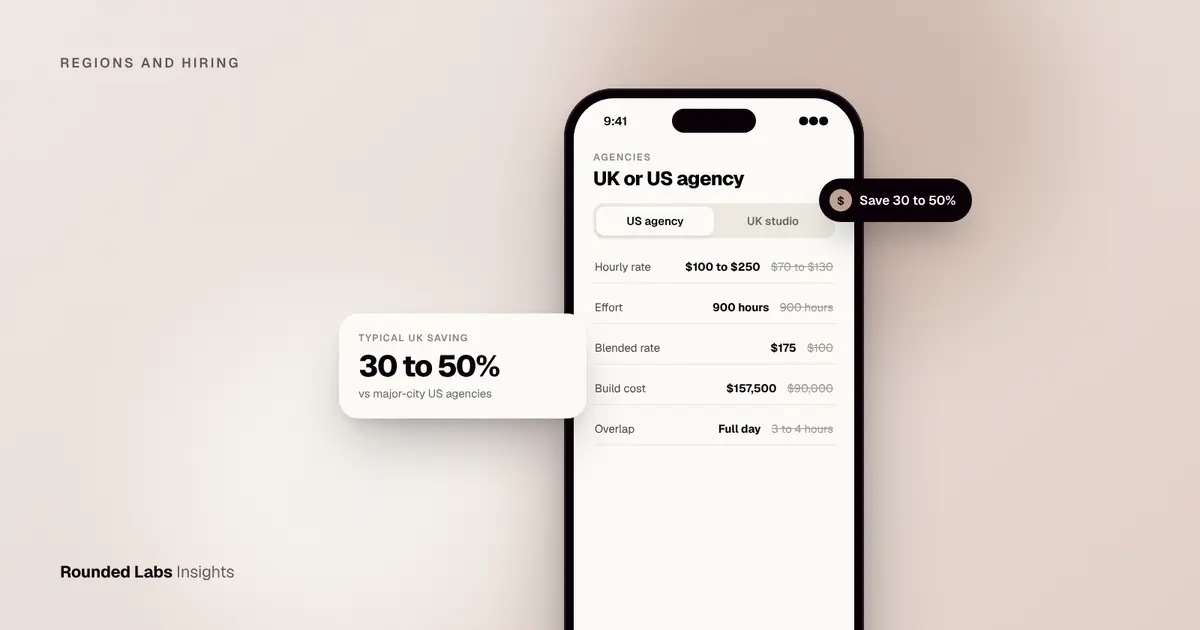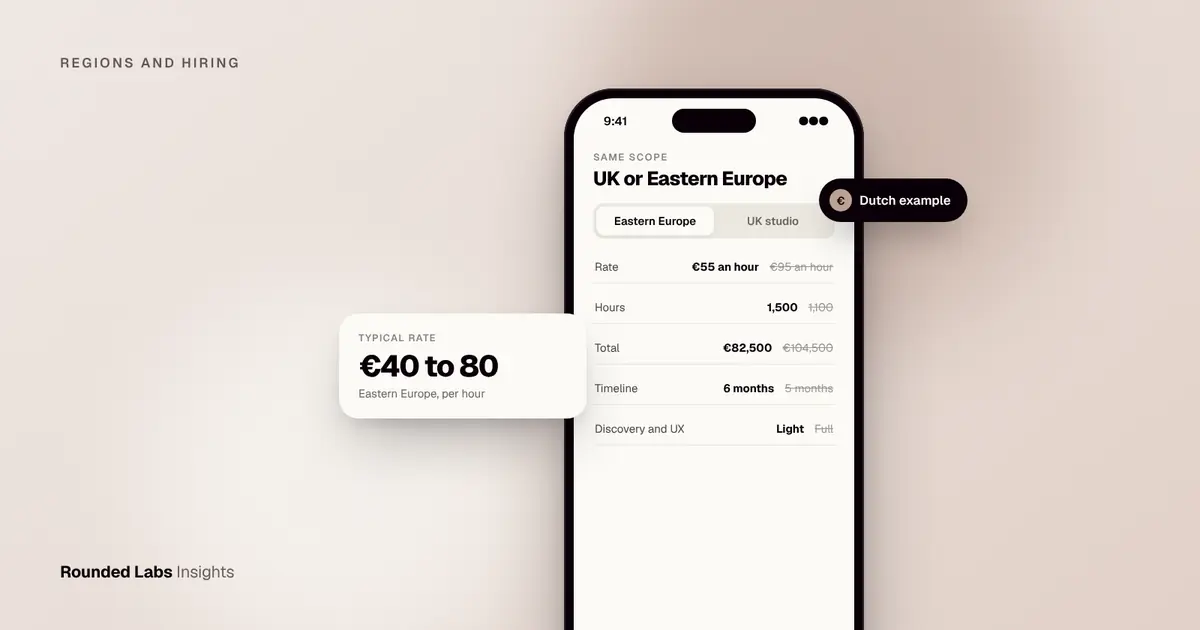


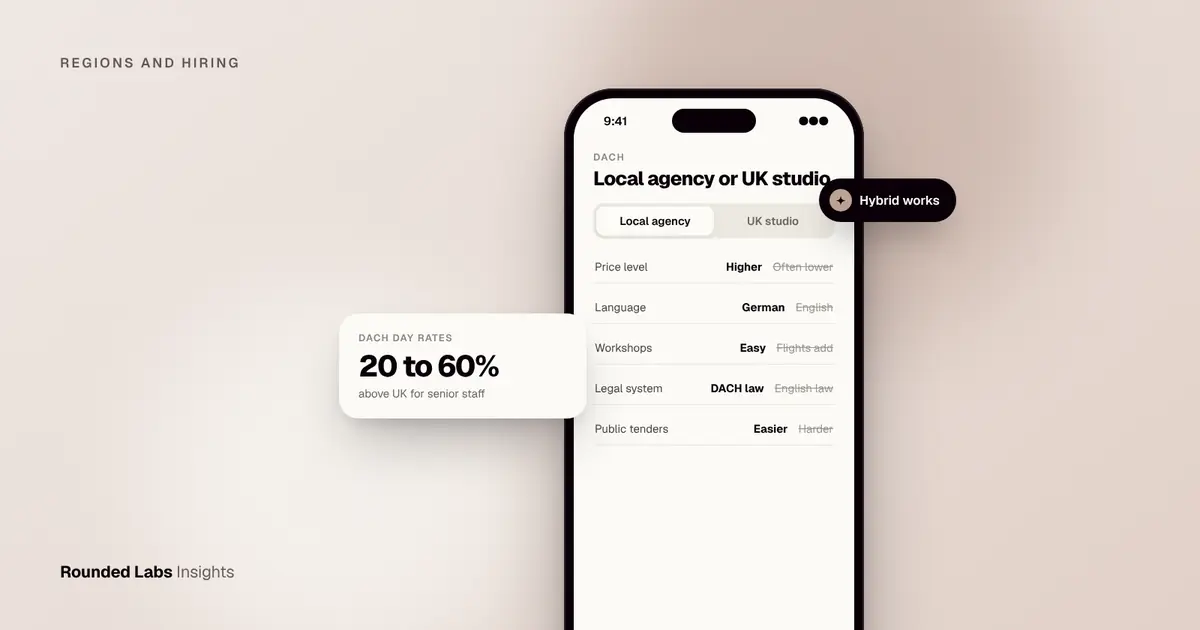
For most DACH companies, a local agency is the safer choice when the project needs on-site workshops, German-language documentation or a public-sector contract, and a UK studio is the better choice when specialist mobile or SaaS skills, speed and price matter more. Market day rates in Germany, Austria and Switzerland are often 20 to 60% above UK rates for comparable senior staff (a market estimate, not a quote), so the gap can decide the budget. Neither option is automatically better.
We moved Cubeware‘s analytics product to SaaS for 4,000+ enterprise customers across the DACH region, working from the UK, so we know both sides of this choice. This guide compares the two options on cost, language, data protection, contracts, procurement and risk, and helps you decide with a worked example, a scoring method and a step by step selection process. If you are also weighing budgets, our pricing page explains how fixed-price projects work. Contract and data points here are general information, not legal advice, and laws change, so check the official sources named below or ask a lawyer in your own country.
Key facts
- Rounded Labs has been building software since 2007 (19 years) and prices every project at a fixed amount agreed before development starts.
- Senior developer rates in Germany, Austria and Switzerland are typically higher than UK rates; Swiss rates are usually the highest in Europe (market estimate).
- The UK has been treated as adequate for GDPR data transfers by the EU, but adequacy decisions are time-limited and can be reviewed, so check the current status.
- Language, time zone and travel matter less than people expect; contract terms and team seniority matter more.
- A hybrid model, with a UK build team and a local legal or project contact, is common and works well.
- The cheapest quote is rarely the cheapest project. Compare total cost, including travel, legal review, translation and the cost of changes.
What are you really choosing between?
The question is rarely “Germany versus the UK”. It is a choice between three things: who will do the work, how close they sit to your people, and what a mistake would cost you. A local agency gives you proximity, shared language and a familiar legal system. A UK studio gives you a larger talent pool in some areas, English-first working and often a lower price.
Before comparing suppliers, write down what you actually need. A regulated banking portal that must be documented in German for an auditor has different needs from a consumer app with a launch date in spring. A manufacturer replacing a paper process on the shop floor has different needs again from a software company modernising its own product. Our guide to red flags when hiring app developers applies to both options, and How to choose an app development company in the UK: a 2026 checklist is a useful template even if you are outside the UK, because most of its checks are not country specific.
Four questions that settle most cases
- Who will read the deliverables? If an auditor, a works council or a public body must read them in German, language moves up the list.
- How often must people meet in person? Weekly workshops at a factory are a strong reason for a local team. Fortnightly video reviews are not.
- How specialised is the technology? If you need a particular mobile, SaaS or modernisation skill, the best fit may sit in another country.
- What would a delay or an error cost? A high cost of failure argues for a supplier you can reach quickly and hold to account under familiar law.
If your answers point in different directions, you probably have a hybrid project, and the later sections show how to split it.
How do the two options compare?
| Factor | Local DACH agency | UK studio |
|---|---|---|
| Typical price level | Higher, Switzerland highest | Often 20 to 40% lower for similar seniority (market estimate) |
| Working language | German by default | English by default, German-speaking staff vary |
| Time zone | Same or one hour from the UK | One hour behind Germany, Austria and Switzerland |
| On-site workshops | Easy and cheap | Possible, with flights adding to cost |
| Legal system | German, Austrian or Swiss law | Usually English law, or your choice if agreed |
| Data transfers | Inside the EU or Switzerland | Cross-border, needs a lawful basis |
| Public-sector tenders | Often easier to qualify | Can be harder, depending on rules |
| Specialist mobile or SaaS skills | Varies widely | Often deep, but varies by studio |
These are broad patterns, not rules. Always judge the individual supplier, not the country. A small, senior UK studio can outperform a large local agency on a specialist build, and a local boutique can outperform a UK studio on a project that depends on regional knowledge. For wider comparisons, see UK vs offshore app development: an honest comparison and UK vs Eastern Europe for European companies building apps.
Where the differences are real and where they are not
| Difference | Real or overstated? | Why |
|---|---|---|
| Price | Real | Salary, overhead and rate levels differ, though total cost depends on scope |
| Language | Often overstated | English is normal for technical work, German matters for user-facing text and formal documents |
| Time zone | Overstated | One hour is negligible |
| Culture of process | Real | German-speaking buyers often expect detailed written specifications and formal sign-off |
| Legal familiarity | Real | Your lawyers know local law, and local agencies know local contract habits |
| Data protection | Real, manageable | Cross-border transfers need documentation but not heroics |
| Travel | Real for some projects | Matters if you need frequent site visits |
How big is the cost difference?
Exact prices vary, but market surveys and agency rate cards generally show that senior developers in Germany and Austria cost noticeably more per day than their UK equivalents, and Swiss rates are higher again. These are market estimates, and any supplier’s actual price depends on the seniority of the team, the scope and the timing. For a deeper look, read How much does an app cost in Germany?, App development cost in Europe and SaaS development cost in Europe. For rates in general, App development rates 2027: UK vs US vs Eastern Europe vs Asia and what each price level buys in app development explain what sits behind different price levels.
Rounded Labs does not charge by the hour. Projects are fixed price, agreed before development starts, and typically run from £30,000 to £250,000+ (about $38,000 to $318,000, or €35,000 to €290,000, at recent exchange rates, which move). We also offer productised services: a Tech Architecture Audit at £7,500, Digital Transformation Prep at £7,000, a Mobile Product Discovery Sprint at £9,500 and a Legacy App Rescue Assessment at £6,500.
Why a headline rate comparison misleads
A day rate tells you what one person costs for a day. It does not tell you how many days the work needs, how senior the people are, or how much management overhead sits on top. A smaller team of senior people can deliver the same scope in fewer days than a larger team with a thin mix of juniors. When you compare quotes, ask for the scope, the team make-up and the assumptions behind each number, and compare outcomes rather than rates. A fixed price removes some of this complexity, since the supplier carries the risk of how many days the scope takes, but only if the scope is clearly written. Fixed price vs time and materials for app projects explains the trade-off.
A worked example
Imagine a mid-sized German manufacturer that wants a customer portal and companion app. Local agency quotes come in at about €180,000, based on roughly 1,300 hours at a blended rate near €140. A UK studio quotes a fixed £120,000, around €139,000. The difference of about €41,000 is real, but the manufacturer should also add flights and hotels for four workshops (perhaps €4,000 to €6,000), a German-language legal review of the contract and any translation of documentation. Even after those extras the UK option is cheaper in this illustration, though the margin narrows. The figures are illustrative market estimates, not a quote.
The chart below shows how the gap changes as the extras are added, using a single set of assumptions: €5,000 for workshop travel, €4,000 for a legal review of the contract in your country and €3,000 for translation of formal documents.
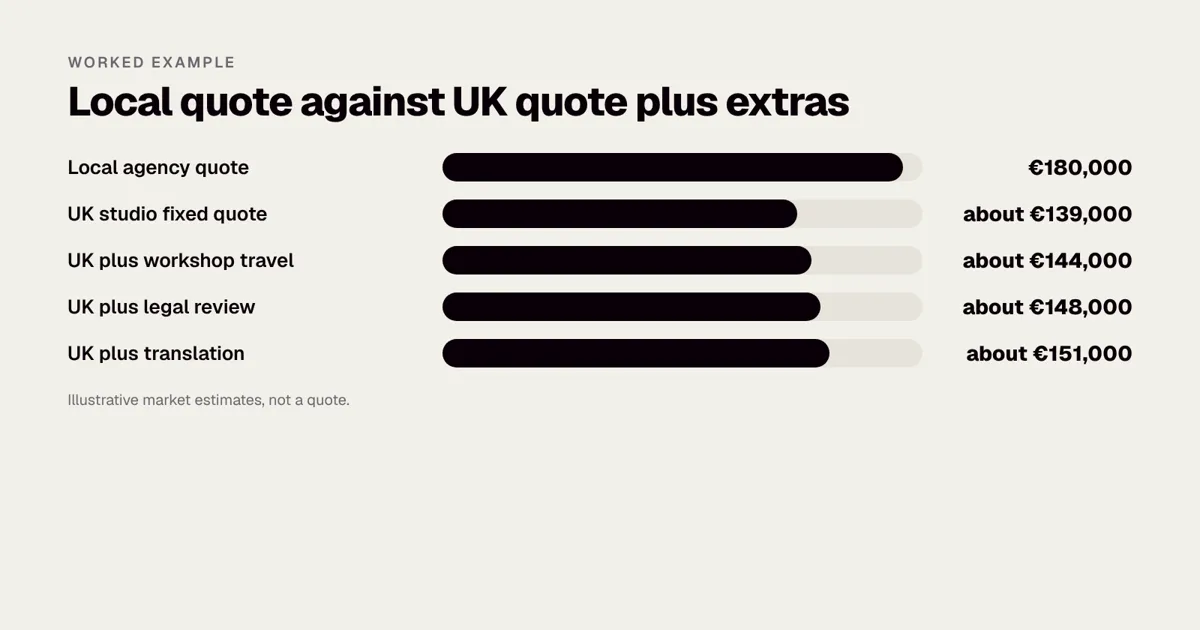
The point is not that the UK always wins on price. The point is to compare like with like. If the local agency’s quote had included the German documentation and four on-site workshops, the gap would be smaller. If the UK studio had included an extra month of senior time for a hard integration, the gap could close or reverse. Ask each supplier to quote against the same written scope.
Not sure which route fits your project? We will tell you honestly if a local agency is the better choice. Book a 30-minute call with a co-founder.
What about GDPR and data protection?
A DACH company can work with a UK studio and stay compliant, but the paperwork needs care. Since Brexit the UK is a “third country” under GDPR. The European Commission has granted the UK an adequacy decision, which allows personal data to flow without extra safeguards, but adequacy decisions can be reviewed or expire, so check the current status on the European Commission’s data protection pages before you sign. At the time of writing, the UK decision has been time-limited and has been extended and reviewed more than once.
Practical steps for a UK-built project:
- Prefer test data. Developers rarely need real customer records.
- Host data in the EU, for example in a Frankfurt region, even if the team is in the UK.
- Sign a data processing agreement that names the studio as processor.
- Keep access logs and limit production access to named staff.
Switzerland has its own Federal Act on Data Protection, so a Swiss company should check both Swiss and EU rules. The Swiss Federal Data Protection and Information Commissioner publishes guidance. Our posts on UK and EU data transfers and hiring a UK studio from the EU after Brexit cover this in detail, and What it costs to make an app GDPR and AI Act ready shows the budget impact.
What a data processing agreement should cover
Under GDPR, when a supplier handles personal data on your behalf, a written agreement is required. The exact content depends on your regulator and your lawyer, but the following points are typical.
| Topic | What to look for |
|---|---|
| Subject and duration | What data, for what purpose, for how long |
| Instructions | The supplier acts only on your documented instructions |
| Confidentiality | Named staff bound by confidentiality |
| Security measures | Technical and organisational measures described |
| Sub-processors | A list, and a right to object to changes |
| Data subject requests | How the supplier helps you respond |
| Breach notification | A timeframe for telling you, so you can meet your own duties |
| Return or deletion | What happens at the end of the contract |
| Audit | Your right to see evidence of compliance |
| Location and transfers | Where data is stored and any transfers outside the EU or Switzerland |
Hosting and location
Hosting in an EU region does not by itself settle every question, since staff access from the UK is still a transfer to a third country under GDPR. In practice, many projects combine EU hosting, limited access by named people, test data in development and a data processing agreement. For choices between cloud platforms, see AWS vs Azure vs Google Cloud for app backends. The German Federal Commissioner for Data Protection and Freedom of Information and the Austrian Datenschutzbehörde publish guidance for their own countries, and the European Data Protection Board publishes guidelines on transfers.
Other EU rules that touch the choice
Several newer EU rules affect what you build, not who builds it, but a supplier should be able to talk about them. The EU AI Act for app and SaaS owners, NIS2 for software suppliers and The EU Cyber Resilience Act and your app are worth reading before you issue a brief. If you are building for finance, see DORA for fintech apps and their suppliers and Fintech apps in Europe: PSD2, open banking and DORA. Accessibility rules also matter, since the European Accessibility Act applies to certain consumer products and services from 2025, as covered in App accessibility: the European Accessibility Act and UK guidance. At the time of writing, national implementation details vary, so check with your own adviser.
Does language and culture matter?
Yes, but less than most buyers fear. German enterprise teams commonly work in English for technical projects, and specifications written in English are normal in software. Where German matters is in user-facing content, legal text, and anything an auditor or works council will read. A good UK studio will build the app with localisation in mind so German strings can be added or reviewed by your own team. How to localise an app for Europe and How to launch an app in Germany explain the practical steps.
Culture shows up in process. German buyers often expect detailed written specifications, formal sign-off and thorough documentation before build starts. That suits a fixed-price approach: when scope is agreed up front, both sides know what will be delivered. Our case study on Delivering for German enterprise clients: lessons from Cubeware goes through what we learned.
A practical language plan
| Item | Typical choice |
|---|---|
| Project meetings and chat | English, or German if the whole team is comfortable |
| Specifications and technical documents | English, with German summaries for sign-off where needed |
| User interface text | German, written or reviewed by your own staff or a professional translator |
| Legal documents and privacy notices | German, reviewed by your lawyer |
| Support content and training | German, owned by your team |
| Code comments and repository | English |
A frequent mistake is to ask the supplier to write the final German text. Machine translation and a developer’s German are not a substitute for a native professional who understands your industry and tone. Assign this to someone on your side, and ensure the app architecture lets them edit text without a developer.
The works council factor
If your app will be used by employees, and particularly if it records what they do, a German works council may have co-determination rights under the Works Constitution Act. Austria and Switzerland have their own arrangements. This is a matter for your HR and legal teams, and it affects timelines more than the choice of supplier. A local agency may have handled similar approvals before, so ask any supplier whether they have worked with works councils and what they would need from you.
How should contracts and IP work?
With a local agency the default is your national law and courts. With a UK studio you can often choose, but you should decide it explicitly. Points to settle in writing:
- Governing law and venue. Choose one and stick to it. Many cross-border contracts use English law with arbitration or a neutral venue.
- IP ownership. Confirm that all code, designs and documentation transfer to you on payment. See Who owns the code? for what to look for.
- Source code access. You should have repository access throughout, not only at the end.
- Payment milestones. Tie payments to delivered, accepted work, not to elapsed time.
- Exit terms. Agree handover steps if the relationship ends.
Have a lawyer in your own country review the draft. It is a small cost compared with the project.
Contract type and acceptance
In German-speaking countries, a distinction between a contract for a result (a work contract) and a contract for services is common, and it affects acceptance, warranty and payment. A fixed-price software project with defined deliverables often resembles a work contract, which comes with formal acceptance. This is a question for your lawyer, who will also tell you whether standard terms and conditions used by a foreign supplier would be tested under local rules on general terms. Mentioning it early prevents a standard contract from the supplier being rewritten late in the process.
Contract terms worth checking
| Term | Why it matters | What good looks like |
|---|---|---|
| Scope description | Defines what a fixed price buys | A written list of features and exclusions |
| Acceptance criteria | Decides when you pay | Tests and criteria agreed before build |
| Change process | Controls cost | A written change request with price and impact |
| Warranty | Covers defects after delivery | A defined period and response times |
| Liability cap | Limits exposure | Reasonable relative to project value, discussed openly |
| Confidentiality | Protects your information | Mutual, with clear duration |
| Subcontracting | Who actually does the work | Named, with your approval needed |
| Termination | Keeps you free to leave | Clear steps and handover duties |
| Escrow or code access | Reduces supplier risk | Regular repository access or an agreed escrow |
For wider reading, Contracts, IP and payment when you hire an overseas app agency and What a good app development proposal looks like are useful companions, and How to switch app agencies without losing your app explains what a clean exit involves.
VAT and tax
Cross-border services between businesses are generally subject to place-of-supply rules, and the reverse charge mechanism often applies when a UK supplier invoices a business customer in Germany, Austria or Switzerland. The exact treatment depends on the facts, so ask your tax adviser to confirm it, and check the official sources in your country. At the time of writing, post-Brexit VAT rules for services are well established, but individual cases differ.
When does a local agency win?
Choose a local agency when:
- The project needs frequent in-person workshops with shop-floor or field staff.
- The deliverables must be written in German for regulators, auditors or a works council.
- You are bidding for public-sector work with a local supplier requirement.
- Your procurement rules favour suppliers inside the EU or Switzerland.
- You want a supplier who can be at your office in an hour.
- You need long-term support from people who know your region’s regulations and business customs.
A local agency can also be the better route when your own team is small and wants a close, hands-on working relationship, with frequent informal contact that is harder to replicate across borders. Be honest about whether your team will really use that access.
When does a UK studio win?
Choose a UK studio when:
- You need specific mobile, SaaS or modernisation experience, such as the work we did for Superdry, whose app serves 768 locations in over 100 countries.
- Budget is a major constraint and the project suits a fixed price.
- English-language documentation is fine.
- You want a senior team directly involved rather than a layer of account managers.
- Speed matters: smaller studios can start sooner than a large agency with a long queue.
- The project has a clear scope and a delivery window, as with Waterstones, where we delivered an app, a mobile site and an eBooks API in 12 weeks.
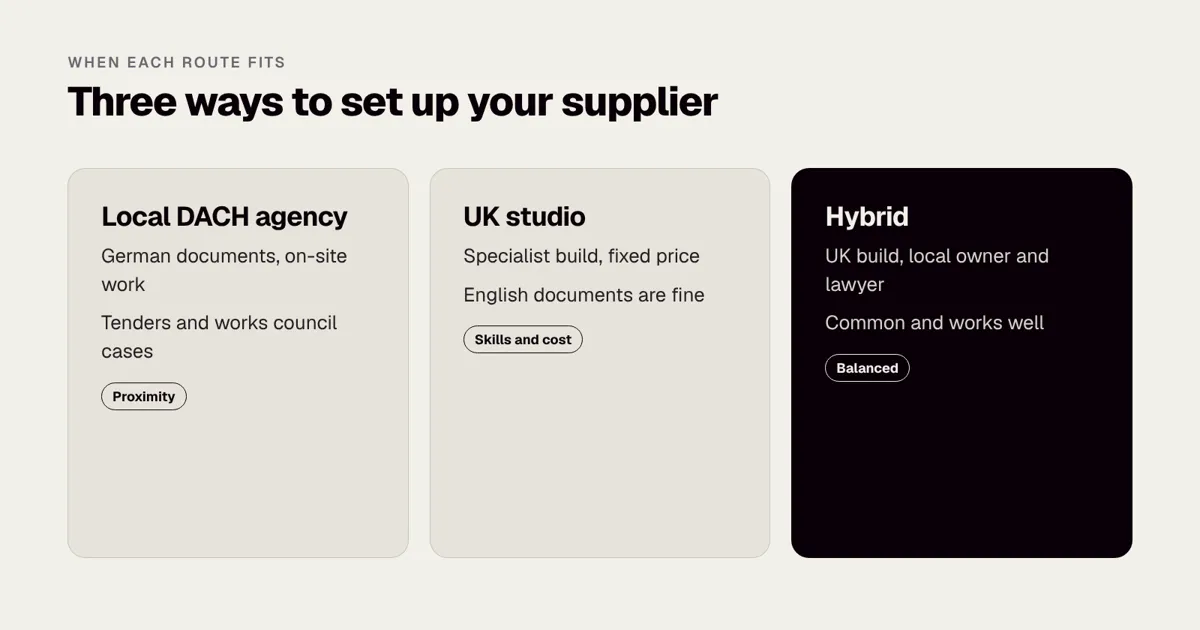
A hybrid is also common: the UK studio builds, and you appoint a local project owner and a legal reviewer. For regulated content, a short discovery phase such as our Mobile Product Discovery Sprint at £9,500 lets you test the working relationship before committing to the full build.
What about public-sector and regulated projects?
Public bodies and some regulated industries add requirements that can decide the question before price enters. These vary by country and by contract value, so treat this section as a map of questions.
| Question | Why it matters |
|---|---|
| Is there a formal tender process? | Many public contracts above a threshold must follow procurement rules, and bidders must qualify under them |
| Are there local supplier or location requirements? | Some tenders and frameworks specify where staff or data must be |
| Is there a security clearance or certification requirement? | Some bodies expect certifications or reference to national guidance such as that from the German Federal Office for Information Security (BSI) |
| Must documents be in German? | Public bodies often require German-language documents |
| Are there sector rules? | Banking, insurance, health and critical infrastructure have extra obligations |
| Who will audit the supplier? | Some regulated firms must be able to audit outsourced services |
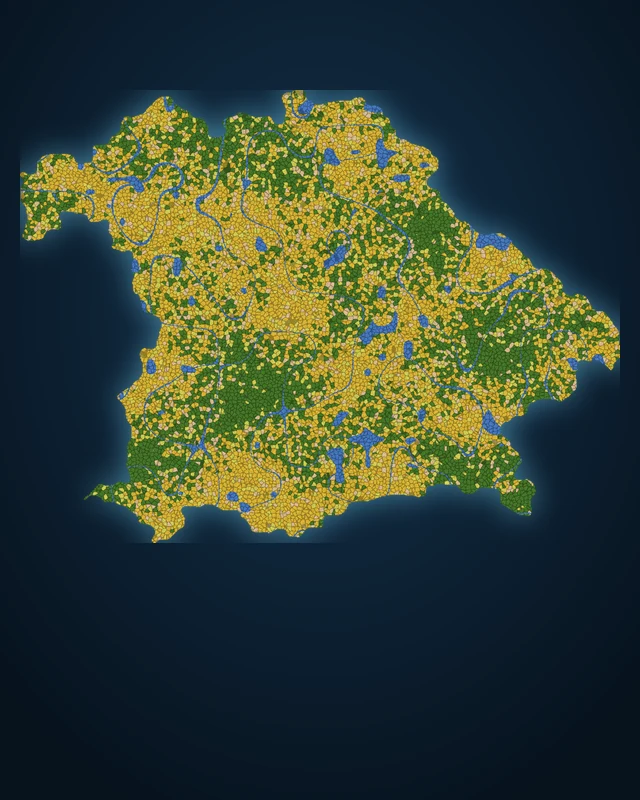
For public tenders, check the notice and the procurement rules carefully, since eligibility can be strict. A UK studio can sometimes participate as a subcontractor to a local prime supplier, which is a form of hybrid. For regulated firms, ask your compliance team what the regulator expects of outsourcing. We have also worked on a computer vision project for the Bavarian government, which taught us how much of public-sector work is about process and documentation as well as code. AI for European public sector bodies goes into the AI side in more depth.
How do you choose a supplier step by step?
A structured process beats a gut feeling. The steps below work for either option, and they take roughly four to six weeks for a mid-sized project.
- Write a one-page brief. Goal, users, key features, constraints, budget range and launch window. How to brief an app development agency has a template, and How to write an app specification helps for larger projects.
- Shortlist five suppliers, a mix of local and UK if you are undecided.
- Ask the same 20 questions to each. See 20 questions to ask an app developer before you sign.
- Check references from clients of similar size and sector. Speak to them directly.
- Run a paid discovery or audit with the top two. This is the single best test of working relationship.
- Compare written proposals against the same scope. App development quotes compared shows how to read them.
- Review the contract with your lawyer, including data processing terms.
- Plan the first 90 days, including who owns decisions on your side. Working with an app agency: the first 90 days helps.
A simple scoring grid
Score each supplier from 1 to 5 on each criterion, multiply by the weight and add up. Adjust weights to your project.
| Criterion | Weight | Local agency | UK studio |
|---|---|---|---|
| Relevant experience and references | 25% | Score here | Score here |
| Total cost including extras | 20% | Score here | Score here |
| Senior team involvement | 15% | Score here | Score here |
| Language and documentation fit | 10% | Score here | Score here |
| Data protection and contract terms | 15% | Score here | Score here |
| Speed to start and deliver | 10% | Score here | Score here |
| Proximity and workshops | 5% | Score here | Score here |
The grid is not a calculator for the truth. Its value is that it makes you write down what matters, and it exposes disagreements within your team before money is spent.
What a paid discovery shows you
A discovery phase of two to four weeks reveals more than any presentation. You see how the team asks questions, whether they challenge your assumptions, how they write, how quickly they respond and whether they deliver a clear plan at the end. You also receive something useful whatever you decide, since a good discovery produces a scope, a prototype or an architecture review that another supplier could use. See What happens in a discovery phase, and why it saves money. Our fixed-price options for this stage are the Mobile Product Discovery Sprint (£9,500), the Tech Architecture Audit (£7,500), Digital Transformation Prep (£7,000) and the Legacy App Rescue Assessment (£6,500), and details are on the pricing page.
What do other worked examples look like?
These are hypothetical, with rounded numbers, to show how the choice depends on the project.
Example two: an Austrian public body with a citizen app
An Austrian regional body wants an app for reporting local issues. The tender requires German documentation, an accessible interface and a supplier able to attend in-person meetings. The decision is straightforward: a local or regional agency, or a UK studio as subcontractor to a local prime, because the tender and documentation requirements dominate. Price matters less than eligibility and the ability to attend meetings.
Example three: a Swiss fintech with a tight launch window
A Swiss company needs a trading dashboard and mobile app by a fixed date in nine months. Swiss rates are high, and the team needs specific mobile and charting skills. The company chooses a UK studio for the build, hosts data in a Swiss or EU region, appoints a Swiss project owner and engages a Swiss lawyer to review the contract and the data protection side. It also asks the studio for evidence of similar financial work. Our experience on Dabbl, designing stock trading for first-time investors, and on MoBank, the UK’s first mobile banking app, is the kind of reference the company should ask any supplier to match. The hybrid approach combines specialist build skills, a tight budget and local legal control.
Example four: a Mittelstand software firm moving to SaaS
A German software firm with 400 enterprise customers has an on-premises product and wants a SaaS version. The challenge is not language, but architecture, migration of customer data and the commercial model. The firm chooses a studio with SaaS modernisation experience, starts with a paid architecture audit and plans the migration in phases, keeping German-speaking support in-house. This is the same pattern we followed with Cubeware, and Legacy software to SaaS for German Mittelstand companies explains the approach in detail. Turning legacy software into SaaS covers the general case.
What these examples share
None of the decisions was about country as such. Each came from the type of deliverable, the importance of in-person contact and the cost of a mistake. That is the test to apply to your own project.
How do you reduce risk whichever route you choose?
Risk in supplier relationships is largely about information and incentives. The steps below work for both options.
- Start small and paid. A discovery or audit before a full contract reveals problems cheaply.
- Insist on written scope and acceptance criteria. Vague scope is where disputes begin.
- Keep repository access throughout. You should be able to see code from week one.
- Use test data. Real customer data in development is rarely necessary.
- Tie payments to accepted milestones. Not to time elapsed.
- Name the people. The team you meet should be the team that works on your project.
- Hold a weekly demo. Working software every week shows real progress. How to run a sprint demo explains the format.
- Watch for signs of drift. See How to tell if an app project is off track.
- Plan a handover from day one. Documentation and a clean repository protect you if the relationship ends.
Warning signs in either market
| Warning sign | What it may mean |
|---|---|
| A price offered before anyone asked about your goals | Quote is a template, not a plan |
| Reluctance to name the team | Work may be subcontracted without your knowledge |
| No written exclusions | Hidden extras will follow |
| Refusal to give repository access | Lock-in risk |
| No references from similar clients | Unproven for your type of project |
| Pressure to sign quickly | Supplier needs revenue more than fit |
| Vague answers on data protection | Compliance risk lands on you |
If a project is already in trouble, How to rescue a failing app project and How to take over an app built by someone else explain your options.
How do you manage a cross-border team day to day?
Working across a border is easier than most buyers expect when you build a few routines. The UK and the DACH countries are one hour apart, so working days overlap almost fully. What matters is communication habits.
- Agree a single channel for decisions. Chat for questions, a written log for decisions.
- Hold a short daily or twice weekly check-in and a weekly demo.
- Name a decision owner on your side who can answer within a day. Delays usually come from waiting for answers.
- Share a glossary of your industry’s terms in both languages, so documents stay consistent.
- Plan in-person moments for the start, for key workshops and for launch, and use video for the rest.
- Record meetings and decisions so new team members can catch up.
Running a remote app team across time zones offers more detail, though the DACH and UK overlap is simpler than most cross-border cases. For a view of how long a build takes, see How long does it take to build an app? Real timelines from 19 years of projects, and for the longer view on how our practice has changed, 19 years of building apps: what has changed since 2007.
Changes during the project
Every project changes along the way. The question is how change is handled. Agree a written process: describe the change, price it, state the effect on the schedule and obtain your approval before work starts. This protects both sides, and it is the heart of how a fixed price stays fair. How to manage scope changes without blowing the budget shows how to do it. A supplier who resists a written change process is signalling a problem.
How should you compare total cost?
Use a simple template to add up everything, not just the headline quote.
| Cost line | Local agency | UK studio |
|---|---|---|
| Build price (fixed or estimated) | Quote | Quote |
| Discovery or audit | Quote | Quote |
| Travel and accommodation for workshops | Low | Estimate |
| Legal review of contract and data terms | Estimate | Estimate, perhaps higher |
| Translation and localisation | Included or estimate | Estimate |
| Internal project owner time | Estimate | Estimate |
| Hosting and third-party services | Same | Same |
| Maintenance after launch | Quote | Quote |
| Contingency (10 to 15% of build, market estimate) | Estimate | Estimate |
Look at the totals at three points in time: launch, the end of year one and the end of year three. Cheaper suppliers sometimes cost more later, when maintenance, changes and rework are included. For after-launch costs, see The total cost of owning an app over five years for the framework, though note its figures are in pounds for the UK market, and use them as a method rather than a price list.
What should you do next?
- Write the one-page brief and decide who owns decisions on your side.
- Answer the four settling questions: deliverable language, meeting frequency, specialist skills and cost of failure.
- Shortlist both local and UK suppliers, and ask for references.
- Run a paid discovery with the top two, using the same scope.
- Compare total cost and the scoring grid.
- Have your lawyer review the contract and data processing terms before you sign.
- Plan the first 90 days and agree how change will be handled.
If you would like a view from a studio that has worked in both directions, book a call with a co-founder and we will tell you honestly whether we are the right fit or whether a local partner would serve you better. If the project is a fit, our fixed-price approach is described on the pricing page.
Frequently asked questions
Is a UK software company allowed to work with DACH clients after Brexit?
Yes. Brexit changed the data protection and VAT position, not the right to do business. You need a proper data processing agreement and a lawful basis for any personal data transfer, and you should check the current adequacy status.
Will a UK studio cost less than a German agency?
Often, but not always. Day rates are typically lower in the UK, though travel, legal review and translation add cost. Compare total cost, not just the headline quote, and ask each supplier to quote against the same written scope.
Do I need a German-speaking developer?
Not usually. English is standard for technical work. You need German speakers for content, legal text and user testing with German users, and these can be on your side of the table.
Can a UK studio sign a contract under German law?
It can, and many do for DACH clients, but English law is also common. Whichever you choose, have a lawyer in your country review it. This is general information, not legal advice.
How do I reduce risk when hiring abroad?
Start with a small paid discovery or audit, use test data, keep repository access throughout and tie payments to accepted milestones. These steps work for any supplier, local or foreign.
Does Rounded Labs charge by the hour?
No. Every project is fixed price, agreed before development starts, as on the pricing page. Projects typically run £30,000 to £250,000+, and productised services start at £6,500.
What if my project involves a works council or public tender?
Raise it with your HR, legal and procurement teams at the start, since both can shape timelines and supplier eligibility. Ask every supplier whether they have handled similar processes and what they would need from you.
Official sources and further reading
- European Commission: Data protection
- European Data Protection Board
- UK Information Commissioner’s Office
- Swiss Federal Data Protection and Information Commissioner
- German Federal Commissioner for Data Protection and Freedom of Information
- Austrian Data Protection Authority
- German Federal Office for Information Security (BSI)
- GOV.UK
Talk it through with one of our co-founders. 30 minutes, no pressure.