

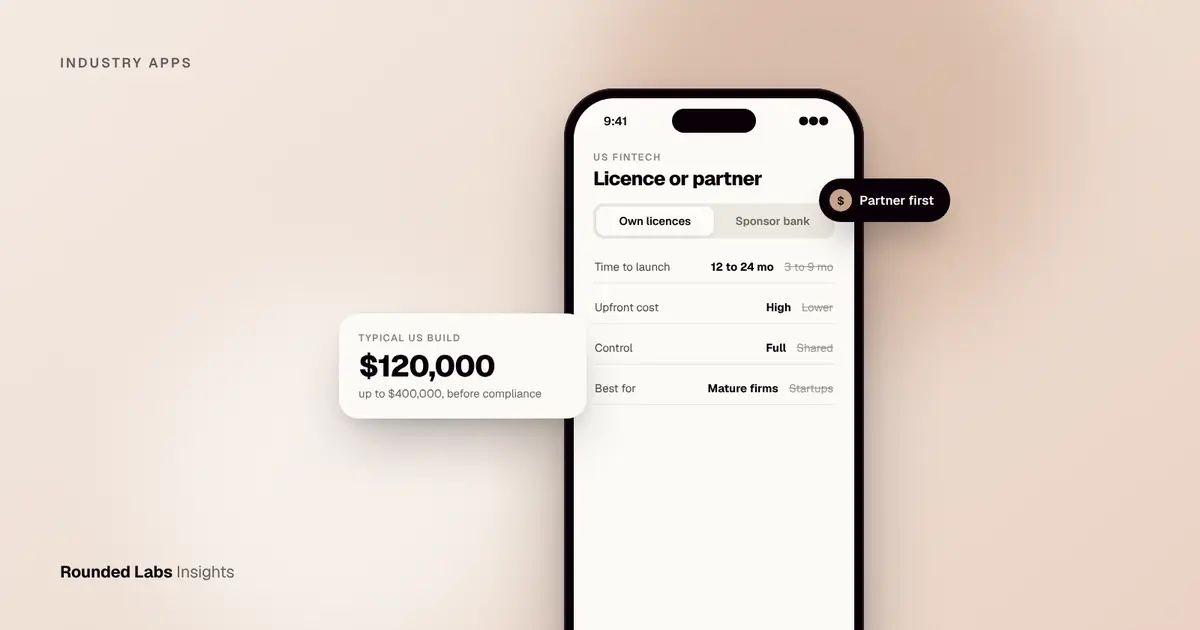
Building a fintech app in the US means solving a regulatory question before a technical one: will you hold your own licences, such as state money transmitter licences, or partner with a regulated bank or platform that holds them for you? Most startups launch through a sponsor bank or banking-as-a-service provider, which shortens time to market, then build the app, identity checks (KYC), anti-money-laundering controls and security on top. A US fintech app typically costs $120,000 to $400,000 to build, before licensing and compliance costs.
We have built financial apps since MoBank, the UK’s first mobile banking app, and more recently Dabbl, a stock trading app designed to make investing simple for first-time investors. This guide explains how a US fintech app comes together and what it costs. Costs and timelines are market estimates, not quotes, and licensing rules change, so check the current official text for your state and product.
Key facts
- Money transmission is regulated state by state; licensing in every state takes many months and significant capital.
- Most startups launch through a sponsor bank or a licensed partner platform.
- KYC and AML duties come from the Bank Secrecy Act, enforced through FinCEN and partner banks.
- Payments, card issuing and account data are usually provided by specialist API platforms.
- Typical build: $120,000 to $400,000; compliance and partner costs on top.
What kinds of fintech apps are built in the US?
| App type | Typical model | Key rules |
|---|---|---|
| Neobank or spending account | Sponsor bank holds deposits; app provides experience | Bank regulations via partner, BSA/AML, consumer protection |
| Payments and wallets | Money transmitter licences or licensed partner | State money transmission laws, BSA/AML |
| Investing and trading | Broker-dealer partner or own registration | SEC and FINRA rules |
| Lending | Bank partnership or state lending licences | Truth in Lending, fair lending, state laws |
| Personal finance and budgeting | Read-only account data | Data security, privacy, open banking rules |
| B2B payments and spend management | Card issuing and payments partners | BSA/AML through partners, card network rules |
Licence or partner?
| Own licences | Sponsor bank or partner | |
|---|---|---|
| Time to launch | Often 12 to 24 months | Often 3 to 9 months |
| Upfront cost | High: legal, bonds, capital, compliance team | Lower, with revenue share or fees |
| Control | Full | Shared; partner sets rules |
| Best for | Mature companies with scale | Startups and new products |
State regulators coordinate money transmitter licensing through the Nationwide Multistate Licensing System (NMLS), and a growing number of states have adopted the Money Transmission Modernization Act to align requirements.
What must a US fintech app include?
- Identity verification (KYC): collect and verify name, date of birth, address and identification number, often with document and selfie checks through a specialist provider.
- AML monitoring: transaction monitoring, sanctions screening against OFAC lists, and suspicious activity escalation. FinCEN sets the rules (FinCEN).
- Secure authentication: biometrics, device binding, multi-factor authentication.
- Disclosures and consent: clear terms, fee disclosures, electronic consent.
- Dispute and error handling: for consumer payments, processes under Regulation E.
- Audit trails and reporting for partners and regulators.
- Fraud controls: velocity limits, device fingerprinting, behavioural signals.
Mobile app security checklist: OWASP MASVS in plain English covers mobile app security, and SOC 2 for startups covers SOC 2, which partner banks often require.
Building a fintech app for the US? We help you choose the right partners, design compliance into the product and quote the build in dollars. Book a 30-minute call with a co-founder.
Which technology partners do fintech apps use?
| Need | Typical partner type |
|---|---|
| Accounts and deposits | Sponsor bank or banking-as-a-service platform |
| Card issuing | Card issuing platform with a bank sponsor |
| Payments and payouts | Payment processors, ACH and real-time payment providers |
| Account linking | Open banking data aggregators |
| KYC and AML | Identity verification and screening providers |
| Brokerage | Brokerage-as-a-service partners |
Sponsor bank partnerships have faced closer regulatory scrutiny since 2024, so check any partner’s current standing. Choosing partners is a major decision: they shape your compliance obligations, unit economics and how easily you can switch later. In 2024 the Consumer Financial Protection Bureau finalised a personal financial data rights rule under section 1033 of the Dodd-Frank Act to standardise open banking, and has since been reconsidering it, so check its current status (CFPB).
How much does a US fintech app cost?
| Scope | UK studio (in $) | US agency | Timeline |
|---|---|---|---|
| Personal finance app with account linking | $80,000 to $150,000 | $120,000 to $220,000 | 4 to 6 months |
| Spending account with card, via sponsor bank | $150,000 to $300,000 | $220,000 to $450,000 | 6 to 10 months |
| Investing or trading app via broker partner | $180,000 to $350,000 | $250,000 to $500,000 | 7 to 12 months |
Add partner set-up fees, legal advice, compliance staff and security assessments. Fintech app development cost in the US breaks down fintech costs in more detail, and How much does it cost to build an app in the US? 2027 prices in dollars covers general US app costs.
What did building Dabbl teach us?
Dabbl aimed to make stock trading visual and approachable. The design challenge was making risk and costs clear without overwhelming beginners, while meeting the disclosure and verification steps a regulated product needs. The lesson applies to every fintech app: compliance steps are part of the user experience, so design them carefully rather than bolting them on.
Frequently asked questions
Do I need a licence to launch a fintech app in the US?
It depends on what the app does. Moving or holding customer money usually requires money transmitter licences or a licensed partner. Read-only budgeting apps generally do not need financial licences but must protect data carefully.
What is a sponsor bank?
A regulated bank that holds customer deposits or issues cards on behalf of a fintech, which provides the app and customer experience. The bank sets compliance requirements and oversees the fintech’s programme.
How long does it take to launch a US fintech app?
With a partner, often 6 to 12 months including partner onboarding and compliance reviews. With your own licences, longer, because state licensing can take a year or more.
What is KYC?
Know your customer: verifying a customer’s identity before opening an account or moving money, as required by anti-money-laundering rules.
Can a UK team build a US fintech app?
Yes. The technology, partner APIs and security practices are global. The team must understand US partner requirements, disclosures and data rules, and work with your US compliance advisers. See Hiring a UK app development company from the US.
Official sources and further reading
Talk it through with one of our co-founders. 30 minutes, no pressure.