

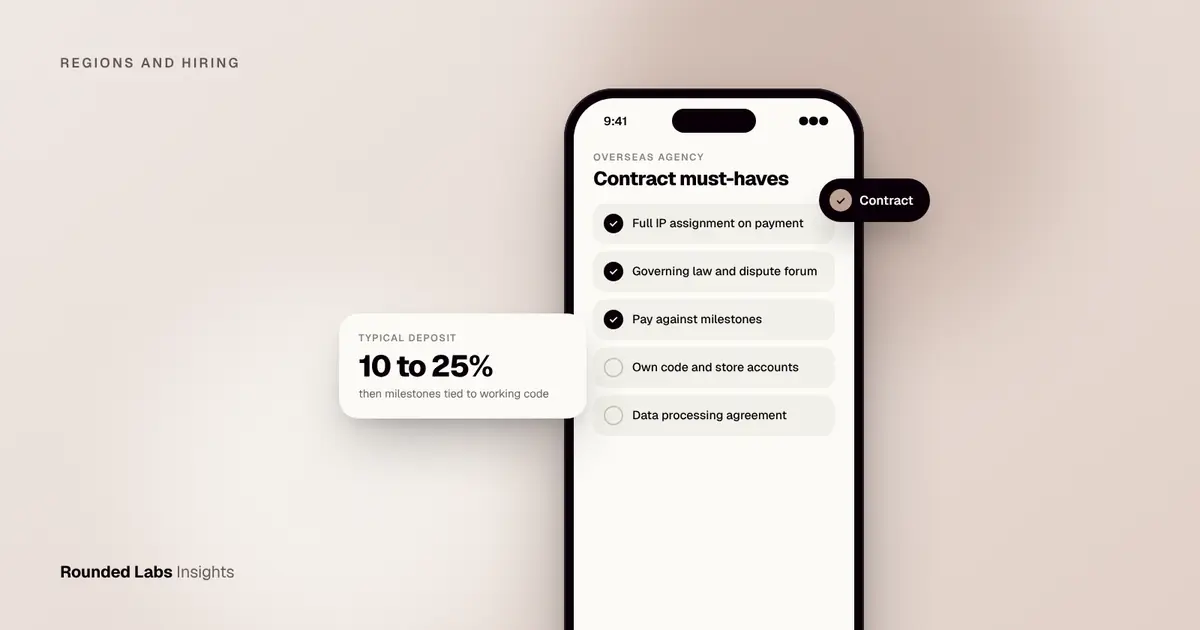
When you hire an app agency in another country, the contract must do four things clearly: give you full ownership of the code and designs, say which country’s law applies and where disputes go, tie payments to delivered work, and protect any personal data the agency handles. Get those right and an overseas agency is no riskier than a local one. Get them wrong and you can end up paying for an app you cannot legally use or move.
We sign contracts with clients in the UK, Europe, the US and further afield, and we have taken over apps from other agencies where poor contracts caused real problems. We have been in business since 2007, and the pattern is consistent: the contract problems that hurt are rarely exotic. They are missing assignment wording, vague acceptance rules, and accounts registered in the supplier’s name. This guide sets out what to put in writing, why each clause matters, and how to negotiate it without turning a good relationship into a legal fight. It is general information, not legal advice, and laws change, so have a qualified lawyer review the final contract.
Key facts
- Insist on a full assignment of intellectual property on payment, not a licence.
- Pick governing law and a dispute forum you can live with; arbitration is often easier to enforce across borders.
- Pay against milestones with working software, not calendar dates alone.
- Own the code repository, cloud accounts and App Store accounts from day one.
- Add a data processing agreement if personal data is involved, and a HIPAA business associate agreement (BAA) for US health data.
- Rounded Labs works to a fixed price agreed before development, so the payment clause is simple: a known total, split into milestones. See the pricing page.
Why does an overseas contract need more care than a local one?
With a local agency, a lot is held together by shared assumptions. You share a legal system, a currency, a tax regime, and often a court you could both reach in a day. When the supplier is in another country, every one of those assumptions becomes a question the contract has to answer. Which law decides what a clause means? Which court or tribunal hears a dispute? Who carries exchange rate movement? Does tax apply to the invoice? Where is the data stored, and who can reach it?
None of this makes overseas work risky in itself. Many US companies hire UK studios for good reasons, including cost, specialist skills and time zone coverage; our guide to hiring a UK app development company from the US covers those trade-offs, and onshore, nearshore or offshore compares the wider options. The point is only that the contract has to do more explicit work. A one-page statement of work that would be fine between two firms in the same city is not enough here.
Where do overseas contracts usually go wrong?
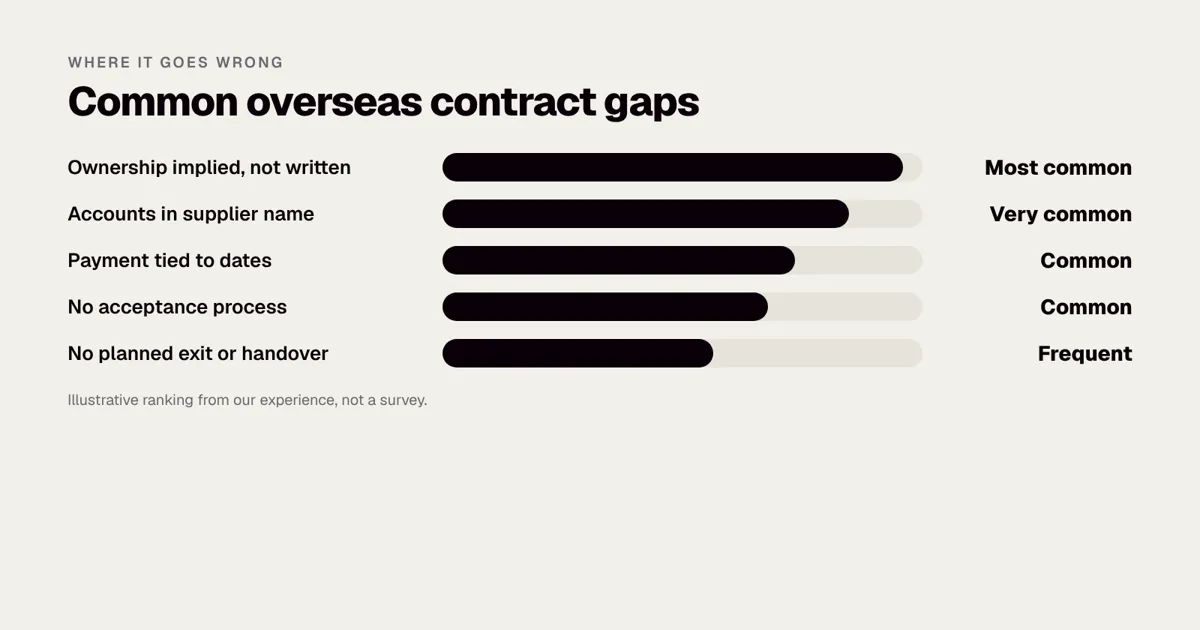
In our experience the same few failures account for most of the pain:
- Ownership is implied, not written. The client assumes that paying means owning. The law often says otherwise.
- Accounts sit with the supplier. The code, the cloud hosting and the App Store listing are all in the agency’s name, so leaving means starting again.
- Payment is tied to dates, not delivery. The client has paid 70% by month three and has software that does not work.
- No acceptance process. Nobody can say when a milestone is finished, so every payment becomes an argument.
- Data protection is an afterthought. The agency copies production data onto laptops or uses an analytics tool nobody approved.
- Exit is not planned. There is no handover obligation, so the relationship ends with a stand-off.
Each section below deals with one of these. If you want the wider context on picking a supplier before you reach the contract stage, see 20 questions to ask an app developer before you sign and the due diligence checklist for US companies hiring abroad.
What should the IP clause say?
The default rules on who owns commissioned software differ by country. In the US, code written by an independent contractor is not automatically “work made for hire”. The US Copyright Office explains the categories in its guidance on works made for hire, and software written by a contractor usually falls outside them unless it fits a narrow list and is agreed in writing. In the UK, the author or their employer owns copyright unless it is assigned in writing. So your contract must assign ownership explicitly, and it should do so in a way that works under the law that governs the contract and the law where the developers sit. At the time of writing these default positions apply, but check the official sources linked below and ask a lawyer about your own case.
A solid IP clause usually contains the following:
- Assignment, not licence. All rights in code, designs, documentation and other deliverables transfer to you. A licence, even an exclusive one, leaves the agency as the owner and can be limited, withdrawn or restricted in ways that hurt you at exit.
- Timing. Transfer should happen on payment of each milestone or on final payment. Milestone by milestone is safer for you, because what you have paid for is yours. If the agency insists on transfer only on final payment, make sure you have a licence to use everything in the meantime.
- Pre-existing materials. The agency may reuse its own libraries, internal tools and templates. You should receive a perpetual, royalty-free, worldwide licence to use those as part of your app, including the right to modify them and to let a new supplier maintain them.
- Open source. The agency should list the open-source components it uses and their licences, and avoid licences that would force you to publish your own code without your agreement. Ask for this list as a deliverable.
- Moral rights waiver where the law allows it, so an individual author cannot object to changes you make later.
- Staff and subcontractors. The agency must have the right to pass on what its own people and subcontractors create. Ask for a warranty that every individual has assigned their rights to the agency in writing.
- Third-party materials. Fonts, stock images, icon sets and SDKs have their own licences. The agency should flag any that need a separate purchase or have restrictions.
- Further assurance. A promise to sign any extra paperwork needed to record the transfer, including after the contract ends.
What is the difference between assignment and licence in practice?
| Feature | Assignment | Exclusive licence | Non-exclusive licence |
|---|---|---|---|
| Who owns the code | You | The agency | The agency |
| Can you modify it | Yes | Only if the licence says so | Only if the licence says so |
| Can the agency reuse it for others | No, apart from its pre-existing tools | No, while the licence runs | Yes |
| Can you hand it to a new supplier | Yes | Depends on the wording | Often not |
| Risk if the agency fails | Low | Medium | High |
| Typical use | Custom bespoke work | Rare, special cases | Off-the-shelf software |
For bespoke work, assignment is the normal ask and a reasonable agency will agree. If an agency refuses to assign at all, treat that as a signal: ask why, and consider whether you are really buying a product they own rather than a custom build. Our guide on who owns the code covers UK practice and escrow in more depth, and red flags when hiring app developers lists other warning signs.
What about a work-for-hire clause?
US lawyers sometimes add “work made for hire” language to a contract with an overseas supplier. That wording can help, but it should never be the only protection. Concepts such as work for hire do not translate neatly into every legal system, and an assignment clause is the more reliable foundation. The common approach is “work made for hire to the extent permitted, and otherwise assigned”. Ask your lawyer to word it for the law that governs your contract.
Worked example: a clause that looks fine and is not
Imagine a contract that says: “The Client shall own all deliverables on final payment.” It reads well, but it has three gaps. It does not say what happens to code written before final payment if the project stops half way. It does not mention the agency’s pre-existing libraries, so the app may depend on tools you have no right to use. And it says nothing about subcontractors, so a freelance developer in a third country might hold rights the agency cannot pass to you.
A better version assigns each milestone’s deliverables on payment, grants a licence to the pre-existing materials, requires written assignments from every contributor and lists the open-source components. It costs a lawyer perhaps an hour of drafting and removes the three gaps.
Which law should govern the contract?
Governing law decides how the contract is interpreted. The dispute forum decides where a disagreement is heard. They are separate choices, and it is common to pick one country’s law and a different forum, such as arbitration in a neutral city.
| Option | Pros | Cons |
|---|---|---|
| Your own law (for example New York or Delaware) | Familiar to you and your lawyers | The agency may price in extra risk; enforcement abroad may need extra steps |
| The agency’s law (for example English law) | Agency accepts it readily; English law is widely used internationally | Less familiar to you |
| Neutral law with arbitration | Balanced; arbitral awards are enforceable in most countries under the New York Convention | Arbitration can cost more than court for small disputes |
The New York Convention on recognising arbitral awards has over 170 contracting states at the time of writing, which is why arbitration is popular for cross-border contracts. A court judgment from one country is not always easy to enforce in another, whereas an arbitral award generally is. Institutions such as the London Court of International Arbitration and the International Chamber of Commerce publish rules and model clauses you can adopt rather than invent your own.
How should you choose?
Use a simple test. Ask where the money and assets would need to be reached if you won a dispute. If the agency’s assets are in the UK, then English law and a forum that produces an award enforceable there is practical. If your main concern is that your own lawyers can read and negotiate the contract quickly, your own law may save fees. For most app projects, a clear contract under either party’s law works well. What matters more is a practical escalation process before anyone reaches court:
- Working level. The project leads try to resolve the issue within 5 working days.
- Senior level. A director on each side meets, within a further 10 working days.
- Mediation or expert determination. For technical disputes, such as whether a milestone meets its acceptance criteria, an independent expert can decide faster and cheaper than a tribunal.
- Arbitration or court. The last resort, with a clear forum and language.
Most disagreements on app projects are about scope and acceptance, not fraud. A contract that makes those two things clear, and offers a quick way to settle them, prevents nearly every serious dispute.
How should payment work?
Payment terms are where a contract either protects you or quietly shifts risk onto you. Think about five things: currency, structure, acceptance, change control and tax.
- Currency. Agree the invoice currency. Paying in your own currency moves exchange rate risk to the agency, which may add a small premium to the price. Paying in the agency’s currency means your cost can move between signing and the final invoice. If you choose the agency’s currency, ask whether you can fix the rate for the project.
- Structure. For fixed-price work, a deposit of 10 to 25%, then milestones linked to working, tested software. For ongoing teams, many suppliers invoice monthly in arrears or in advance with a short notice period. At Rounded Labs, every project is a fixed price agreed before development starts, split into milestones, so you always know the total.
- Acceptance. Define how milestones are accepted: a demo, a test build, a checklist, and a time limit for your feedback. Without a time limit, delay on your side can become an argument about the agency’s invoice.
- Change control. A written process for changes, with cost and time impact agreed before work starts.
- Tax. Cross-border services are often outside the supplier’s sales tax or VAT (for example, UK VAT is generally not charged to businesses outside the UK). Check withholding tax rules in your own country and ask your accountant what paperwork the agency must supply.
For a broader comparison of pricing models, fixed price vs time and materials explains the trade-offs, and app development quotes compared shows why quotes vary so widely.
What does a good milestone plan look like?
The best milestone plans tie payment to evidence, not to elapsed time. Here is an illustrative plan for a build priced at a round figure for easy reading. These are example percentages, not a quote.
| Milestone | Evidence of completion | Share of price |
|---|---|---|
| Signing and kick-off | Signed contract, access set up | 15% |
| Design approved | Clickable prototype signed off by you | 15% |
| First working build | Core flows running on a test device | 20% |
| Feature complete | All agreed features in a test build | 20% |
| Acceptance testing passed | Your test checklist signed off | 20% |
| Store release and handover | Live in the stores, documentation and credentials delivered | 10% |
Holding back a final 10% until the handover is complete is a strong incentive for the agency to finish the unglamorous work, such as documentation and account transfers, that is easy to skip.
How do you write acceptance criteria that work?
Acceptance criteria should be testable by a person who did not write the code. Compare these two lines:
- Weak: “The app should be fast and easy to use.”
- Better: “A new user can register, verify their email and reach the home screen in under three minutes in a moderated test with five participants. Screen loads complete within two seconds on a mid-range test device on a standard mobile connection.”
Put the test devices, operating system versions and test scripts in an appendix. Agree the defect categories too: a critical defect blocks acceptance, a minor defect is logged and fixed under warranty. For help on what testing should cover, see app testing explained.
What about late payment and withholding?
Include a right to withhold payment for disputed amounts while you resolve them, with an obligation to pay the undisputed part. Include a reasonable late-payment rule that applies to both sides, and a provision that the agency cannot switch off hosting, withdraw code or take down the store listing because of a disputed invoice. Without that last point, a dispute can hold your live app hostage.
Want to see a fair contract? We are happy to share our standard terms or work on yours, with full IP assignment on payment. Book a 30-minute call with a co-founder.
What about access and control?
Write these into the contract, then check them in the first week. This is the single most effective protection, because it makes most legal remedies unnecessary.
- Code lives in your GitHub, GitLab or Bitbucket organisation, with the agency’s developers added as members.
- Cloud accounts (AWS, Google Cloud, Azure) are yours, with the agency as a user. You hold the root account and billing.
- App Store Connect and Google Play Console accounts are yours, so the app is published under your name. Apple and Google both publish guidance on developer accounts; see the Apple Developer and Google Play Console sites.
- Domains, email services, push notification certificates and third-party API keys are registered to you.
- The agency documents the architecture, deployment steps and credentials as part of the deliverables.
- Passwords and keys sit in a shared password manager that you administer, not in email threads.
Why does this matter more than the legal text?
A contract is only as useful as your ability to enforce it. If you hold the repository and the accounts, an agency that behaves badly has no leverage over you. If the agency holds them, you may have a legal right to the code and no practical way to reach it. We have seen apps where the only copy of the code sat on a former supplier’s server, and the client had to negotiate access, sometimes paying twice. Our guide on how to switch app agencies without losing your app walks through the recovery steps, and the first 90 days with an agency includes an access checklist for the start of a project.
A first-week access checklist
- Create your organisation accounts for source control, cloud hosting and the app stores before work begins.
- Add the agency’s team as members with the least privilege they need.
- Confirm that the first commit appears in your repository, not theirs.
- Check that build and deployment scripts run from your accounts.
- Store recovery codes and two-factor devices where you can reach them.
- Ask for a short architecture note by the end of week two.
How do you protect personal data?
If your app handles personal data, the contract needs to say who does what with it. The agency may touch data during development, testing and support, so treat it as a data processor from the first day.
- GDPR or UK GDPR: if the agency processes personal data for you and the data concerns people in the EU or UK, you need a data processing agreement that covers the points in Article 28 of the GDPR, and a lawful route for any international transfer. See UK and EU data transfers for app projects and GDPR for US companies launching an app in Europe. The UK Information Commissioner’s Office and the European Data Protection Board publish the official guidance.
- HIPAA: if the agency handles protected health information for a US covered entity or business associate, you need a business associate agreement. The US Department of Health and Human Services explains the rules at hhs.gov/hipaa. See how to build a HIPAA-compliant app.
- US state laws: if you serve residents of states with privacy laws, your supplier contracts may need specific terms; see US state privacy laws and your app.
- Security schedule: minimum controls, such as encryption, access control, background checks and incident notification times.
- Production data rule: developers use synthetic or anonymised data for development and testing, unless you agree otherwise in writing.
What should a security schedule include?
| Control | What to ask for |
|---|---|
| Access | Named accounts, two-factor authentication, removal of leavers within 24 hours |
| Data location | Where data is stored and processed, and approval for any change |
| Encryption | In transit and at rest for personal data and credentials |
| Sub-processors | A list of tools and suppliers that touch your data, with notice of changes |
| Incident response | Notification within an agreed time, such as 24 or 48 hours, and cooperation on investigation |
| Return and deletion | Deletion or return of your data at the end, with written confirmation |
| Testing | Vulnerability scanning and, for sensitive apps, an independent penetration test |
For the technical side, the mobile app security checklist translates the main standard into plain English, and what is penetration testing for apps explains what a test covers.
Laws on international data transfers change, so at the time of writing you should check the official sources and take legal advice for your situation rather than rely on a summary.
What about termination and handover?
Hope for a good relationship, and write the exit as if you were certain to need it. Termination clauses are cheap to negotiate at the start and very expensive to invent in the middle of a dispute.
- Either party can end the contract with reasonable notice; you can end it immediately for serious breach, such as non-payment of undisputed sums, insolvency or a serious breach of confidentiality or data protection.
- On termination, you pay for work done to the last accepted milestone, plus a fair proportion of the work in progress, and receive all work in progress, code, documentation and credentials.
- A handover period where the agency helps a new team take over, at agreed rates. State the number of days and the form of help: a walkthrough, answers to questions and a final code drop.
- Confidentiality survives termination.
- Warranty obligations survive too, so defects found within the warranty period are fixed.
- Return or deletion of your data is confirmed in writing.
What is a reasonable warranty and support period?
Most contracts include a warranty period after delivery, during which the agency fixes defects found against the agreed specification at no extra charge. A common length is 30 to 90 days, but treat that as a market norm, not a rule. Define what counts as a defect, how quickly the agency must respond, and what is out of scope, such as new features, changes in third-party services and operating system updates after delivery. Our guide on what to budget after launch and how to prepare your app for each new iOS release show why ongoing maintenance is a separate decision from warranty.
What should the handover pack contain?
- The full source code and the history of the repository.
- Build and release instructions that a new developer can follow.
- Architecture notes and diagrams.
- A list of third-party services, accounts and licences, with the owner of each.
- Environment configuration, with secrets handed over through the password manager.
- Test scripts and results.
- A list of known issues and the plan for each.
If you have asked for this pack as a milestone deliverable, the handover is mostly done before anyone needs it.
Do you need source code escrow?
If the agency hosts or licenses software to you rather than assigning it, escrow protects you if the agency fails. A neutral third party holds a copy of the source code and releases it to you if defined events occur, such as insolvency or ceasing to support the product. If you own the code and the repository from day one, escrow is usually unnecessary, because you already hold what escrow would give you.
| Situation | Escrow useful? | Better protection |
|---|---|---|
| Bespoke app, code in your repository | No | Ownership and access controls |
| Agency hosts your app on its servers | Sometimes | Move hosting to your account |
| You license the agency’s platform | Yes | Escrow plus a right to maintain |
| White-label product built on the agency’s core | Yes | Escrow plus a licence to the core |
For more detail on how escrow works in practice, read who owns the code.
What other clauses are worth adding?
Beyond the big five, a handful of smaller clauses prevent frequent disputes.
Confidentiality and non-disclosure
An NDA protects confidential information shared before and during the project. It does not assign IP in the code, so you need both. Your main contract can include confidentiality terms so you do not need a separate NDA once you sign. Set the term clearly, for example for the length of the contract and a number of years afterwards, and make sure subcontractors are bound too.
Liability and insurance
Limits on liability are normal, but the cap should be sensible. A common starting point is a cap tied to the fees paid under the contract. Ask for higher or unlimited liability for breach of confidentiality, data protection breaches and infringement of third-party IP, or at least a higher cap for those areas. Ask what insurance the agency holds, such as professional indemnity and cyber cover, and for what limits. Do not assume a number is standard: ask your lawyer and insurer what suits your risk.
Subcontracting
Decide whether the agency may use subcontractors and under what conditions. Reasonable terms are: prior notice, the agency stays responsible for their work, they sign the same IP and confidentiality terms, and they do not receive production data unless approved. If a large part of the work is done by someone you have not met, you should know.
Key people
If you chose the agency because of specific people, name them and agree what happens if they leave. A fair clause requires replacement of equal skill and a short handover.
Intellectual property indemnity
The agency should promise that its deliverables do not infringe third-party rights, and agree to defend you if someone claims they do. Carve-outs for materials you supply are fair.
Publicity and references
If the agency wants to name you in a case study, make it opt-in. Agencies often publish work, as we do with Superdry and Waterstones, but only with the client’s agreement.
Non-solicitation
Some contracts stop either side hiring the other’s staff for a period. Make sure it does not prevent you from hiring the agency’s developers if the relationship ends, or add a buy-out fee that is realistic.
How do you negotiate without souring the relationship?
A contract negotiation is the first real test of how an agency behaves. Treat it that way.
- Start with a term sheet. Agree the commercial points first: price, milestones, ownership, timeline. Lawyers can then turn it into a contract.
- Separate must-haves from nice-to-haves. Full assignment of code, ownership of accounts and a sensible exit are must-haves. A specific governing law is often negotiable.
- Explain your reason. Agencies respond better to “our investors require clean IP ownership” than to a bare demand.
- Watch for the response. A good agency says yes, or proposes a reasonable alternative. A defensive reply to a standard request tells you something.
- Keep your lawyer to a budget. Ask for review of the high-risk clauses, not a rewrite of everything.
Whose paper should you use?
Either can work. Many agencies have balanced templates, and starting from theirs can save time and money. Large companies usually prefer their own master services agreement, and that is also fine if it is adapted to the realities of software projects. Whichever you use, focus on IP, payment, acceptance, data protection and exit terms. A well-run agency will have a clear process for this; as part of our standard process, we share terms early and agree changes before work starts.
What does this cost, and how long does it take?
Legal review of an agency contract is a cost to plan. As a market estimate at the time of writing, a lawyer’s review of a software development agreement might cost somewhere in the low thousands of dollars, depending on the firm, the length of the document and how many rounds of changes you need. This is not a quote and varies widely, so ask for a fixed fee up front. Allow one to three weeks from first draft to signature for a straightforward project, longer if your legal team is large.
Compare that with the cost of getting it wrong. Our work is fixed price, with projects typically running from £30,000 to £250,000+, and our productised services are a Tech Architecture Audit at £7,500, a Mobile Product Discovery Sprint at £9,500, Digital Transformation Prep at £7,000 and a Legacy App Rescue Assessment at £6,500. A legal review is a small fraction of any of those, and it protects an asset you have spent far more on.
If you are inheriting a project with weak contract foundations, a Legacy App Rescue Assessment can establish what you actually own, what depends on whom, and what it would take to bring everything under your control.
What does a contract checklist look like?
Use this as a final review before you sign.
| Area | Question to answer | Done |
|---|---|---|
| IP | Is there a written assignment of all deliverables on payment? | |
| IP | Is the licence to the agency’s pre-existing tools perpetual and royalty-free? | |
| IP | Is there a list of open-source components and licences? | |
| Law | Is the governing law named, and the dispute forum? | |
| Law | Is there a staged escalation process? | |
| Payment | Are payments tied to milestones and acceptance? | |
| Payment | Is the currency and tax treatment clear? | |
| Payment | Is there a change control process? | |
| Access | Do you own the repository, cloud and store accounts? | |
| Data | Is there a data processing agreement or BAA where needed? | |
| Data | Is there a security schedule? | |
| Exit | Are termination, handover and deletion clearly set out? | |
| Risk | Are liability caps and insurance reasonable? |
If you can tick every row, you are in a strong position. If you cannot, find out why before you pay anything.
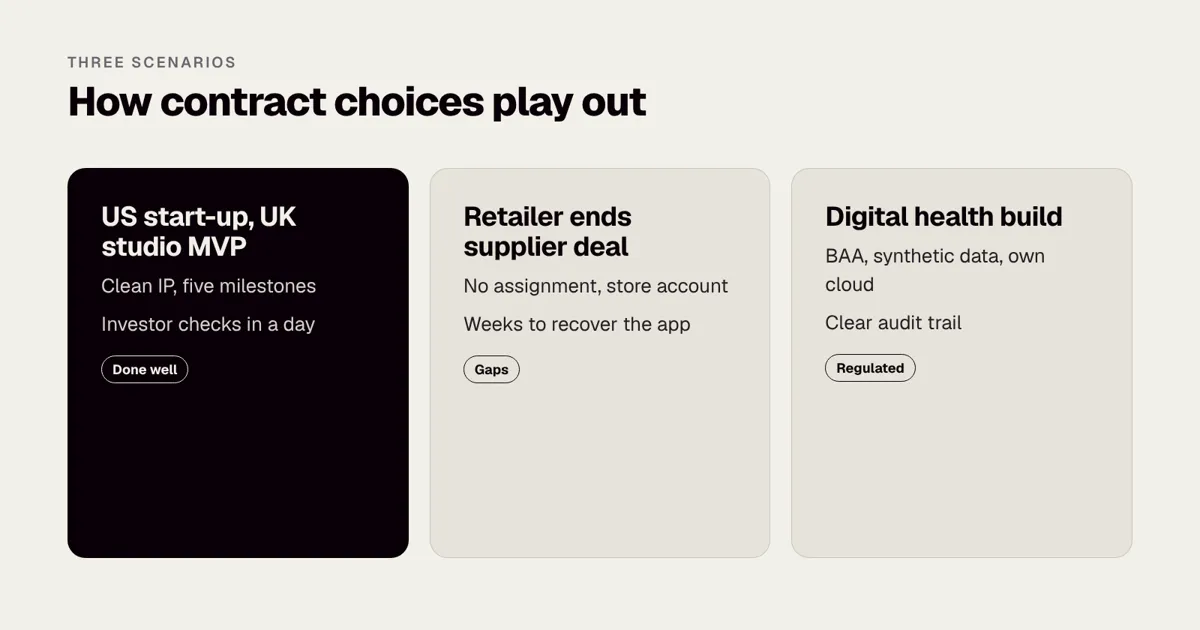
What do three realistic scenarios look like?
Scenario 1: A US start-up hires a UK studio for an MVP
A seed-stage start-up in Austin hires a UK studio for a fixed-price MVP. The founders create GitHub and cloud accounts before the kick-off call, sign a contract under English law with arbitration in London, and agree five milestones with acceptance tests. The invoice currency is dollars, and the studio carries the exchange rate risk in return for a modest premium. IP transfers on each payment. Nine months later the start-up raises a round, and the investor’s due diligence on IP ownership takes a day, because the paper trail is clean.
Scenario 2: A US retailer brings an app in house after a supplier relationship ends
A US retailer’s app was built by an overseas agency under a short statement of work with no assignment clause and the app store account in the agency’s name. When the retailer wants to move supply, it must negotiate for the code, pay for a transfer, and wait weeks for the store listing to move. The lesson is not that the agency was dishonest; it is that nothing in the paperwork forced a clean handover. Adding the contract terms above would have turned a negotiation into a checklist.
Scenario 3: A healthcare company needs a HIPAA-covered build
A US digital health company hires a UK agency to build a patient-facing app. Before work starts the parties sign a BAA, restrict developers to synthetic data, agree where production data is hosted and name the incident notification time. The agency’s team completes security training, and access is limited to the people who need it. The contract also records that the company, not the agency, holds the cloud accounts. When a regulator asks questions later, the company can show who had access to what.
These are illustrative scenarios, not real clients, and no part of them is legal advice.
What should you do next?
- List the five most important things you need to own or control, such as code, accounts, data and designs.
- Create your accounts for source control, cloud hosting and the app stores.
- Ask each shortlisted agency for its standard terms and compare them against the checklist above.
- Agree a term sheet, then a full contract with your lawyer.
- Check access in week one, and again at each milestone.
If you want a second pair of eyes on a draft, or want to talk through how a fixed-price engagement would be structured, book a call with a co-founder. You can also see how we work on real projects in our Waterstones case study, where an app, mobile site and eBooks API were delivered in 12 weeks, and our Superdry case study, which involved a brand with 768 locations in over 100 countries.
Frequently asked questions
Who owns the code if the contract says nothing?
It depends on the countries involved, but often the developer or agency owns copyright, and you may only have an implied licence to use the work. That is not enough to modify it, move it to another supplier or sell your business with confidence. Never rely on this; always include a written assignment.
Should I use my contract or the agency's?
Either can work. Many agencies have balanced templates, and large companies usually prefer their own master services agreement. Focus on IP, payment, acceptance, data protection and exit terms, and have a lawyer review whichever document you use.
Is an NDA enough to protect my app idea?
An NDA protects confidential information shared before and during the project. It does not assign IP in the code, and it does not protect an idea that is already public or independently developed. You need both an NDA and an IP assignment, and the main contract can include confidentiality terms.
What if the overseas agency stops responding?
If you own the repository and accounts, you can bring in another team and carry on. Milestone payments mean you have not paid far ahead of delivery, and termination and handover clauses set out what the agency must provide. Our guide on switching agencies covers the practical steps.
Can I enforce a contract against an agency in another country?
Yes, but it can be slow and costly. Arbitration awards are enforceable in most countries under the New York Convention, which is why many cross-border contracts choose arbitration. Clear contracts and good access controls mean you rarely need to enforce anything.
Do I need a different contract for a fixed-price project and an ongoing team?
The IP, data and exit clauses stay the same. The payment and scope sections change: fixed-price work uses milestones and acceptance, while an ongoing team needs a clear process for planning work, approving spend and giving notice. Rounded Labs works on fixed-price projects agreed before development, so you can compare quotes on a like-for-like basis.
Is this legal advice?
No. This guide is general information. Laws, fees and official guidance change, so check the official sources listed below and ask a qualified lawyer to review your contract.
Official sources and further reading
- New York Convention on arbitral awards
- US Copyright Office: Works made for hire (Circular 30)
- GOV.UK: Intellectual property and your work
- UK Information Commissioner’s Office
- European Data Protection Board
- US Department of Health and Human Services: HIPAA
- London Court of International Arbitration
- International Chamber of Commerce
- Apple Developer
- Google Play Console
Talk it through with one of our co-founders. 30 minutes, no pressure.