

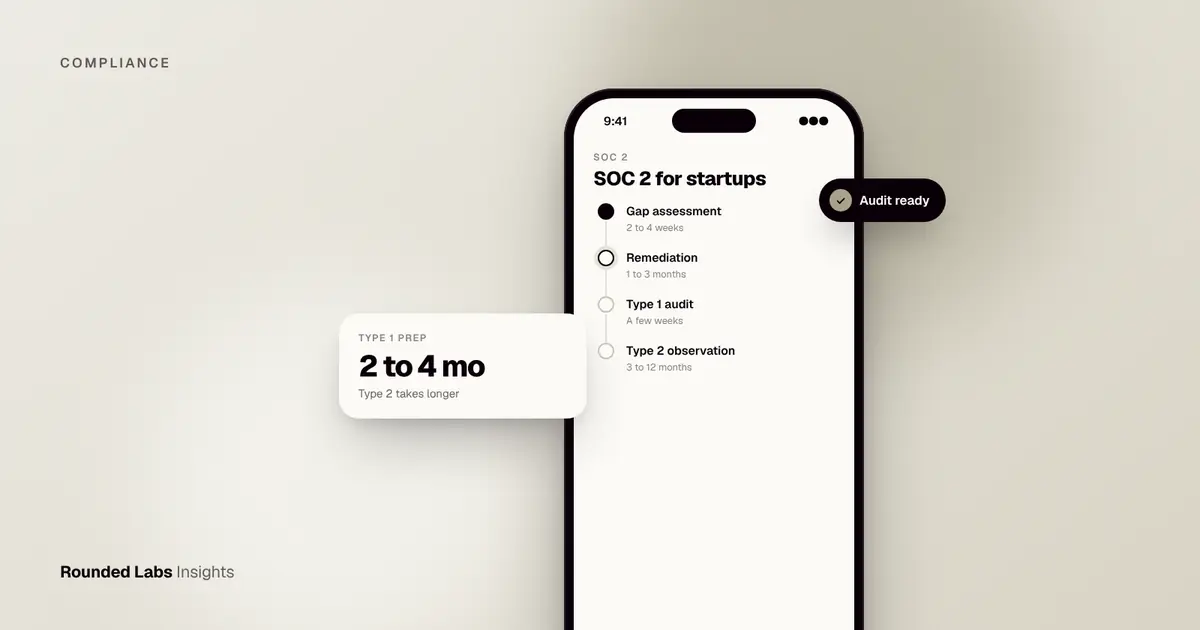
SOC 2 is an independent audit report showing that a company’s systems protect customer data, and US enterprise buyers increasingly ask for it before they sign with a SaaS or app vendor. Most startups need it when deals start stalling at security review, typically when selling to mid-market and enterprise customers. A Type 1 report can be ready in two to four months; a Type 2 report needs an observation period of three to twelve months on top.
We build SaaS platforms and business apps, including the move of Cubeware from a desktop product to SaaS for thousands of enterprise customers. This guide explains what SOC 2 asks of your product and engineering team, so you can build the right things before the audit, not after.
Key facts
- SOC 2 is an AICPA attestation framework, performed by licensed CPA firms.
- Based on the Trust Services Criteria: Security (required), plus optional Availability, Confidentiality, Processing Integrity and Privacy.
- Type 1 tests control design at a point in time; Type 2 tests operating effectiveness over a period.
- Typical first-year cost for a startup: $20,000 to $80,000 including audit, tooling and work (market estimates, not quotes).
- Most of the work is process and evidence, but the product needs real changes too.
When does a startup need SOC 2?
Signals that it is time:
- Enterprise prospects send long security questionnaires and ask for “your SOC 2”.
- Deals are delayed by procurement or security reviews.
- You process customer data inside your platform, especially personal or financial data.
- Competitors in your market already have it.
If you only sell to consumers or small businesses, SOC 2 is usually unnecessary early on. A clear security page and good practice may be enough. Outside the US, ISO 27001 is often preferred; many companies eventually hold both.
Type 1 or Type 2?
| Type 1 | Type 2 | |
|---|---|---|
| What it tests | Whether controls are designed properly at a date | Whether controls worked over a period |
| Observation period | None | Usually 3 to 12 months |
| Time to report | 2 to 4 months of preparation | Preparation plus observation, often 6 to 12 months |
| What buyers think | A useful first step | The standard most enterprises expect |
A common path is Type 1 to unblock early deals, then Type 2 a year later.
What do auditors look at?
The Trust Services Criteria (AICPA) group controls into areas such as:
- Governance: security policies, risk assessment, roles and responsibilities.
- People: background checks, onboarding and offboarding, security training.
- Access: single sign-on, multi-factor authentication, least privilege, quarterly access reviews.
- Change management: code review, testing, approvals, separation between development and production.
- Operations: monitoring, logging, incident response, vulnerability management.
- Vendors: assessing and monitoring the suppliers that touch customer data.
- Business continuity: backups, disaster recovery, tested restores.
What changes does your app itself need?
This is where engineering teams are often surprised. Auditors and enterprise customers will look for:
| Area | What to build |
|---|---|
| Customer authentication | SSO (SAML or OpenID Connect) for enterprise customers, MFA, session limits |
| Authorisation | Role-based access control inside the product, admin roles separated |
| Audit trail | Customer-visible logs of key actions: logins, permission changes, data exports |
| Data protection | Encryption in transit and at rest, tenant isolation, secure deletion |
| Infrastructure as code | Repeatable environments with reviewed changes (post:C24 on CI/CD) |
| Monitoring | Alerts on errors, security events and uptime, with on-call ownership |
| Backups | Automated, encrypted, regularly restore-tested |
| Secure SDLC | Dependency scanning, static analysis, regular penetration tests (post:C22) |
Several of these, especially SSO and audit logs, are also features enterprise buyers ask for directly, so they pay off in sales as well as in the audit.
Getting ready for SOC 2? We build the product-side controls auditors and enterprise buyers expect, from SSO to audit logs. Book a 30-minute call with a co-founder.
How long does SOC 2 take?
- Gap assessment: 2 to 4 weeks to compare current practice with the criteria.
- Remediation: 1 to 3 months to write policies, configure tools and build missing product features.
- Type 1 audit: a few weeks of fieldwork and reporting.
- Type 2 observation: 3 to 12 months of operating the controls, then the audit.
Compliance automation platforms can speed up evidence collection a great deal, but they do not build your SSO or fix your access reviews.
What does SOC 2 cost?
| Item | Typical range |
|---|---|
| Compliance automation platform | $7,500 to $25,000 a year |
| Auditor (Type 1) | $10,000 to $25,000 |
| Auditor (Type 2) | $15,000 to $50,000 |
| Penetration test | $5,000 to $25,000 |
| Engineering work | Varies; 4 to 12 weeks for a typical startup |
These ranges are market estimates, not quotes, and vendor and auditor prices change, so ask for current quotes. Costs depend on the size of your system and the criteria in scope. How to build a HIPAA-compliant app covers HIPAA, which some health SaaS companies need alongside SOC 2.
Common SOC 2 mistakes startups make
- Starting with the auditor, not the gap assessment. You will pay for an audit that finds what a cheap internal review could have found.
- Writing policies nobody follows. Auditors test evidence, not documents. Keep policies short and true.
- Leaving the product out. Enterprise buyers check SSO, audit logs and data deletion as much as your HR processes.
- Over-scoping. Include only the criteria customers ask for. Security alone is often enough for a first report.
- Treating it as a one-off. Type 2 reports need controls to run every day, so automate evidence where you can.
Frequently asked questions
Is SOC 2 a legal requirement?
No. SOC 2 is voluntary, but it is often a contractual requirement from enterprise customers, especially in the US.
Can a non-US company get SOC 2?
Yes. Any service organisation can engage a licensed CPA firm for a SOC 2 examination. Non-US SaaS companies selling to US enterprises often do.
What is the difference between SOC 2 and ISO 27001?
SOC 2 is an attestation report, common in the US, describing your controls and the auditor’s opinion. ISO 27001 is a certification of an information security management system, more common in Europe and Asia. Their controls overlap heavily.
Does SOC 2 cover our cloud provider?
No. Your report covers your controls. You rely on your cloud provider’s own SOC 2 report for the infrastructure it manages, and should review it as part of vendor management.
How often do you need a new SOC 2 report?
Most companies renew annually, so customers always have a report covering a recent period.
Official sources and further reading
- AICPA and CIMA (SOC 2 and the Trust Services Criteria)
- NIST Cybersecurity Framework
- ISO (ISO/IEC 27001)
Talk it through with one of our co-founders. 30 minutes, no pressure.