

European public sector bodies can use AI today, but it works best on narrow, well-documented tasks such as classifying imagery, triaging documents and answering routine enquiries, built as a small pilot first. Most public AI projects stall on procurement, data and legal duties, not on the model. Start with one use case, a named owner, a clear data source and a fixed-price pilot of a few months.
We built a land classification prototype for the Bavarian government, working with Cubeware, so we know what it takes to get AI past a public sector review. This guide is for civil servants, programme leads, procurement officers and digital teams in national, regional and local bodies. It explains where AI pays back, which EU rules apply, how procurement shapes the project, how to scope and run a pilot, and how to avoid the mistakes that cause most projects to stall. Our AI product development service covers the build side. This is general information, not legal advice, and laws and dates change, so always check the official source.
Key facts
- Public bodies are subject to the EU AI Act, GDPR and national procurement law at the same time, so plan for all three.
- The AI Act applies in stages, and some high-risk dates may move, so check the current timetable on the European Commission’s AI Act page.
- AI used for access to public services, benefits, migration or law enforcement is likely to be treated as high-risk.
- Narrow, internal use cases such as document triage or image analysis are the easiest to start with.
- A pilot should have a named owner, a measurable success test, a data protection review from week one and a plan for what happens after.
- Rounded Labs prices at a fixed price agreed before development starts, and projects typically run from £30,000 to £250,000+.
Where does AI actually help in the public sector?
The strongest cases share a pattern: a large volume of repetitive work, a human who still makes the final call, and data the body already owns.
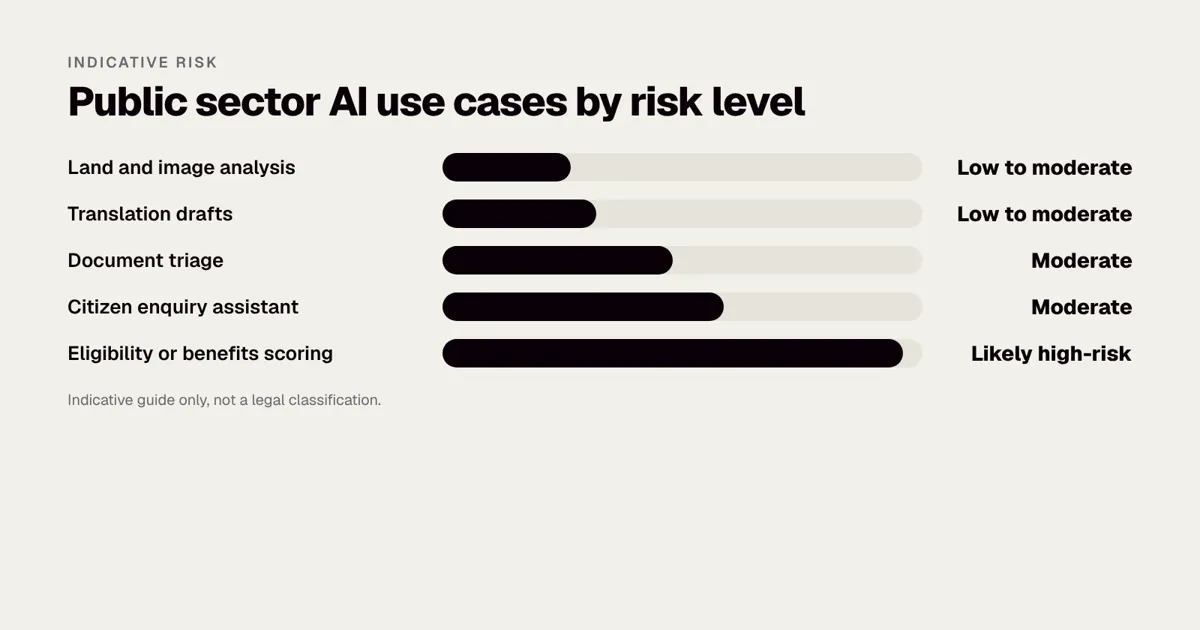
| Use case | What AI does | Typical risk level |
|---|---|---|
| Land and satellite image analysis | Classifies land use across large areas | Low to moderate |
| Document triage | Sorts incoming letters and forms by topic and urgency | Moderate |
| Citizen enquiry assistant | Answers routine questions from approved sources | Moderate, with transparency duties |
| Search across internal records | Finds and summarises policy or case files | Moderate |
| Translation and plain language support | Drafts translations and simplified versions for human review | Low to moderate |
| Meeting and case note summaries | Produces drafts for staff to check and correct | Low to moderate |
| Eligibility or benefits scoring | Ranks or decides on people’s entitlements | Likely high-risk |
The last row matters. The more an AI output affects a person’s rights, the heavier the legal duties and the more human oversight you need. For a first project, pick something from the top of the table. Our guides to AI for public sector: use cases that pay back and AI for local government give more detail, and What is worth building for public sector apps looks at the wider app picture.
What makes a good first use case?
Score each candidate on five questions. A good first project answers yes to at least four.
- Is the task repetitive and high in volume? Value comes from scale.
- Does a person still make the final decision? This keeps the risk manageable.
- Is the data already owned, digital and reasonably clean? Data problems are the usual reason pilots fail.
- Can you measure success against the current process? If you cannot measure it, you cannot defend it.
- Would a wrong answer be easy to catch and cheap to correct? Early projects should not carry high stakes.
What did the Bavarian project teach us?
In 2023, the Bavarian government commissioned a prototype that could classify rural land and farmland automatically from regularly updated satellite imagery. The goal was to give departments a scalable alternative to slow manual analysis. No off-the-shelf model could identify the specific land types required, so we designed and trained custom computer vision models from the ground up. You can read the full story on the project page, the technical detail in How we built AI land classification for the Bavarian government, and the follow-up piece From prototype to procurement: AI for a European government looks at what comes after a successful prototype.
Three lessons carry over to most public bodies:
- Training data decides everything. Budget time to get good labelled data before you judge any model.
- A prototype is a legitimate first deliverable. It lets you test value and risk before committing to a full contract.
- Custom is sometimes the only option. If your task is unusual, expect to train or adapt a model rather than buy one.
How do you explain AI results to non technical stakeholders?
Ministers, councillors, auditors and the public will not read a model card. They want to know what the system does, how often it is right and who checks it. Prepare a plain language summary that covers the purpose, the data used, the accuracy measured against a human check, the cases where the system is least reliable and the role of staff. Use examples, not formulas. Our guide on explaining AI results to government stakeholders goes into this in more detail, and our broader piece on computer vision in mobile apps explains how image models work in simple terms.
Which EU rules apply to a public sector AI project?
Four sets of rules usually apply together.
- The EU AI Act. It sorts AI systems into risk tiers. Some practices are banned, high-risk systems face documentation, testing and oversight duties, and chatbots must tell people they are talking to a machine. Public bodies that deploy high-risk systems have extra duties, including an assessment of the impact on fundamental rights. Our guide The EU AI Act for app and SaaS owners walks through the tiers, and The EU AI Act and UK rules for AI apps covers the UK side.
- GDPR. If the system touches personal data you need a lawful basis, a data protection impact assessment in most public sector cases, and clear rules on automated decisions.
- Cybersecurity rules. Depending on your sector, NIS2 and national security standards may apply. Software with digital elements may also fall under The EU Cyber Resilience Act.
- National rules. Many countries add their own transparency, records and algorithm register requirements.
The AI Act applies in stages and the timetable for some high-risk duties has been the subject of proposals to adjust dates, so check the European Commission’s AI Act page for the current dates before you fix a plan. At the time of writing, the Act has been in force since 2024, with bans on certain practices and AI literacy duties applying first, followed by rules for general-purpose models and then the main high-risk requirements. Treat any date in a blog post, including this one, as a prompt to check, not a final answer.
How do the AI Act risk tiers work for public bodies?
| Tier | What it means | Public sector example |
|---|---|---|
| Prohibited | Banned practices | Social scoring of people by public authorities |
| High-risk | Strict duties for documentation, testing, oversight and logging | Systems used to assess eligibility for public benefits or services |
| Transparency duties | People must be told they are dealing with AI, or that content is AI generated | Citizen enquiry chatbot |
| Minimal risk | No specific AI Act duties beyond general law | Spam filtering for internal email |
Whether your particular system is high-risk depends on its purpose and how it is used, not on the technology. Read the official text and take advice from your legal team before you decide. Our guides on EU AI Act high-risk systems, transparency duties for chatbots and general-purpose AI models give a plain English reading of each part.
What are the duties on a public body that uses AI?
Duties differ depending on whether you are the provider, who builds or places the system on the market, or the deployer, who uses it. Many public bodies are deployers of a system built by a supplier. For high-risk systems, deployers are generally expected to use the system according to its instructions, assign trained human oversight, monitor how it behaves, keep logs for an appropriate period and tell affected people where required. Public bodies deploying certain high-risk systems must also carry out an assessment of the impact on fundamental rights before first use. If you commission a custom system, you might become the provider as well, so be clear in the contract who holds which role.
What does GDPR add?
Beyond the lawful basis, the main practical points are these.
- Data protection impact assessment. Our guide to GDPR data protection impact assessments explains when one is needed and what it covers. Public sector AI projects will often need one.
- Records of processing. Keep your record up to date; see GDPR records of processing for apps.
- Automated decisions. GDPR gives people rights where decisions are made solely by automated means with significant effects. Keep a human meaningfully involved.
- Data minimisation and retention. Use only the data you need, for as long as you need it.
- Where data goes. Check hosting location, sub processors and any transfers outside the EU or EEA. The European Data Protection Board publishes guidance and opinions that data protection officers rely on.
What about accessibility and security?
Public sector digital services have to meet accessibility requirements, and an AI chatbot or portal is no exception. Plan for keyboard use, screen readers and plain language from the outset. On security, follow your national authority and the EU agency ENISA for current guidance, and plan penetration testing before launch. For accessibility on the UK side, see UK accessibility regulations for public sector apps, which gives a useful comparison even if you are elsewhere in Europe.
How does public procurement shape an AI project?
Public bodies usually cannot simply pick a supplier. Above national and EU thresholds, which are revised every two years, contracts must be advertised and awarded through a transparent process, often published on the TED portal. Below those thresholds, national rules apply, and they differ by country. Always check the current threshold values with your procurement team or the European Commission’s public procurement pages.
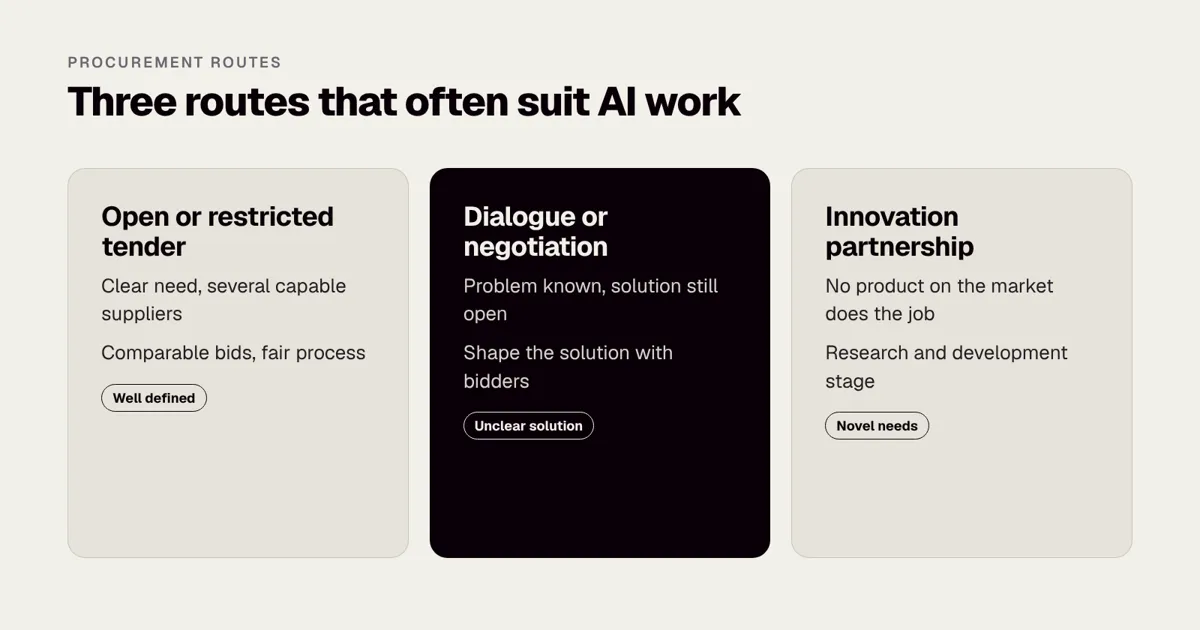
Procurement routes that suit AI work include:
- Open or restricted tender for well-defined needs.
- Competitive procedure with negotiation or dialogue when the solution is not yet clear.
- Innovation partnership or pre-commercial procurement for research and development where no market solution exists.
- Framework agreements that let you buy smaller pieces of work after one main process.
Write the requirement around the outcome, for example “classify land use to a stated accuracy on our test set”, rather than around a specific model. That keeps the tender fair and lets suppliers propose better methods. Our guide to public tenders for software in the EU covers the process in more detail.
Which route fits which situation?
| Situation | Route to consider | Why |
|---|---|---|
| You know exactly what you need and several suppliers can do it | Open or restricted tender | Clear, comparable bids |
| You know the problem but not the best solution | Competitive procedure with negotiation or dialogue | Lets you shape the solution with bidders |
| No product on the market does the job | Innovation partnership or pre-commercial procurement | Designed for research and development |
| You expect repeated, smaller purchases | Framework agreement | One process, many call offs |
| Contract is small and under thresholds | National simplified procedure | Faster, but check local rules |
What should a tender for AI include?
- The problem and the outcome, not the model.
- A test set or a way to build one, so accuracy can be compared fairly.
- Data access arrangements, including who prepares and labels data.
- Security, hosting and data protection requirements.
- Transparency and documentation duties, including what suppliers must supply to meet the AI Act.
- Ownership of code, trained models and documentation, and exit support.
- A staged structure, for example prototype, then pilot, then production, with decision points between them.
- Evaluation criteria weighted for quality, risk, price and sustainability, in line with your national rules.
Planning an AI pilot for a public body? We can help you shape the scope, risks and budget before you go to tender. Book a 30-minute call with a co-founder and we will talk it through.
How do you compare quotes fairly?
Price alone is a poor guide. Compare what is included: data preparation, labelling, testing against your measure, documentation, training for staff, hosting and support. One supplier may quote for a model alone while another includes everything needed to run it. See App development quotes compared for why prices range so widely, and Fixed price vs time and materials for why we only work on a fixed price agreed before development starts.
What should a public sector AI pilot include?
A good pilot answers a few questions quickly and cheaply:
- Is there enough usable data? Test this in the first two weeks.
- Does the model beat the current process? Agree the measure before you start, such as accuracy against a human-labelled sample.
- Where does the human step in? Define what staff review and what they can override.
- Can it be explained? Record how the system works in plain language for staff, auditors and, where relevant, citizens.
- Can it run where you need it? Decide early whether it must run on EU-hosted or on-premises infrastructure.
A worked example: a regional authority wants to sort 2,000 incoming planning documents a month. The pilot takes a sample of 500 past documents, labels them by topic, trains a classifier and measures how often it agrees with experienced staff. If agreement is high enough, staff review only the uncertain cases. Nothing is decided about a person’s rights by the model alone, so the risk stays manageable.
What does a 12 week pilot timetable look like?
| Weeks | Activity | Output |
|---|---|---|
| 1 to 2 | Data review, success measure agreed, data protection review started | Go or no go on data quality |
| 3 to 4 | Labelling a sample, baseline from the current process | Test set and baseline accuracy |
| 5 to 8 | Model development and tuning | Working prototype and first results |
| 9 to 10 | Staff testing in a safe environment, error analysis | List of failure cases, oversight design |
| 11 to 12 | Documentation, report, recommendation | Decision paper for the next stage |
Some pilots take 8 weeks, others 16, depending on data and approvals. Use this as a template to adjust.
How do you decide whether the pilot worked?
Agree three things before you start.
- A target. For example, “agrees with trained staff on at least a set share of cases in a test set the model has not seen”. Choose the share with the people who will rely on it, not the supplier.
- A comparison. The model is measured against the current process, including its error rate and its cost in staff time.
- A decision rule. State in advance what result leads to what decision: proceed, adjust and re-test, or stop.
A pilot that ends with “stop” is not a failure if it cost a small amount and taught you something. A pilot that ends with “proceed” without a measured result is the real risk.
What should happen to the data?
Decide in the first weeks who prepares the data, where it is stored, who can see it and what happens to it afterwards. Strip or pseudonymise personal data wherever possible. Keep the training and test data separate, and keep a record of what was used. If a supplier will train a model on your data, be explicit in the contract about whether they may reuse it, and for what.
How do you measure whether an AI system is good enough?
Accuracy sounds simple, but one number can mislead. Here are the measures that matter, in plain English.
| Measure | Plain meaning | Why it matters |
|---|---|---|
| Accuracy | Share of all answers that are correct | Easy to read, but hides problems when one category is rare |
| Precision | When the system says “yes”, how often is it right? | Matters when false alarms waste staff time |
| Recall | Of all the real “yes” cases, how many did it find? | Matters when missing a case is costly |
| Agreement with staff | How often the system and trained staff reach the same answer | A practical test, and staff often disagree with each other too |
| Confidence | How sure the system says it is | Lets you route uncertain cases to people |
| Error pattern | Where and for whom it fails | Reveals bias and weak spots a single score hides |
Why does the mix of cases matter?
Imagine a system that flags planning documents needing urgent attention, where only 2% are urgent. A system that never flags anything would be 98% accurate and completely useless. Precision and recall show the truth: it found none of the cases that matter. Always ask for results broken down by category and, where people are involved, by relevant groups, and ask what the test set contained. A test set that does not look like real work will flatter the model.
What does a human review step really look like?
A useful pattern is to let the system sort work into three lanes.
- High confidence: staff sample a small share to confirm quality over time.
- Medium confidence: staff review each case before it moves on.
- Low confidence or unusual: the case goes straight to a person, with the system’s notes attached.
Set the boundaries between lanes using the pilot data, not a guess, and review them regularly. Staff need the time, training and authority to disagree with the system. If people feel pressure to accept every suggestion, oversight is only on paper, and it will not satisfy either the AI Act or your own auditors.
What does the AI Act mean for the data you use?
For high-risk systems, the Act expects training, validation and testing data to be relevant, sufficiently representative and, as far as possible, free of errors, with attention to possible bias. Even outside the high-risk category, those are sound principles. Practical steps include documenting where each dataset came from, checking whether some groups, regions or document types are missing, recording how labels were created and by whom, and keeping a version history so you can show which data trained which model.
Who labels the data, and how do you keep it consistent?
Labelling is a human task, and people disagree. Write clear guidelines with examples, have two people label a shared sample and measure how often they agree, resolve differences in a short meeting and update the guidelines. For specialist tasks such as land use or legal categories, use subject experts, not generalists. In the Bavarian project, the training data was the foundation of everything else, which is why we recommend agreeing the labelling approach before choosing a model.
What if your data is in poor shape?
Many bodies hold decades of scanned paper, inconsistent spreadsheets and records in several languages. That does not rule out AI, but it changes the first project. Consider a data readiness phase first: digitise a representative sample, agree a common structure and test how well the content can be read. Our Tech Architecture Audit at £7,500 fixed is designed to establish what systems and data you have before you commit to a build, and How to add AI features to an existing app covers the technical side of connecting AI to existing systems. For document heavy work, see AI document processing for UK businesses, where much of the advice applies in Europe too.
What risks should go in the register?
A short risk register belongs in every pilot. Review it every two weeks.
| Risk | Likelihood | Impact | Mitigation | Owner |
|---|---|---|---|---|
| Data is incomplete or cannot be shared | Medium | High | Data review in weeks 1 and 2; stop if not resolved | Project owner |
| Model errors affect a person’s rights | Low if scoped well | High | Keep human decision, no automated outcomes | Service lead |
| Personal data sent outside agreed locations | Low | High | EU hosting, contract terms, technical controls | Data protection officer |
| Staff do not trust or use the tool | Medium | Medium | Involve staff in testing, offer training | Service lead |
| Supplier lock in | Medium | Medium | Own code, models and documentation; exit plan | Procurement |
| Scope grows during the pilot | Medium | Medium | Fixed scope and price, change process | Project owner |
| Model accuracy drifts after launch | Medium | Medium | Monitoring and scheduled re-testing | Technical lead |
| Public criticism or media attention | Low to medium | Medium | Publish a plain language description and contact point | Communications |
The likelihood and impact ratings above are illustrations for a narrow internal use case, and your own ratings will differ.
What questions should you ask a supplier?
Use these in tender clarifications, supplier meetings and reference calls.
- Which parts of the work have you done before for a public body, and what happened after the pilot?
- Who will do the work, and who is our day to day contact?
- How will you measure success, and on what data?
- Where will our data be stored and processed, and by which sub processors?
- What documentation do you provide to help us meet the AI Act and GDPR?
- Who owns the code, the trained models and the labelled data at the end?
- What happens if we want to move to another supplier?
- How do you handle bias testing and error analysis?
- What does ongoing monitoring involve, and what does it cost?
- What is the fixed price, what does it include and what would change it?
Compare the answers to the advice in 20 questions to ask an app developer before you sign and Red flags when hiring app developers. Good suppliers answer plainly, and they are as willing to say what they cannot do as what they can.
How do you go from pilot to production?
Many pilots succeed and then stop. The reasons are rarely technical: no budget line, no owner, no route through procurement and no plan for support. Plan the next stage while the pilot is running.
| Question | What to settle |
|---|---|
| Who pays for production, and from which budget? | A funded decision, not a hope |
| Does the pilot contract allow follow on work? | Check procurement rules on extensions and new contracts |
| Who runs it day to day? | A team and a named service owner |
| How does it connect to existing systems? | An integration plan with realistic effort |
| What rules now apply? | Updated data protection and AI Act assessment for the live use |
| How will you monitor and improve it? | Metrics, review dates and a route for staff feedback |
| What would make you switch it off? | An agreed threshold and a person with authority to act |
Our piece on From prototype to procurement gives a worked view of this step. If the existing platform needs work first, Rebuild or refactor: what it costs to fix an old app and What is technical debt? explain how to judge the foundations before building on them.
What do three realistic scenarios look like?
These are illustrative examples to show how the advice applies, not case studies of named bodies.
A regional planning office wants to sort incoming documents
The office receives thousands of applications and letters each month. A pilot labels a sample, trains a topic classifier and routes documents to the right team, with staff reviewing uncertain cases. The model never decides an application. Risk is moderate, the data is already digital and success is measurable against staff agreement. This is a strong first project, and the main work is data preparation and integration with the case system.
A city council wants an enquiry assistant
The council wants residents to ask questions about waste collection, parking and local services. The assistant answers only from a reviewed set of approved web pages and tells people when it does not know. It declares clearly that it is an AI system, offers a route to a person and logs questions for review. Transparency duties apply, and accessibility, language support and data protection need attention. A narrow scope with a reviewed source set avoids the worst problems of invented answers, and our guide to Making AI features safe covers those safeguards.
A national agency wants to prioritise benefit claims
The agency wants a model to rank claims by likelihood of error or fraud. Here the system affects people’s rights, so it is likely to be high-risk, and the duties on documentation, testing, oversight, logging and impact assessment are heavy. This is not a first project. If it is pursued, it needs specialist legal advice, a long timeline, strong governance and probably a staged approach that starts with lower risk internal tools. Choosing a lower risk first use case builds the skills and trust needed for this kind of work later.
What is a checklist before you issue a tender or start a pilot?
- [ ] One clearly named use case and one accountable owner
- [ ] A written statement of the problem and the expected outcome
- [ ] A measurable success test and a decision rule agreed in advance
- [ ] Data sources identified, with access and quality checked
- [ ] Data protection officer involved and a data protection impact assessment started
- [ ] A view on AI Act risk level, checked with legal advice
- [ ] Procurement route chosen with the procurement team
- [ ] Hosting and security requirements written down
- [ ] Human oversight designed, with named reviewers
- [ ] Ownership of code, models and documentation settled
- [ ] A plan for staff communication and training
- [ ] Budget and route for the next stage, if the pilot succeeds
What does it cost?
Costs vary with data quality, security requirements and integration needs. As a market estimate (not a quote), a focused pilot often costs in the range of £30,000 to £80,000, and a production system integrated into existing case management can run much higher. Ongoing costs include hosting, monitoring and model updates. Rounded Labs agrees a fixed price before development starts; see the pricing page. If you want an independent view before committing, our Tech Architecture Audit is £7,500. For the wider comparison between buying and building, read Off-the-shelf SaaS vs custom software.
For the budget side of compliance, What it costs to make an app GDPR and AI Act ready gives ranges by risk level. Teams also need a plan for hallucinations, privacy and security, covered in Making AI features safe, and for keeping running costs predictable, covered in How to keep AI running costs under control.
Where does the money go?
| Cost area | What it covers | Notes |
|---|---|---|
| Data preparation and labelling | Cleaning, sampling, labelling by staff or specialists | Often the largest and most underestimated line |
| Model development | Training, tuning, testing against your measure | Depends on how unusual the task is |
| Integration | Connecting to case management, document stores or portals | Can exceed the model cost in older environments |
| Security and compliance | Testing, documentation, data protection and AI Act work | Rises with risk level |
| Hosting and monitoring | EU hosted or on-premises infrastructure, alerts and checks | Ongoing, not one off |
| Training and change management | Staff guidance, new procedures, communication | Skipped by many projects, and then adoption suffers |
These are categories, not prices. The size of each depends on your case.
Are there funding routes?
Many European programmes fund digital and AI projects in the public sector, and national governments run their own schemes. Funding rules, deadlines and eligibility change frequently. Start with the European Commission site and your national digital agency, and read the official call text before you plan around any funding.
Should you build custom AI or buy a product?
| Question | Buy a product | Build or adapt |
|---|---|---|
| Does an existing product do the job well? | Yes | No |
| Is the task common, such as transcription or translation? | Yes | Rarely |
| Is the task unusual, such as classifying specific land types? | No product fits | Yes |
| Do you need control over data location and models? | Check the contract carefully | Easier to guarantee |
| Do you need to explain how decisions are made? | Depends on supplier transparency | Under your control |
| Are you worried about supplier lock in? | Higher risk | Lower, if you own the code and models |
For more detail, see Custom AI vs off-the-shelf ChatGPT tools for your business, How to scope an AI MVP and RAG for business owners, which explains how a system can answer questions from your own documents.
Is there a safe way to use general-purpose chatbots in the meantime?
Many staff already use consumer chatbots. Rather than ignoring this, set a clear policy: what data may never be entered, which approved tools are available, and how outputs must be checked. Provide an approved option with a proper contract and a risk assessment, so staff do not turn to unapproved tools.
How do you keep a public AI project on track?
- Name one accountable owner inside the body, not only a supplier contact.
- Involve the data protection officer from week one, not at sign-off.
- Publish what you can. Several countries expect or encourage public registers of algorithms.
- Plan for exit. Make sure you own the trained models, code and documentation, and can move to another supplier.
- Write down the limits. State plainly what the system must never be used for.
- Keep a human in the loop for any output that affects a person’s rights, and make sure that person has the time and authority to disagree with the system.
- Monitor after launch. Accuracy can drift as inputs change. Set up checks and a route for staff to report problems.
If you work with suppliers across borders, DACH companies: local agency or UK studio? looks at the trade-offs, and Delivering for German enterprise clients: lessons from Cubeware draws on our work in Germany. For other regulated sectors the same ideas apply; see App development for public sector in Europe for a wider view of features, rules and costs.
What are the most common reasons public AI projects fail?
| Reason | How to avoid it |
|---|---|
| Poor or inaccessible data | Test data in the first two weeks; fix access before building |
| Vague goals | Agree a measurable target and decision rule at the start |
| Legal review at the end | Involve legal and data protection from week one |
| No owner | Name an accountable person inside the body |
| Over ambitious scope | Start with a narrow task and a human decision |
| Procurement mismatch | Write requirements around outcomes and stage the contract |
| Staff not involved | Include users in testing and design from the start |
| No plan after the pilot | Agree funding and route to production before you begin |
How do you build trust with staff and citizens?
Tell people what the system does, what it does not do and who is responsible. Offer a clear route to a human. Share the measured results, including the cases where the system is weaker. Invite feedback from staff, unions and citizen groups, and act on it visibly. Public trust is slow to earn and quick to lose, and openness is the cheapest protection you have.
Why work with us?
Rounded Labs has built software since 2007, including the UK’s first mobile banking app (MoBank), and our AI work for the Bavarian government shows how we handle data, risk and public scrutiny. Every project is fixed price, agreed before development begins, with typical projects running from £30,000 to £250,000+. If you want an independent view on a legacy system before adding AI, our Tech Architecture Audit costs £7,500 fixed. If your platform is struggling, a Legacy App Rescue Assessment is £6,500 fixed. See the pricing page and, if you would like to talk through a use case, book a call with a co-founder.
Frequently asked questions
Does the EU AI Act apply to public authorities?
Yes. It applies to providers and deployers of AI systems, and public bodies are often deployers. High-risk uses in areas such as public services, migration or law enforcement carry extra duties, including a fundamental rights impact assessment.
Can a public body use a general-purpose chatbot?
Possibly, but you must check data protection, hosting location and transparency. Never paste personal or confidential data into a consumer tool without a contract and a risk assessment in place.
Do we need to run a tender for a small pilot?
It depends on the value and your national rules. Small contracts may fall below the thresholds that trigger a full EU tender, but national procedures still usually apply. Ask your procurement team early.
Should we build custom AI or buy a product?
Buy when a product already does the job well. Build when your task is unusual, as in the Bavarian land classification work, or when you need control over data and models.
How long does a first pilot take?
A focused pilot commonly takes 8 to 16 weeks once data is available. Procurement before that can take longer than the build itself.
Who is responsible if the AI makes a mistake?
The public body remains responsible for decisions it takes, whatever tools it uses. That is why human oversight, clear roles in the contract and good records matter. Take legal advice on liability for your own situation.
Do we have to publish information about the AI we use?
Requirements vary by country and by risk level. Some high-risk systems must be registered in an EU database, and several national governments run algorithm registers or expect transparency statements. Check the current rules for your body and consider publishing a plain language description even where it is not required.
Official sources and further reading
Talk it through with one of our co-founders. 30 minutes, no pressure.