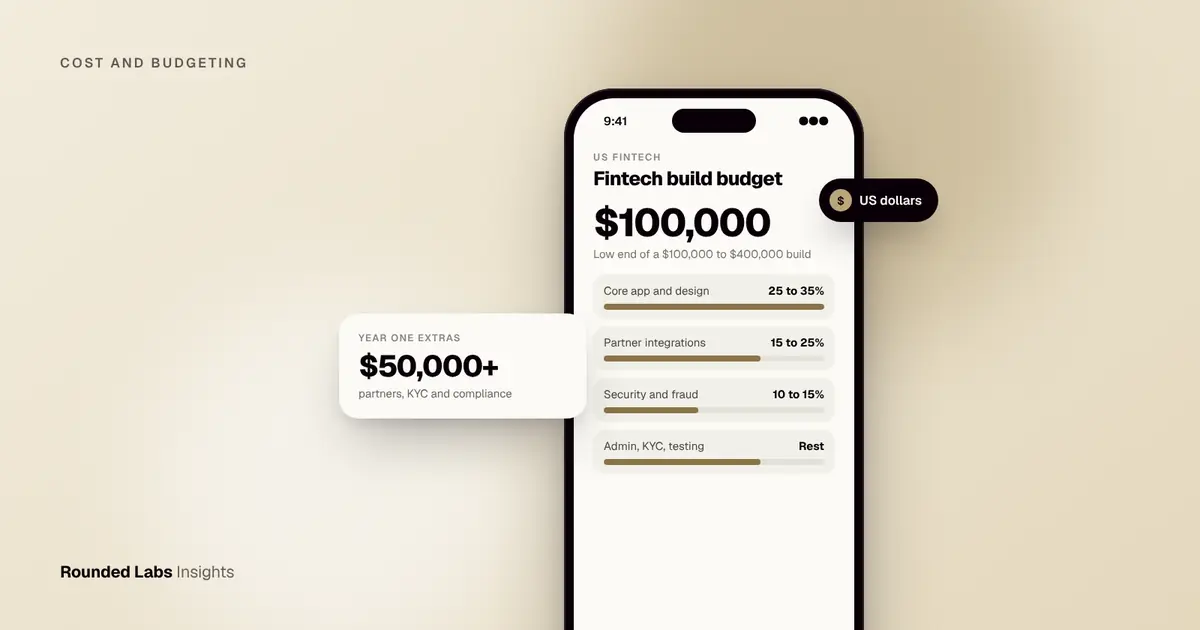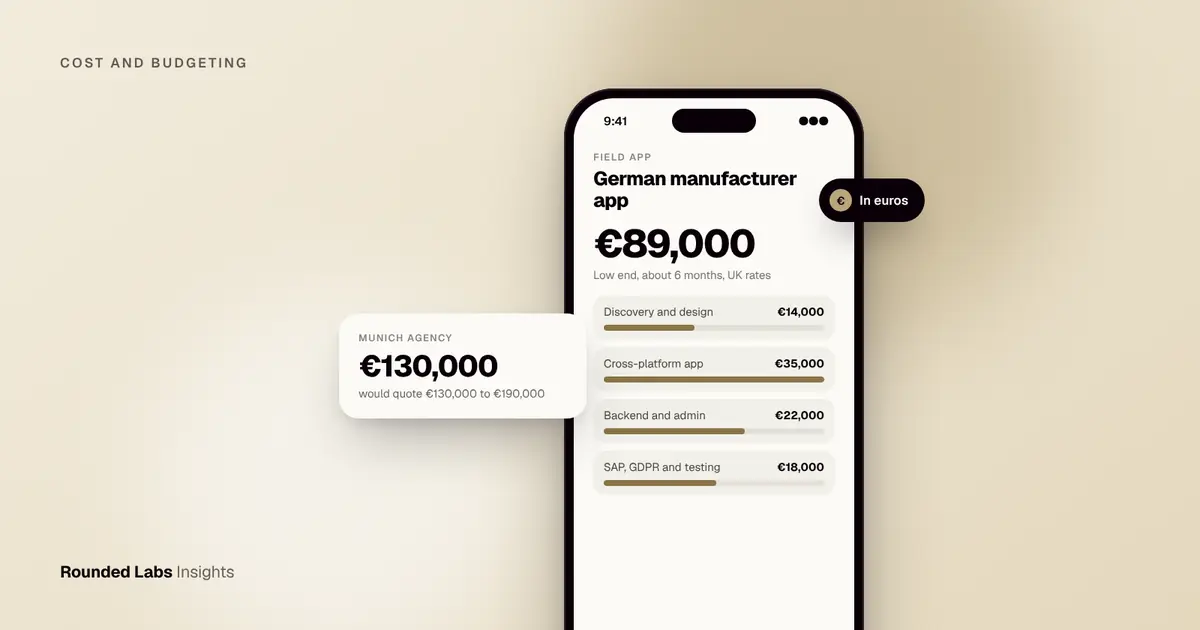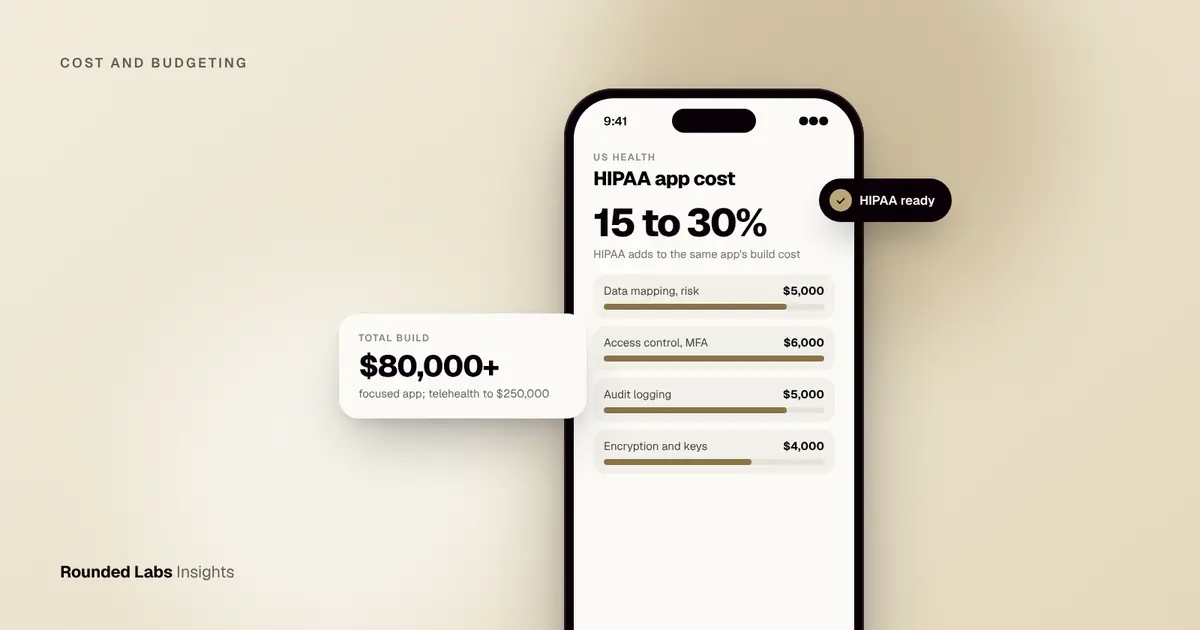
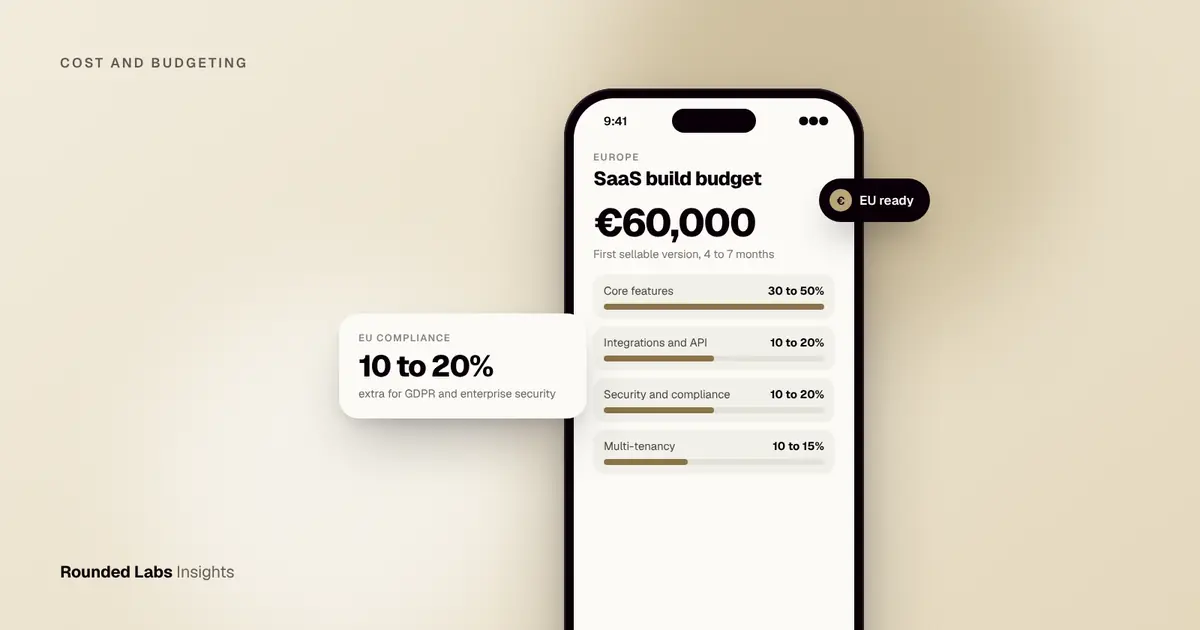
Building a SaaS product in Europe typically costs €60,000 to €150,000 for a first sellable version, €150,000 to €400,000 for a mature B2B platform, and more for enterprise products. SaaS adds multi-tenancy, billing, roles, admin tools and the security and compliance work European business customers expect.
We helped Cubeware, an analytics provider serving 4,000+ enterprise customers across Germany, Austria and Switzerland, move from a legacy desktop product to SaaS. This guide gives European founders and software companies realistic budgets in euros, and shows where SaaS projects spend their money. All figures are market estimates, not quotes, and prices vary by supplier and scope. Rounded Labs works to a fixed price agreed before development starts, with projects typically running from £30,000 to £250,000+, so where we describe our own services we use pounds, as on our pricing page.
Key facts
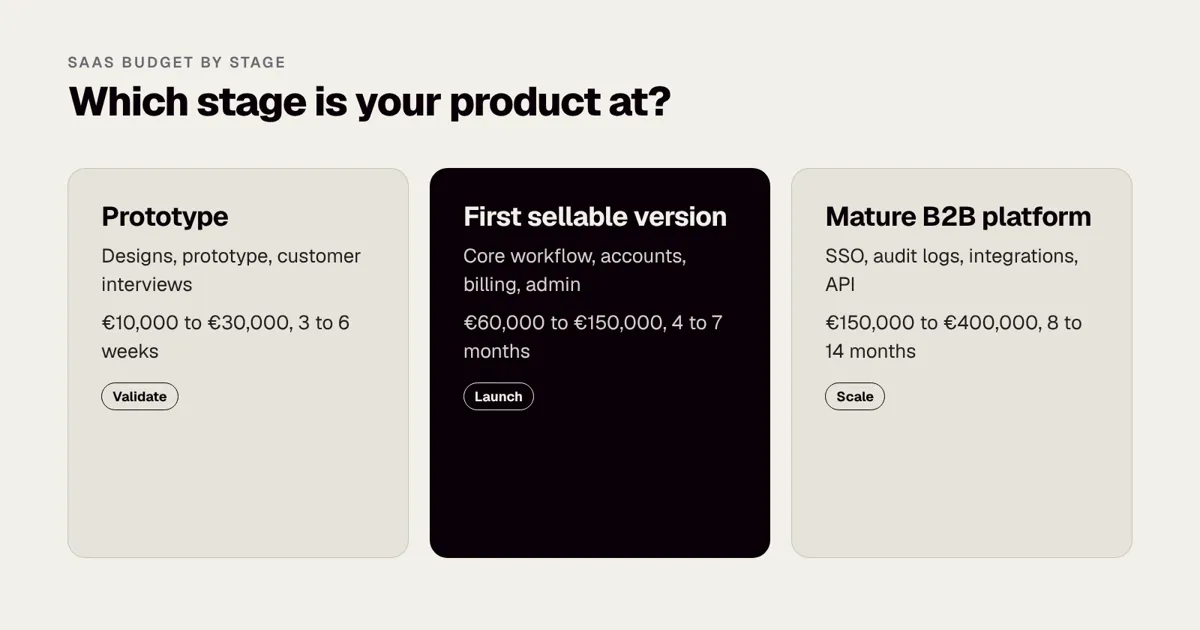
- First sellable SaaS version: €60,000 to €150,000, 4 to 7 months.
- Mature B2B SaaS platform: €150,000 to €400,000, 8 to 14 months.
- Legacy product to SaaS migration: €150,000 to €600,000+, depending on size.
- EU compliance and enterprise security features add 10 to 20%.
- Running costs: €500 to €10,000+ a month for hosting, tooling and services.
- Most overspend comes from the parts customers never see: tenancy, billing, permissions, admin tools and security. Budget for them from day one.
What does SaaS development cost by stage?
| Stage | What it includes | Western European agency | UK studio (in €) | Timeline |
|---|---|---|---|---|
| Prototype and validation | Designs, clickable prototype, customer interviews | €10,000 to €30,000 | €8,000 to €20,000 | 3 to 6 weeks |
| First sellable version | Core workflow, accounts, roles, billing, admin | €80,000 to €180,000 | €60,000 to €130,000 | 4 to 7 months |
| Mature B2B platform | SSO, audit logs, integrations, reporting, API | €200,000 to €500,000 | €150,000 to €350,000 | 8 to 14 months |
| Legacy to SaaS migration | Re-architecture, data migration, customer transition | €200,000 to €800,000+ | €150,000 to €600,000+ | 9 to 24 months |
These are market estimates for the kind of work described, not quotes from any named supplier. Exchange rates move, so if you are comparing a euro estimate with a pound quote, convert at the current rate on the day. App development cost in Europe covers general app costs across Europe, and Off-the-shelf SaaS vs custom software: when to build helps decide whether to build custom software or buy existing SaaS.
Why the ranges are so wide
Two SaaS products with the same feature list can differ in price by a factor of two. The main reasons are:
- The shape of the customer. A product for 200 small firms that sign up by credit card is a different build from a product for 20 large firms that each want single sign-on, audit logs and a security questionnaire answered.
- How much already exists. A product with an established database, an API and some users is cheaper to extend than a blank page, but only if the existing code is sound. See What is technical debt? for how old shortcuts raise the price of new work.
- How regulated the market is. A scheduling tool for gyms and a records tool for care providers share a technology stack but not a risk profile.
- How much quality you require. Automated tests, monitoring and a repeatable release process add cost at the start and save more later.
- Who is on the team and where. Day rates vary by country, and so does the cost of communication. App development rates 2027: UK vs US vs Eastern Europe vs Asia compares the main regions, and UK vs Eastern Europe for European companies building apps looks at the trade-offs for European buyers.
What makes SaaS more expensive than a simple app?
| SaaS component | Why it matters | Typical share of build |
|---|---|---|
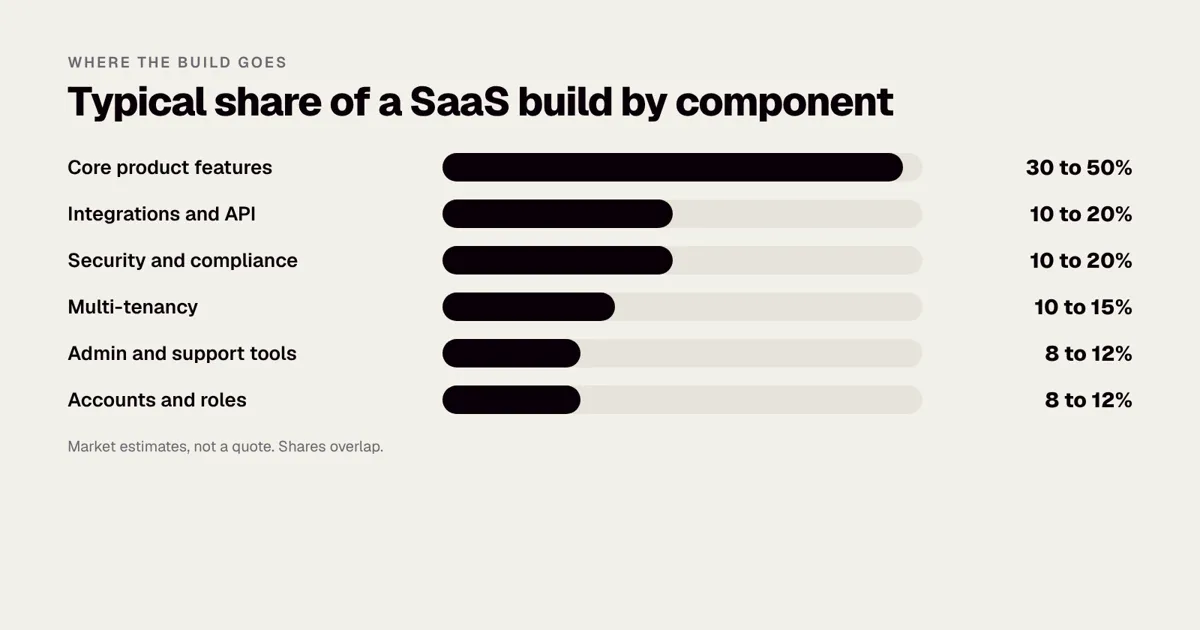
| Multi-tenancy | Keeping each customer’s data separate and secure | 10 to 15% |
| Accounts, roles and permissions | Admins, users, guests, custom roles | 8 to 12% |
| Subscription billing | Plans, trials, invoices, VAT, dunning (Stripe Billing or similar) | 5 to 10% |
| Admin and support tools | Customer management, impersonation for support, usage views | 8 to 12% |
| Integrations and API | Connecting to customers’ CRM, ERP, SSO | 10 to 20% |
| Security and compliance | Encryption, audit logs, SSO, GDPR features | 10 to 20% |
| Core product features | The workflow customers pay for | 30 to 50% |
Many founders budget only for the core features and are surprised by the rest. The ranges overlap and the shares are proportions of a typical build, so they will not add up to exactly 100% for any one product.
The sections below take each component in turn, because each hides decisions that change the price.
Multi-tenancy: how customers share the product
Multi-tenancy means one running product serves many customers (tenants) while keeping their data apart. There are several ways to do it, and the choice affects cost, security and how easily you can serve a demanding customer.
| Model | How it works | Build cost | Running cost per customer | Best for |
|---|---|---|---|---|
| Shared database, tenant column | All customers in the same tables, separated by a tenant identifier | Lowest | Lowest | Early products, many small customers |
| Separate schema per tenant | One database, a separate set of tables per customer | Moderate | Low to moderate | Mid-market products with some isolation needs |
| Separate database per tenant | Each customer has its own database | Moderate to high | Moderate | Customers who require stronger isolation or custom retention |
| Separate stack per tenant | Each customer has its own copy of the application | Highest | Highest | A few very large or regulated customers |
For most first versions the shared model with strict, well-tested separation is the sensible start. The risk is that a single coding error exposes one customer’s data to another, so the separation must be enforced in one place in the code, not remembered by every developer on every screen. Design it so that you can move a large customer to its own database later without rewriting the product.
Accounts, roles and permissions
SaaS accounts are more complicated than app accounts. A customer is an organisation, and organisations have people with different powers. You will need owners, administrators, ordinary users and often read-only or external guests. Larger customers will ask for custom roles, team structures, approval workflows and the ability to restrict access to certain records.
The cost trap is building a simple “admin or user” model and then retrofitting fine-grained permissions when the first enterprise customer asks. It is far cheaper to design a permissions model that can grow, even if you only expose two roles at launch. If your product includes sign-in, see How to add user login and sign-up to your app and How to add two-factor authentication to your app for the building blocks.
Subscription billing
Billing looks simple until you list what it has to do: free trials, monthly and annual plans, upgrades and downgrades part way through a period, proration, seat counts, usage charges, discount codes, invoices that meet local requirements, failed card retries (known as dunning), credit notes and refunds, and tax. Most SaaS companies use a billing platform such as Stripe Billing rather than build this themselves, and connect it to their own product through the platform’s API.
Using a platform changes the cost, it does not remove it. Allow time for:
- Mapping your plans and prices to the platform’s products.
- Linking each customer organisation in your product to a billing customer.
- Handling the events the platform sends when payments succeed or fail.
- Turning features on and off when a plan changes or lapses.
- Producing invoices with the details your customers’ finance teams require.
VAT on digital services is a specialist subject. Treatment differs between business and consumer customers and between countries, and the rules change. Ask a tax adviser, and check the official guidance of the relevant national tax authority and the European Commission at the time you launch. For how subscription flows work inside mobile apps, see How to add subscriptions to your app, and for other payment points see How to add in-app payments to your app.
Admin and support tools
Nobody sees the admin area in a demo, and every SaaS company needs it. It lets your own team create and suspend customer accounts, see usage, reset access, view logs, issue credits, export data on request and, with permission, view the product as a customer sees it to resolve a support case. Without it, every support request becomes a developer task. The 8 to 12% in the table is a floor. Products with complex customer set-up often spend more here than on any single customer-facing feature.
Integrations and the API
Business customers rarely use software in isolation. They want data to flow into their accounting package, CRM, identity provider or data warehouse. Each integration has a cost: reading the other system’s documentation, building and testing the connection, handling failures, and maintaining it when the other system changes. Offering your own public API adds documentation, authentication, rate limits and versioning. See What is an API integration? for the basics. A useful rule is to build the integration that your first three paying customers ask for, and to avoid building a long list “because enterprise buyers might want it”.
Security and compliance features
Enterprise buyers send security questionnaires, and the answers are expensive if the product was not built for them. Common requirements include encryption of data in transit and at rest, single sign-on, audit logs, role-based access, regular penetration tests, backup and recovery plans, and a documented process for handling incidents. What is penetration testing for apps? explains the testing side, and SOC 2 for startups explains how an audit report can shorten sales cycles in markets that ask for it. Many European buyers ask instead for ISO 27001 certification, so check what your target customers request before choosing a route. The International Organization for Standardization publishes information about its standards at iso.org.
Which EU rules affect SaaS?
- GDPR: you are usually a processor for your customers, so you need a data processing agreement, sub-processor list, records and security measures. See GDPR for US companies launching an app in Europe, which also applies in spirit to any non-EU supplier.
- NIS2: if your customers are in sectors such as energy, health, transport or digital infrastructure, they will impose security requirements on you, and some SaaS providers fall under NIS2 directly. See NIS2 for software suppliers.
- DORA: financial sector customers must control ICT suppliers, including SaaS. See DORA for fintech apps and their suppliers.
- EU Data Act: since September 2025, it includes rules that make switching between cloud and data processing services easier, which affect contracts and exit terms. See The EU Data Act and connected apps.
- EU AI Act: if your SaaS includes AI features. See The EU AI Act for app and SaaS owners and The EU AI Act and UK rules for AI apps, in plain English.
- European Accessibility Act: for consumer-facing services in scope. See App accessibility: the European Accessibility Act and UK guidance.
- EU Cyber Resilience Act: adds security duties for products with digital elements, and is relevant where your SaaS has a downloadable component. See The EU Cyber Resilience Act and your app.
Which of these apply to you depends on your customers, your features and your size. Dates and scope are set by the law and by each member state’s implementation, and they change. At the time of writing, the sensible approach is to check the official texts on EUR-Lex and the guidance of your national regulator, and to take advice from a lawyer who knows your sector. The European Data Protection Board publishes guidance on GDPR, and the European Commission hosts information on the other measures. This is general information, not legal advice.
Planning a SaaS product for European customers? We will scope it, price it in euros and design GDPR and enterprise security in from the start. Book a 30-minute call with a co-founder.
What compliance adds to the budget
| Item | Typical extra cost (market estimate) | When it is needed |
|---|---|---|
| Data processing agreement and sub-processor list | €1,500 to €5,000 of legal time | Before your first paying customer |
| Privacy by design review of the data model | 2 to 5 days of design and engineering | During design |
| Audit logs and data export tools | 3 to 6% of build | Before enterprise sales |
| Single sign-on | €5,000 to €15,000 | When the first enterprise customer asks |
| Penetration test | €4,000 to €15,000 | Before launch, then yearly |
| Security certification preparation (for example ISO 27001) | €15,000 to €60,000+ including advisers | When your market expects it |
| AI Act assessment for AI features | Depends on the risk class | If AI is part of the product |
Spread across a project, this is the “10 to 20%” in the key facts. The figures depend heavily on the product, so treat them as a guide for planning, and ask for a written breakdown when you collect quotes.
Where should SaaS data be hosted?
For European business customers, EU hosting is strongly preferred and often required in contracts. It simplifies GDPR and procurement. The big cloud providers each offer EU regions, and you can read about their offerings at Amazon Web Services, Microsoft Azure and Google Cloud. Our comparison AWS vs Azure vs Google Cloud for app backends explains how to choose, and Firebase, Supabase or a custom backend? helps for small teams.
Three practical points affect cost:
- Region choice. Prices differ slightly between regions, and some services are not offered in every region. Pick one early and design with it in mind.
- Data location for sub-processors. Email, analytics, monitoring and support tools also hold customer data. Each one needs a location and a contract. Keep the list short.
- Backups and recovery. Decide how fast you must recover, and how much data you can afford to lose. Faster recovery costs more to run.
If you are a UK company serving EU customers, or an EU company working with a UK studio, see UK and EU data transfers for app projects, explained and Hiring a UK studio from the EU after Brexit: contracts, VAT and data.
How long does SaaS development take?
| Phase | Typical length | What happens |
|---|---|---|
| Discovery and design | 3 to 6 weeks | Customer research, scope, architecture, prototype |
| Foundations | 4 to 8 weeks | Tenancy, accounts, roles, billing, deployment pipeline |
| Core product build | 8 to 16 weeks | The workflow customers pay for, in short releases |
| Hardening | 3 to 6 weeks | Security testing, performance, accessibility, data protection |
| Pilot customers | 4 to 8 weeks | A small group uses the product, you fix what they find |
| General release | 1 to 2 weeks | Billing live, support in place, announcement |
These phases overlap, and the sum depends on how many people work in parallel. The key insight is that the foundations take about as long for a small product as for a large one. That is why a very small SaaS product can feel disproportionately expensive. The first sellable version includes the same plumbing as a much bigger one, with fewer rooms built on top.
What speeds a project up
Three habits shorten SaaS projects more than extra developers: a written scope with a clear first customer in mind, a single decision maker on your side, and an automated release process from the start. What is CI/CD for apps? explains the last point. If you are unsure how long your own project is likely to take, How long does it take to build an app? Real timelines from 19 years of projects gives a wider picture.
What does SaaS cost to run?
| Item | Typical monthly cost |
|---|---|
| Cloud hosting in an EU region (compute, database, storage, backups) | €300 to €5,000+ |
| Monitoring, logging and error tracking | €50 to €1,000 |
| Email, notifications and other APIs | €50 to €1,000 |
| Billing platform fees | Usually a percentage of revenue |
| Security tooling and annual penetration test | €200 to €1,500 equivalent |
Costs grow with customers and data. Designing for efficiency early, such as sensible database design and caching, keeps the cost per customer low.
Beyond infrastructure: the people costs
Infrastructure is rarely the biggest running cost. A live SaaS product needs people to fix bugs, answer support questions, update dependencies and security patches, and build the roadmap. Plan for yearly maintenance and improvement on a scale of 15 to 25% of the build cost for a stable product, more if you are still adding features quickly. This is a market estimate. Our guide to app maintenance costs in the UK explains the components, and The total cost of owning an app over five years shows how running costs accumulate.
A simple unit economics check
Before committing to a build, check that the running cost per customer leaves room for profit. The numbers below are illustrative, not drawn from any real product.
| Item | Illustrative value |
|---|---|
| Average revenue per customer per month | €200 |
| Hosting, tools and APIs per customer per month | €15 |
| Billing platform fees | About 3% of revenue, so €6 |
| Support cost per customer per month | €20 |
| Gross margin per customer per month | About €159, or 80% |
| Customers needed to cover €10,000 of monthly fixed costs | About 63 |
If the figures in your own version of this table do not work, no amount of clever engineering will fix it. Better to find out before you spend €100,000.
A worked example: B2B scheduling SaaS for Dutch care providers
A Dutch founder wants a SaaS product that helps home care providers schedule staff, record visits and invoice municipalities. The table shows an illustrative budget, using market estimates for a UK studio. It is not a quote.
| Item | Effort | Cost at UK studio rates |
|---|---|---|
| Discovery and design | 4 weeks | €14,000 to €20,000 |
| Multi-tenant web app and staff mobile app | 12 weeks | €45,000 to €62,000 |
| Scheduling engine and visit records | 6 weeks | €20,000 to €28,000 |
| Billing, invoicing and exports | 3 weeks | €10,000 to €14,000 |
| Security, GDPR features and testing | 3 weeks | €10,000 to €14,000 |
| Total | About 7 months | €99,000 to €138,000 |
What the founder should add to the budget
The build total leaves out several items. Legal drafting for customer contracts and a data processing agreement, perhaps €3,000 to €8,000. A penetration test, €4,000 to €15,000. Seeding the first customers, since care providers will want training and data import. Contingency of 10 to 15% for changes found in pilot use. And the first year of running costs. A realistic first-year cash need is therefore well above the build range.
Where the risk sits
Care data is health-related personal data, which GDPR treats as a special category requiring extra care. The product must handle visit records, staff schedules and invoices to public bodies, so the founder needs advice on data protection, local invoicing rules and retention periods. The product decision that saves most money here is the narrowest sensible start: one type of provider, one municipality format for invoices, and one mobile platform for staff, with the rest added after the pilot.
A second example: a founder with €60,000
A founder building a project management tool for architecture practices has €60,000. The honest answer is that this buys a narrow first version, not the full product.
| Decision | Choice | Why |
|---|---|---|
| Customer | Small practices of 5 to 25 people | They buy quickly, with no procurement process |
| Core workflow | Project plans and time tracking | One job done well |
| Tenancy | Shared database with strict separation | Cheapest sound option |
| Accounts | Owner and member roles, built on a permissions model that can grow | Avoids a rebuild later |
| Billing | A billing platform with two plans and an annual option | No custom billing code |
| Integrations | One, to the accounting package the first customers use | Others wait for demand |
| Platform | Responsive web app, no native mobile app | Halves the front-end work |
| Not included | Single sign-on, public API, custom roles, advanced reports | Added when customers ask and pay |
That plan costs around €50,000 to €60,000 and gives the founder something to sell. It would not satisfy a large practice with security questionnaires, and that is fine, because the aim of version one is to find out whether the product earns money. For how to test demand first, read How to validate an app idea before you spend £50k and What is an MVP?.
What did we learn from moving Cubeware to SaaS?
Moving a long-established product used by thousands of enterprise customers to SaaS is as much about the transition as the technology. Customers need a clear migration path, data must move without loss, and the business model changes from licences to subscriptions. Planning the customer transition alongside the architecture is what makes the difference. Turning legacy software into SaaS tells the fuller story, Legacy software to SaaS for German Mittelstand companies covers legacy modernisation for German companies, and Delivering for German enterprise clients: lessons from Cubeware looks at what it takes to work with German enterprise buyers.
What changes when you move from licences to subscriptions
| Area | Licence model | Subscription model |
|---|---|---|
| Revenue | Large payment up front, smaller maintenance fees | Smaller regular payments, rising over time |
| Customer upgrades | Customer chooses when to install | You release to everyone, so quality and compatibility matter more |
| Support | Mixed versions in the field | One current version, but you run the service |
| Data | Stays on the customer’s systems | Held by you, so security and contracts matter more |
| Sales | Fewer, larger deals | More frequent renewals, so product value must show continuously |
| Cash flow | Lumpy | Smoother, but slower to build at the start |
Founders and finance teams often underestimate the dip in cash during the transition, because new subscription revenue arrives more slowly than the licence income it replaces. Model it before you commit. The wider legacy-to-SaaS range of €150,000 to €600,000+ in this guide reflects both the engineering work and the customer move.
Where to start with a legacy product
Before committing to a full migration, find out what you actually have. At Rounded Labs we offer fixed-price assessments for this stage: a Tech Architecture Audit at £7,500, a Digital Transformation Prep engagement at £7,000 and a Legacy App Rescue Assessment at £6,500, all priced in pounds. They produce a written view of the code, the risks and the options, so the larger migration is quoted against facts rather than assumptions. See the pricing page for what each includes. If an older product has been built by someone else and you are unsure what you inherited, read Rebuild or refactor: what it costs to fix an old app and How to take over an app built by someone else.
Should you build custom SaaS or buy something that exists?
Before spending anything, check whether an existing tool already does the job. A custom build is justified when your workflow is the product, when no existing tool fits your market, or when you intend to sell the software to others. It is rarely justified for internal needs that an off-the-shelf product covers.
| Option | Typical starting cost | Best when | Main limit |
|---|---|---|---|
| Buy existing SaaS | Subscription fees | A standard process, small team | You adapt to the tool |
| Low-code or no-code | Low thousands of euros to start | Validating demand, internal tools | Scaling, performance, ownership of logic |
| Custom build | €60,000 and above | Your product is the business | Cost and time |
| Hybrid | Varies | Core custom, commodity bought | Needs careful integration |
Our guides Low-code vs custom app development and Off-the-shelf SaaS vs custom software: when to build explain each route. A low-code prototype is a legitimate first step. It is a poor foundation for a product with hundreds of business customers and strict security requirements.
How does your own pricing model change the build?
The way you charge customers decides how much billing and measurement code you need, so settle it before you ask for a quote.
| Pricing model | How it works | What it adds to the build | Watch out for |
|---|---|---|---|
| Flat tiers | A few plans at fixed prices | Low: feature switches by plan | Customers who outgrow a tier and leave rather than upgrade |
| Per seat | Price rises with the number of users | Moderate: seat counting, invites, mid-period changes | Customers sharing logins to avoid paying |
| Usage based | Price rises with volume, such as records or messages | High: metering, limits, usage reports, disputes | Bills customers cannot predict, and support queries about them |
| Hybrid | A base fee plus usage above a threshold | Highest: both of the above | Complexity that is hard to explain on a pricing page |
For a first version, flat tiers with an annual option are the cheapest to build and the easiest to explain. Per seat pricing is a natural second step once you have customers who ask for it. Usage-based pricing is attractive when your costs rise with usage, but it needs reliable metering, and every disputed invoice becomes a support case. Whichever you choose, record the data you will need later, such as seats, active users and key events, from the first release. Adding history after the fact is not possible.
Onboarding is part of the product
Business customers do not simply sign up and start. They invite colleagues, import existing data, connect other systems and ask questions. Budget for an onboarding flow with sample data, an import tool for common file formats, a short guided set-up and an in-product help route. For the first ten customers you may do much of this by hand, which is sensible, but build the import tool early because it is the step that decides whether a trial turns into a subscription.
How can you keep SaaS costs under control?
- Start with one customer segment and one core workflow.
- Buy commodity components: authentication, billing, email, analytics.
- Choose a sensible multi-tenancy model for your stage rather than the most complex one.
- Add enterprise features (SSO, audit logs) when customers ask, but design so they are easy to add.
- Automate testing and deployment from the start. See What is CI/CD for apps?.
- Write the scope down and agree what is excluded, so that changes are visible.
- Choose the team model deliberately. Fractional CTO vs app agency for early-stage startups and App agency vs freelancer vs in-house team set out the trade-offs.
- Ask about funding. Some countries offer tax relief or grants for software research and development. In the UK, see R&D tax relief and Innovate UK funding for app projects. For European support, start from the European Commission and your national agency, and check eligibility at the time you apply.
Quality is part of the cost, not an extra
The cheapest quote often leaves out the things that keep a SaaS product alive: automated tests, monitoring, backups and a safe way to release changes. A SaaS product that goes down for a day loses customers, and one that leaks data loses trust. Allow for them in the build, and ask each supplier to show you where they sit in the quote.
How do you choose a supplier and compare quotes?
Quotes for SaaS are hard to compare because the scope is easy to read in different ways. Use these questions.
- Does the quote name multi-tenancy, roles, billing and admin tools, or only the “main features”?
- How will customer data be separated, and who has tested it?
- Which billing platform is assumed, and is the integration included?
- Where will the product be hosted, and who owns the cloud account? You should.
- What is excluded? A good quote says so in writing.
- Is the price fixed? A fixed price is only meaningful when the scope is defined. See Fixed price vs time and materials for app projects.
- What happens after launch? Look for warranty, bug-fix terms and the cost of continued support.
- Who owns the code and the data? You should own both, with a clear handover.
At Rounded Labs, the price is fixed and agreed before development starts, and projects typically run from £30,000 to £250,000+. If two quotes differ by 40% or more, ask both suppliers to walk you through the lines that differ. The cheaper one often leaves out something you will pay for later. Two further reads help: App development quotes compared: why prices range so widely and How to estimate your app budget in pounds, dollars or euros.
Warning signs in a SaaS proposal
- A price given before anyone asked who your customers are.
- No mention of tenancy, permissions or billing.
- “Security” described as a single line with no detail.
- Hosting in an unspecified location, or under the supplier’s own account.
- A team that has never run a live subscription product.
- No plan for the first ten customers.
How should the budget be phased?
A sensible way to avoid overspending is to treat the build as a series of funded stages, each ending with a decision. The table is a template, with illustrative shares of a total budget.
| Stage | Share of budget | Decision at the end |
|---|---|---|
| Discovery and prototype | 8 to 12% | Do customers want this, and will they pay? |
| Foundations and first workflow | 30 to 35% | Does the core workflow work for a pilot customer? |
| Pilot and fixes | 15 to 20% | Will pilot customers sign and pay? |
| General release features | 20 to 25% | Is the product ready to sell widely? |
| Contingency and legal | 10 to 15% | Held back for what the pilot reveals |
A fixed price for each stage, agreed before it starts, gives you the option to stop or change direction at the end of any of them without losing the whole investment. The Mobile Product Discovery Sprint we offer at £9,500 fixed covers the first row for mobile-led products.
What happens after launch?
Launch is when the real cost pattern begins. In the first six months, expect the following.
- Support load that is highest in the first weeks, as customers meet the edge cases the pilot did not.
- Feature requests from paying customers. Decide how you will rank them. A small number of requests will come from your largest customers, and the temptation is to build all of them.
- Security reviews from larger customers, who send questionnaires and may ask for test reports.
- Churn as some customers leave. Track why, because it points to missing features or poor onboarding.
- Platform updates to frameworks, libraries and cloud services that need regular attention.
A healthy rhythm is a short release cycle, a visible roadmap, a monthly review of usage and revenue figures, and a yearly review of security and architecture. The yearly review is the right moment to ask whether the original design choices still fit your size, and a Tech Architecture Audit is a fixed-price way to do it.
What should you do next?
- Write one sentence naming your first customer and the job the product does for them.
- Test demand before you build. A prototype or a landing page is a cheap test. See How to validate an app idea before you spend £50k.
- List what must exist for the first paying customer: workflow, accounts, roles, billing, admin.
- Decide your hosting region and your data protection approach, and note which EU rules your customers will care about.
- Choose a multi-tenancy model that fits your stage.
- Ask at least two suppliers to quote against the same written scope.
- Put legal advice, a penetration test and contingency in the budget.
- Agree a fixed price for the first stage, with a decision point at the end.
If you want help working out which stage you are at, talk to a co-founder, and read What happens in a discovery phase, and why it saves money to see how a discovery stage is run.
Frequently asked questions
How much does it cost to build a SaaS MVP in Europe?
A first sellable SaaS version usually costs €60,000 to €150,000 depending on complexity and team location. A narrower MVP for early validation can cost €30,000 to €60,000. These are market estimates, and a clear written scope matters more than any average.
How long does SaaS development take?
Four to seven months for a first sellable version, and eight to fourteen months for a mature B2B platform. Migrations of large legacy products often take longer. Most of the time goes on foundations and hardening, not on the headline features.
Should SaaS data be hosted in the EU?
For European business customers, EU hosting is strongly preferred and often required in contracts. It simplifies GDPR and procurement. Remember that sub-processors such as email and analytics providers also hold data and need locations and contracts of their own.
What is multi-tenancy?
An architecture where one instance of the software serves many customers, with each customer’s data kept separate. It keeps running costs down but needs careful design for security. The choice between a shared database, separate schemas and separate databases changes both cost and isolation.
Can a UK company build SaaS for EU customers?
Yes. At the time of writing the EU treats UK data protection as adequate (check the current status of the adequacy decisions), and a UK studio can host in EU regions and sign GDPR processing agreements. See Hiring a UK studio from the EU after Brexit.
Is it cheaper to build SaaS with low-code tools?
It is cheaper to start, and a good way to test demand. For a product sold to many business customers, limits on scale, security controls and ownership of your logic usually become costly. Many founders prototype with low-code and rebuild once they have paying customers.
What do ongoing costs look like once the product is live?
Hosting and tools typically run from a few hundred to several thousand euros a month, depending on customers and data. People costs for support, fixes and improvements are usually larger, often 15 to 25% of the build per year. Treat all of these as market estimates and model your own.
Official sources and further reading
Talk it through with one of our co-founders. 30 minutes, no pressure.