

A business app built by a Western European agency typically costs €50,000 to €130,000 for a focused first version, and €130,000 to €400,000 or more for a complex platform. Prices are highest in Switzerland, the Nordics and southern Germany, lower in Ireland and the Netherlands, and lowest in Eastern Europe, with UK studios usually landing between Western and Eastern European rates.
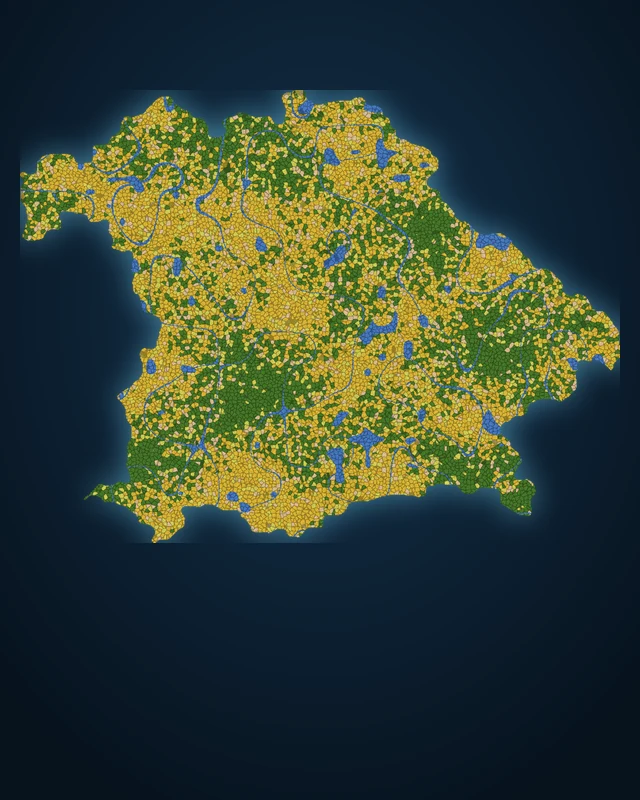
Rounded Labs has delivered for European clients for years, including the move of Cubeware, an analytics company with 4,000+ enterprise customers across the DACH region, to SaaS, and an AI prototype for the Bavarian government. This guide shows what European buyers should budget in euros, what changes from country to country, and which EU rules add cost. All figures are market estimates, not quotes, and will vary with scope; Rounded Labs prices its own projects fixed on its pricing page.
Key facts
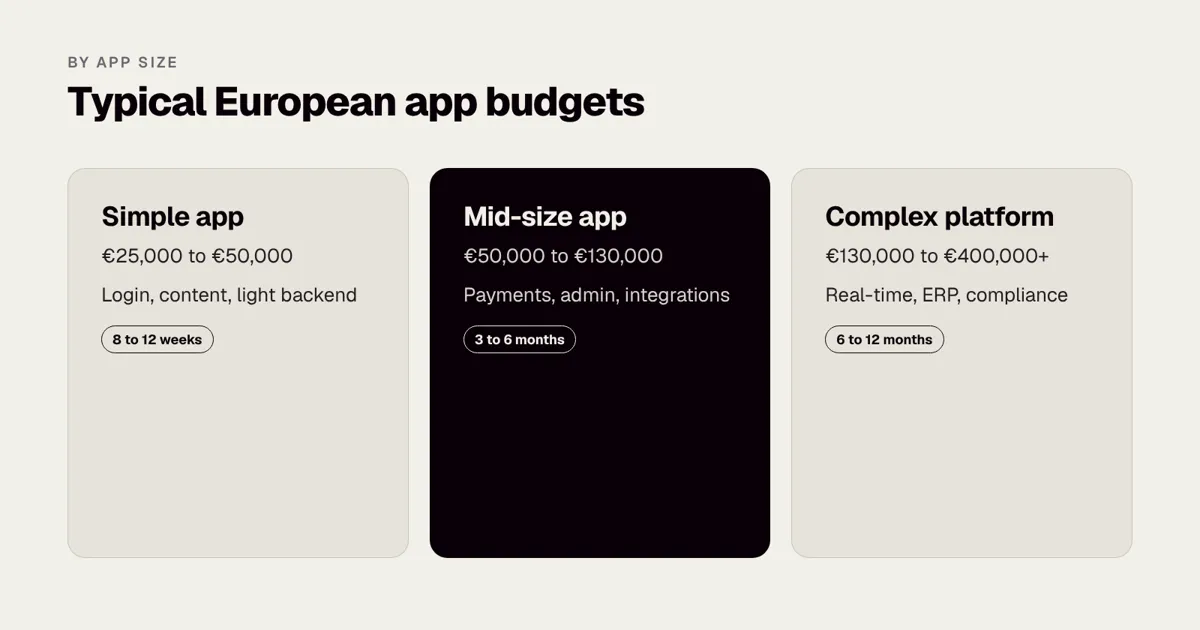
- Simple app: €25,000 to €50,000, 8 to 12 weeks.
- Mid-size app with accounts, payments and admin: €50,000 to €130,000, 3 to 6 months.
- Complex platform: €130,000 to €400,000+, 6 to 12 months.
- Agency rates: about €90 to €160 an hour in Germany, Switzerland and the Nordics; €40 to €80 in Eastern Europe (market estimates).
- EU rules such as GDPR, the European Accessibility Act and the Cyber Resilience Act add 5 to 15% to many projects.
- Rounded Labs works to a fixed price agreed before development starts, quoted in euros on request.
How much does an app cost in Europe by size?
| App size | Typical scope | Western European agency | UK studio (in €) | Timeline |
|---|---|---|---|---|
| Simple | Up to 10 screens, login, content, light backend | €25,000 to €50,000 | €20,000 to €40,000 | 8 to 12 weeks |
| Mid-size | Accounts, payments, notifications, admin panel, one or two integrations | €50,000 to €130,000 | €40,000 to €100,000 | 3 to 6 months |
| Complex | Marketplace, real-time features, ERP or banking integrations, compliance work | €130,000 to €400,000+ | €100,000 to €300,000+ | 6 to 12 months |
The ranges assume iOS and Android from one cross-platform codebase plus a web admin. Separate native apps add 30 to 60% to the mobile budget; Native vs cross-platform: what it does to your budget explains when that is worth it, and What is a native app? explains what you get.
What a “simple”, “mid-size” and “complex” app means in practice
Quotes are only comparable when the words mean the same thing. Use these definitions when you brief suppliers.
| Level | Typical features | What is usually not included |
|---|---|---|
| Simple | Sign in, content pages, a form or two, push notifications, a basic admin screen | Payments, integrations, offline mode, custom animation |
| Mid-size | User accounts and profiles, payments, a search or catalogue, chat or messaging, an admin panel, one or two integrations, analytics | Complex workflows, real-time features, deep compliance work |
| Complex | Multiple user roles, marketplace or booking logic, real-time updates, offline sync, integration with ERP, banking or health systems, audit trails | Nothing is free: each item is scoped separately |
If a supplier quotes “an app” without listing screens, roles and integrations, you cannot compare their price with anyone else’s. App development quotes compared: why prices range so widely explains why two sensible quotes can differ by a factor of three.
Per feature ranges
Some buyers prefer to price by feature. These are market estimates for building each feature once in a cross-platform app, including backend work and testing. The right numbers for you depend on what already exists.
| Feature | Typical range | Notes |
|---|---|---|
| Email sign-up and login | €2,000 to €6,000 | Social login and two-factor add more |
| Payments with a provider | €5,000 to €15,000 | Subscriptions, refunds and tax records raise the price |
| In-app chat | €6,000 to €20,000 | Pre-built components are cheaper than custom |
| Maps and location | €4,000 to €14,000 | Usage fees from the map provider continue |
| Offline mode with sync | €10,000 to €30,000 | Conflict handling is the hard part |
| Admin dashboard | €8,000 to €30,000 | Depends on reports and roles |
| ERP or CRM integration | €8,000 to €25,000 | Depends on the quality of the vendor’s interface |
| Push notifications | €2,000 to €8,000 | Segmenting and scheduling add cost |
For deeper detail on individual features, see App feature costs: login, payments, chat and maps and the guide on How to add in-app payments to your app.
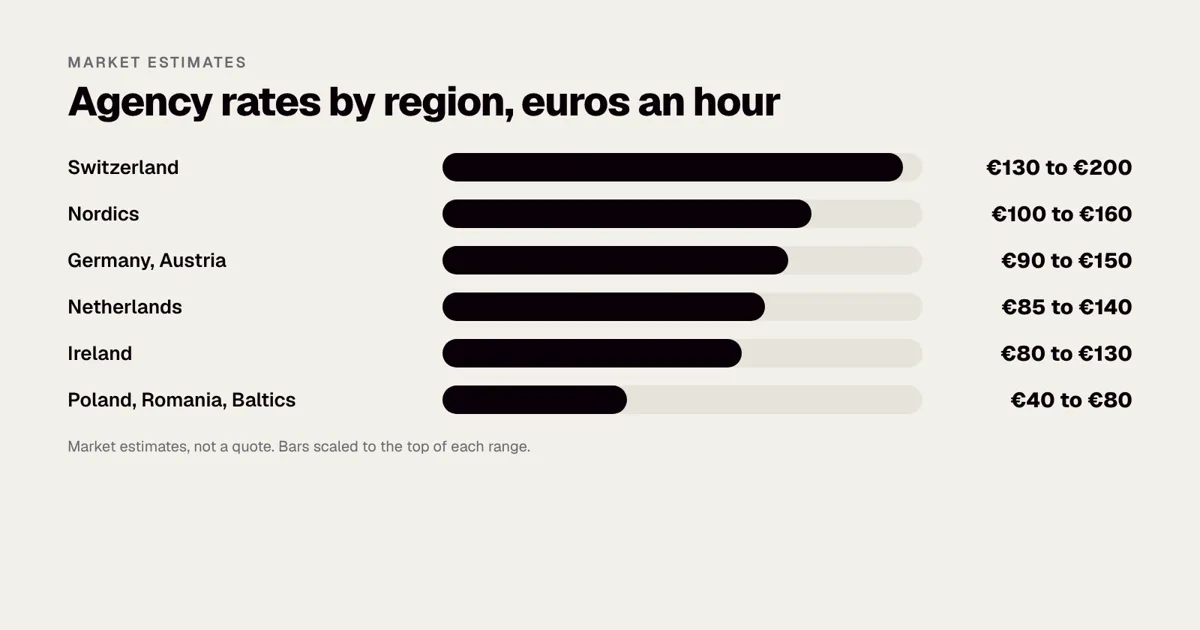
How do rates differ across European countries?
| Country or region | Typical agency rate (EUR, an hour) | Notes |
|---|---|---|
| Switzerland | €130 to €200 | Highest rates in Europe |
| Germany, Austria | €90 to €150 | Munich and Frankfurt at the top of the range |
| Nordics | €100 to €160 | Strong design culture, high salaries |
| Netherlands | €85 to €140 | Mature agency market |
| Ireland | €80 to €130 | Strong fintech and SaaS skills |
| France, Spain, Italy | €60 to €110 | Wide variation by city |
| UK senior studio | €70 to €120 | One hour behind CET, English-first |
| Poland, Romania, Baltics | €40 to €80 | Strong engineering, design depth varies |
Rates follow local salaries. Eurostat publishes comparable labour cost data across EU countries (Eurostat), and the gap between Western and Eastern member states explains most of the rate gap. How much does an app cost in Germany goes deeper on Germany, and UK vs Eastern Europe for European companies building apps compares UK and Eastern European teams.
Why the cheapest rate is not the cheapest project
A lower rate does not guarantee a lower total. Four things can erase the difference.
- Productivity and experience. A senior team that has built a similar product may need half the time of a junior team learning as it goes.
- Management overhead. If you must spend your own time clarifying requirements, answering questions and testing, your internal cost rises. Count it.
- Rework. Poor early decisions on architecture, security or accessibility are expensive to correct later.
- Hidden extras. Some quotes exclude design, testing, project management or deployment. Ask for every item to be listed.
A fairer comparison is the cost of the finished, tested, store-ready outcome, written down as a fixed scope. App development rates 2027: UK vs US vs Eastern Europe vs Asia and App development hourly rates explained: what you get at each price explain how rates translate into project cost. We note that market rates are a reference point only. Rounded Labs does not sell by the hour: every project is priced as a fixed amount before development starts.
Local agency or UK studio?
The choice is not only about price. It also covers language, procurement rules, time zone, contracts and the comfort of meeting in person.
| Consideration | Local agency | UK studio |
|---|---|---|
| Language and culture | Native language and local business norms | English-first, with experience of European clients |
| Procurement | Easier for public bodies with local preference rules | Possible, but check tender rules |
| Rates | Often higher in DACH, Nordics and Switzerland | Often lower than DACH and Nordics |
| Time zone | Same | One hour behind CET |
| Contracts and VAT | Domestic | Cross-border, with reverse charge VAT often relevant for business customers |
| Data location | Usually local | Can be EU hosted on request |
Our articles on DACH companies: local agency or UK studio? and Hiring a UK studio from the EU after Brexit: contracts, VAT and data cover these in detail. Have your finance team confirm the VAT treatment for your situation.
Which EU rules add cost to an app?
European apps carry a compliance layer that US budgets often leave out. The dates and duties below are correct at the time of writing, but regulation moves, so confirm each point with the official source and your legal adviser. This is general information, not legal advice.
- GDPR. Consent flows, data subject rights, a privacy policy, records of processing and sometimes a data protection impact assessment. Usually 3 to 8% of the build. GDPR for US companies launching an app in Europe covers GDPR for companies new to Europe, and the European Data Protection Board publishes guidelines.
- European Accessibility Act. Since 28 June 2025, many consumer-facing digital services, including ecommerce and banking apps, must meet accessibility requirements (check the current text with the European Commission). Building to WCAG 2.2 AA from the start adds 3 to 8%; retrofitting later costs more. See App accessibility.
- Cyber Resilience Act. Software products sold in the EU face security and vulnerability-handling duties, with vulnerability and incident reporting duties applying from September 2026 and most other duties from December 2027. See The EU Cyber Resilience Act and your app.
- EU AI Act. AI features may carry transparency duties, and some uses are high-risk. See The EU AI Act for app and SaaS owners: what applies and when.
- Sector rules. DORA for financial services (post:G9), the Medical Device Regulation for some health apps, PSD2 for payments.
What it costs to make an app GDPR and AI Act ready puts numbers on the cost of making an app GDPR and AI Act ready. The EU publishes its legislation on EUR-Lex, which is the official source to check.
Need a quote in euros? We price European projects in EUR, work in CET-friendly hours and build to GDPR and accessibility rules from day one. Book a 30-minute call with a co-founder.
A compliance cost table
| Item | Typical addition to the build | Who it affects |
|---|---|---|
| GDPR design (consent, rights, records, retention) | 3 to 8% | Almost every app |
| Accessibility to WCAG 2.2 AA | 3 to 8% | Consumer services in scope of the EAA, and good practice elsewhere |
| Security testing and vulnerability handling | 3 to 6% | Every app, more for products sold as software |
| AI transparency and documentation | 2 to 6% | Apps with AI features |
| Sector rules (finance, health, payments) | 10 to 30% or more | Regulated sectors |
| Legal review of terms and privacy notices | €2,000 to €8,000 in total | Almost every app |
Together, these commonly add 5 to 15% to a business app that is not in a regulated sector. Those are planning figures, not promises, and a legal adviser should confirm what applies to your product.
Which rules apply to which app?
Many buyers ask whether they are “in scope”. The table gives a first-pass guide only. Take advice for your case.
| Your app | Rules to check first |
|---|---|
| Consumer shop or booking app | GDPR, European Accessibility Act, consumer law, payments rules |
| B2B workflow app for your own staff | GDPR, employment law on monitoring, security |
| App with AI features | GDPR, EU AI Act transparency duties |
| Fintech or payments app | GDPR, PSD2, DORA, anti-money-laundering rules, licensing |
| Health or wellbeing app | GDPR special category data, Medical Device Regulation if it makes medical claims |
| App sold as a product to other businesses | Cyber Resilience Act, NIS2 for some suppliers, GDPR as processor |
DORA for fintech apps and their suppliers and NIS2 for software suppliers cover two rules that increasingly appear in procurement questionnaires. Fintech apps in Europe: PSD2, open banking and DORA takes the finance sector in more depth.
How do costs vary by sector?
The same technical scope costs different amounts depending on the sector, because rules, integrations and risk differ.
| Sector | Cost effect | Why |
|---|---|---|
| Retail and ecommerce | Baseline | Well understood patterns, payment and catalogue integrations |
| Booking and services | Baseline | Calendar logic and reminders |
| Marketplace | Up 20 to 40% | Two sides, payouts, disputes and back office |
| Fintech | Up 30 to 100% | Licensing, security, partner integrations and audit trails |
| Health | Up 20 to 60% | Special category data, clinical safety and possibly device regulation |
| Public sector | Up 10 to 30% | Procurement, accessibility, security reviews and documentation |
| Industrial and field service | Baseline to up 30% | Offline mode, ERP integration and device variety |
For more specific guidance, see our guides for marketplace apps in Europe, booking apps in Europe, banking apps in Europe, healthcare app development in Europe and retail app development in Europe. For software businesses, SaaS development cost in Europe covers multi-tenant products. For public sector bodies, AI for European public sector bodies and From prototype to procurement: AI for a European government describe how a project moves from prototype to a procurement-ready product, as in our Bavarian government work.
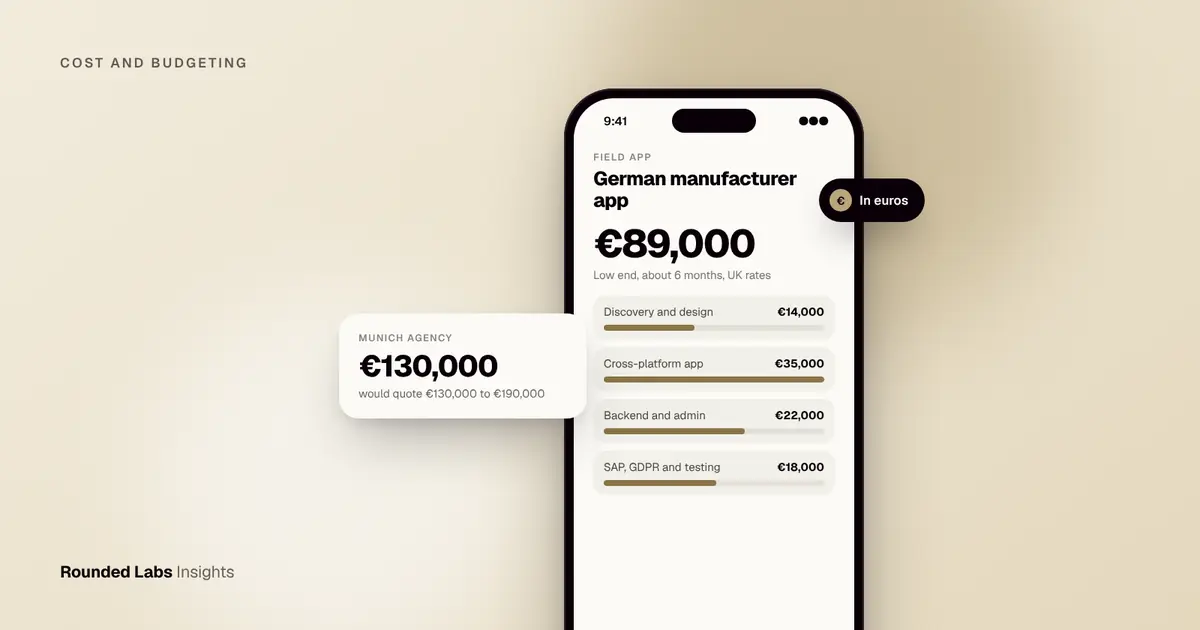
A worked example: a B2B field app for a German manufacturer
A Mittelstand manufacturer wants a tablet and phone app for 300 service engineers: job lists, offline checklists, photos, signatures, and sync with SAP.
| Item | Effort | Cost at UK studio rates |
|---|---|---|
| Discovery, process mapping and design | 4 weeks | €14,000 to €20,000 |
| Cross-platform app with offline mode | 10 weeks | €35,000 to €48,000 |
| Backend, sync and admin dashboard | 8 weeks | €22,000 to €30,000 |
| SAP integration | 4 weeks | €12,000 to €18,000 |
| GDPR, accessibility and security testing | 2 weeks | €6,000 to €9,000 |
| Total | About 6 months | €89,000 to €125,000 |
A Munich agency would typically quote €130,000 to €190,000 for the same scope. How to make your app work offline explains why offline-first apps take extra work, and Legacy software to SaaS for German Mittelstand companies covers legacy modernisation for German companies.
Reading the example
Three lessons come from this scope.
- The integration is the risk. The SAP work is only four weeks in the plan, but it depends on access, test systems and the cooperation of the internal SAP team. Confirm those before you sign. What is an API integration? and How to add ERP integration to your app describe how these projects run.
- Offline is a design choice with a price. If engineers work in plants with poor signal, offline mode is essential and accounts for a visible share of the budget.
- Compliance fits in a small slice if it is planned. The compliance and security line here is under 10% of the total. It would be far larger if added after the app was finished.
A related approach to enterprise customers in Germany is covered in Delivering for German enterprise clients: lessons from Cubeware.
A second example: a Dutch consumer booking app
A mid-sized Dutch wellness business wants an app for customers to book classes, buy passes, receive reminders and manage their account, with a web admin for studio managers. It must meet accessibility rules and use iDEAL and card payments through a payment provider.
| Item | Effort | Market estimate (UK studio) |
|---|---|---|
| Discovery, design and prototype | 3 weeks | €9,000 to €14,000 |
| Customer app: browse, book, pay, manage | 9 weeks | €26,000 to €38,000 |
| Studio admin and timetable management | 5 weeks | €12,000 to €18,000 |
| Payments, passes and receipts | 3 weeks | €7,000 to €11,000 |
| Reminders, notifications and email | 2 weeks | €4,000 to €6,000 |
| Accessibility, GDPR, testing and launch | 3 weeks | €7,000 to €11,000 |
| Total | About 4 to 5 months | €65,000 to €98,000 |
A Dutch agency would probably price the same scope higher, though the gap varies by firm. The main variable here is the pass and subscription logic: studios invent complicated rules about expiry, freezes and refunds, and each rule is code and a test. Agree the rules in writing before design starts. How much does a booking app cost in Europe? and How to add subscriptions to your app cover the patterns.
What should a European app brief include?
A good brief saves money because it reduces guesswork in every quote. Whether you issue a formal tender or send an email to three suppliers, cover the following points.
- Business goal and users. Who will use the app, what job does it do for them and how will you know it worked? Give numbers where you have them, such as the number of engineers, customers or locations.
- Platforms and devices. iOS, Android, tablets, web admin. State minimum operating system versions if they matter, for example because staff use older company devices.
- Languages and markets. Which languages at launch and which countries. Say whether right-to-left text, local payment methods or local tax rules are needed.
- Integrations. Name every system the app must connect to, who owns it and whether an interface is documented. Include test system availability.
- Data and hosting. What personal data is collected, where it must be stored and who may access it. Mention any customer or sector requirements, such as ISO 27001 or specific audits.
- Accessibility. State the target standard, such as WCAG 2.2 AA, and whether the app falls under the European Accessibility Act.
- Security expectations. Sign-in method, single sign-on, device management, penetration testing and any internal security review process. Mobile app security checklist: OWASP MASVS in plain English can be attached as a reference.
- Budget range and timeline. Giving a range lets suppliers propose what fits, instead of guessing. Mention any fixed dates such as a trade show or a regulatory deadline.
- After launch. Who will own the product, what support you expect and how updates will be handled.
- Procurement rules. Any tender process, insurance, references or contract terms the supplier must meet.
How to brief an app development agency has a longer template, and How to write an app specification (free template) helps with the detail. When you receive responses, look for suppliers who challenge your assumptions. A supplier who agrees with everything may not have understood the work.
Red flags in European quotes
- A price with no scope list, or a scope list that does not mention testing, accessibility or data protection.
- A very low price from a supplier who cannot show comparable live apps.
- No named people, or a promise that “the team” will be assigned later.
- Reluctance to give you ownership of the code, designs and accounts.
- No mention of what happens after launch.
- Pressure to sign quickly without a discovery phase.
Red flags when hiring app developers and How to choose an app development company in the UK: a 2026 checklist expand on these points. The checklist is written for the UK but applies equally to European buyers.
What is different about buying an app in each major market?
Price is only one part of the picture. Buyers in each market bring their own expectations, and a supplier who ignores them creates friction. The notes below are general observations, not rules, and individual firms vary.
Germany and Austria
Procurement tends to be thorough. Expect detailed requirements documents, data protection officers who read the architecture, works councils who ask how an internal app monitors staff, and an expectation of formal documentation. Industrial buyers often need integration with SAP and older systems, and offline use in plants and on sites. Contracts are typically detailed, and a fixed price against a specified scope fits the culture well. German-language interfaces are normal, so budget for translation and for longer text in layouts. Our guide on how much an app costs in Germany goes further.
The Netherlands
The agency market is mature and competitive, and buyers are usually well informed about options, so quotes are often compared line by line. Payment methods matter: iDEAL is widely used for online payments in the Netherlands, so a consumer app that does not support it may lose conversions. Accessibility and privacy are taken seriously by public bodies and larger companies.
Ireland
Ireland has a strong base of fintech and software-as-a-service companies, many of which sell across Europe and need GDPR and security evidence for their own enterprise customers. Buyers often want to move quickly and to show a working product to investors or customers. EU hosting in Dublin is common.
The Nordics
Design quality and usability expectations are high, digital identity and payment infrastructure is mature, and salaries push agency rates up. Consumers expect smooth sign-in with national digital identity schemes, which adds integration work. Accessibility and sustainability are often explicit requirements in tenders.
Switzerland
Rates are the highest in Europe, and data residency and sector rules, particularly in finance and health, are taken seriously. Switzerland is not in the EU, so check how its data protection law interacts with the GDPR for your case, and ask your legal adviser about cross-border transfers.
France, Spain and Italy
Local-language interfaces are essential, and regional variation in rates is wide. Public tenders have their own rules, and some buyers prefer a local partner for support. A UK or other international supplier is usually a better fit for English-speaking product teams or technical projects than for heavily localised public sector work.
Eastern Europe
Strong engineering talent and lower rates are the headline. The main risks are variable design depth, time zone and language differences in some teams, and the management effort needed to turn requirements into a good product. Many European companies use a mix: product and design in one place, engineering capacity in another. UK vs Eastern Europe for European companies building apps explains the trade-offs.
What is in a typical European app project plan?
A well run project has clear phases. The durations below are typical for a mid-size app and are market estimates.
| Phase | Typical duration | Main outputs | Share of budget |
|---|---|---|---|
| Discovery | 2 to 4 weeks | Scope, priorities, architecture, plan and fixed price | 8 to 12% |
| Design | 3 to 5 weeks | Flows, interface designs, clickable prototype, accessibility review | 10 to 15% |
| Build | 8 to 16 weeks | App, backend, admin, integrations | 50 to 60% |
| Test and harden | 3 to 5 weeks | Device testing, security checks, accessibility checks, fixes | 10 to 15% |
| Launch and handover | 1 to 2 weeks | Store submission, hosting, documentation, training | 3 to 5% |
Phases overlap in practice. Design for the next screens continues while the first are built, and testing begins as soon as the first features work. The key point for a buyer is that discovery and design are not overhead. They are where the biggest and cheapest decisions get made, and a project that skips them tends to pay for the same decisions later at a higher price. App testing explained: QA, UAT and beta testing explains how the test phase works, and App launch checklist: 30 steps before you publish covers the end.
Who is on the team, and why does it change the price?
| Role | Typical involvement | Effect on price |
|---|---|---|
| Product or project lead | Throughout | Keeps scope, timeline and communication in order |
| Designer | Discovery and design, then part-time | Shapes usability and accessibility |
| Mobile engineers | Build and test | The largest cost share |
| Backend engineer | Build and integrations | Rises with integrations and scale |
| Tester | Build and test | Reduces rework and launch risk |
| Security and compliance input | Targeted | Small but important share |
A cheaper quote sometimes omits one of these roles. A project with no tester finds its bugs in production, and a project with no lead drifts. Ask who will be on your team and what percentage of their time you are paying for.
What does an app cost to run after launch?
- Store fees: Apple charges $99 a year and Google Play a one-off $25 at the time of writing. Under the Digital Markets Act, alternative payment and distribution options exist in the EU, with their own fee terms, so check Apple’s and Google’s current pages.
- Hosting in the EU: €200 to €3,000 a month for most business apps. Hosting in EU regions (Frankfurt, Dublin, Amsterdam) simplifies GDPR.
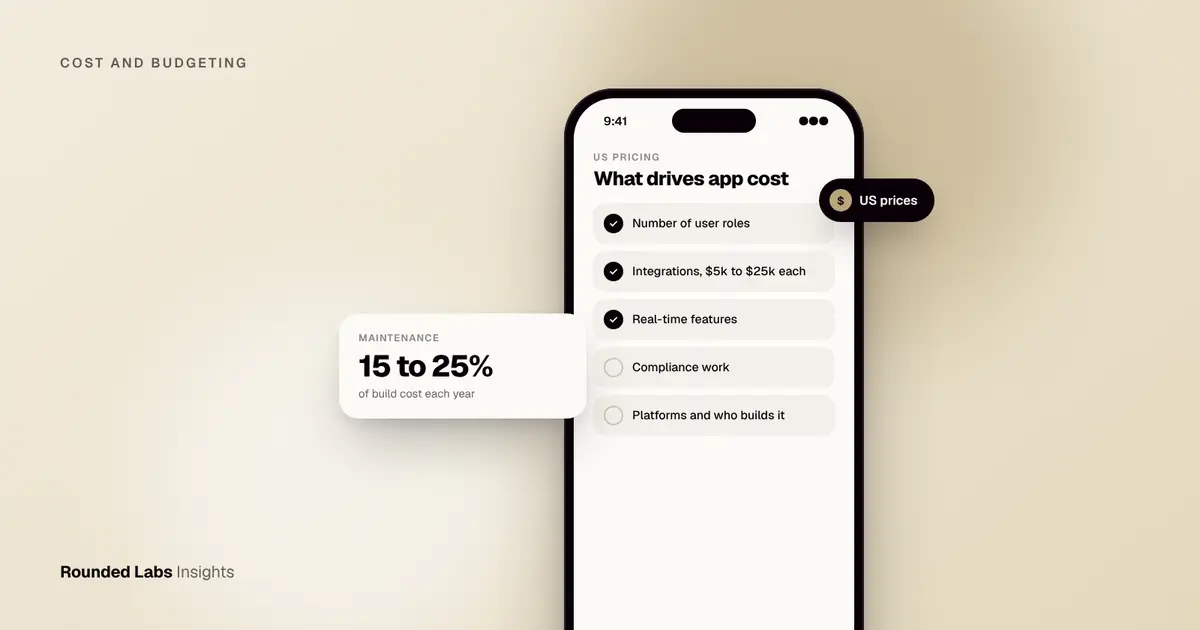
- Maintenance: 15 to 25% of the build cost each year. App maintenance costs in the UK: what to budget after launch has a line-by-line maintenance budget.
A sample yearly running budget
For a mid-size app that cost €90,000 to build, a planning budget might look like this. All numbers are market estimates.
| Item | Yearly estimate | Notes |
|---|---|---|
| Maintenance and updates | €13,500 to €22,500 | 15 to 25% of the build |
| Hosting and monitoring | €2,400 to €12,000 | €200 to €1,000 a month for this size |
| Third party services | €1,000 to €8,000 | Email, SMS, maps, analytics |
| Store accounts | About €100 | Check current fees |
| Legal and privacy reviews | €1,000 to €3,000 | Annual review of notices and contracts |
| Security testing | €3,000 to €8,000 | Depends on risk and customer requirements |
| Total | About €21,000 to €54,000 | Varies widely with usage |
Plan for this from the start. The total cost of owning an app over five years shows why ownership cost often exceeds build cost, and The hidden costs of building an app: store fees, hosting and APIs lists the lines people forget.
How do you compare quotes from different countries?
Collect at least three quotes, ideally from different markets, against the same written scope. Then compare them with a table like this.
| Check | Question to ask | Why it matters |
|---|---|---|
| Scope | Is every screen, role and integration listed? | Prevents unseen extras |
| Platforms | Is it one cross-platform app or two native apps? | A 30 to 60% difference |
| Design | Is UX and UI design included? | Often excluded from low quotes |
| Testing | What devices and test types are included? | Poor testing is costly later |
| Compliance | Are GDPR, accessibility and security included? | Retrofit costs more |
| Hosting | Where, and who pays? | Data location and monthly cost |
| Ownership | Who owns the code, designs and accounts? | Affects your freedom to change supplier |
| Price type | Fixed price or open-ended? | Changes your risk |
| After launch | What support or updates are included? | Prevents surprise bills |
How to brief an app development agency helps you write the scope, and What a good app development proposal looks like explains what to expect back. 20 questions to ask an app developer before you sign is a good list for the meeting itself. If you are choosing between local and international suppliers, UK vs offshore app development: an honest comparison sets out the trade-offs.
Fixed price versus open-ended pricing
Many European buyers are used to being offered a rate and an estimate of days. That can work, but it moves the risk of overrun to you. A fixed price agreed before development starts moves it to the supplier, provided the scope is written down and changes are handled openly. The cost of that certainty is a disciplined discovery phase, which is why it is worth paying for. Fixed price vs time and materials for app projects goes through the difference, and What happens in a discovery phase, and why it saves money explains the first step. A budget conversation can be started with a Mobile Product Discovery Sprint at £9,500 or, if you already have software, a Tech Architecture Audit at £7,500.
How can you reduce the cost without cutting quality?
- Launch one platform or one cross-platform build. Avoid two native apps unless a feature requires it. See iOS first or Android first?.
- Cut the first release to one core journey. What is an MVP? shows how to draw the line.
- Use proven services for payments, authentication and messaging rather than building them.
- Design once, for all your markets. Plan multi-language support at the start. How to add multi-language support to your app explains how.
- Build accessibility in from the first design. It is cheaper than retrofitting.
- Choose a backend that fits your size. Firebase, Supabase or a custom backend? helps you decide.
- Control AI costs. If you add AI, set usage limits and measure cost per request. How to keep AI running costs under control has a practical approach.
- Write a good specification. Our free app specification template saves design time and reduces change requests. How to cut app development costs without cutting quality has further ideas.
What not to cut
Some savings cost more later. Do not cut security testing, accessibility, data protection design or proper handover of the code and accounts. These are the areas where a retrofit is slow and where a failure can lead to fines, customer loss or rework.
How should European buyers think about funding?
Budgets in Europe can often be supported by public funding, depending on the country, sector and company size. Examples include national innovation grants, regional programmes and EU-level schemes. We do not list specific schemes or amounts here because they change frequently and eligibility is narrow. Check your national innovation agency and the European Commission funding pages for the current position. For companies working with a UK supplier, R&D tax relief and Innovate UK funding for app projects explains UK schemes, which may be relevant if you have a UK entity. Speak to your tax adviser before assuming any relief applies.
How we work with European clients
- Fixed-price projects, typically £30,000 to £250,000+ (roughly €35,000 to €290,000), quoted and invoiced in euros on request. See our pricing page. Conversion rates change, so the euro figure at the time of your quote may differ.
- Working hours one hour behind CET, so full-day overlap.
- EU data hosting on request, GDPR built into design, and accessibility to WCAG 2.2 AA.
- Experience with DACH enterprise procurement through our work with Cubeware and the Bavarian government. Hiring a UK studio from the EU after Brexit covers contracts, VAT and data when you hire a UK studio from the EU.
We have built mobile software since 2007, including the UK’s first mobile banking app, MoBank, and the Superdry app for a business with 768 locations in over 100 countries. For European buyers the relevant point is that the same delivery discipline applies to a Mittelstand field app, a Dutch consumer app or a Nordic fintech: a clear scope, a fixed price, regular demonstrations and a clean handover.
Data transfers and hosting
If personal data is held in the EU and accessed by a UK team, the transfer must be lawful. At the time of writing the UK benefits from an EU adequacy decision, but you should confirm that this remains in force and which safeguards your contract needs. UK and EU data transfers for app projects, explained goes through the points, and we can host in EU regions on request, such as Frankfurt, Dublin or Amsterdam.
What mistakes do European buyers make when budgeting?
- Comparing rates, not outcomes. A low rate with a long timeline can cost more than a higher rate with a short one.
- Forgetting compliance. GDPR, accessibility and security work is real work and should be on the quote.
- Underestimating integrations. ERP, CRM and banking links are often the most uncertain part of a project.
- Skipping discovery. Skipping it is the most common way to turn a fixed budget into an open one.
- Ignoring running costs. Hosting, maintenance and third party fees continue every year.
- Not owning the accounts. Make sure developer accounts, cloud accounts and source code are in your company’s name. See Who owns the code? IP, contracts and escrow for UK app projects.
- Assuming one country’s price applies everywhere. A German public tender, a Dutch start-up and an Irish fintech have different needs.
- Treating AI as free. AI features carry ongoing usage costs and regulatory duties. See How much does it cost to add AI to an app?.
- Building for every market at once. Start with one language and one country if you can. Expand once you have proof.
A budgeting checklist for European buyers
- Write the three most important user journeys and the number of user roles.
- List every integration and confirm access to each system.
- Decide on cross-platform or native, and list any feature that needs native code.
- Identify which EU rules apply to your product and sector, and who will confirm that.
- Decide where data will be hosted and who may access it.
- Decide which languages the app must support at launch.
- Get at least three quotes against the same written scope, and ask each to list exclusions.
- Add 15 to 25% a year of the build cost for maintenance, plus hosting and third party fees.
- Agree who owns the code, designs and store accounts.
- Plan a pilot with real users before a full rollout. How to estimate your app budget in pounds, dollars or euros offers a worksheet approach.
Frequently asked questions
How much does a simple app cost in Europe?
A simple app with up to ten screens, login and a light backend costs about €25,000 to €50,000 with a Western European agency and €20,000 to €40,000 with a UK studio. Expect 8 to 12 weeks. These are market estimates, not quotes, and a fixed price depends on a written scope.
Is it cheaper to build an app in Eastern Europe?
Hourly rates in Poland, Romania and the Baltics are often half those in Germany. Total cost depends on productivity, design depth and management effort, so compare quotes for the same written scope. Time zone, language and contract terms also matter.
Does GDPR make apps more expensive?
GDPR typically adds 3 to 8% to a build for consent, data rights, documentation and security. It costs far less when designed in from the start than when added after launch. This is general information, not legal advice.
Do I need an EU-based developer to sell in the EU?
No. Your developer can be anywhere. What matters is that the app meets EU rules and that personal data is processed lawfully, including any transfers outside the EU. The UK has held an EU adequacy decision, which you should confirm is still in force; see UK and EU data transfers for app projects, explained.
How long does an app take to build in Europe?
Timelines do not depend on country: 8 to 12 weeks for a simple app, 3 to 6 months for mid-size, 6 to 12 months for a complex platform. See How long does it take to build an app? Real timelines from 19 years of projects.
Do I have to make my app accessible under EU law?
Many consumer-facing digital services, such as ecommerce and banking apps, have had to meet accessibility requirements under the European Accessibility Act since 28 June 2025, with some exemptions, for example for micro-enterprises providing services. Check the current text and your national law, and build to WCAG 2.2 AA as good practice. See App accessibility.
Can Rounded Labs quote in euros?
Yes. We agree a fixed price before development starts and can quote and invoice in euros on request, with the exchange rate set at the time of the quote. To discuss your scope, book a call with a co-founder.
Official sources and further reading
Talk it through with one of our co-founders. 30 minutes, no pressure.