

A business app built by a German agency typically costs €50,000 to €150,000 for a focused first version and €150,000 to €450,000 or more for a complex enterprise platform. German agency rates of €90 to €150 an hour are among the highest in Europe, which is why many German companies also consider UK and Eastern European partners for part or all of a project.
We have worked with German clients for years, including moving Cubeware, an analytics provider with 4,000+ enterprise customers across Germany, Austria and Switzerland, to SaaS, and building an AI land classification prototype for the Bavarian government. This guide gives German buyers realistic budgets, explains what German expectations add to a project, and shows how to compare a local agency with a UK studio on equal terms. All figures are market estimates, not quotes. Rounded Labs prices its own projects as a fixed price agreed before development starts, typically £30,000 to £250,000+, as set out on our pricing page. Where law is discussed, this is general information, not legal advice, and you should check the official source and take advice for your own situation.
Key facts
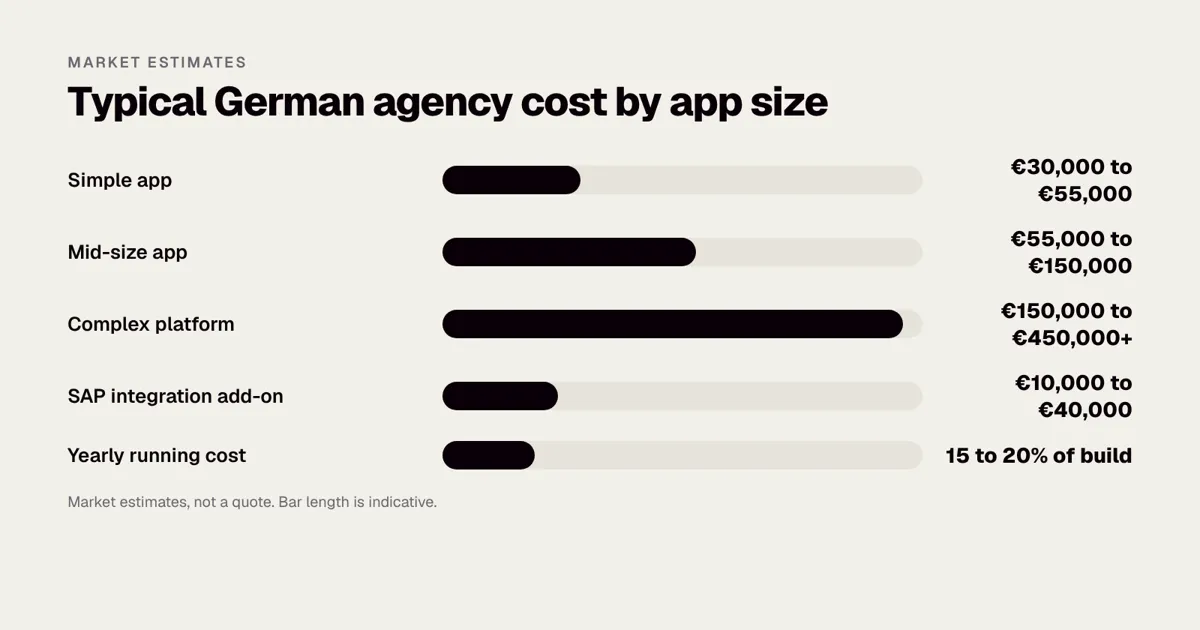
- Simple app: €30,000 to €55,000. Mid-size app: €55,000 to €150,000. Complex enterprise platform: €150,000 to €450,000+.
- German agency rates: about €90 to €150 an hour, with Munich and Frankfurt at the top and eastern cities lower.
- German requirements often add cost: data protection (DSGVO), accessibility (BITV 2.0 for public bodies), works council approval for staff apps, and SAP integration.
- A UK studio is typically 25 to 40% cheaper than a German agency for comparable scope, but only if the scope is written down properly.
- Budget 15 to 20% of the build per year for running costs, plus 10 to 15% contingency.
- Procurement and approvals can add 4 to 12 weeks before any build begins.
How much does an app cost in Germany by size?
Price depends far more on scope than on the city or the agency’s logo. The table below uses three sizes that most German buyers recognise. The figures are market estimates drawn from the range of quotes buyers typically report, not quotes from us, and they assume one product for iOS and Android built cross-platform.
| App size | Typical scope | German agency | UK studio (in €) | Timeline |
|---|---|---|---|---|
| Simple | Up to 10 screens, login, content | €30,000 to €55,000 | €20,000 to €40,000 | 8 to 12 weeks |
| Mid-size | Accounts, payments, admin, one or two integrations | €55,000 to €150,000 | €40,000 to €100,000 | 3 to 6 months |
| Complex | SAP or ERP integration, offline, roles, compliance | €150,000 to €450,000+ | €100,000 to €300,000+ | 6 to 12 months |
The three rows are not a ladder you climb gradually. Each step usually marks a change in kind: from content to transactions, and from transactions to integration with systems the business already runs. The jump from mid-size to complex is the largest, because integration with SAP or another ERP means working with data models, authorisation rules and release cycles that you do not control.
For a wider look at costs across the continent, including the Netherlands, Ireland and the Nordics, see App development cost in Europe. If you want to turn these ranges into your own number, How to estimate your app budget in pounds, dollars or euros walks through the method.
What do the three sizes look like in practice?
A simple app is something like a product catalogue with a contact form, an event guide for a trade fair, or a branded companion app for a service. It has a handful of screens, a login, and content that an editor can update. There is usually no payment and no integration. The risk is not technical: it is that the app gets built and no one uses it, so a short validation step is worth the money. How to validate an app idea before you spend £50k covers cheap ways to do that.
A mid-size app is a customer portal, a booking tool, a member app or an internal workflow tool. It has accounts and roles, probably a payment or a document flow, an admin area for staff, and one or two integrations such as a CRM or a payment provider. Most German business apps sit here. This is where fixed scope pays off, because the number of small decisions is large enough that unmanaged changes will move the budget.
A complex platform is a multi-role system tied to SAP or another ERP, with offline use for field staff, audit trails, single sign-on and formal security review. Timelines of 6 to 12 months are normal, and most of the variation comes from the other side of the integration: how well documented the existing system is, and how quickly your IT team can open test environments.
Why are German agency rates so high?
German software developer salaries are among the highest in the EU, and Destatis, the federal statistics office, reports labour costs well above the EU average (Destatis). Agencies add employer social contributions, office costs, tooling and margin on top of salary, and larger agencies carry sales and project management layers that smaller studios do not. Rates also vary by city:
| City | Typical agency rate (market estimate) |
|---|---|
| Munich | €110 to €160 an hour |
| Frankfurt | €100 to €150 an hour |
| Hamburg | €95 to €140 an hour |
| Berlin | €85 to €135 an hour |
| Leipzig, Dresden and other eastern cities | €70 to €110 an hour |
These are market estimates for agency work. Individual freelancers in the same cities often charge less, but they bring a different risk profile, which is covered in App agency vs freelancer vs in-house team.
What does a rate actually buy?
A rate is only one side of the cost equation. The other side is how many hours a given scope takes, and that depends on the team’s experience with similar work, how much reusable code they have, and how much management overhead sits between you and the people writing code. A higher rate with fewer hours can cost the same as a lower rate with more hours. Two buyers comparing a €140 an hour agency with a €90 an hour studio often discover that the total quotes are within 15% of each other once the scope is written out line by line.
That is why we suggest comparing totals for a defined scope, not rates. If you only get a rate card, you cannot predict the final bill. App development rates explained: what you get at each price goes deeper on this, and App development rates 2027: UK vs US vs Eastern Europe vs Asia puts German rates in a global frame.
Why a fixed price changes the comparison
Many German agencies quote on a time-and-materials basis, which means you pay for the hours actually worked and carry the risk of overrun. A fixed price reverses that: the supplier carries the risk of overrun, and you carry the responsibility of defining scope. At Rounded Labs we only work to a fixed price agreed before development starts, and our projects typically run £30,000 to £250,000+. Our productised services have set prices too: a Tech Architecture Audit is £7,500, Digital Transformation Prep is £7,000, a Mobile Product Discovery Sprint is £9,500 and a Legacy App Rescue Assessment is £6,500. See Fixed price vs time and materials for app projects for how the two models compare, and App development quotes compared for why quotes vary so widely.
What do German requirements add to an app project?
German buyers, especially in the Mittelstand and the public sector, expect thoroughness. That is a strength, because it avoids surprises, but it carries cost that a quote from a generic app studio may not include. The items below are the ones that most often change a German budget.
Data protection (DSGVO)
The GDPR, known in Germany as the DSGVO, applies to any app that handles personal data of people in the EU. In practice, a German project usually needs:
- A data processing agreement (Auftragsverarbeitungsvertrag) with every supplier that touches personal data, including the development partner and hosting provider.
- A record of processing activities and clear lawful bases for each use of data.
- EU hosting by default, with a documented reason for any transfer outside the EU.
- A data protection impact assessment where processing is likely to be high risk.
- Working deletion and export routes, so that a user request can be honoured within the legal deadline.
German data protection supervisory authorities are active, and many buyers have an internal data protection officer who will ask detailed questions during procurement. The federal commissioner publishes information on its homepage (BfDI), and the text of the regulation is on EUR-Lex. Our guide GDPR for US companies launching an app in Europe covers the basics, and What it costs to make an app GDPR and AI Act ready shows where the cost sits. Allow roughly 5 to 10% of the build for privacy design, documentation and testing on a mid-size project. This is a market estimate.
Works council approval
An app used by employees, such as field service reporting, time tracking or shift planning, can need agreement from the works council (Betriebsrat), because tools that can monitor behaviour or performance are subject to co-determination under the Works Constitution Act. Whether your app triggers this depends on what it records and who can see it, so ask your legal or HR team early.
The practical consequence is time. A works council will want to see what data is collected, who can view it, how long it is kept and what reports exist. Preparing a short, plain document answering these questions, and showing the council a prototype, can turn a six-week delay into a two-week one. Build the data fields with this in mind: if the app does not need to record an individual’s location after the shift ends, do not record it.
Accessibility
Public bodies in Germany must meet BITV 2.0, which is based on the Web Content Accessibility Guidelines. Consumer-facing digital services also fall under the European Accessibility Act, which has applied since 28 June 2025 at the time of writing. Both are covered in App accessibility: the European Accessibility Act and UK guidance. Check the current scope and exemptions on the European Commission site and with your own advisers, because they depend on your sector and company size.
Accessibility is cheapest when designed in. Colour contrast, text scaling, screen reader labels and touch target size cost little if they are part of the first design, and a lot if retrofitted after audit. The W3C publishes the underlying guidelines on its homepage (W3C).
SAP and ERP integration
Many German companies run SAP, and an app that cannot read from or write to it is often of limited use. Integration commonly adds €10,000 to €40,000 depending on the interface, the quality of documentation and whether an integration layer already exists. SAP publishes its integration tooling and documentation on its own site (SAP).
The main cost drivers are:
- Interface type. Modern APIs are cheaper than legacy file exchanges or custom interfaces.
- Test access. If your IT team needs three weeks to provide a test system, the project waits three weeks.
- Data quality. Duplicate customer records, missing fields and inconsistent codes need cleaning before an app can display them sensibly.
- Authorisation. Mapping app roles to SAP roles is often the slowest part.
Our explainer What is an API integration? covers the general approach.
Documentation in German
User guides, admin documentation and training material in German add translation and review time. For user-facing text in the app itself, native review is essential: machine translation of interface labels leads to awkward wording that employees notice immediately. How to localise an app for Europe explains how to plan this.
Security expectations
Enterprise buyers often require a penetration test and controls in the style of ISO 27001. The Federal Office for Information Security (BSI) publishes guidance for German organisations on its homepage (BSI). For app projects, our Mobile app security checklist and What is penetration testing for apps? set out what is typically tested. A penetration test for a mid-size app is often priced separately by a specialist firm, and as a market estimate it can add a few thousand to low tens of thousands of euros.
At the time of writing, the EU Cyber Resilience Act introduces reporting duties from September 2026 and further duties from December 2027 for products with digital elements. Whether your app is in scope depends on how it is sold and what it does, so read The EU Cyber Resilience Act and your app and check the official text. If your business is a software supplier, NIS2 for software suppliers may also be relevant.
Planning an app in Germany? We work one hour behind CET, so there is a full shared working day, and we know German enterprise expectations from our DACH projects. Book a 30-minute call with a co-founder.
How is a German app budget built up?
Quotes often arrive as one number, which makes comparison hard. A useful way to read any quote is to split it into the groups below. The percentages are market estimates for a mid-size business app and will shift with your scope.
| Cost group | What it covers | Share of build |
|---|---|---|
| Discovery and design | Workshops, journeys, wireframes, prototype, scope document | 10 to 15% |
| Front end | App screens for iOS and Android, web portal if needed | 30 to 35% |
| Back end and admin | Database, APIs, admin area, roles | 20 to 25% |
| Integrations | SAP, CRM, payments, identity | 10 to 20% |
| Data protection, accessibility and security | Documentation, testing, penetration test | 8 to 12% |
| Testing and launch | Device testing, store submission, handover | 8 to 12% |
| Project management | Planning, reporting, reviews | 8 to 12% |
If a quote has no line for integrations, no line for security testing or no line for handover, ask why. The cheapest quote is often the one with the most missing lines.
Costs outside the build
Build price is not the whole budget. Add the following when you plan:
- Legal and data protection advice. Review of contracts, data processing agreements and, where relevant, the works council agreement.
- Content and translation. German and English text, help articles, training material.
- Store fees. At the time of writing, Apple’s developer programme costs $99 a year and Google Play charges a one-off $25 registration fee. Check the Apple Developer site and Google’s own pages for current terms. See The hidden costs of building an app for the wider list.
- Hosting and monitoring. EU-region cloud hosting, backups and alerts. Compare current prices on the providers’ own pricing pages, and see AWS vs Azure vs Google Cloud for app backends.
- Internal time. Your product owner, IT staff and subject experts will spend real hours. Many German projects underestimate this.
- Contingency. Set aside 10 to 15% of the build for change found in testing.
The total cost of owning an app over five years shows how these lines add up across the lifetime of the product.
What does a worked example look like: a customer portal for a German B2B supplier?
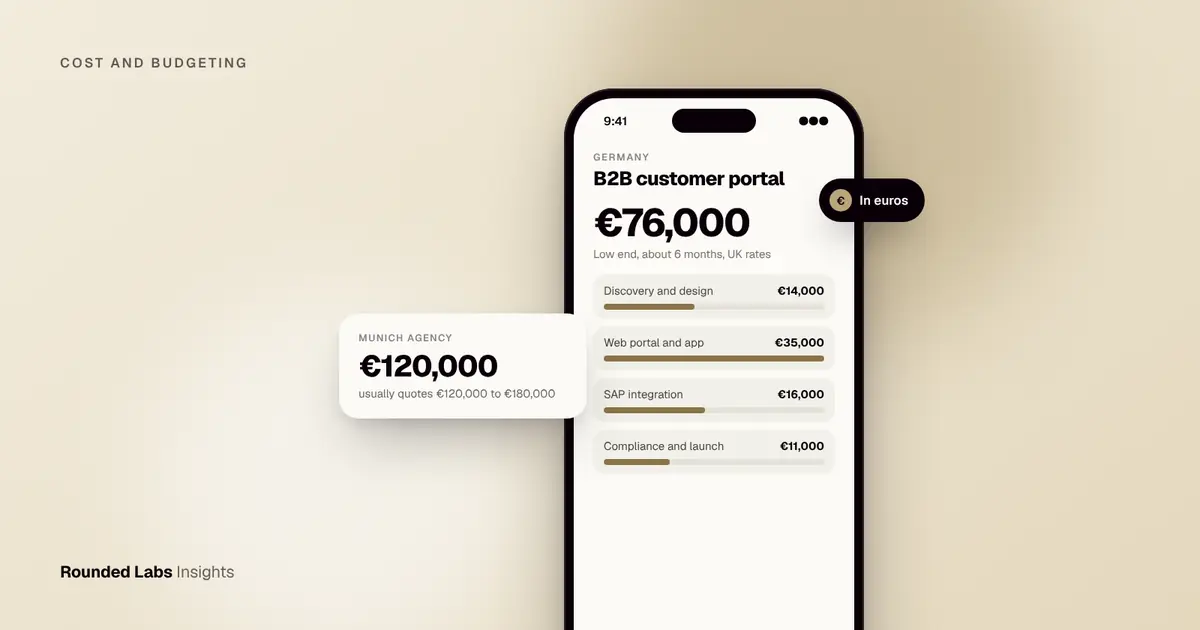
Imagine a mid-sized industrial supplier that wants a web and mobile portal where customers reorder parts, track deliveries and download certificates, connected to SAP. The table shows how a UK studio might price it. These are market estimates, not quotes.
| Item | Effort | Cost at UK studio rates |
|---|---|---|
| Discovery and design (in English and German) | 4 weeks | €14,000 to €20,000 |
| Web portal and cross-platform app | 10 weeks | €35,000 to €50,000 |
| SAP integration | 5 weeks | €16,000 to €24,000 |
| Data protection, accessibility and security testing | 2 weeks | €6,000 to €9,000 |
| Launch and handover | 2 weeks | €5,000 to €8,000 |
| Total | About 6 months | €76,000 to €111,000 |
A Munich agency would usually quote €120,000 to €180,000 for this scope, again as a market estimate. The difference does not come from one line. It comes from lower rates across the board and from a smaller management layer.
What would we do in the first four weeks?
Discovery is where this project is won or lost. A good discovery stage for this portal would:
- Interview three or four customers who reorder parts, to find out what they do today and where it hurts.
- Map the SAP objects the portal needs: customers, materials, orders, deliveries, certificates.
- Agree which user roles exist, such as buyer, accounts clerk and administrator.
- Build a clickable prototype and test it with customers on a real phone.
- Produce a scope document that lists what is in and out of the first release.
What happens in a discovery phase, and why it saves money explains the approach, and a Mobile Product Discovery Sprint at £9,500 fixed price is our version of it. For a company that is not sure its systems are ready, our Tech Architecture Audit at £7,500 looks at what the app will connect to before any build starts.
Where could the portal go wrong?
- The SAP test system arrives late, and the integration slips by three weeks.
- Customers want to see prices that depend on contracts, and the pricing logic turns out to live in a spreadsheet nobody documented.
- The first design uses grey text on white, which fails contrast checks, and the screens need rework.
- The works council is not involved, because the app is customer-facing, until staff are asked to use the admin area and raise concerns.
Each of these is avoidable with an early conversation. None is exotic. They are the normal friction of putting an app in front of an established business.
What about a second example: a field service app for a Mittelstand manufacturer?
A manufacturer with 60 service engineers wants an offline-capable app for job lists, checklists, photos and signatures, synchronised with its ERP. This is a complex build by our table, but it can be staged.
| Phase | What ships | Estimated cost (UK studio) |
|---|---|---|
| Phase 1 | Job list, checklist and photo capture, offline storage | €45,000 to €70,000 |
| Phase 2 | ERP sync, customer signature, PDF reports | €30,000 to €50,000 |
| Phase 3 | Parts ordering, reporting dashboard, roles | €25,000 to €45,000 |
| Total | €100,000 to €165,000 |
Three points shape the budget here. First, offline use means the app stores data locally and resolves conflicts when it reconnects, which is harder than it sounds. Our guide How to make your app work offline explains why. Second, this is a staff app, so the works council is involved from day one. Third, the engineers are the real users, so a pilot with five of them before the full rollout will find problems no workshop will. Compare with Field service apps for cleaning and trades businesses, which covers a similar pattern in the UK.
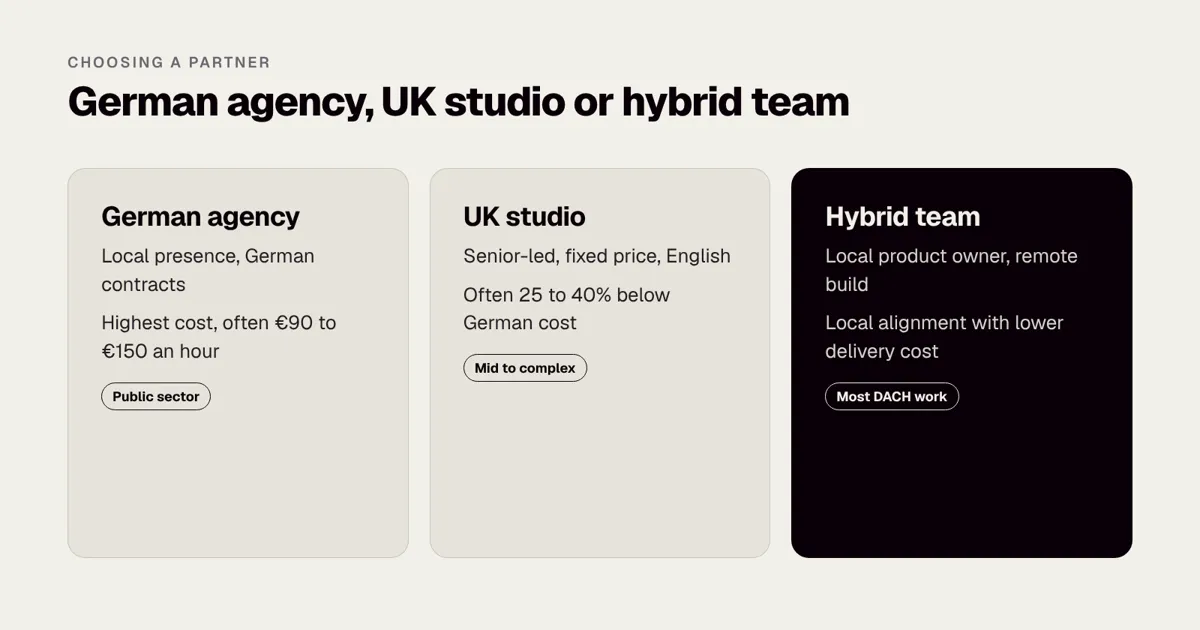
Which option is right: a German agency, a UK studio or an Eastern European partner?
There is no universal answer. The table below sets out what usually matters. Ratings are general observations, not rankings of specific firms.
| Factor | German agency | UK studio | Eastern European partner |
|---|---|---|---|
| Cost for comparable scope | Highest | Lower, often 25 to 40% | Lowest, often 40 to 60% below German |
| Language and culture fit | Native German | English with German-aware delivery | Varies; English usually |
| Time zone | Same | One hour behind | Same or close |
| Face-to-face meetings | Easy | Possible, with travel | Possible, with travel |
| Contracts | German law, familiar | German or English law, agreed up front | Varies |
| Data protection | Local, familiar | EU hosting and DPAs possible | Inside the EU, usually familiar |
| Best for | Public sector, regulated work needing local presence | Products needing senior design and engineering at a lower cost | Large builds where cost is the dominant factor |
If you want a deeper comparison, read DACH companies: local agency or UK studio?, UK vs Eastern Europe for European companies building apps and UK vs Poland for app development: cost, quality and risk. For the Brexit-era questions about contracts, VAT and data, see Hiring a UK studio from the EU after Brexit.
When a local agency is the better choice
Choose a German agency when the project needs on-site presence in your offices every week, when the customer is a public body that requires a German-registered supplier, or when your internal culture strongly prefers a German-speaking team across every function. Those are good reasons, and they are worth paying for.
When a UK studio is the better choice
Choose a UK studio when you value senior-led design and engineering, when you want a fixed price agreed before development starts, and when English is already a working language in the team. We have 19 years in business, since 2007, and built the UK’s first mobile banking app, MoBank, so we have worked in regulated and high-stakes settings for a long time. Delivering for German enterprise clients: lessons from Cubeware describes what we learned working with a DACH software provider.
A hybrid model
Many German buyers combine the two: a local product owner who knows the business and its stakeholders, and an external delivery team that designs and builds. The product owner handles internal alignment, the works council and the SAP team. The delivery team handles design, build and testing. This keeps the benefits of local knowledge while lowering cost, and it is the structure behind most of the DACH work we do.
How do procurement and contracts work with German companies?
German companies, especially larger ones, usually follow a structured buying process. The typical documents are:
- Lastenheft. The buyer’s written requirements.
- Pflichtenheft. The supplier’s response, describing how the requirements will be met.
- Security and data protection questionnaires. Often long, and sometimes specific to the buyer’s industry.
- Framework contract. Terms that cover several projects, with individual orders under it.
- Acceptance criteria. How the buyer decides that work is complete.
Public bodies follow formal tendering rules, and the procedure depends on the size of the contract and the body concerned. Allow 4 to 12 weeks for this before the build starts, and agree early on contract language, governing law and acceptance criteria.
What should the contract cover?
- Scope and fixed price. What is delivered, for what price, and what counts as a change.
- Intellectual property. You should own the code you pay for. See Who owns the code? IP, contracts and escrow for UK app projects and Contracts, IP and payment when you hire an overseas app agency.
- Data protection. A data processing agreement under Article 28 of the GDPR, covering what the supplier may do with your data.
- Warranty and support. What happens when defects are found after launch, and for how long.
- Termination and handover. Documentation, repositories and cooperation if you change supplier. How to switch app agencies without losing your app covers this.
Not sure what your requirements document should say? We can review a draft Lastenheft or a rough brief and tell you what is missing before you invite quotes. Book a call with a co-founder.
Handling the UK and EU data question
Personal data moving between Germany and the UK is a common question. At the time of writing, the EU has recognised the UK’s data protection regime through an adequacy decision, which allows data to flow without extra transfer tools. Adequacy decisions can be reviewed and renewed, so confirm the current status with the European Commission before you rely on it. A standard processing agreement still applies. Our explainer UK and EU data transfers for app projects covers the detail. This is general information, not legal advice.
How do German companies cut cost without taking on risk?
Cutting cost is easy; cutting it safely is the skill. These approaches work in practice.
- Hybrid teams. A local product owner with a UK or European delivery team, as described above.
- Paid discovery first. A short, fixed-price discovery stage fixes scope and tests the relationship before you commit to a larger spend. See What is an MVP? and How to choose features for version one.
- Cross-platform development for iOS and Android. Frameworks such as Flutter and React Native let one team build both apps, which typically lowers cost compared with building two native apps. See Native vs cross-platform and Flutter vs React Native in 2026.
- Standard components for authentication, payments and analytics, instead of building from scratch. How to add user login and sign-up to your app and How to add in-app payments to your app show what is involved.
- Phased delivery, starting with the highest-value workflow and adding the rest as usage proves itself.
- Clear decisions. Delays usually come from waiting for approvals, not from coding.
For more ideas see How to cut app development costs without cutting quality.
What not to cut
Some savings cost more later. Do not cut:
- Discovery and scope definition.
- Security testing for anything that holds customer or staff data.
- Accessibility, if your audience includes the public or staff with access needs.
- Documentation and handover, which protect you if the team changes.
- Testing on real devices, particularly for older Android models used by field staff.
How do you get quotes you can compare?
Send every supplier the same written brief and ask for a response in the same structure. The brief should contain:
- The business goal, in two or three sentences.
- The users and roles.
- The five to ten most important tasks the app must support.
- The systems it must connect to, with names and versions where known.
- Constraints: data location, accessibility standard, works council status, deadline.
- What you will provide: test systems, content, a decision maker.
How to brief an app development agency and How to write an app specification (free template) give you templates. Then compare the answers with 20 questions to ask an app developer before you sign and What a good app development proposal looks like. If two quotes differ by 40% or more, ask both suppliers to walk you through the lines that differ, because the cheaper one has often left out something you will pay for later.
Warning signs in a German or UK quote
- A price offered in the first call, before anyone has asked about integrations.
- No mention of data protection, accessibility or security testing.
- No named person who owns delivery.
- “Unlimited changes” with no definition of scope.
- No handover plan, or no statement of who owns the code.
See Red flags when hiring app developers for a longer list.
What do running costs look like after launch?
Plan for yearly running costs of 15 to 20% of the original build, as a market estimate. That covers hosting, bug fixes, updates for new iOS and Android versions, security patches, support and small improvements. For a €100,000 build, that is €15,000 to €20,000 a year.
| Running cost | What it covers | Typical share |
|---|---|---|
| Hosting and monitoring | Servers, databases, backups, alerts | 3 to 6% |
| Platform updates | New iOS and Android releases, library updates | 4 to 6% |
| Security and compliance | Patches, annual review, penetration retest | 3 to 5% |
| Support and fixes | Helpdesk handover, bug fixes | 3 to 5% |
| Small improvements | Minor features from user feedback | Variable |
See App maintenance costs in the UK for the same logic in pounds, and How to prepare your business app for each new iOS release for why updates matter every year.
Funding and tax support
Some German companies can reduce the net cost of development through public support. At the time of writing, Germany has a research allowance (Forschungszulage) for eligible research and development, and various federal and state programmes exist. Eligibility depends on the activity, the company and the programme, so check the official sources and speak to your tax adviser before assuming any relief. The Federal Ministry of Finance publishes information on its homepage (Bundesfinanzministerium). UK-based work may be treated differently from German-based work, which is another reason to ask early.
What can a German buyer learn from our own projects?
Two projects show how the factors above work in practice.
For Cubeware, an analytics provider with 4,000+ enterprise customers across Germany, Austria and Switzerland, we helped move a product to SaaS. The work meant listening to enterprise customers who expect continuity, careful data handling and clear documentation. The lesson is that DACH enterprise buyers are not hard to work with, but they expect you to have answers before they ask.
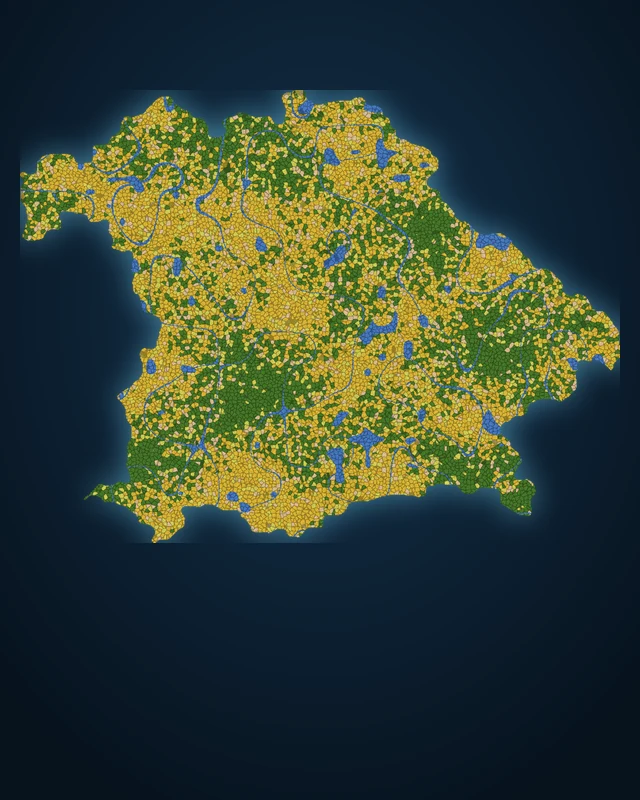
For the Bavarian government, we built an AI land classification prototype using computer vision. A public sector client brings tendering, security questions and a high bar for explanation. Our write-up, How we built AI land classification for the Bavarian government, and the follow-up on procurement for a European government describe the process.
Outside Germany, we modernised the Superdry app for a brand with 768 locations in over 100 countries, and delivered an app, a mobile site and an eBooks API for Waterstones in 12 weeks. Both show that large organisations can ship quickly when scope is clear and decisions are made on time. Our own history goes back to 2007, and 19 years of building apps: what has changed since 2007 tells the longer story.
What are the most common mistakes German buyers make?
- Comparing rates, not totals. A lower rate with a longer timeline may cost the same.
- Starting without a written scope. Quotes then differ because suppliers imagined different products.
- Leaving the works council to the end. It can stop a staff app after the build is done.
- Treating SAP integration as a line item. It is a project inside the project.
- Forgetting German content. Translation, review and training material take real time.
- Skipping discovery to save two or three weeks, then paying months for rework.
- Not planning running costs. An app with no maintenance budget ages quickly.
- Choosing on price alone. Ask about experience with similar work, team continuity and ownership of code. How to choose an app development company in the UK: a 2026 checklist applies to any market.
What should you do next?
If you are weighing up an app in Germany, work through this list.
- Write one paragraph on the business goal and the people who will use the app.
- List the systems it must connect to, and who owns them.
- Check whether the works council, a data protection officer or a legal team needs to be involved.
- Decide your first release: one workflow, one user group.
- Ask two or three suppliers to quote against the same written scope.
- Add legal, translation and contingency to the budget.
- Choose a short paid discovery stage before committing to the full build.
If you want a second opinion on your scope, our pricing page lists the fixed-price services that fit before a larger project, and you can talk to a co-founder for an honest view of where you sit in the table above. If you are working out whether an existing system is ready, How to audit an existing app’s code and Turning legacy software into SaaS are good starting points, and Legacy software to SaaS for German Mittelstand companies covers a common DACH case.
Frequently asked questions
How much does a simple app cost in Germany?
A simple app with up to ten screens and a light backend costs about €30,000 to €55,000 with a German agency and €20,000 to €40,000 with a UK studio. These are market estimates, not quotes. The price rises quickly if you add payments, accounts with roles or any integration with existing systems.
Why are app development rates in Germany so high?
German developer salaries and employer social contributions are among the highest in Europe, and agencies in Munich and Frankfurt carry high overheads. Rates in eastern German cities are noticeably lower. A high rate does not always mean a higher total, because experienced teams often need fewer hours.
Can a UK company sign a German data processing agreement?
Yes. At the time of writing, the EU recognises the UK’s data protection regime through an adequacy decision, so personal data can flow from Germany to the UK without extra transfer tools. Confirm the current status on the official European Commission site. A standard GDPR Article 28 data processing agreement covers the supplier relationship. See UK and EU data transfers for app projects, explained. This is general information, not legal advice.
Do I need a German-speaking development team?
Not usually. Most German companies work in English with development partners. User-facing text and documentation should be written or reviewed by native German speakers, and it helps to have a German-speaking product owner on your side.
How long does an app take to build in Germany?
Timelines match the rest of Europe: 8 to 12 weeks for simple apps, 3 to 6 months for mid-size and 6 to 12 months for complex platforms. Works council approval or procurement can add 4 to 12 weeks before the build starts. How long does it take to build an app? covers realistic timelines.
Does a staff app always need works council approval?
Not always, but often. If the app can record or display information that allows monitoring of behaviour or performance, co-determination rights may apply under German labour law. Ask your legal or HR team early, and prepare a short description of what the app records and who can see it.
Is a fixed price realistic for a German project?
Yes, if the scope is defined. A fixed price works when discovery has produced a clear scope document and when both sides agree how changes are handled. Rounded Labs always works to a fixed price agreed before development starts. See the pricing page for what is typical.
Official sources and further reading
Talk it through with one of our co-founders. 30 minutes, no pressure.