

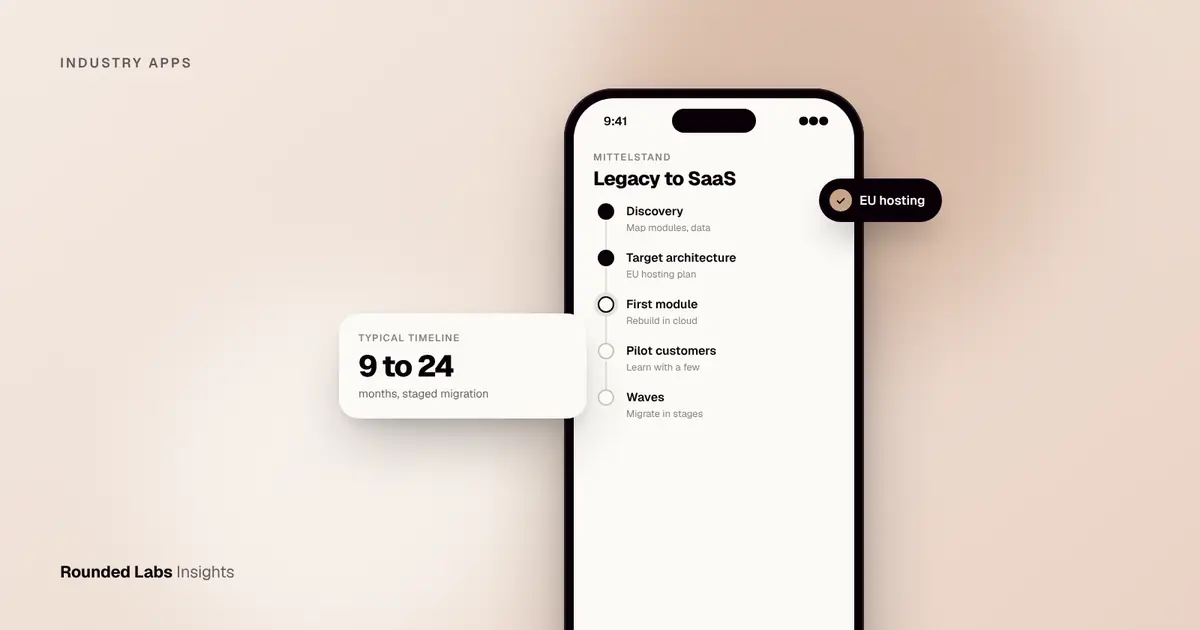
Many German Mittelstand companies run on software built 10 to 25 years ago, and moving it to SaaS is now a priority because customers expect browser access, regular updates and subscription pricing, while old technology becomes harder to secure and staff. The safest approach is usually a staged move: keep the existing product running, rebuild the most valuable parts as cloud services, migrate customers in waves, and retire the old system last. A typical modernisation costs €150,000 to €600,000 or more and takes 9 to 24 months (market estimates, not quotes).
We helped Cubeware, an analytics software company serving 4,000+ enterprise customers across Germany, Austria and Switzerland, move its legacy product to SaaS, and the business was later acquired by insightsoftware. This guide shares what we have learned about legacy-to-SaaS moves for German companies.
Key facts
- Options range from hosting the existing software in the cloud to a full rebuild as multi-tenant SaaS.
- Staged migration (the “strangler fig” pattern) reduces risk compared with a big-bang rewrite.
- Typical cost: €150,000 to €600,000+; timeline 9 to 24 months.
- German customers expect EU hosting, data processing agreements and strong security.
- The move changes the business model, pricing, support and sales, not just the technology.
Why are Mittelstand companies moving to SaaS now?
- Customer expectations. Buyers want browser access, mobile apps, integrations and continuous updates.
- Recurring revenue. Subscriptions give more predictable income than licence sales and maintenance contracts.
- Talent. Fewer developers want to work on ageing desktop technologies.
- Security and regulation. Older systems struggle with modern security expectations and new rules such as NIS2 and the Cyber Resilience Act, whose obligations phase in over several years, so check current dates (post:G10, The EU Cyber Resilience Act and your app).
- Valuation. Software businesses with SaaS revenue are typically valued more highly by investors and acquirers.
What are the options?
| Option | What it means | Pros | Cons |
|---|---|---|---|
| Rehost (“lift and shift”) | Run the existing software on cloud servers, often via remote desktop | Fast, low cost | Not true SaaS; old limitations remain |
| Replatform | Adapt the existing code to run as a hosted web service | Moderate cost, reuses logic | Technical debt carries over |
| Staged rebuild (strangler fig) | Build new cloud services module by module around the old system | Lower risk, value delivered early | Requires careful integration and planning |
| Full rebuild | New SaaS product from scratch | Clean architecture | Highest risk, long time before value |
Rebuild or refactor: what it costs to fix an old app compares rebuild and refactor costs, and What is technical debt explains technical debt.
How does a staged migration work?
- Discovery: map modules, data, integrations, customers and how they use the product. Identify the most valuable and most painful areas.
- Target architecture: define the SaaS platform, multi-tenancy model, EU hosting, identity and integration approach.
- First module: rebuild one high-value area as a cloud service, connected to the existing system.
- Pilot customers: move a small group of friendly customers and learn.
- Waves: migrate further modules and customer groups in planned waves.
- Retire: switch off old components once no customers depend on them.
Planning a move to SaaS? We help German software companies plan and deliver staged migrations, with EU hosting and DSGVO-compliant processes. Book a 30-minute call with a co-founder.
What do German customers expect from SaaS?
- EU or German hosting and clear data residency.
- Data processing agreements under GDPR Article 28 and a published list of sub-processors (post:G8).
- Security evidence such as ISO 27001 or BSI C5 attestation for cloud services, especially in regulated sectors (BSI).
- Integration with SAP, DATEV or other existing systems.
- German-language interface and documentation.
- Clear migration support for data and users.
How much does modernisation cost?
| Scope | Typical cost (UK studio, in €) | Timeline |
|---|---|---|
| Rehost with web access | €40,000 to €120,000 | 3 to 6 months |
| Staged rebuild of a mid-size product | €150,000 to €400,000 | 9 to 18 months |
| Full SaaS platform for a large legacy product | €400,000 to €1,000,000+ | 18 to 30 months |
German agencies often quote higher for similar scope, so compare several quotes. SaaS development cost in Europe covers SaaS development costs in Europe.
What did we learn from Cubeware?
- Plan the customer transition as carefully as the code. Customers need clear timelines, migration tools and support.
- Deliver value early. Releasing modern modules early keeps customers and staff engaged.
- Change the business model deliberately. Pricing, contracts, sales compensation and support all change with SaaS.
- Keep domain experts close. The people who know the old product’s rules are essential to rebuilding it correctly.
Delivering for German enterprise clients shares more lessons from working with German enterprise clients, and Turning legacy software into SaaS tells the wider story.
How should pricing change when you move to SaaS?
Licence customers are used to a large upfront fee plus annual maintenance, often 18 to 22% of the licence price. SaaS replaces this with a subscription that includes hosting, updates and support. Common approaches are per user, per module or tiered plans. Model the transition carefully: revenue dips in the short term as upfront licence income is replaced by monthly payments, then grows as subscriptions accumulate and churn falls. Finance, sales and support teams need to be part of the plan from the start.
Frequently asked questions
How long does it take to move legacy software to SaaS?
Most staged migrations take 9 to 24 months for a mid-size product. Large products with many modules and customers can take longer.
Should we rebuild from scratch or migrate gradually?
Gradual migration is usually lower risk because it delivers value early and avoids a long period with two products. A full rebuild can make sense when the old technology cannot be extended at all.
Do German customers accept SaaS hosted outside Germany?
Most accept EU hosting with strong contracts and security. Some public sector and regulated customers require German data centres or specific certifications, so check early.
Can a UK company deliver a German SaaS migration?
Yes. The UK currently benefits from an EU adequacy decision for data (check it is still in force), UK studios can host in German or EU regions, and work is one hour behind CET. See Hiring a UK studio from the EU after Brexit.
What happens to existing licence customers?
Usually they are offered a migration path with incentives, while the old product is supported for a defined period. Communicating this clearly is critical.
Official sources and further reading
- BSI: Federal Office for Information Security (Cloud Computing Compliance Criteria Catalogue, C5)
- EUR-Lex: GDPR
- Martin Fowler: Strangler Fig Application
Talk it through with one of our co-founders. 30 minutes, no pressure.