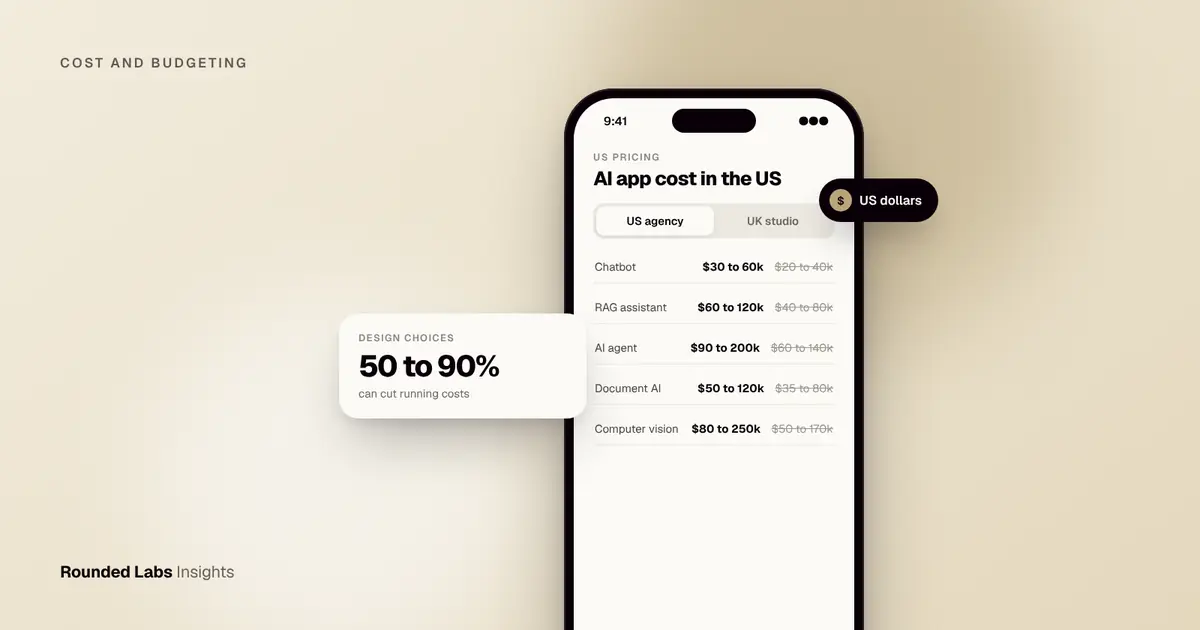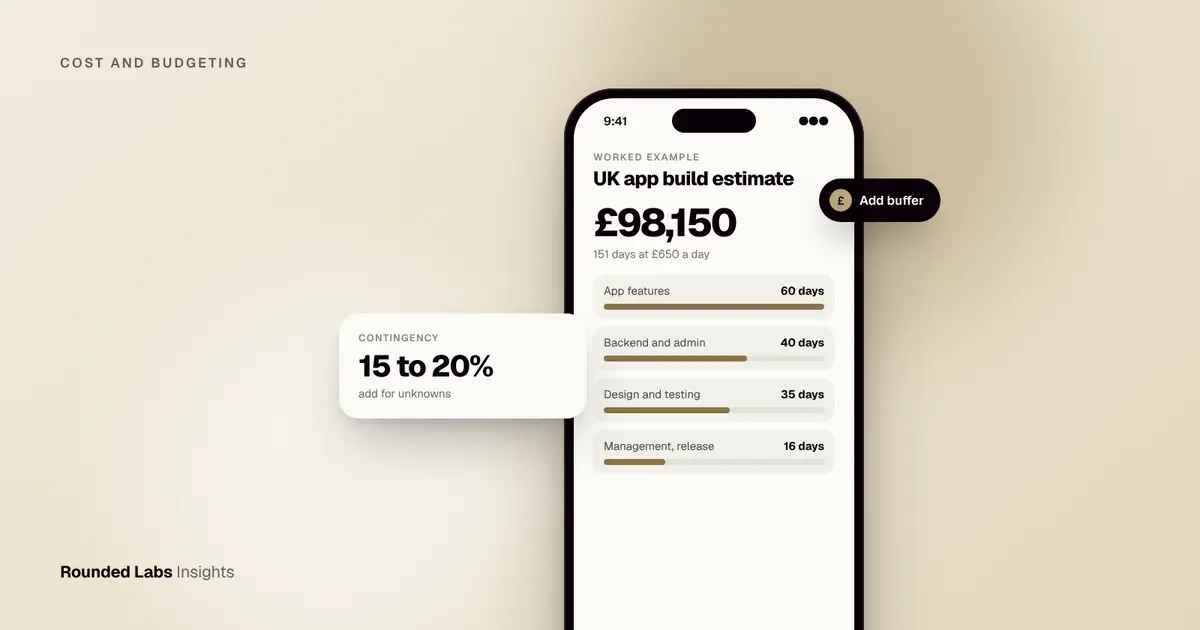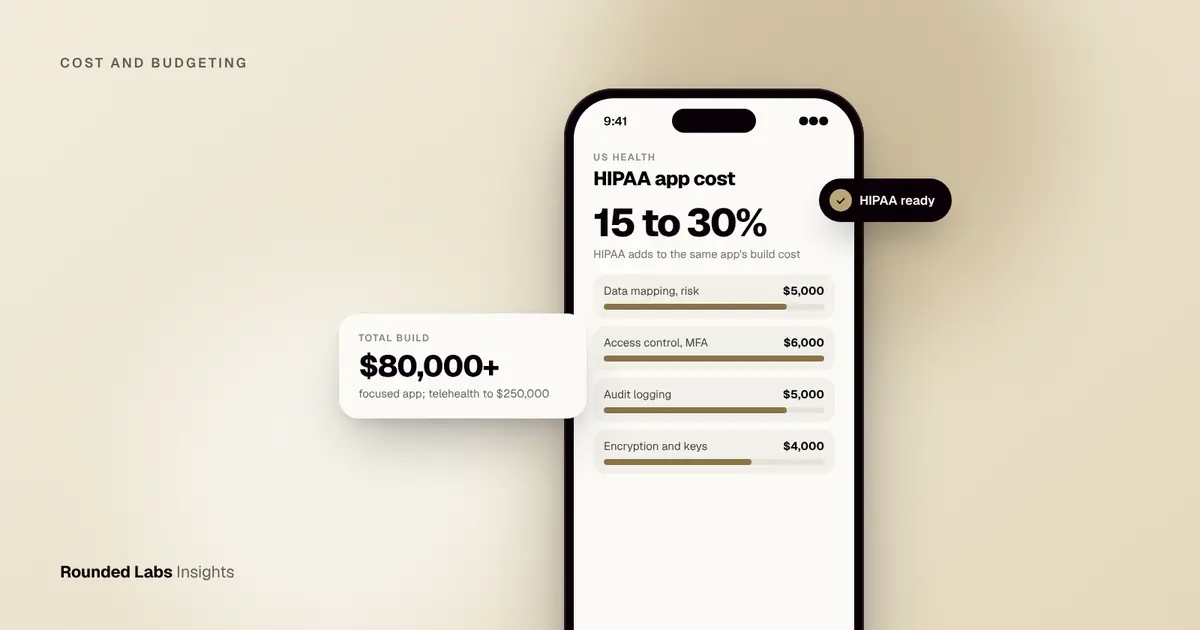
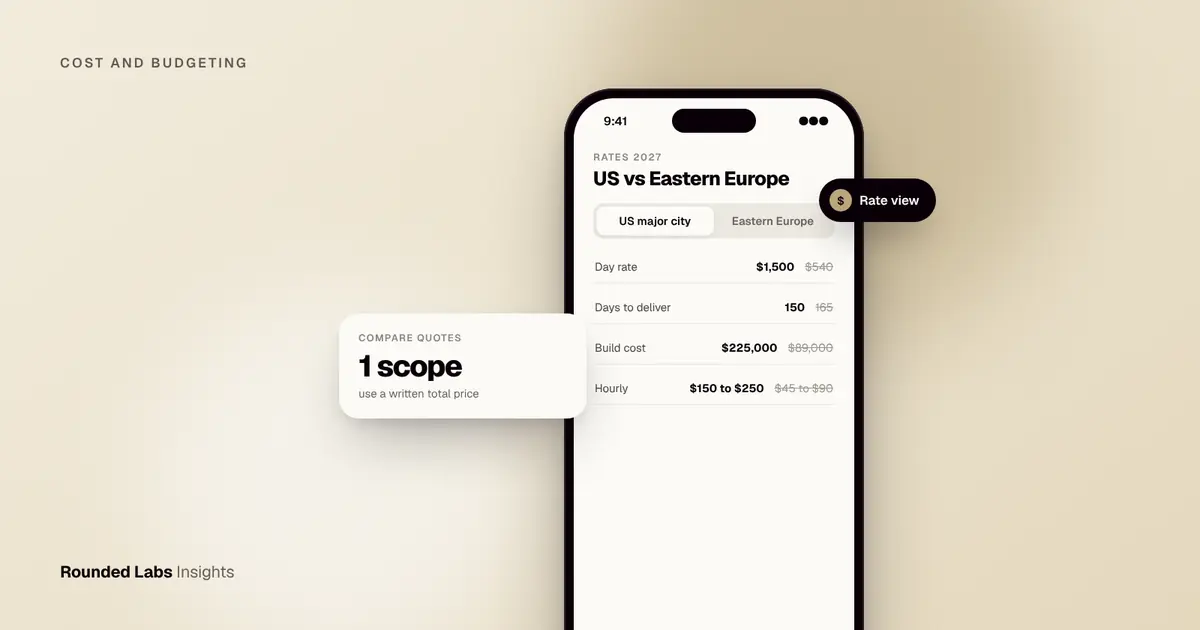
App development rates in 2027 run from about $25 an hour in South and Southeast Asia to $150 to $250 an hour at major-city US agencies, with senior UK studios at roughly $70 to $130 and Eastern European agencies at $45 to $90. Rates follow local salaries, so the gaps are large and fairly stable. But the rate is only one input to the total cost, and the cheapest rate often gives the most expensive project.
This guide pulls together the public data that explains why rates sit where they do, then turns it into ranges you can use to check a quote. We are a UK studio that has built apps since 2007 for brands like Superdry and Next, so we sit inside one of these bands, and we have tried to be fair to the others. Every range here is a market estimate drawn from public sources and general industry experience, not a quote or a guarantee. Treat it as a sanity check rather than a price list.
Key facts
- US major-city agency: $150 to $250 an hour ($1,200 to $2,000 a day).
- US smaller-city agency: $100 to $160 an hour.
- Senior UK studio: $70 to $130 an hour (about £55 to £100, or £450 to £800 a day).
- Western European agency: $95 to $175 an hour depending on country.
- Eastern Europe: $45 to $90 an hour. India, Southeast Asia and similar markets: $25 to $50.
- A fixed price removes most of the rate comparison. What matters is the total cost for a written scope.
What are typical app development rates by region?
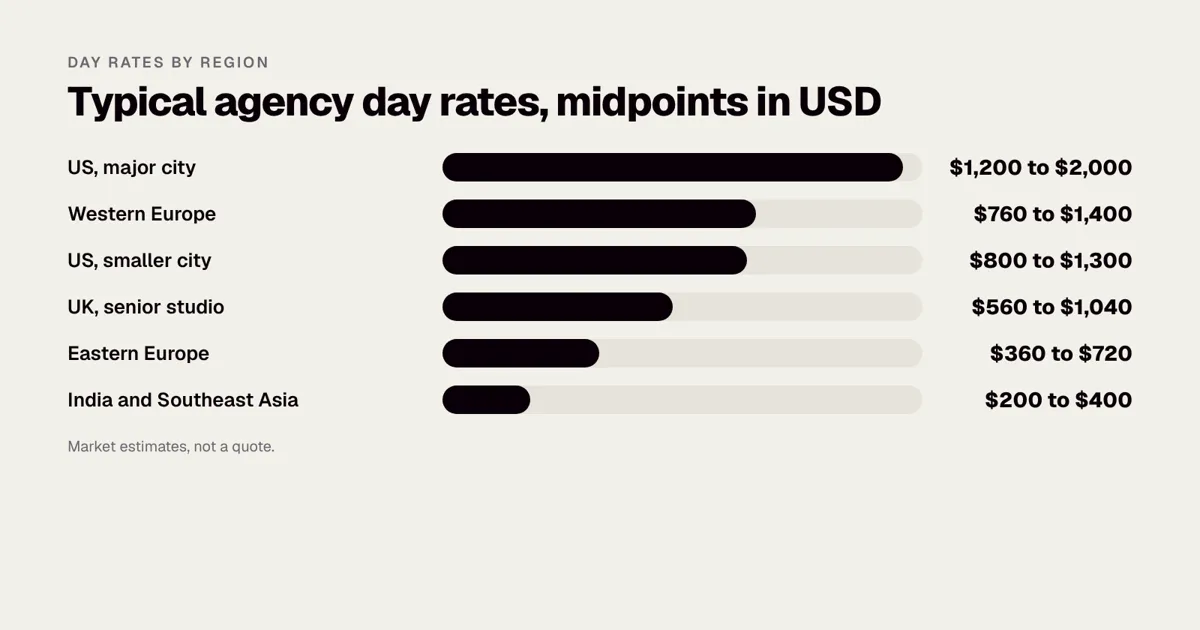
The table below gives the bands we see quoted across the market for agencies, meaning companies with project management, design and testing included, not individual freelancers. Day rates assume an eight-hour day. All figures are market estimates for 2027 planning.
| Region | Typical agency rate (USD an hour) | Typical day rate (USD) |
|---|---|---|
| US, major city | $150 to $250 | $1,200 to $2,000 |
| US, smaller city | $100 to $160 | $800 to $1,300 |
| UK, senior studio | $70 to $130 | $560 to $1,040 |
| Western Europe (Germany, Netherlands, Nordics) | $95 to $175 | $760 to $1,400 |
| Southern Europe (Spain, Italy, Portugal) | $65 to $120 | $520 to $960 |
| Eastern Europe (Poland, Romania, Baltics) | $45 to $90 | $360 to $720 |
| India | $25 to $50 | $200 to $400 |
| Southeast Asia (Malaysia, Vietnam, Philippines) | $25 to $50 | $200 to $400 |
| Latin America | $40 to $80 | $320 to $640 |
Three cautions apply before you use these numbers. First, they are bands, not averages: inside any region the spread between a boutique specialist and a large generalist can be wider than the spread between regions. Second, they describe agencies. Freelancers are usually cheaper per day and carry more delivery risk, a trade-off we cover in App agency vs freelancer vs in-house team. Third, specialist skills such as AI engineering, security work or regulated fintech add 20 to 40% to any band.
Public directories such as Clutch publish agency rate bands that show the same pattern: the highest bands sit in the US and Switzerland, and the lowest in South and Southeast Asia. For a plain-English look at what each rate buys, read App development hourly rates explained.
Why do rates differ so much between countries?
Agency rates are mostly salary plus overheads plus margin, so the best public clue to a country’s rate is what its developers earn. You can check the underlying data yourself on the official sources below.
- United States. The US Bureau of Labor Statistics publishes pay data for software developers in its Occupational Outlook Handbook (BLS). Pay in the major tech cities sits well above the national picture, which is why a San Francisco or New York agency charges more than one in a smaller city.
- United Kingdom. The Office for National Statistics publishes earnings for programmers and software development professionals through its Annual Survey of Hours and Earnings (ONS). Pay is clearly lower than in the major US cities, which is why a UK studio can charge less for comparable seniority.
- European Union. Eurostat publishes labour costs by country (Eurostat). The spread between the highest-cost and lowest-cost member states is several times, and agency rates follow it.
- Developer salary surveys. The annual Stack Overflow Developer Survey reports self-declared pay by country. It is a survey of its own respondents, so treat it as a guide to ordering rather than an exact measure, but the ordering is consistent: the US first, then a group of Western European countries, with India and Southeast Asia well below.
Two other forces matter. Currency moves change the dollar rate of UK and European teams quickly, and demand for AI skills has pushed rates for machine-learning engineers up in every region. Our guides How much does it cost to build an app in the US? and App development cost in Europe apply these rates to complete projects.
How is an agency day rate actually built up?
It helps to see the arithmetic, because it shows why the same developer skill costs different amounts in different places. The example below uses illustrative salaries that we have chosen to show the method. They are not statistics, and you should replace them with figures from the sources above for your own market.
- Start with salary. Take a senior developer on an assumed salary.
- Add employment costs. Taxes, pension, equipment and benefits typically add 25 to 35% on top of salary. We use 30%.
- Add overhead. Project managers, designers who are not billed directly, sales, finance, office and tooling are spread across the billable team. We add 25%.
- Divide by billable days. Nobody bills 250 days a year. Holidays, sickness, training, bench time between projects and internal work mean 160 to 180 billable days is realistic. We use 170.
- Add margin. A healthy agency keeps 15 to 25% of the price as profit and a buffer for bad projects. We use 20%.
| Step | US major city (USD) | UK studio (GBP) | Eastern Europe (GBP equivalent) |
|---|---|---|---|
| Assumed senior salary | $140,000 | £60,000 | £30,000 |
| With 30% employment costs | $182,000 | £78,000 | £39,000 |
| With 25% overhead | $227,500 | £97,500 | £48,750 |
| Cost per billable day (170 days) | $1,338 | £574 | £287 |
| Price per day with 20% margin | about $1,670 | about £720 | about £360 |
The results land inside the bands in the first table, which is the point. Salary differences carry straight through to day rates, and the other steps scale them. The same sum also shows where an unusually low quote might come from: a small margin, a heavily utilised team, a junior-heavy mix or a supplier that is not covering its overheads. Each of these can be legitimate or a warning sign, and the next sections show how to tell which.
Why do senior and junior rates differ inside one agency?
A blended agency rate hides a mix of roles. Most agencies price roles against a senior developer as a reference. The multipliers below are rules of thumb used across the market, not measured statistics, but they are useful when you read a quote that lists roles separately.
| Role | Rough multiple of a senior developer day rate | What to check |
|---|---|---|
| Junior developer | 0.4 to 0.6 | Who reviews their work, and how often |
| Mid-level developer | 0.7 to 0.85 | Whether they own features end to end |
| Senior developer | 1.0 | Years shipping apps in your stack |
| Technical lead or architect | 1.2 to 1.5 | How many hours they actually spend on your project |
| Product designer | 0.8 to 1.0 | Whether research and prototyping are included |
| QA engineer | 0.5 to 0.7 | Automated as well as manual testing |
| Project manager | 0.8 to 1.0 | Whether management is included in the blended number |
If a quote shows one blended number, ask for the role split behind it. A blended figure that looks competitive can be made of two juniors, one part-time lead and a manager who is shared across six projects.
How do rates turn into project costs?
A rate is only meaningful alongside the hours it takes to deliver. A cheaper team that needs 40% more hours has erased a 30% rate saving. The worked example below uses a mid-size app of about 150 person-days at the senior UK rate and compares it with four other options. The day counts for lower-rate teams reflect extra rework, clarification and management load that commonly appear in market experience. They are illustrative assumptions, not measurements.
| Team | Day rate | Typical days to deliver | Build cost |
|---|---|---|---|
| US agency, major city | $1,500 | 150 | $225,000 |
| UK senior studio | $800 | 150 | $120,000 |
| German agency | $1,100 | 150 | $165,000 |
| Eastern European agency | $540 | 165 | $89,100 |
| Offshore team | $300 | 190 | $57,000 |
The offshore team is far cheaper in this example, and for a simple, well-specified app that gap can be real. But it brings coordination costs that do not appear in the table: time zones, language, handover documents and your own time reviewing work. For a product with payments, integrations and compliance, those costs are often where projects go wrong.
What overrun wipes out a lower rate?
The more useful question is how many extra days a cheaper team can take before the saving disappears. Take the UK build of $120,000 as the benchmark.
| Lower-rate team | Day rate | Days at which cost equals $120,000 | Extra days over 150 before the saving is gone |
|---|---|---|---|
| Eastern European agency | $540 | 222 | 72 days, or 48% more |
| Southern European agency | $640 | 187 | 37 days, or 25% more |
| Offshore team | $300 | 400 | 250 days, or 167% more |
Read this table honestly. A Southern European agency at $640 only needs a 25% overrun to match the UK price, so the risk is real. An offshore team at $300 can take more than two and a half times as long and still cost the same, so a well-managed offshore project can be the cheapest route. The rate does not decide the outcome. The quality of the scope, the supplier’s process and how well your team can steer the work do. Our comparison UK vs offshore app development goes through the non-cost factors in detail.
Want a fixed price instead of a rate comparison? We quote fixed prices in pounds, dollars or euros, so you compare totals instead of rates. Book a 30-minute call with a co-founder.
What do the rates not tell you?
- Seniority mix. A quoted blended rate can hide junior developers doing most of the work. Ask who will actually build, and at what level.
- Utilisation. Some teams bill for people who are partly idle or shared across projects, so you pay for attention you do not receive.
- Management overhead. Distance, time zones and language add your own time, which does not appear on the invoice. If your product owner spends ten extra hours a week clarifying, that is a cost.
- Quality and rework. Cheap code that needs rebuilding in a year costs more than careful code that lasts. Our Legacy App Rescue Assessment exists for exactly this situation, and the guide Rebuild or refactor shows how those decisions are made.
- Contract shape. On a time-based contract, slow delivery costs you. On a fixed price it costs the supplier. Fixed price vs time and materials for app projects explains the trade-off.
- Ownership and exit. A low rate is poor value if you cannot get the code, accounts and documentation when the contract ends. See Who owns the code?.
- Total cost of ownership. Build cost is one part of five years of spend, as The total cost of owning an app over five years shows.
Which region suits which kind of project?
There is no best region, only a best fit for a given scope, budget and appetite for risk. These are generalisations, so use them as a starting point for questions, not a verdict on any individual company.
When does a US agency make sense?
A US agency suits a project where time-zone overlap with your own US team matters, where local legal and compliance knowledge is part of the work (for example HIPAA or state privacy rules), or where your customers expect a US supplier. You pay the highest rates, and you usually get the shortest communication loops with US stakeholders. For a closer look, see UK vs US app development agencies and In-house team vs agency in the US.
When does a UK studio make sense?
A UK studio sits between the US and Western European bands. It suits buyers who want senior people, English-language documentation, UK and EU data law experience and a middle-market rate. For US buyers, the practical points are time-zone overlap in the UK afternoon and the US morning, and contract terms that work across both legal systems. Hiring a UK app development company from the US and Contracts, IP and payment when you hire an overseas app agency cover both.
When does a Western European agency make sense?
Germany, the Netherlands and the Nordics offer strong engineering and high rates. They suit buyers who need local-language support, a physical presence for workshops or an agency embedded in a specific industry cluster. DACH companies: local agency or UK studio? compares the choices for German-speaking buyers. Our delivery for Cubeware, described in Delivering for German enterprise clients, is one example of cross-border work with a German client.
When does Eastern Europe make sense?
Eastern European agencies combine strong technical training with rates around half to two thirds of UK bands. They suit well-defined builds, backend-heavy work and teams that can manage a supplier closely. Check English-language communication, legal jurisdiction and how staff turnover is handled. UK vs Eastern Europe for European companies building apps goes through those checks.
When does India or Southeast Asia make sense?
These markets offer the lowest rates and very large talent pools, and they suit clearly specified work with strong oversight from your side: a detailed specification, a technical lead on your team who reviews code and a tolerance for rework cycles. They are harder to manage for early-stage products where requirements change weekly. The principle in Onshore, nearshore or offshore applies: the further the team, the more written clarity you need.
When does Latin America make sense?
For US buyers, Latin American teams offer working-day overlap with North American hours at rates below US bands. They suit buyers who want near-real-time collaboration without paying major-city US rates. As elsewhere, quality varies by company, so judge the team, not the region.
Which skills add a premium to the base rate?
The regional bands assume mainstream mobile and web development. Specialist work sits above them, and the premium is often larger than the gap between two neighbouring regions. The percentages below are market rules of thumb for planning, not measured statistics.
| Specialism | Typical premium on the base band | Why it costs more |
|---|---|---|
| AI and machine learning engineering | 20 to 40% | Scarce skills, evaluation work, data handling |
| Mobile security and penetration testing | 20 to 35% | Liability and the cost of getting it wrong |
| Regulated fintech or health | 20 to 40% | Compliance knowledge, audit trails, partner reviews |
| Real-time and video features | 15 to 30% | Hard to test, expensive to run |
| Embedded, wearable and hardware links | 15 to 30% | Device testing and unusual toolchains |
| Accessibility specialists | 10 to 20% | Specialist testing with assistive technology |
Two points follow. First, if your project needs one of these skills, a supplier in a lower band may still be right for the rest of the work, and a specialist can be brought in for the hard part. Second, the premium applies to the days that need the skill, not to the whole project. A good proposal shows where the specialist days sit. If you are weighing AI work specifically, our guide AI app development cost in the US shows how those days add up.
How do agency rates compare with hiring your own team?
Some buyers compare an agency day rate with a salary and conclude that hiring is far cheaper. The comparison needs three corrections. A salary is not a cost to the employer: employment costs, equipment, management time and recruitment fees come on top. An employee is not available every day: holidays, sickness and training reduce working days, and an early-stage team spends time on meetings and hiring. And an employee is a fixed cost whether or not you have work for them, while an agency is a cost you can stop.
| Item | In-house senior developer (illustrative, GBP) | Agency day rate equivalent |
|---|---|---|
| Salary | £60,000 | Not applicable |
| Employment costs at 30% | £18,000 | Included in rate |
| Equipment, software, desk | £3,000 to £6,000 | Included in rate |
| Recruitment fee or time | £6,000 to £12,000 once | Not applicable |
| Management time | A share of a lead’s time | Provided by the agency |
| Working days a year | About 200 | Billed only when used |
At roughly £81,000 to £84,000 a year plus recruitment for about 200 working days, an in-house senior developer costs about £400 to £420 a day, before management and idle time. That is below an agency day rate, which is expected: the agency also pays for design, testing, project management, sales and the gaps between projects, and you pay only while you need them. The in-house route wins when you have steady work for years and can manage engineers. The agency route wins when you have a project with an end, or need several skills for a few months. Our guide App agency vs freelancer vs in-house team works through the decision, and the fractional CTO comparison covers a middle path for early-stage startups.
What questions should you ask a lower-rate supplier?
Lower rates are attractive, and many suppliers in lower-cost regions do excellent work. The goal is to find out which kind you have. Put these questions in writing and compare answers across suppliers.
- Who exactly will work on my project, and for how many days? Ask for names, roles and allocation, not just a team description.
- How is the work reviewed? Look for code review on every change, automated tests and a named technical lead.
- How do we communicate? Agree overlap hours, a weekly demo, a shared tracker and an escalation route.
- What happens when someone leaves? Staff turnover is a fact of life in every region, and a good supplier has a handover routine.
- Where is the code stored, and who owns it? The repository, hosting and store accounts should be in your name from day one.
- What is excluded from this price? Testing, project management, store submission and post-launch fixes are common gaps.
- Can we talk to two recent clients with a similar scope? Ask what went wrong and how it was handled.
- What is your process when the scope changes? Look for a written change request with a price before any work begins.
The same questions work for a higher-rate supplier. A premium price does not excuse unclear answers.
How much contingency should you add in each region?
Contingency is the allowance you hold for the unexpected, and it depends more on scope clarity than on the region. Even so, the risk profile of a supplier affects how much of it you need on your side. The figures below are planning rules of thumb for a time-based contract. On a fixed price the supplier holds most of this risk, but you should still keep a smaller reserve for changes you request.
| Situation | Suggested reserve on your side |
|---|---|
| Clear scope, fixed price, experienced supplier | 5 to 10% for changes you request |
| Clear scope, time-based contract | 15 to 20% |
| Loose scope, fixed price | 15 to 25%, and expect change requests |
| Loose scope, time-based contract | 25 to 40%, and consider a discovery phase first |
| New supplier, distant time zone, first project together | Add 5 to 10% to whichever row applies |
The pattern is simple: clarity of scope matters more than rate, and a fixed price for a written scope is the cheapest way to reduce reserve you have to hold.
How should you compare quotes from different regions?
Rates are a poor starting point for comparison. This sequence gives a fairer result.
- Write one scope. A feature list, user journeys, platforms, integrations and an acceptance test for each major feature. Our guide How to brief an app development agency shows what to include.
- Ask every supplier to price the same scope in one currency and with the same assumptions, including testing and handover.
- Request a breakdown by phase and role. A quote without one cannot be checked against the bands above.
- Convert to a total, then to a risk-adjusted total. Add an allowance for overrun that reflects what the supplier’s contract says about who pays when work takes longer.
- Check references from clients with a similar scope, ideally on a call, and ask each one what happened when something went wrong.
- Look at the contract, not only the price: ownership of code, warranty period, support after launch, exit terms.
Our guides 20 questions to ask an app developer before you sign and What a good app development proposal looks like give detailed checklists for steps 3 to 6.
What does a currency move do to a quote?
Rates are quoted in different currencies, and exchange rates move. A UK studio that quotes in pounds becomes 10% more expensive in dollars if sterling rises 10% against the dollar between two quotes. For a $120,000 project that is $12,000, which is as large as many contingency budgets. Practical steps:
- Ask for the quote in your own currency, and ask how long the price is held.
- If you pay in instalments, ask whether later instalments are fixed in your currency or the supplier’s.
- Check current exchange rates on an official source such as the European Central Bank or the Bank of England, and compare at the date of quoting, not an old figure.
- Do not choose a supplier because of a two-week exchange rate swing. Choose on scope, process and fit, then use currency as a tie-breaker.
What mistakes do buyers make when they compare rates?
- Comparing a blended agency rate with a freelancer’s rate. The agency number includes design, testing, management and cover. Compare like with like, or add those roles to the freelancer’s side.
- Comparing quotes in different currencies on different dates. A week of exchange rate movement can hide or create a gap of several percent.
- Treating the lowest quote as the baseline. The lowest quote is often the one with the most exclusions. Use the median of three quotes as the reference, then ask about the outliers.
- Ignoring your own time. If your product owner spends a day a week answering questions, that is a real cost. It tends to rise with distance and fall with a clear written scope.
- Skipping the contract. Rates tell you nothing about ownership, warranty, exit or what happens after launch. Read those terms before you decide.
- Paying for discovery twice. If a supplier’s price includes discovery and you have already done it, reuse the work. Our guide What a good app development proposal looks like shows what should be in a proposal and what should not.
- Assuming region predicts quality. Teams in every band include excellent and poor ones. References, a sample of recent work and a short paid trial of a small piece of the project tell you far more than a postcode.
What are the warning signs in a very low or very high rate?
A rate outside the bands is not automatically wrong, but it deserves a question. The table lists common signs, grouped by direction.
| Sign | Possible innocent reason | Possible problem |
|---|---|---|
| US quote below $100 an hour | Smaller city, remote team, specialist niche | Offshore work resold without saying so |
| UK quote below $60 an hour | Very small studio, junior-heavy team | Underpriced, then cuts scope or asks for changes |
| Quote far below competitors for the same scope | Supplier has reusable components | Missing features, testing or admin tools |
| Day rate with no named people | Standard agency practice for pooled teams | Team changes after signing |
| Large discount for signing quickly | Genuine capacity gap | Pressure to skip due diligence |
| Rate far above bands with no specialism | Strong brand, premium service | Paying for overhead rather than skill |
For more on this theme, read Red flags when hiring app developers.
What does a fixed price change?
A fixed price is a total for a written scope, agreed before development starts. It turns the rate question into a total-cost question, and it moves the risk of overrun to the supplier. That is the only way Rounded Labs works: we agree a fixed price before development starts, based on a written scope, and our projects typically range from £30,000 to £250,000+ (see our pricing page). For smaller starting points we offer productised services at published fixed prices:
| Service | Fixed price | What it answers |
|---|---|---|
| Tech Architecture Audit | £7,500 | Is the current system sound enough to build on? |
| Digital Transformation Prep | £7,000 | What should change first, and in what order? |
| Mobile Product Discovery Sprint | £9,500 | What should we build, and what will it cost? |
| Legacy App Rescue Assessment | £6,500 | Fix, refactor or rebuild an existing app? |
That means the rate comparison in this article is mainly useful for checking whether other suppliers’ quotes are reasonable, not for pricing our work. If a supplier gives you a total that is much lower than the rate bands would suggest, ask which part of the scope the number leaves out. If a supplier quotes a low rate on a time-based contract, ask what caps the total.
How do rates affect the fixed price you are offered?
Even on a fixed price, rates are inside the number. A supplier estimates the days, multiplies by its cost, adds a contingency for the risk it is taking and a margin. Three consequences follow:
- Suppliers in higher-rate markets can still offer competitive totals if their teams are faster or their scoping is tighter.
- A supplier that quotes a very low fixed price for a vague scope is usually planning to make it up through change requests. Our guide How to manage scope changes without blowing the budget shows how to control that.
- A well-defined scope lowers the risk premium in every quote. A paid discovery phase pays for itself in this way. See What happens in a discovery phase.
Three buyers, three decisions
The examples below are illustrative scenarios built from the market bands in this guide. They are not client projects.
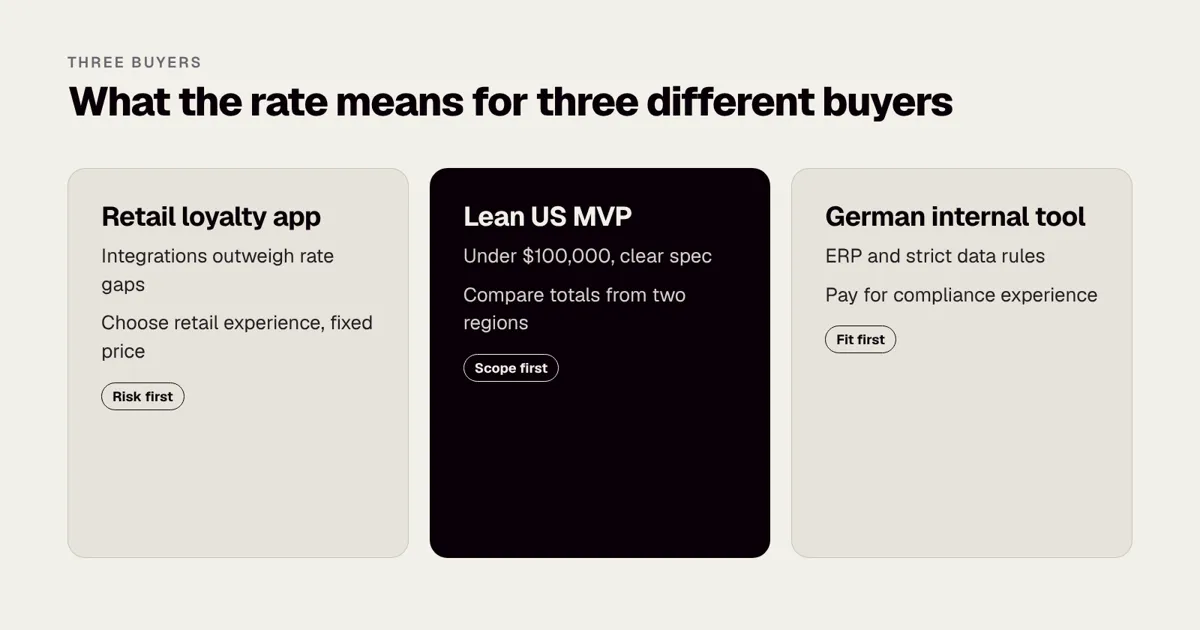
A retail brand with a loyalty app
A UK retailer wants an iOS and Android app with loyalty, offers and a store locator, integrated with existing back-office systems. The budget is modest, but the integrations matter, and the brand cannot tolerate an outage at peak trading. Rate differences between suppliers are small compared with the risk of a broken integration. The sensible approach is to prioritise suppliers with retail experience and ask for a fixed price. We modernised the app for Superdry, a brand with 768 locations in over 100 countries, and built the Waterstones app, mobile site and eBooks API in 12 weeks, so we know how integration-heavy retail projects behave.
A US startup with a lean MVP
A US startup needs a first version of a booking product quickly, with a budget under $100,000 and a founder who can write a clear specification. A smaller-city US agency, an Eastern European team or a UK studio could all fit. The decisive questions are who will manage the work day to day, whether the founder can review technical output and whether the team will write tests. Starting with a Mobile Product Discovery Sprint at £9,500 gives a priced, written scope to compare any supplier against. Our guide What is an MVP? shows how to keep the first version small.
A German manufacturer with an internal tool
A manufacturer wants an internal field tool that connects to its ERP and must meet strict data protection requirements. A Western European or UK team with GDPR experience fits better than a lowest-rate option, because compliance review and documentation will be part of the delivery. The extra rate buys fewer surprises at security review time. UK and EU data transfers for app projects, explained covers the data side of that choice.
How do you negotiate without damaging quality?
Negotiating on the rate alone is a weak move, because the supplier can lower the rate and the quality at the same time. Better levers are available.
- Reduce scope, not quality. Remove features that do not affect your first release. Our guide How to cut app development costs without cutting quality lists what to cut first.
- Agree phases. A fixed price for discovery and design, then another for build, lets you compare suppliers on evidence.
- Offer clarity. Complete briefs, quick decisions and a named product owner reduce supplier risk, which lowers prices.
- Pay on milestones tied to working software, not to calendar dates.
- Ask for a warranty period after launch, in which bugs in delivered features are fixed at no cost.
- Keep ownership clear from the start, with code, design files and accounts in your name.
How should you read rate data in 2027?
Rates are moving in three ways. Developer pay in most markets changes by a few percent a year, so bands drift slowly. AI skills have moved faster, and teams that offer AI features command a premium that is not yet stable. And tools that speed up coding, such as AI coding assistants, are changing how many days a given scope takes. Suppliers are experimenting with passing on those gains, and some are not. When you compare quotes, ask whether the day counts reflect modern tooling, and treat any claimed percentage saving as a claim to test, not a fact. Our guide How much does it cost to add AI to an app? covers where AI adds cost rather than removing it.
Developer salaries are the other long-running driver. Our guide What drives app developer salaries in the UK, US and Europe looks at the factors behind them.
How do you check your own estimate?
Use this short routine to sanity-check a quote you have received.
- Note the total and the scope it covers.
- Estimate days by dividing the total by the supplier’s day rate, if given. If no rate is given, divide by the band midpoint for the region.
- Compare the days with the size of the app. A simple app of one platform and few screens might take 40 to 80 days. A mid-size app with accounts, payments and an admin panel might take 120 to 200. A complex product with integrations and compliance often takes more than 250. These are rough planning figures, and your own scope may differ.
- Ask about the gap. If the days are much lower than the size suggests, ask what is excluded. If they are much higher, ask what the team will do with the time.
- Cross-check with a second quote for the same scope.
For help building your own estimate in your preferred currency, see How to estimate your app budget in pounds, dollars or euros. If you want a view from someone who has priced these projects for 19 years, talk to a co-founder and we will tell you honestly how a quote compares.
What should you do next?
- Write a one-page scope and a list of must-have features.
- Pick three suppliers from at least two regions and ask them to price the same scope.
- Use the bands in this guide to spot quotes that look too low or too high, and ask about them.
- Decide how much risk you want to hold. If you want a total you can rely on, ask for a fixed price and check what it includes.
- Consider a paid discovery step before committing to a full build. See How to validate an app idea before you spend £50k.
Cost and rate figures here are market estimates for planning, not quotes. Check current prices with each supplier before you commit.
Frequently asked questions
What is the average hourly cost of app development in 2027?
There is no single average, because rates depend on region and seniority. A rough global spread is $25 to $50 an hour in South and Southeast Asia, $45 to $90 in Eastern Europe, $70 to $130 for senior UK studios and $150 to $250 at major-city US agencies. These are market estimates, so confirm them with current quotes.
Why are US app developers so expensive?
US software developer salaries are among the highest in the world, and agencies add overheads such as benefits, office costs and margin on top. The Bureau of Labor Statistics publishes the underlying pay data for software developers, which you can check on its website. Demand in major tech cities pushes rates higher still.
Is it cheaper to hire a UK team than a US team?
Usually yes, by roughly 30 to 50% for comparable seniority, though savings are smaller against agencies in lower-cost US cities. Exchange rates can move the gap in either direction. See Hiring a UK app development company from the US for the practical side.
Does a lower hourly price mean a cheaper project?
Not necessarily. Total cost depends on days as well as day rate, and slower delivery, rework and extra management can erase a lower rate. The break-even table above shows how many extra days a cheaper team can take before the saving disappears.
How often do app development rates change?
Rates move gradually with salaries and exchange rates, typically a few percent a year. AI skills have moved faster, so check current quotes before you budget. Always compare quotes issued in the same month and currency.
Should I choose a supplier on rate or on fixed price?
Choose on the fixed price for a clearly written scope, then check the supplier’s process and references. Rates are useful for judging whether a quote is plausible, but a total for an agreed scope is what you will actually pay. Make sure the fixed price lists what is excluded.
Do freelancers cost less than agencies?
Day rates are usually lower, and freelancers can be an excellent choice for a narrow task. A full app also needs design, testing, project management and cover for illness, which an agency includes. See Freelance marketplaces vs an app studio for how the trade-offs work.
Official sources and further reading
Talk it through with one of our co-founders. 30 minutes, no pressure.