

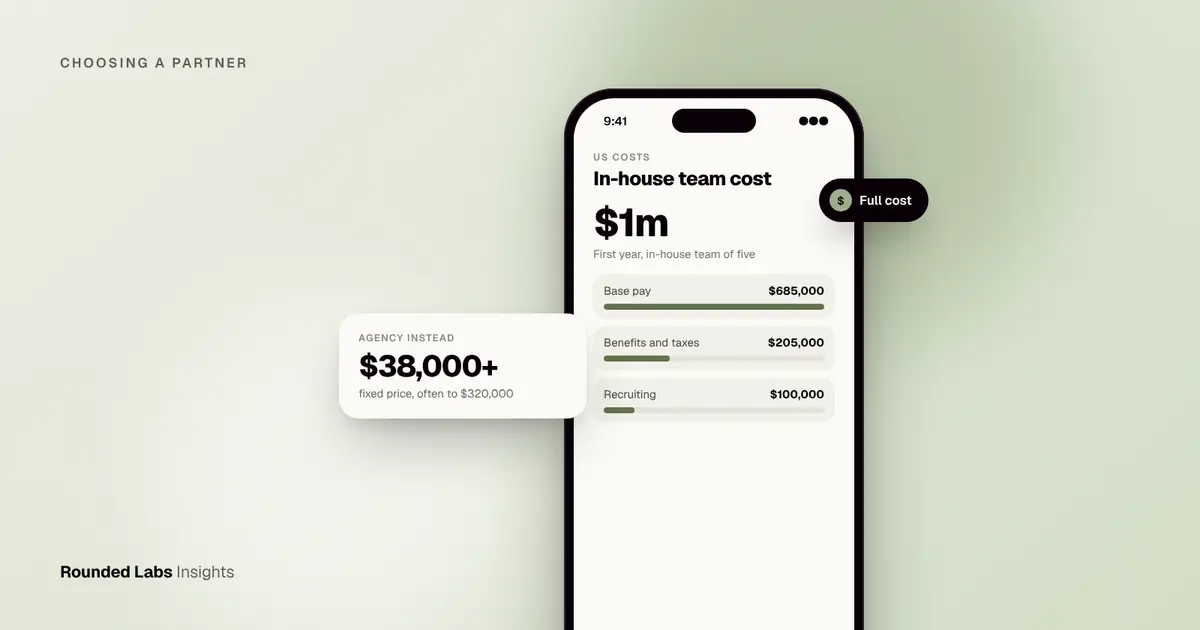
An in-house app team of five in the US typically costs $800,000 to $1,000,000 a year once salaries, payroll taxes, benefits, equipment and recruiting are counted, while an agency builds a first version for a fixed price, often $38,000 to $320,000 or more. The in-house route wins when you have years of continuous product work. The agency route wins when you need a launch, a rescue or a skill you do not have yet.
Founders usually compare a developer’s salary with an agency quote and conclude in-house is cheaper. It rarely is, because the salary is only part of the bill. We have worked with product teams of every size over 19 years, including Dabbl, a trading app for first-time investors, and the pattern holds: the right model depends on how much work you have and for how long. This guide shows the full cost of both models, with a worked example. For how Rounded Labs prices projects, see our mobile app development page. All figures are market estimates, not quotes, and use about £1 = $1.27.
Key facts
- The “fully loaded” cost of an employee is usually 1.25 to 1.4 times base salary once payroll taxes, benefits and overheads are added.
- Recruiting a senior engineer takes many weeks, and agency recruiters often charge 15 to 25% of first-year salary.
- A salary has to be paid whether or not there is work. An agency fee stops when the project ends.
- Rounded Labs works at a fixed price agreed before development starts; projects typically run £30,000 to £250,000+ (about $38,000 to $318,000+).
- For ongoing, core product work over two or more years, in-house often becomes the cheaper option.
What does a US in-house app team really cost?
Start with salaries. These are rough US market ranges for mid-level to senior staff in 2026; they vary widely by city and by company stage. The US Bureau of Labor Statistics publishes official pay data for software developers (BLS software developers).
| Role | Typical base salary (US, market estimate) |
|---|---|
| Mobile developer (iOS or Android) | $130,000 to $180,000 |
| Backend developer | $130,000 to $175,000 |
| Product designer (UX/UI) | $100,000 to $150,000 |
| QA engineer | $85,000 to $125,000 |
| Product or project manager | $110,000 to $160,000 |
On top of base pay come the costs people forget. The BLS tracks employer compensation costs (BLS employer costs for employee compensation), and benefits and taxes commonly add around 30% or more to salaries in the private sector. Add laptops, software licences, cloud sandboxes, a management layer and training.
What is the “fully loaded” cost?
Fully loaded cost is what an employee costs you in total, not what appears on their offer letter. A practical rule is to multiply base salary by 1.25 to 1.4, then add recruiting and equipment in year one.
| Cost item | Share of a $150,000 salary |
|---|---|
| Payroll taxes and benefits | $37,500 to $60,000 |
| Equipment, software and tools | $3,000 to $8,000 |
| Recruiting (agency fee at 15 to 25%) | $22,500 to $37,500, one-off |
| Management and admin time | Hard to price, but real |
So a $150,000 developer costs roughly $190,000 to $220,000 in the first year. This is also why headline salary comparisons mislead: you are comparing a partial cost with a complete price.
What does an agency cost by comparison?
A fixed-price agency quote includes design, development, testing, project management and delivery in one number. It does not include benefits, desks or recruiting. Our projects typically run £30,000 to £250,000+ (about $38,000 to $318,000+), and the price is agreed before development starts, so a delay does not raise the bill. See the pricing page for how that works.
Some agencies bill by the hour or month instead. That model is not ours, and it carries more budget risk; we compare the two in Fixed price vs time and materials for app projects.
Not sure which route fits your product? Tell us what you are building and how long you expect to keep building it, and we will give you an honest view, even if the answer is “hire in-house”. Book a 30-minute call with a co-founder.
A worked example: a first version in 12 months
Take a US startup that wants a customer app on iOS and Android with a backend and an admin dashboard.
In-house. Two mobile developers at $150,000, one backend developer at $155,000, one designer at $125,000 and one QA engineer at $105,000 come to $685,000 in base pay. At a 1.3 multiple that is about $890,000 a year. Add recruiting of roughly $100,000 across five hires, and the first year approaches $1,000,000. Hiring itself may take 3 to 6 months, so the app is usually not live in 12 months.
Agency. A project of this size is likely to be priced somewhere in the range of $100,000 to $320,000 as a fixed price, depending on features. Delivery typically takes a few months, not a year, because the team already exists and works together.
The in-house team is not wasted money: after launch, it keeps shipping. The point is that for a one-off build, you pay for capacity you may not need. If you are weighing a third option, read App agency vs freelancer vs in-house team.
When does in-house become cheaper?
Costs cross over when work is continuous. A rough guide:
- Under 12 months of work: an agency is almost always cheaper, because you skip hiring and idle time.
- 12 to 24 months: it depends on how fixed the scope is. A mixed model often wins.
- More than 2 years of steady product work: in-house usually costs less per feature, and the knowledge stays with you.
Our analysis of lifetime costs is in The total cost of owning an app over five years. Remember that you can also own the codebase either way, and a good agency hands over everything, as we describe in How to switch app agencies without losing your app.
What are the risks of each model?
In-house risks. Key-person risk (one engineer leaves and takes the knowledge), slow hiring, skills gaps (you may need a security or AI specialist for only a few weeks) and management load on the founder.
Agency risks. Choosing the wrong partner, unclear scope and poor handover. Both are manageable: use a checklist such as 20 questions to ask an app developer before you sign and look at the supplier’s track record. We modernised Superdry‘s app across 768 locations in over 100 countries, and we are happy to explain what we did and how.
Is a hybrid model better?
For many US companies, yes. Common patterns:
- Agency builds, in-house maintains. The agency delivers version one and a clean handover, and a small internal team takes over.
- In-house core, agency specialists. Your team owns the product while an agency handles spikes such as a redesign, a payments integration or an AI feature.
- Fractional leadership. A part-time senior technical lead guides a small team. See Fractional CTO vs app agency for early-stage startups.
If you are choosing between US and UK suppliers, UK vs US app development agencies covers cost, time zones and risk.
How do you decide?
Ask four questions:
- How many months of continuous work do I have for developers?
- Can I recruit and manage engineers without slowing the business?
- Do I need skills for a short time only, such as security or AI?
- Is speed to market more important than long-term unit cost?
If the answers are “under a year”, “not easily”, “yes” and “yes”, an agency is likely the better fit. If they are “three years or more”, “yes”, “no” and “no”, hire. Whichever you pick, start from a clear brief; How to brief an app development agency helps. If you want a second opinion before committing, talk to a co-founder.
Frequently asked questions
Is it cheaper to hire developers than use an agency?
Not for short projects. Once salary, benefits, recruiting and idle time are counted, a team of five can cost $800,000 or more a year, while a fixed-price agency project ends when the app is delivered. For work lasting more than two years, in-house is often cheaper.
What is the typical multiplier for an employee's full cost?
Many employers use 1.25 to 1.4 times base salary. The exact figure depends on benefits, state payroll taxes and equipment, so check your own payroll numbers.
Can I use contractors instead of employees in the US?
Yes, but classification rules matter (see the IRS guidance). Workers who are treated as employees in practice may need to be on payroll, so take legal or tax advice before relying on contractors for core, ongoing work.
Does an agency cost more per hour than a developer's salary?
Compared hour for hour, an agency looks more expensive, but you are not paying for idle time, recruiting or benefits. A fixed price also shifts overrun risk to the supplier.
Who owns the code if an agency builds it?
That is set by the contract. Make sure it says you own the code and assets on payment, and ask for the repository and documentation at handover.
Official sources and further reading
Talk it through with one of our co-founders. 30 minutes, no pressure.