


For a US company, onshore development is the simplest to manage and the most expensive; nearshore teams in Latin America share your working day at lower cost; and offshore teams in Asia cost least but need the most structure. UK and Western European studios sit in a fourth option that US buyers often overlook: senior teams with three to four hours of daily overlap, at 30 to 50% below major-city US agency rates.
We are a UK studio that has built apps since 2007 for brands including Superdry, Next and HMV, with a second team in Kuala Lumpur. That gives us a practical view of all three models. This guide compares them honestly, including when we are not the right fit. Rates and savings are market estimates, not quotes, and vary by firm.
Key facts
- Onshore (US): $100 to $250 an hour, full time zone overlap.
- Nearshore (Latin America): $40 to $90 an hour, 0 to 3 hours difference.
- UK and Western Europe: $70 to $130 an hour, about 5 hours ahead of Eastern time.
- Offshore (South and Southeast Asia): $25 to $50 an hour, 9 to 13 hours ahead.
- The cheapest hourly rate rarely gives the cheapest project once rework and management time are included.
What do onshore, nearshore and offshore mean?
- Onshore: a team in your own country. For a US company, a US agency or US-based freelancers.
- Nearshore: a team in a nearby country with a similar time zone. For the US, usually Mexico, Colombia, Brazil, Argentina or Costa Rica.
- Offshore: a team far away with a large time difference, typically India, Pakistan, the Philippines or Vietnam.
- UK and Europe: strictly offshore by distance, but with enough overlap and cultural closeness that many US buyers treat it as a separate option.
How do the options compare?
| Onshore (US) | Nearshore (LatAm) | UK and Western Europe | Offshore (Asia) | |
|---|---|---|---|---|
| Typical rate (USD per hour) | $100 to $250 | $40 to $90 | $70 to $130 | $25 to $50 |
| Time zone overlap with Eastern | Full | Full or nearly full | 3 to 4 hours | 0 to 2 hours |
| Language | Native English | Good English in senior teams | Native English | Good English in senior teams |
| Product and design depth | High | Variable | High | Variable |
| Management effort for you | Low | Medium | Low to medium | High |
| Legal and IP familiarity | Highest | Medium | High (common law) | Medium |
| Best for | Regulated or high-stakes work, close collaboration | Teams wanting same-day collaboration at lower cost | Product-led builds needing senior design and engineering at lower cost | Well-specified work with strong in-house product leads |
Rates are market estimates for established firms, not quotes and not the cheapest in each market. App development rates 2027 has a rate benchmark by country.
What really drives the total cost?
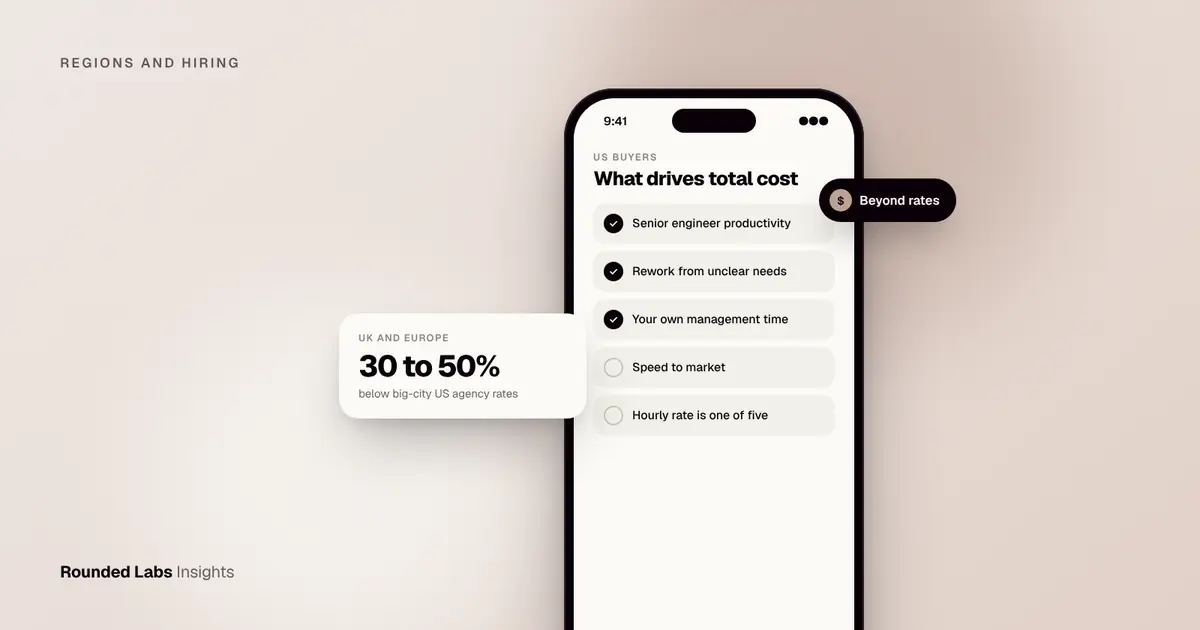
The hourly rate is only one of five factors:
- Productivity. Senior engineers often deliver the same scope in fewer hours.
- Rework. Misunderstood requirements cost twice: once to build, once to fix.
- Your management time. Larger time gaps and thinner product skills push more work onto your team.
- Speed to market. A cheaper build that ships three months later can cost more in lost revenue.
- Long-term maintainability. Poorly structured code makes every later change more expensive (post:C19 on technical debt).
A useful test: ask each shortlisted team to estimate the same written scope, then compare total cost and timeline, not rates. App development quotes compared: why prices range so widely explains why quotes vary so widely.
Comparing options for your app? We will give you a fixed quote in dollars for your scope and tell you honestly if a nearshore or onshore team suits it better. Book a 30-minute call with a co-founder.
When should you choose each option?
Choose onshore if:
- Your product handles highly regulated data and your customers demand US-based staff.
- You need people in the room for workshops every week.
- Budget is less of a constraint than speed of decision-making.
Choose nearshore if:
- You want real-time collaboration through the whole day.
- Your own product and design leadership is strong.
- You are scaling an existing engineering team rather than building a product from scratch.
Choose a UK or Western European studio if:
- You want senior product, design and engineering in one team.
- You can work with morning overlap and async updates.
- You want to cut cost meaningfully without dropping the quality bar. Hiring a UK app development company from the US explains how this works day to day.
Choose offshore if:
- The work is well specified and you have strong in-house product management.
- You can invest in documentation, QA and regular check-ins.
- Cost is the deciding factor.
How do you reduce the risk of any outsourced team?
- Start with a paid discovery phase to test the working relationship before the full build (post:B7).
- Own the repositories and accounts from day one.
- Pay against milestones, with working software at each one.
- Agree a governing law and IP assignment in the contract (post:H6).
- Check references from clients in your country.
Our Due diligence checklist for US companies hiring abroad has a full due diligence checklist.
Frequently asked questions
Is nearshore better than offshore for US companies?
Nearshore usually makes collaboration easier because of time zone alignment, at a higher rate than offshore. Offshore can work well for clearly specified work with strong in-house product leadership. The right choice depends on how much day-to-day collaboration your project needs.
Is the UK considered nearshore for the US?
Not geographically, but in practice UK teams share three to four hours of working time with the US East Coast, native English and similar business norms, which gives many of the benefits of nearshore.
How much can a US company save by outsourcing app development?
Against major-city US agencies, savings are typically 30 to 50% with UK or Western European studios, 40 to 70% with nearshore teams and 60 to 80% with offshore teams on rates alone. Real savings depend on productivity and rework.
What is the biggest risk of offshore development?
Misunderstood requirements leading to rework, often made worse by limited overlap. Strong documentation, regular demos and a discovery phase reduce this risk.
Can I mix models?
Yes. Many companies use a senior team for product design, architecture and core features, and a lower-cost team for well-defined extensions or QA. Clear ownership of the codebase is essential.
Official sources and further reading
Talk it through with one of our co-founders. 30 minutes, no pressure.