

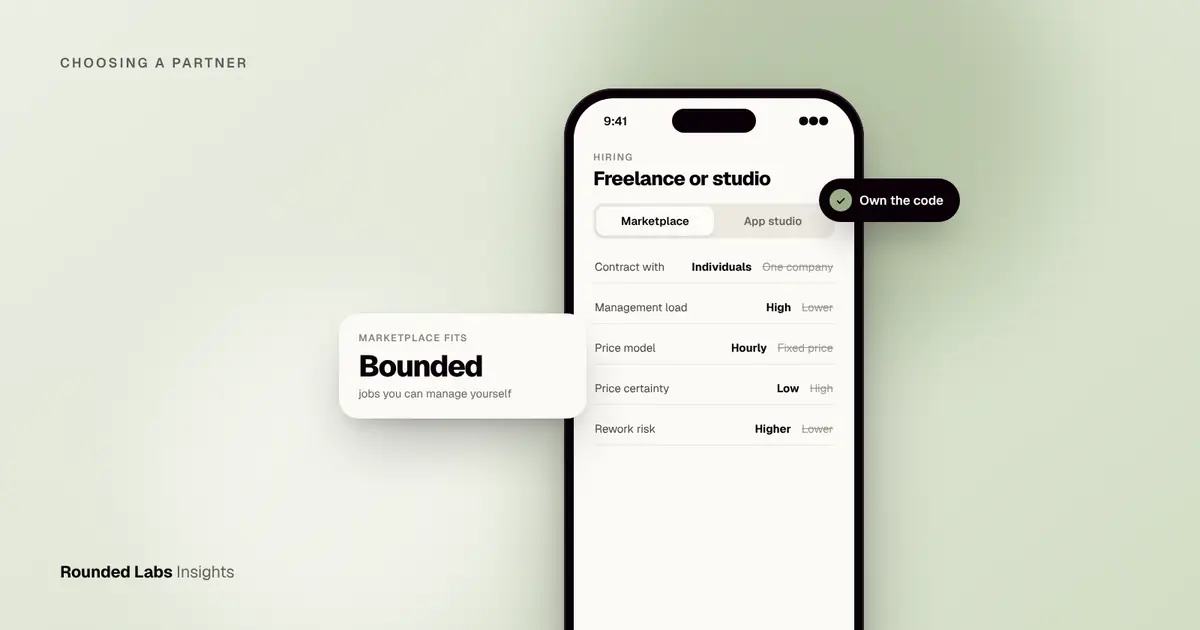
Hire a freelancer from a marketplace when you have a small, well-defined task and can manage the work yourself; choose an app studio when you need a whole product designed, built, tested and supported by a team. Marketplace developers often quote roughly £25 to £100 an hour (a market estimate, not a quote), so a single freelancer can look cheaper, but a full app usually needs several roles, which narrows the gap.
We have delivered apps since 2007, including the modernisation of the Superdry app across 768 locations in over 100 countries and the first mobile banking app in the UK for MoBank. This guide compares the two routes honestly, covers where each one fails, and shows how to decide. If you want the wider picture, our mobile app development service page explains how a studio project runs. We are a studio, so we have a view, but we will say plainly where a freelancer is the better choice.
Key facts
- Marketplaces such as Upwork and Freelancer give fast access to individuals; quality and availability vary widely.
- A typical app needs product, design, mobile or web engineering, backend, testing and project management. One freelancer rarely covers all of them well.
- Marketplace rates are market estimates and change with skills and location; the real cost depends on hours, rework and your own management time.
- Rounded Labs works at a fixed price agreed before development starts, with projects typically £30,000 to £250,000+. See the pricing page.
- Contract terms matter: confirm in writing that you own the code, designs and accounts.
- The cheapest quote is rarely the lowest total cost once rework, delay and your own time are counted.
What is the real difference between a marketplace and a studio?
A marketplace is a directory with payment protection. You find individuals, judge their quality yourself, agree scope with each one and manage the result. A studio is a single supplier that takes responsibility for the outcome, supplying the people, process and accountability as one package.
| Factor | Freelance marketplace | App studio |
|---|---|---|
| Who you contract with | Individual(s) | One company |
| Roles covered | Whatever you assemble | Product, design, engineering, testing, delivery |
| Management load | High: it falls on you | Lower: a project lead handles it |
| Price model | Usually time based or per milestone | Often fixed price, though some suppliers charge by time |
| Continuity if someone leaves | You start again | Team members are replaced |
| Accountability | Each person for their own part | One company for the whole result |
| Best for | Small, defined tasks | Complete products and complex builds |
The deepest difference is who carries the risk of integration. When you hire three freelancers, you are the project manager, the product owner and the quality gate. When you hire a studio, those jobs are inside the price. Neither model is wrong, but they suit different buyers.
For more on this three-way choice, including in-house hiring, read App agency vs freelancer vs in-house team, and for the UK specific angle on location see UK vs offshore app development.
What marketplaces do well
It is fair to give marketplaces credit for what they do well, because most of our own clients have used one at some point.
- Speed to first conversation. You can post a brief in the morning and have proposals by the evening.
- Choice. There are thousands of developers with niche skills, from a specific SDK to a single payment integration.
- Payment protection. Funds held against milestones reduce the risk of non-payment on both sides.
- Low commitment. You can start a small job without a long contract or a minimum spend.
- Visible history. Ratings and past job counts give a rough signal, though they are not a substitute for checking the work.
What studios do well
- A whole team. Product thinking, design, mobile engineering, backend, testing and delivery are coordinated, so the parts fit.
- One point of accountability. If something is wrong, there is a single supplier to resolve it.
- Process. Reviews, automated testing, release management and security checks are normal practice, not extras.
- Continuity. People can be replaced without the project stopping.
- Longevity. A company with a track record is likely to be around to support the app next year.
When does a freelancer make sense?
Freelancers are a good fit more often than studios like to admit. Consider one when:
- You need a specific, bounded job: a prototype, a bug fix, an API integration or a design refresh.
- You already have a technical lead who can review the work and make decisions.
- The budget is small and the risk of the project failing is acceptable.
- You are extending an existing app that someone on your side already understands.
- You need a specialist for a few weeks, such as an accessibility audit or a store submission.
- You are building a throwaway proof of concept to show investors or test demand.
A strong freelancer can be excellent value on this kind of work. The trouble starts when a founder with no technical background tries to build a full product by stitching together several people they have never met.
A decision table by project type
| Project | Better fit | Why |
|---|---|---|
| Fixing a bug in an existing app | Freelancer | Small, bounded, quick to brief |
| Clickable prototype for investors | Freelancer or studio | Low risk, short life |
| Full consumer app on iOS and Android | Studio | Many roles and a long build |
| Marketplace or fintech product with payments | Studio | Security, compliance and integration risk |
| Adding one feature to an app you control | Freelancer | Existing technical lead can review |
| Rescuing an app another supplier abandoned | Studio, after an assessment | Needs diagnosis before a plan |
| Internal staff tool for a small team | Either | Depends on complexity and your IT support |
| App with regulated data such as health or finance | Studio | Process and accountability matter |
If you are unsure where your project sits, read What happens in a discovery phase, and why it saves money. A discovery phase turns a vague idea into a written scope, and it is also the best way to judge whether a project is small enough for a freelancer.
Where do marketplace projects go wrong?
The failures are predictable, and most are about management rather than skill.
- No one owns the whole. The designer, the developer and the backend freelancer each finish their part. Nobody checks that the parts fit together.
- Scope drift. Time based work rewards time spent, not outcomes. A vague brief becomes a growing bill.
- Availability. A freelancer who takes on a better offer leaves you with half-finished code and no handover.
- Quality you cannot see. Without technical review, you only learn code was poor when changes become slow and expensive. This is technical debt, covered in What is technical debt?.
- Weak security and testing. Freelancers working alone often skip test automation, security review and store submission planning.
- Accounts in the wrong name. Developer accounts, cloud services and domain names are set up under the freelancer’s own login, and you discover this when you need to move.
- Knowledge held in one head. Nobody else understands how the app is put together, so every change depends on one person.
Our guide Red flags when hiring app developers lists warning signs for any supplier, freelance or agency. If you inherit a half-finished app, How to switch app agencies without losing your app explains how to recover it.
Why these failures are structural, not personal
Most freelancers are honest and capable. The failures above come from the setup. If three people each have a separate contract, a separate schedule and a separate incentive, nobody has a reason to look at the seams between their work. The seams are where apps break: the login that works in the design but not with the backend, the push notification that the mobile developer built but the server never sends, the payment flow that handles success but not failure.
A studio solves this by making someone responsible for the seams. You can solve it yourself on a marketplace by appointing a technical lead, but that person must be competent and have time, which is a cost, even if it is not on the invoice.
Not sure whether you need a team or one developer? A short call can save you a failed first build. Book a 30-minute call with a co-founder and we will tell you honestly which route fits, even if that is not us.
What does each route really cost?
Time based rates only tell part of the story. These are market estimates for a mid-sized mobile app, and your project will differ.
| Cost element | Assembled freelance team | Studio, fixed price |
|---|---|---|
| Build price | £15,000 to £60,000, depending on hours and rates | Typically £30,000 to £250,000+ |
| Your time managing | Often 5 to 15 hours a week | A few hours a week |
| Rework risk | Higher, as quality varies | Lower, with review and testing built in |
| Testing and release work | Often extra or missing | Included in the agreed scope |
| Price certainty | Low: hours can grow | High: agreed before work starts |
| Support after launch | Whatever you negotiate | Agreed with the project |
The cheapest quote is not the lowest cost if you pay twice. A realistic comparison includes your own time, the cost of fixing mistakes and the cost of delay. For how pricing models compare, see Fixed price vs time and materials for app projects, and for a wider look at why quotes differ so much, read App development quotes compared.
Typical market rates by region and type
The following table is a generic market guide, not a Rounded Labs price list. Rates vary with experience, skill and demand, so treat it as orientation only.
| Supplier type | Typical market range | What to expect |
|---|---|---|
| Junior freelancer, marketplace | £15 to £35 an hour | Cheap, but needs supervision |
| Mid-level freelancer, marketplace | £30 to £60 an hour | Solid for defined tasks |
| Senior freelancer, UK based | £60 to £100 an hour or more | Strong, but usually one person |
| Small UK agency | £60 to £120 an hour, or fixed price | A small team with some process |
| Larger studio | Often fixed price for a defined scope | Full team and accountability |
Our guide to app development rates explained goes further on what each level typically includes, and App development rates 2027: UK vs US vs Eastern Europe vs Asia compares regions. Note that Rounded Labs does not charge by the hour. We agree a fixed price before development starts, so the number you sign is the number you pay for the agreed scope.
What the rate does not include
A low rate can hide a lot of missing work. When you compare a marketplace quote with a studio quote, ask whether each includes:
- Discovery and scoping.
- User interface and experience design.
- Mobile engineering for both platforms, or one.
- Backend and database work.
- Admin tools.
- Automated and manual testing on real devices.
- Security review.
- App Store and Google Play submission.
- Analytics and crash reporting set up.
- A warranty or support period after launch.
- Documentation and handover.
If a quote lists only “development”, you are being asked to buy the other items separately, or to do without them.
A worked example: a booking app for a small business
A founder wants a booking app for a chain of salons, with customer accounts, payments, reminders and a simple admin screen.
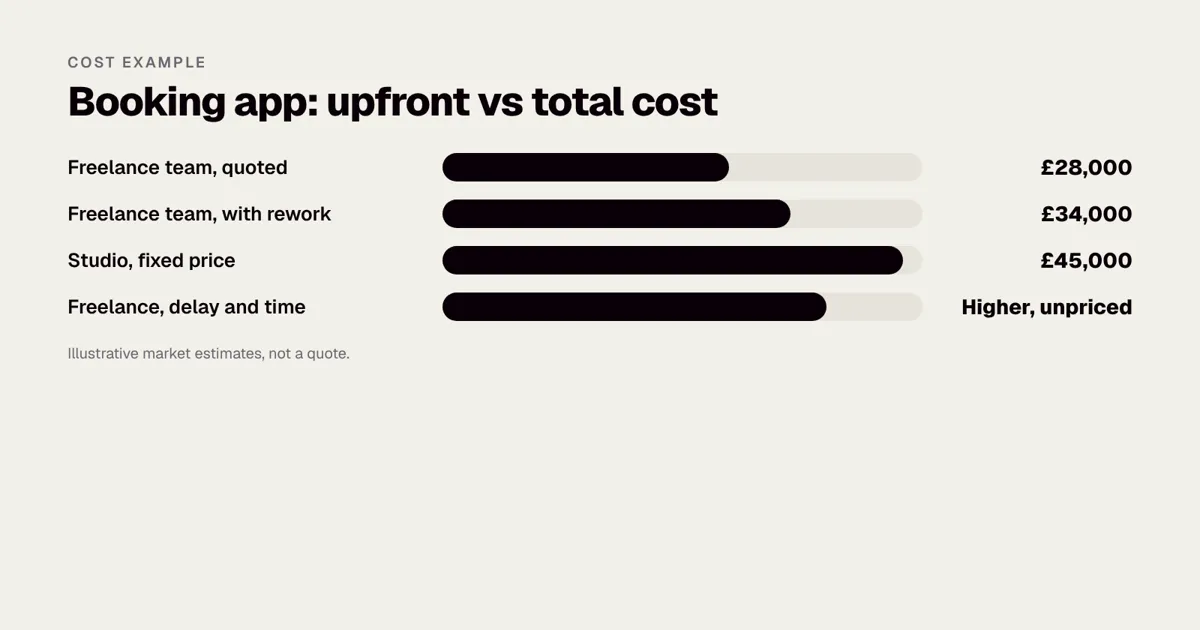
- Marketplace route. They hire a designer, a mobile developer and a backend developer from a marketplace for around £28,000 in total. The founder spends several hours a week passing messages between them. At month four the backend developer disappears, the payment flow has bugs, and a replacement quotes £6,000 to rework it. The final cost is about £34,000 and the launch is three months late.
- Studio route. A studio quotes a fixed price of £45,000 for the same scope, with testing, store submission and a support period included. The founder attends a weekly review and gets a working app on the agreed date.
These figures are illustrative, not a promise. The pattern is the point: the freelance route looked £17,000 cheaper upfront, but the gap shrank to £11,000 once rework was added, and it came with a later launch and more risk. The right answer depends on how much risk and management time you can absorb.
Counting the hidden costs in the example
| Item | Marketplace route | Studio route |
|---|---|---|
| Quoted build | £28,000 | £45,000 |
| Rework after a freelancer left | £6,000 | £0 |
| Founder time (about 8 hours a week for 6 months, valued at your own rate) | Significant | Lower |
| Three months of delay | Lost bookings and income | None |
| Support in first quarter | Extra purchase | Included |
If the founder’s time is worth £40 an hour and they spend eight hours a week for 26 weeks, that is about £8,300 of time that never appears on an invoice. Add it, and the gap narrows further. This is not an argument that a studio is always cheaper; it is a reminder to compare the whole cost.
When the freelancer route wins
Change the example. The same founder already has a technical co-founder who can review code, and wants only a loyalty feature added to an existing app. A freelancer at £40 to £70 an hour for 80 hours, so £3,200 to £5,600, is likely to be better value than a studio project, and the risk is low because the co-founder can check the work. The decision turns on who can supervise, not on any rule about size.
How do you hire a freelancer safely?
If you go the marketplace route, reduce the risk:
- Write a clear brief before you contact anyone. Our app specification template guide shows what to include, and How to brief an app development agency works equally well for individuals.
- Start with a paid trial task of a few days and judge the work, not the profile.
- Ask for code access from day one in a repository you own, and review it with a technical adviser.
- Pay by milestone against working software, not hours alone.
- Put ownership in writing. The contract should say you own all code, designs and accounts, including the Apple and Google developer accounts.
- Check employment status. In the UK, how you engage a contractor can have tax implications; check the current rules on gov.uk, including the off-payroll working rules.
- Keep communication in your own channels so you hold the history if the person leaves.
- Insist on documentation. A short README, setup steps and a list of services used.
Our questions to ask an app developer list works for freelancers and studios alike.
A freelancer vetting checklist
- Ask for two or three live apps they have shipped, and install them. Do they work, and do they feel fast?
- Ask what part of each app they personally built.
- Ask for a reference from a client with a similar project, and speak to them.
- Ask how they test their work and how they handle bugs after delivery.
- Ask how they manage access to code, so you can see the repository from day one.
- Ask about their availability over the next six months, and what happens if they are ill.
- Ask how they would handle a change in scope, and how they price it.
- Pay for a short paid task before committing to a long one.
Warning signs in a proposal
| Warning sign | Why it matters |
|---|---|
| A price far below every other quote | They have misunderstood scope, or will add cost later |
| A promise to deliver in weeks what others quote in months | Corners will be cut, usually testing |
| No questions about your users or goals | They are pricing the screens, not the product |
| Reluctance to share code or use your repository | Lock in, or poor practice |
| No mention of testing or store submission | You will pay for it later |
| Pressure to pay everything upfront | Risk of non-delivery |
| Vague ownership wording | You may not own what you pay for |
Who owns the code, and what should the contract say?
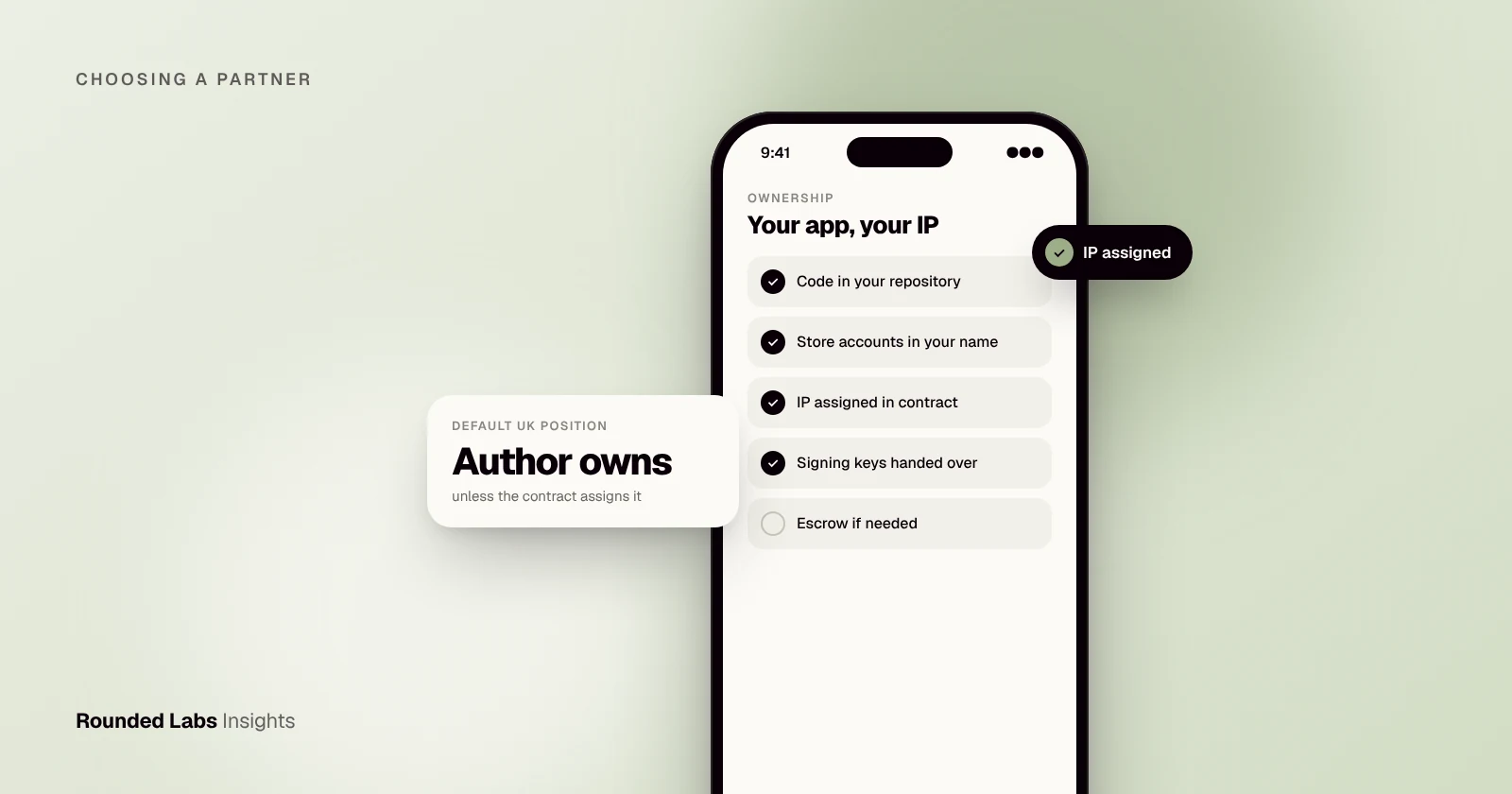
Ownership is where many small projects go wrong. In the UK, the person who creates a piece of software is generally the first owner of the copyright unless there is an employment relationship or a written assignment. A freelancer is usually not your employee, so without a written assignment you may only have a licence to use the work. The government’s intellectual property overview on GOV.UK is the official starting point. This is general information, not legal advice; take advice from a solicitor on any contract that matters to your business.
A sound contract covers:
- Assignment of copyright in all code, designs and documentation to you on payment.
- Third party and open source components, with licences listed. See What is an open-source licence? for why this matters.
- Accounts in your name: Apple Developer, Google Play, cloud hosting, domain, analytics and any third party services.
- Source code delivery at each milestone, not only at the end.
- Confidentiality for your data and business plans.
- Acceptance criteria for each milestone. What is acceptance criteria? explains how to write them.
- A change process, so new requests are priced before they are built. What is a change request? and What is scope creep? are good background.
- What happens if the relationship ends, including handover and notice.
Our longer guide, Who owns the code? IP, contracts and escrow for UK app projects, goes into assignment and escrow in detail, and What is source code ownership? is a short primer. For the platform side, make sure the developer account is registered in your company’s name on the Apple Developer Program and the Google Play Console, not in a freelancer’s personal name.
Contracts with a studio
A studio contract should also be checked, not trusted. Look for the same ownership terms, a clear scope and price, a defined acceptance process and a warranty period for defects. Documents such as a statement of work and a master services agreement are normal for larger projects. Our guide on what a good app development proposal looks like explains what to expect to see in writing before you sign.
What does quality look like, and how can you check it?
You do not need to read code to judge quality, but you do need someone who can. Options:
- A technical adviser for a few hours to review the repository. This might be a trusted contact, a fractional technical lead or a one off audit. Our Tech Architecture Audit is a fixed price £7,500 option for a deeper independent review.
- Automated checks. Ask whether the project has automated tests, a build pipeline and static analysis. Our guide to What is CI/CD for apps? explains the terms.
- Security basics. Ask how the app handles login, data storage and network traffic. Mobile app security checklist: OWASP MASVS in plain English gives you a list of questions, and the OWASP site is the standards body behind it.
- Testing evidence. Ask to see how the app has been tested on real devices. App testing explained: QA, UAT and beta testing sets out what good looks like.
- Performance. Open the app on an older phone. Slow launches and stutters are a sign of deeper issues.
A simple scorecard
| Area | What good looks like | Red flag |
|---|---|---|
| Code access | Repository in your name from day one | Code only shared at the end |
| Tests | Automated tests run on each change | “We test by hand” and nothing else |
| Security | Secrets kept out of code, data encrypted | Passwords or keys in the repository |
| Releases | A repeatable build and release process | Builds made on one person’s laptop |
| Documentation | Setup instructions, architecture notes | Nothing written down |
| Handover | Clear steps and a walkthrough | “It is all in my head” |
If you want an independent assessment of an app someone else built, our Legacy App Rescue Assessment is a fixed price £6,500 option that reports on what to keep, repair or rebuild.
How do support and maintenance compare?
Building the app is only the start. Operating systems change every year, third party services alter their rules, and bugs appear on devices you did not test. Any route needs a plan for after launch.
| Question | Freelancer | Studio |
|---|---|---|
| Who fixes a crash at 9am on Monday? | Whoever is free, if anyone | A named support arrangement |
| What if the person is unavailable? | You wait or find someone new | The team covers |
| How are OS updates handled? | Ad hoc | Planned, see How to prepare your business app for each new iOS release |
| Is there a warranty? | Rarely | Often a defined period |
| Cost certainty | Time based | Agreed in advance |
Budget for ongoing costs whichever route you take. Our guide on App maintenance costs in the UK gives realistic ranges, and The total cost of owning an app over five years shows why the build price is a small part of the picture.
Moving between routes
Many teams start with one route and change later. If you began with freelancers and now need a studio, the transition works well when the code is in your repository, documented and reasonably clean. When it is not, a studio may recommend an audit first, since poor code can cost more to fix than to rebuild; Rebuild or refactor explains the trade off. If you began with a studio and want to bring work in house or to a freelancer, make sure your contract gives you the repositories, accounts and documentation you need.
How should you decide?
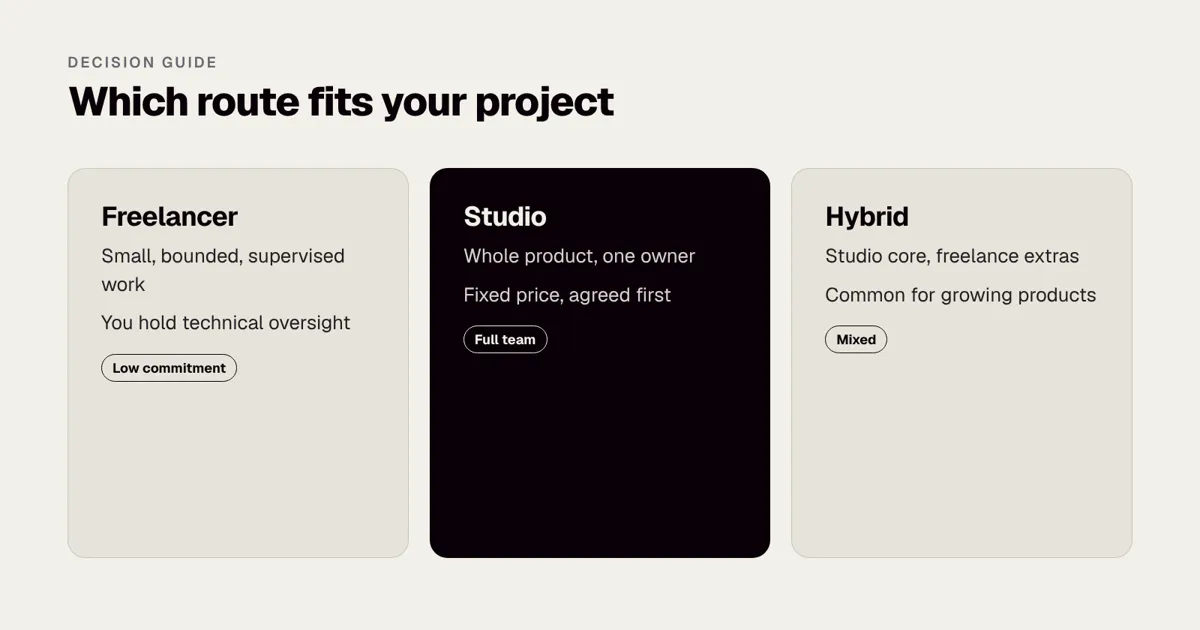
Ask three questions. Do you have someone technical who can direct and review the work? Is the job small and clearly defined? Can you absorb a delay or rework without harming the business? If the answer to all three is yes, a freelancer is a sensible choice. If any answer is no, a studio is usually safer. Many teams do both: a studio builds the core product, and freelancers handle later, narrower tasks. For a wider checklist see How to choose an app development company in the UK.
A scoring exercise
Score each statement from 0 (not true) to 2 (completely true). Add up your total.
- I have a written specification of what the app must do.
- I have a technical person who can review code.
- The app has fewer than five main screens.
- The app does not handle payments, health data or personal financial data.
- I can spend 10 hours a week managing the work.
- A delay of three months would not damage the business.
- I am comfortable replacing a freelancer mid-project if needed.
- I have a budget for fixing mistakes.
| Total score | Suggested route |
|---|---|
| 12 to 16 | A freelancer, or a few, is likely to suit you |
| 7 to 11 | Consider a studio for the core and freelancers for extras, or a discovery phase first |
| 0 to 6 | A studio is probably safer |
This is a rough guide, not a rule. The point is to make you think about risk and supervision before you compare prices.
What if you cannot afford a studio?
A studio project, at £30,000 or more, is out of reach for many early founders. That is a fair constraint. Options include:
- Start smaller. Validate the idea with a prototype and user testing before a build. Our guide on how to validate an app idea before you spend £50k shows how.
- Build a narrower first release. What is an MVP? and MVP vs prototype explain how to cut scope without cutting quality.
- Use a freelancer with a technical adviser. Pay a few hours of expert review, and keep control of the repository.
- Consider a fractional technical lead. See Fractional CTO vs app agency for early-stage startups.
- Look at funding. Some projects qualify for relief or grants; R&D tax relief and Innovate UK funding for app projects gives an overview, and you should check the official sources and take advice.
- Cut cost without cutting quality. How to cut app development costs without cutting quality lists practical ways.
Our Mobile Product Discovery Sprint is a fixed price £9,500 option that produces a prototype, tested flows and a costed plan, which gives you something concrete to take to either a studio or a freelancer.
What does working with a studio look like in practice?
If you decide on a studio, it helps to know what to expect, so you can judge whether the supplier is doing it properly.
- Discovery. Workshops, user research and a written scope. See What happens in a discovery phase.
- Proposal and fixed price. A written scope, timeline, team and price, agreed before development starts.
- Design. Wireframes and visual design, reviewed with you before build.
- Build in short cycles. Regular demos on real devices so you see progress.
- Testing. Automated and manual testing, then user acceptance by you.
- Release. Store submission and launch support.
- Support. A defined period of fixes, then an agreed plan.
Our guide to Working with an app agency: the first 90 days describes the early weeks in detail. Proof of how this works at scale includes the Waterstones project, where an app, a mobile site and an eBooks API were delivered in 12 weeks, and our 19 years of projects since 2007.
Questions that expose a weak studio
Studios vary too. Ask these questions, and be wary of vague answers:
- Who exactly will work on my project, and are they employees or subcontractors?
- Can I speak to a past client with a similar project?
- What is included in the fixed price, and what is excluded?
- How do you handle changes after the price is agreed?
- Who owns the code and the accounts, and when does ownership pass to me?
- What happens if a key person leaves?
- What is your testing process, and what devices do you test on?
- What support do you offer after launch, and what does it cost?
Is a marketplace safe for payments?
Marketplaces usually hold funds in escrow, which protects against non-payment or non-delivery of a milestone. It does not protect you from poor code quality, so you still need technical review. Marketplace fees are paid by one or both sides and change from time to time, so check the current terms on each platform before you commit. If you contract directly with a freelancer outside a platform, use a written agreement, pay against milestones and avoid large upfront payments.
With a studio, payment is normally against agreed milestones in a contract. Be cautious of any supplier, studio or freelancer, who asks for the full amount before any work is delivered.
Three more realistic scenarios
Abstract advice is easier to apply with concrete cases. These are illustrations built from common patterns, not descriptions of named clients, and every figure is a market estimate.
Scenario one: the retailer who needs a loyalty feature
A regional retailer already has an app built by a studio two years ago. Marketing wants a points balance and a rewards screen. The in-house IT manager understands the app and has the repository. This is a bounded task with a capable reviewer, so a freelancer is a sensible choice. The retailer writes a one page brief, runs a three day paid trial on a small part of the feature, and pays by milestone. The risks are small: the code lives in the retailer’s repository, and the IT manager checks each change before it is merged. A studio would add process the project does not need.
Scenario two: the founder with a payments product
A founder wants a savings app that connects to bank accounts, shows balances and lets users move money. This involves personal financial data, regulated partners, security review and a long list of edge cases, such as failed payments and disputed transactions. Even a very good freelancer would struggle to cover design, mobile engineering, backend, security and compliance alone. Here a studio, or a carefully managed team with an experienced technical lead, is the safer route. Our guide to how much a fintech app costs in the UK shows why the cost and risk sit in the parts users never see.
Scenario three: the owner of a half-built app
A business owner paid a freelancer £18,000 for an app that is now six months late. The freelancer has stopped replying, the repository is in their personal account and nobody knows what has been built. The first step is not to hire anyone to continue. It is to find out what exists: who holds the accounts, whether the code can be recovered, how much of it is usable. Our fixed price Legacy App Rescue Assessment at £6,500 is designed for exactly this, and the guide on how to switch app agencies without losing your app lists the order in which to recover accounts and code. After the assessment the owner can decide whether to repair, rebuild or continue with a different supplier, with facts rather than hope.
What the three scenarios have in common
In each case the right choice turned on supervision, scope and risk, not on price alone. The retailer had a reviewer, a small scope and low risk. The founder had a complex scope, regulated data and high risk. The business owner needed facts before a decision. If you can describe your own situation in those three terms, you can usually see the answer. If you cannot, that is a sign you would benefit from an outside view before you spend anything.
What should you do this week?
If you are weighing the two routes, a few small actions will make your decision better, whichever way it goes.
- Write one page describing what the app must do, who uses it and what success looks like. Use the app specification guide as a template.
- List the roles the project needs, and tick the ones you could cover yourself.
- Identify your technical reviewer. If you do not have one, find one before you hire anyone.
- Get two or three quotes from each route, and make sure each quote covers the same scope.
- Check the contract wording on ownership, accounts and handover.
- Decide your tolerance for delay and rework, in weeks and in pounds.
- Talk to someone independent. If you would like a candid opinion on which route fits, book a call with a co-founder. We will say so if a freelancer is the right answer.
A closing comparison: which route for which founder?
| Founder profile | Likely best route |
|---|---|
| Technical founder building a first version | Freelancers, or build it yourself |
| Non-technical founder with a small budget | Prototype first, then a narrow freelance build with an adviser |
| Established business launching a customer app | Studio |
| Business with an internal IT team | Studio for the build, in-house for support, or a hybrid |
| Founder rescuing an abandoned app | Assessment first, then studio or specialist |
| Agency or business needing a single integration | Freelancer |
Whichever you choose, write down the scope, own the code and accounts, review quality independently and plan for support. Those four habits do more to protect a project than the choice between a marketplace and a studio.
Frequently asked questions
Are freelance app developers cheaper than agencies?
On the time based rate, often yes. On the total cost of a complete app, the gap is smaller once you add management time, rework and the extra roles you need. Compare like for like, including testing and support.
Who owns the code if I hire a freelancer?
Only what your contract says. In the UK, a freelancer can keep the copyright unless the contract assigns it to you, so get an explicit assignment in writing before work starts. Check the official guidance on GOV.UK and take legal advice if the app matters to your business. This is general information, not legal advice.
Can I start with a freelancer and move to a studio later?
Yes, if the code is in a repository you control and is reasonably documented. A studio may recommend an audit first, since poor code can cost more to fix than to rebuild.
What does Rounded Labs charge?
We work at a fixed price agreed before development starts, and projects are typically £30,000 to £250,000+. Our productised services have set prices, such as the Tech Architecture Audit at £7,500 and the Mobile Product Discovery Sprint at £9,500. See the pricing page for how it works.
Is a marketplace safe for payments?
Marketplaces usually hold funds in escrow, which protects against non-payment or non-delivery of a milestone. It does not protect you from poor code quality, so you still need technical review.
How many freelancers does a typical app need?
A mobile app with a backend usually needs a designer, a mobile developer, a backend developer and someone to test and coordinate. Some individuals cover two roles well, but rarely all of them. Count the roles first, then decide who fills each one.
Should I use a freelancer for an urgent fix?
Often yes, if the problem is bounded and you have access to the code. Give them a clear description, a test environment and a way to verify the fix. If the app has no documentation and the original developer is gone, an assessment may be needed first.
Do I need a contract with a freelancer?
Yes. A short written contract that covers scope, price, milestones, ownership and confidentiality protects both sides. Marketplace terms cover some of this, but not always ownership, so add your own assignment clause and have a solicitor check it.
Official sources and further reading
Talk it through with one of our co-founders. 30 minutes, no pressure.