App development rates range from about £20 to £200 an hour ($25 to $250, roughly €23 to €230) depending on where the team is, how senior it is, and what is included in the rate. A low rate usually buys coding time only; a higher rate usually includes product thinking, design, testing, project management and accountability for the result. The rate that matters is the cost of the finished, working app, not the cost of an hour.
We have built apps since 2007 for startups, banks and brands such as Next and Superdry. This guide explains what each rate level typically buys, so you can compare quotes on equal terms. All rates here are generic market estimates, not quotes, and they are not Rounded Labs rates: we work at a fixed price agreed before development starts, with projects typically £30,000 to £250,000+ (see our pricing page). Rates move with the market, so check current figures with suppliers. The sections below cover what each band includes, why rates differ, why comparing them alone misleads, how day rates and blended rates work, how to build a fair comparison, and how to turn a rate into a realistic project budget.
Key facts
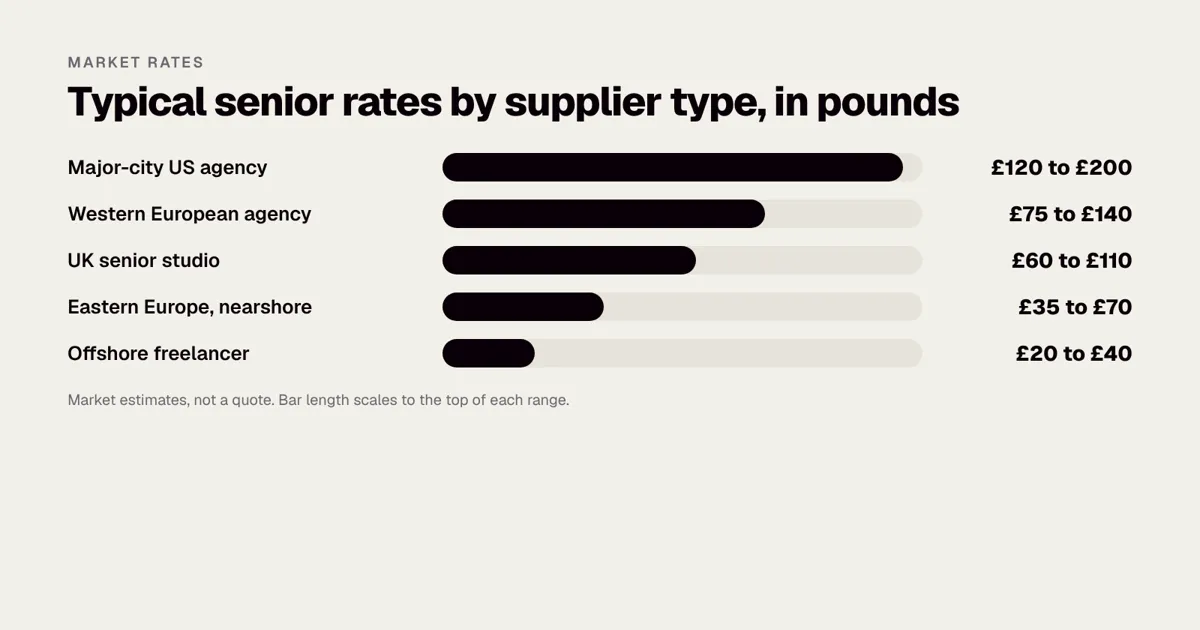
- Offshore freelancers and small teams: about £20 to £40 an hour (market estimate).
- Eastern Europe and nearshore agencies: about £35 to £70 an hour.
- UK senior studios: about £60 to £110 an hour.
- Western European agencies: about £75 to £140 an hour.
- Major-city US agencies: about £120 to £200 an hour ($150 to $250).
- Two quotes at different rates can total the same, or the cheaper rate can cost more, because the number of hours and what is included differ.
- Fixed price moves the risk of overruns from you to the supplier, which is why it is the only way Rounded Labs prices projects.
What do you get at each rate level?
| Rate (GBP an hour) | Who usually charges it | What is typically included | Watch out for |
|---|---|---|---|
| £20 to £40 | Offshore freelancers, small offshore teams | Coding to a specification | Little design, testing or product input; you manage the project |
| £35 to £70 | Eastern European and nearshore agencies | Solid engineering, some QA and project management | Design and discovery may be light or extra |
| £60 to £110 | UK senior studios | Discovery, design, engineering, QA, delivery management | Check who actually does the work |
| £75 to £140 | Western European agencies | Full service, local presence | High cost for equivalent scope |
| £120 to £200 | Major-city US agencies | Full service, same US time zone | Highest cost |
These are market estimates drawn from the range of public price lists and quotes in the sector, not quotes from any supplier, and not Rounded Labs rates. They change with demand, exchange rates and specialism, so treat them as a starting point for a conversation rather than a benchmark to hold a supplier to. App development rates 2027 has a country-by-country rate benchmark, and How to estimate your app budget in pounds, dollars or euros shows how to turn rates into a budget in your own currency.
What each band feels like in practice
The £20 to £40 band. You are usually buying a person or a small team that writes code to a specification you provide. That can work very well when the specification is complete, you have technical knowledge on your side and the work is well bounded, such as building a screen from a finished design. It tends to go wrong when the brief is loose, because nobody in the engagement is paid to challenge it. Time zones, language and contract enforcement add friction. Freelance marketplaces vs an app studio and App agency vs freelancer vs in-house team go into this trade-off.
The £35 to £70 band. Eastern European and nearshore agencies often sit here. You get established engineering practices, usually some QA, and a project manager. The quality can be high. The common gaps are discovery, user research and design depth, which may be light or priced separately. For a European buyer the time zone alignment can be a real advantage; UK vs Eastern Europe for European companies building apps compares this directly, and UK vs Poland for app development: cost, quality and risk looks at one market in detail.
The £60 to £110 band. Senior UK studios typically include discovery, design, engineering, testing and delivery management in the rate or in the same price. You are paying for people who have shipped similar products before and who will tell you when an idea will not work. The risk is in who does the work: a senior face in the sales meeting does not guarantee a senior hand in the code. Ask for names and experience.
The £75 to £140 band. Western European agencies, in places such as Germany, the Netherlands, Ireland and the Nordics, are priced with high local salary costs. You get local presence, legal familiarity and a strong engineering culture. For a wider look at that market, see App development cost in Europe: Germany, Netherlands, Ireland and the Nordics.
The £120 to £200 band. Major-city US agencies are the most expensive, with the same time zone and market knowledge as a US buyer. How much does it cost to build an app in the US? 2027 prices in dollars covers the US market in more depth, and UK vs US app development agencies: cost, quality and risk compares the two.
Converting between currencies
Rates are quoted in many currencies, and exchange rates move. For rough comparisons, this table uses an illustrative conversion of £1 to $1.25 and £1 to €1.15. Use the current rate from a central bank, for example the Bank of England, before you make a decision.
| GBP an hour | USD an hour (approx.) | EUR an hour (approx.) |
|---|---|---|
| £30 | $38 | €35 |
| £50 | $63 | €58 |
| £75 | $94 | €86 |
| £100 | $125 | €115 |
| £150 | $188 | €173 |
| £200 | $250 | €230 |
Remember that the currency in which you are billed matters as much as the number. A supplier quoting in dollars exposes a UK buyer to exchange rate swings during a long project, while a fixed price in your own currency removes that risk.
Why do rates vary so much?
- Salaries and overheads in each location. A developer in a high-cost city costs more to employ, and the supplier needs to cover offices, equipment, insurance and management.
- Seniority. A senior engineer may cost twice a junior’s rate and deliver three times as much, or more on hard problems such as architecture and security.
- What the rate covers. Some rates are “developer only”; others include design, testing and management. A rate with everything inside is not comparable with a rate for coding alone.
- Risk. Agencies that commit to fixed prices and outcomes price in that risk. Agencies that bill by effort pass the risk to you.
- Demand and specialism. AI, security and regulated sectors command higher rates, because fewer people have the experience.
- Utilisation. A supplier needs to cover idle time between projects, sales, training and holidays. A rate that looks high may simply reflect that only part of a person’s week is billable.
- Reputation and track record. A studio with 19 years of delivery, such as ours since 2007, is pricing in knowledge as well as time.
What sits behind a rate
It helps to see how a supplier might build a rate. This worked example is an illustration of the logic, not a description of any real supplier’s accounts.
| Component | Illustrative share of the rate |
|---|---|
| Salary and benefits for the person doing the work | 50 to 60% |
| Management, sales and administration | 10 to 15% |
| Office, equipment, software licences | 5 to 10% |
| Training, recruitment and bench time | 5 to 10% |
| Margin and risk contingency | 10 to 20% |
When a rate seems too low to be viable, one of these components has been squeezed. Sometimes it is margin, which is fine. Sometimes it is senior oversight, testing or management, which is where problems begin.
Why is the hourly price a poor way to compare?
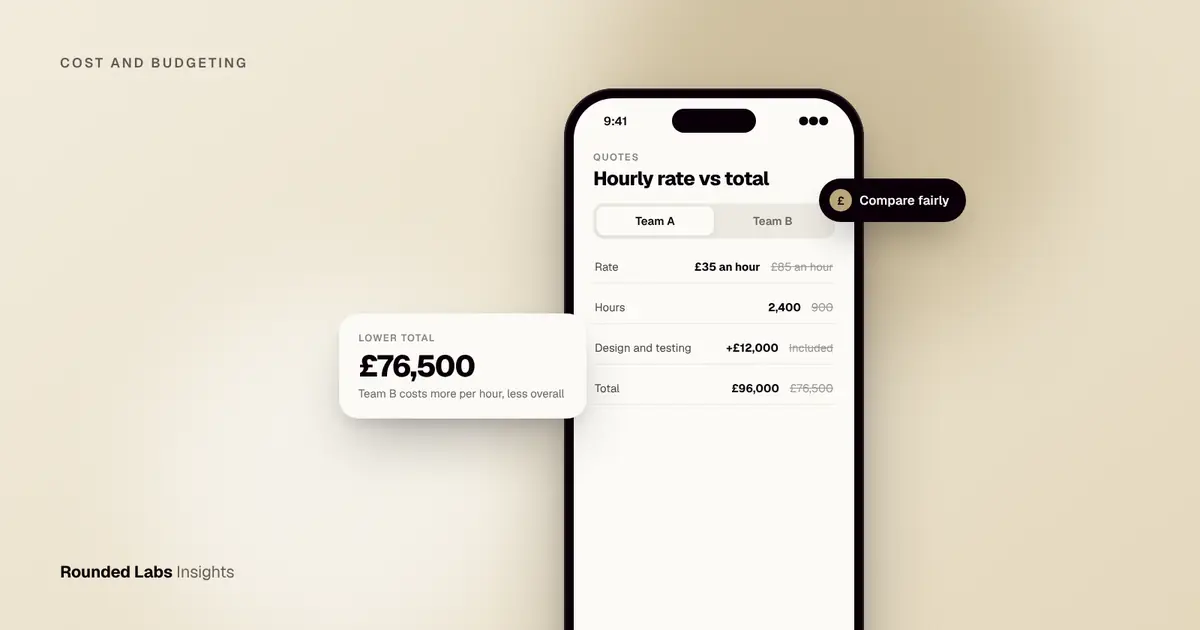
Because hours are not equal. Compare two quotes for the same app:
| Team A | Team B | |
|---|---|---|
| Rate | £35 an hour | £85 an hour |
| Estimated hours | 2,400 | 900 |
| Design and testing included | No, add £12,000 | Yes |
| Your management time | High | Low |
| Total | £96,000 | £76,500 |
Team B costs more an hour and less overall. This is an illustration with invented numbers, but the pattern is common. A cheaper rate with more hours can easily cost more than a dearer one with fewer. App development quotes compared: why prices range so widely explains why app quotes vary so widely, and What a good app development proposal looks like shows what a good proposal contains.
Want a quote you can compare? We give a fixed price with the scope and what is included set out clearly. Book a 30-minute call with a co-founder.
Five reasons the hours differ
- Experience. An engineer who has built a similar feature many times writes it faster and with fewer defects.
- Reuse. A team with tested components for login, payments and notifications builds on them instead of from scratch.
- Rework. Unclear requirements, missed edge cases and poor testing create rework that is billed at the same rate as new work.
- Overhead. Time spent on meetings, handovers and coordination varies enormously by team and by time zone.
- Estimation honesty. An estimate that looks low may leave out work that will turn up later as a change request.
The effective cost of a rate
An effective rate is what you actually pay for each hour of useful, accepted work. If some of the hours go on rework or on waiting, the effective rate is higher than the quoted one. A simple illustration:
| Quoted rate | Share of hours that become accepted work | Effective cost of an accepted hour | |
|---|---|---|---|
| Team A | £35 | 60% | about £58 |
| Team B | £85 | 90% | about £94 |
The shares here are invented to show the method, not measured figures. The point is that the gap between two quoted rates is often smaller than it looks once you ask how much of the time becomes working software. Add your own management time, which is also a cost, and the gap narrows again.
Hidden costs that sit outside the rate
- Your own time. Managing a low-cost supplier can take several hours a week of a founder’s or product manager’s time.
- Discovery and design. Often priced separately or left out of low rates.
- Testing and device coverage. A rate for development rarely includes thorough testing on many devices.
- App store submission and rejection handling. See Why Apple rejects apps, and how to avoid it.
- Hosting, third-party services and licences. These are not part of any rate. The hidden costs of building an app lists them.
- Maintenance after launch. The build is not the end of the spending; App maintenance costs in the UK explains the budget to expect afterwards.
- Warranty and bug fixes. Ask whether fixes in the first weeks are included.
Day rates, blended rates and fixed prices
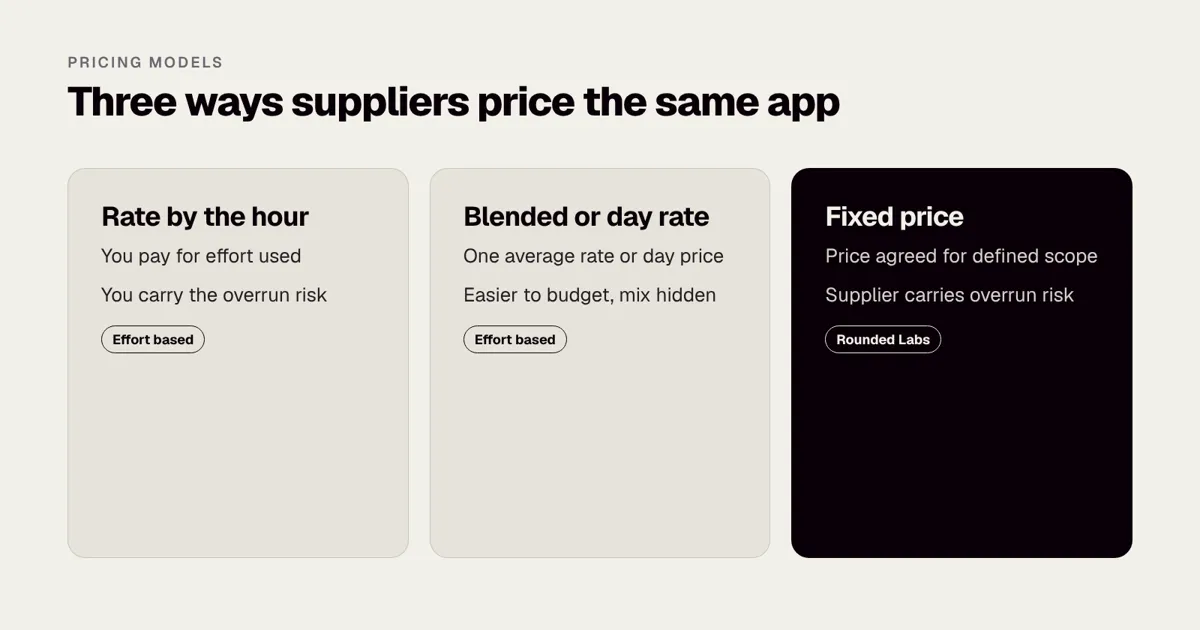
- Rate by the hour: common with freelancers and for small changes. It suits short, well-defined tasks.
- Day rate: common in the UK and Europe; usually 7 to 8 hours. A £600 day rate is about £80 an hour at 7.5 hours.
- Blended rate: one average rate across a team of mixed seniority, which simplifies budgeting.
- Monthly team rate: a dedicated team for a fixed monthly fee, a model some suppliers use for ongoing products. This is a generic market model, not one Rounded Labs offers.
- Fixed price: a price for a defined scope; the supplier carries the risk of overruns. Fixed price vs time and materials for app projects compares fixed price and time and materials.
How a blended rate is calculated
A blended rate divides the total cost by the total hours. A worked example, using illustrative numbers:
| Role | Hours | Rate | Cost |
|---|---|---|---|
| Senior developer | 300 | £100 | £30,000 |
| Mid-level developer | 500 | £70 | £35,000 |
| Junior developer | 200 | £50 | £10,000 |
| Designer | 120 | £80 | £9,600 |
| QA engineer | 150 | £60 | £9,000 |
| Total | 1,270 | £93,600 |
The blended rate is £93,600 divided by 1,270 hours, which is about £73.70 an hour. The blended figure is useful for a quick comparison, but it hides the mix. A supplier who quotes a low blended rate may have loaded the team with juniors. Ask for the split by role.
Which pricing model suits which situation?
| Situation | Model that usually fits | Why |
|---|---|---|
| Clear scope, defined launch | Fixed price | You know the cost before development starts and the supplier carries the overrun risk |
| Small change or urgent fix | Rate by the hour or day | Too small to scope formally |
| Early idea, scope unknown | A fixed-price discovery phase, then a fixed price for the build | Turns unknowns into a plan before big spending |
| Long-running product with steady changes | A planned series of fixed-scope phases, or a dedicated team model from some suppliers | Keeps cost visible for each phase |
| Specialist advice | Day rate | Short, expert input |
Rounded Labs prices every project at a fixed price agreed before development, and our fixed-price productised services help you decide what to build first: the Tech Architecture Audit is £7,500, Digital Transformation Prep is £7,000, the Mobile Product Discovery Sprint is £9,500 and the Legacy App Rescue Assessment is £6,500. For the wider case for scoping first, see What happens in a discovery phase, and why it saves money.
Hourly figures and the incentives they create
When a supplier is paid by effort, every extra hour is extra revenue. Most suppliers are honest and want repeat work, but the structure has an in-built tension: the supplier gains when a task takes longer, and you gain when it takes less. That does not make effort-based billing bad. It means you need controls, such as a weekly report on hours against forecast, a cap or review point, and someone on your side who can judge the progress. How to read an agency’s weekly report shows what to look for. Under a fixed price, the incentive flips: the supplier benefits from efficiency, and you protect yourself by agreeing the scope and acceptance criteria clearly. How to manage scope changes without blowing the budget explains how change requests work under fixed price.
How should you compare rates fairly?
- Send every supplier the same written brief. How to brief an app development agency lists what to include, and How to write an app specification gives a template.
- Ask for an itemised estimate by phase and role.
- Ask exactly what is included: discovery, design, QA, project management, launch, warranty.
- Ask who will do the work and their experience.
- Compare total cost, timeline and risk, not the hourly figure.
- Check references and past projects of similar size.
- Ask what happens if the estimate is wrong, and who bears the cost.
- Read the contract for ownership of the code and designs. Who owns the code? IP, contracts and escrow for UK app projects explains the points to check.
A comparison sheet you can copy
Fill in one column for each supplier, and compare like with like.
| Question | Supplier 1 | Supplier 2 | Supplier 3 |
|---|---|---|---|
| Rate or price model | |||
| Hours or price for discovery | |||
| Hours or price for design | |||
| Hours or price for build | |||
| Hours or price for testing | |||
| Project management included? | |||
| Warranty period | |||
| Total cost | |||
| Timeline | |||
| Who owns the code? | |||
| Named team and experience | |||
| Similar projects and references | |||
| Your time commitment per week |
Worked example: three quotes for the same booking app
Imagine you want a booking app for a chain of salons: iOS and Android, customer accounts, appointment booking, card payments, reminders and a simple admin panel. You request quotes from three suppliers. The figures below are invented for illustration.
| Supplier X (offshore freelancer) | Supplier Y (nearshore agency) | Supplier Z (UK studio, fixed price) | |
|---|---|---|---|
| Quoted basis | £30 an hour | £55 an hour | Fixed price |
| Estimated hours | 2,200 | 1,500 | Not shown |
| Cost of those hours | £66,000 | £82,500 | |
| Design | Not included, add £9,000 | Included | Included |
| Testing | Not included, add £8,000 | Included | Included |
| Project management | You | Included | Included |
| Your time per week | 8 to 10 hours | 3 to 4 hours | 1 to 2 hours |
| Total cost | £83,000 plus your time | £82,500 | £78,000 |
| Who bears the overrun risk | You | You, unless capped | Supplier |
On the face of it, Supplier X has the cheapest rate by far. After adding design and testing, and counting your own time, it is no longer the cheapest, and you carry all the risk. Supplier Z has no hourly figure to compare, which is why the sheet above matters: it forces everything into a total. This is an illustration, not a real quote, and a real comparison would need the detail of each proposal.
Questions that cut through a rate
- “What would make this estimate wrong, and who pays if it is?”
- “Which parts of the work are fixed and which are estimated?”
- “Who will be on my project, and what have they built before?”
- “What happens if we find a problem in testing?”
- “What is not included that I may need?”
- “Can I see a weekly report from a past project, with names removed?”
20 questions to ask an app developer before you sign goes further, and Red flags when hiring app developers lists warning signs.
What should a good rate include?
At a senior studio, you should expect the rate to cover: a named lead who understands your business, design that is tested with users, code reviews, automated and manual testing, release management for the App Store and Google Play, documentation, and regular progress reporting. If those are extras, factor them into the comparison.
A checklist for what a rate should cover
| Item | Included? | Notes |
|---|---|---|
| Named delivery lead | Single point of contact | |
| Discovery and scoping | Workshops, user flows, a written plan | |
| UX and UI design | Tested with real users where practical | |
| Development | iOS, Android, backend, admin | |
| Code reviews | A second pair of eyes on every change | |
| Automated testing | Reduces regression bugs | |
| Manual testing on devices | Real phones, not only simulators | |
| App store submission | Both stores, with rejection handling | |
| Analytics set-up | Events agreed before build | |
| Documentation | How to run, test and release | |
| Weekly reporting | Working builds, not just hours | |
| Warranty period | Fixes for defects found after launch | |
| Handover | Code, accounts and docs in your name |
If a supplier cannot tell you what is in its rate, you cannot compare it with another. Working with an app agency: the first 90 days explains what a well-run start looks like, and How to switch app agencies without losing your app is worth reading before you sign with anyone, because it shows what you will need from a handover.
How do rates change with seniority?
Within one agency, rates usually step up by role:
| Role | Typical UK studio rate (market estimate) |
|---|---|
| Junior developer | £45 to £65 an hour |
| Mid-level developer | £60 to £85 an hour |
| Senior developer or architect | £80 to £120 an hour |
| Designer | £60 to £100 an hour |
| QA engineer | £45 to £75 an hour |
| Delivery or product lead | £70 to £110 an hour |
A healthy team mixes levels: seniors set direction and review, mid-level and junior engineers deliver much of the build. Be wary of a quote that is all senior (expensive) or all junior (risky).
What seniority actually buys
- Fewer wrong turns. A senior engineer recognises early that a design will not scale, will not pass app store review or will not meet accessibility rules.
- Better trade-offs. Seniors can say which feature to cut and which shortcut is safe.
- Faster problem solving. A hard bug, such as a rare crash or a slow screen, may take a junior days and a senior an afternoon.
- Mentoring and review. Seniors raise the quality of everyone’s work, which is invisible in a rate table.
Where seniority is not worth paying for
Not every task needs a senior. Building standard screens from a finished design, writing straightforward tests and updating content are fine for mid-level or junior people under review. A good studio puts senior time where judgement matters: architecture, security, integrations and the first version of anything new.
The “senior in the pitch, junior in the code” problem
A familiar complaint is that the people who sell the work are not the people who do it. Protect yourself by asking for named people, their roles and the share of time each will spend on your project. A supplier who answers confidently, and puts the names in the proposal, is usually more reliable than one who talks about “the team”.
How do UK, US and European rates compare in total project cost?
A rate is only one input. The total depends on the scope and on how efficiently the team works. The table below turns the ranges above into indicative project costs for the same mid-sized app. All figures are market estimates, not quotes, and use invented assumptions of 1,000 to 1,800 hours depending on team efficiency.
| Supplier type | Rate band (an hour) | Likely hours | Indicative total (market estimate) |
|---|---|---|---|
| Offshore freelancer or small team | £20 to £40 | 1,500 to 2,600 | £30,000 to £104,000, plus your time |
| Eastern European or nearshore agency | £35 to £70 | 1,200 to 2,000 | £42,000 to £140,000 |
| UK senior studio | £60 to £110 | 900 to 1,600 | £54,000 to £176,000 |
| Western European agency | £75 to £140 | 900 to 1,600 | £67,500 to £224,000 |
| Major-city US agency | £120 to £200 | 800 to 1,500 | £96,000 to £300,000 |
The ranges overlap heavily. That overlap is the point: the best-value supplier for you is often not the one with the lowest rate, and a high rate with efficient delivery can fall inside the same total as a low rate with more hours. Use the table to sense-check quotes, not to predict them. For how scope drives cost, see How much does it cost to build an app in the US? 2027 prices in dollars and How to cut app development costs without cutting quality.
Where Rounded Labs sits
Rounded Labs does not charge by the hour, day or month. Projects are fixed price, agreed before development starts, and typically run from £30,000 to £250,000+. Before development we agree the scope, what is included and the acceptance criteria, so the number you see at the start is the number you pay unless you change the scope in writing. Our pricing page explains the approach. Two of the projects we are known for illustrate the range of scale: Waterstones was an app, a mobile site and an eBooks API delivered in 12 weeks, and Superdry spans 768 locations in over 100 countries.
Do AI coding tools change rates?
AI coding assistants help experienced developers write, test and document code faster, especially for routine work. The best studios pass part of that saving on through fewer hours rather than lower rates. They do not replace product judgement, architecture or careful testing, so expect total costs to fall gradually rather than sharply.
What to ask a supplier about AI tools
- “Which AI tools do you use, and for which tasks?”
- “How do you review AI-generated code?”
- “How do you protect our code and data when using these tools?”
- “Are any savings reflected in the estimate?”
On fixed price, any saving shows up in the supplier’s margin or in a lower price at the outset, not in a change to the rate. On a rate-by-the-hour model, ask to see the estimated hours before and after AI assistance. For AI features inside your app, rather than AI used by the developers, see How much does it cost to add AI to an app? and How to keep AI running costs under control.
What does a rate tell you about the supplier, and what does it not?
A rate is a signal, but a weak one. Here is what you can reasonably infer and what you cannot.
| A rate can suggest | A rate cannot tell you |
|---|---|
| The cost base of the supplier’s location | Whether the team has built something like yours |
| Roughly what seniority is involved | How often projects finish on time |
| Whether the price is likely to include more than coding | Whether the code will be maintainable |
| How much margin and risk the supplier is pricing in | Whether the supplier will be there after launch |
To learn more, look at evidence: examples of similar work, references you can speak to, sample weekly reports, and the supplier’s own account of a project that went wrong and what they changed. A supplier who can tell that story honestly is usually safer than one who has never had a problem. How to choose an app development company in the UK: a 2026 checklist turns this into a step by step process, and UK vs offshore app development: an honest comparison deals with the offshore question.
What taxes and extra charges should you expect on top of a rate?
Rates are usually quoted before tax and before some extra costs. Check these before you sign.
| Item | What to check |
|---|---|
| VAT | UK agency rates are usually quoted excluding VAT, which is added for UK customers. Services to businesses outside the UK are generally invoiced without UK VAT, but the rules depend on the place of supply. |
| Withholding or local taxes | Some countries apply withholding taxes on payments to foreign suppliers. |
| Currency conversion | Card or bank fees for international payments. |
| Expenses | Travel for workshops, if any, and whether it is capped. |
| Third-party costs | Licences, map and payment fees, store accounts and hosting. |
| Change requests | How they are priced and approved. |
At the time of writing, VAT rules and rates are set by the government and can change, so check GOV.UK for the current position and ask an accountant about your own case. This is general information, not tax or legal advice.
Questions about payment terms
Payment terms can matter as much as a rate. Look at when you pay, what you pay for and what you receive. Payment against delivered milestones aligns incentives better than a large payment up front. Escrow and milestone payments for app projects explains the options, and How to pay an overseas agency safely covers cross-border payments.
How should you turn a rate into a realistic budget?
If you only have a rate and a rough feature list, you can still build a sensible planning budget. This method is for early planning only. Replace it with a written, fixed-price proposal as soon as you can.
- List the features you need for version one. How to choose features for version one can help you to be disciplined.
- Estimate the hours for each feature using ranges, not points. Ask two suppliers for their view and compare.
- Add the invisible work. Design, testing, project management, release and fixes typically add substantial hours on top of the pure coding estimate. Ask each supplier for their ratio.
- Multiply by a rate range for the kind of supplier you are considering.
- Add contingency. A margin of 15 to 25% is common in planning for effort-based work (a market planning habit, not a rule). Fixed-price work builds contingency into the supplier’s price.
- Add running costs. Hosting, services and maintenance after launch. The total cost of owning an app over five years lays out what to expect.
- Add your own time. Decision making, content and testing on your side are not free.
A worked planning example
A founder wants a loyalty app for a small chain of cafes. The feature list: sign-up, points on purchase through a QR code, rewards, push notifications and a basic admin panel.
| Item | Hours (range) | Notes |
|---|---|---|
| Discovery and design | 100 to 160 | User flows, screens, clickable prototype |
| App development, iOS and Android | 350 to 550 | Cross-platform build assumed |
| Backend and admin panel | 150 to 250 | Accounts, points ledger, rewards, reports |
| Integrations (point of sale, push) | 60 to 120 | Depends on the till system |
| Testing and fixes | 100 to 160 | Device testing and fixes |
| Project management and release | 70 to 120 | Store submission and coordination |
| Total | 830 to 1,360 |
At a UK senior studio band of £60 to £110 an hour, that is about £49,800 to £149,600. At a nearshore band of £35 to £70, it is about £29,050 to £95,200. Both ranges are wide because the input ranges are wide, which is the honest picture at this stage. A fixed-price discovery step turns that range into a specific price. Loyalty apps vs loyalty cards for UK retailers explains the product side, and How much does a loyalty app cost in UK? gives a market view of costs for this type of app.
What mistakes do buyers make when comparing rates?
- Choosing the lowest rate and ignoring the hours. The product of rate and hours is what you pay.
- Comparing a rate for coding with a rate for everything. They are not the same product.
- Skipping the brief. If suppliers estimate against different assumptions, their numbers cannot be compared.
- Ignoring your own time. A cheaper supplier that needs 10 hours of your week is not cheaper if your time is worth something.
- Paying too much up front. Tie payments to delivered work.
- Not checking who owns the code. Make sure the contract says the intellectual property is yours when you pay.
- Treating one reference as proof. Speak to more than one past client, including one whose project was difficult.
- Forgetting running costs. The cost of operating an app often becomes a significant share of its lifetime cost. App maintenance costs in the UK has the numbers to plan for.
- Mistaking a fixed price for a fixed outcome. A fixed price is only as good as the scope and acceptance criteria behind it. Ask for both in writing.
- Treating rates as negotiable on all terms. You can often negotiate scope, phasing and payment terms more successfully than the rate itself.
When should you choose which pricing model and supplier type?
| Your situation | Likely best fit | Reason |
|---|---|---|
| Tiny budget, technical founder, well-defined task | Freelancer or small offshore team | Low cost, and you can manage the work yourself |
| Mid budget, need quality and some design | Nearshore or Eastern European agency | Balanced cost and capability |
| Consumer product where quality and speed to market matter | UK senior studio or equivalent | Product thinking, design and delivery in one team |
| Regulated sector or enterprise customers | Experienced agency in a jurisdiction you understand | Compliance, security and accountability matter most |
| Existing app that needs rescue | A specialist assessment first | Know what you have before you spend on more. See Rebuild or refactor: what it costs to fix an old app |
| Long-term product with an internal team | Hybrid of in-house and agency | See When to bring app development in-house |
For an outsourcing decision between regions, Onshore, nearshore or offshore: where US companies get apps built and UK vs India for app development: cost, quality and risk go through the trade-offs. If you are weighing an agency against a freelancer for a first app, App agency vs freelancer vs in-house team gives a structured comparison, and In-house team vs agency in the US: the real cost with salaries shows how an employee’s salary translates into an effective cost.
A short summary you can act on
- Ignore the rate until you know what it includes.
- Ask every supplier for the same itemised breakdown against the same written brief.
- Convert each proposal into a total cost, a timeline and a risk position.
- Add your own time and the cost of running the app after launch.
- Prefer a fixed price for a defined scope, with milestones and clear acceptance criteria.
- Check who owns the code, who does the work and what happens if something goes wrong.
If you would like a fixed price for your project, with the scope, inclusions and timeline written down, book a call with a co-founder and we will walk through it with you.
Frequently asked questions
What is a typical app developer rate in the UK?
UK agencies typically charge £60 to £110 an hour for senior, full-service teams. UK freelancers range more widely, from about £40 to £100 an hour. These are market estimates, not quotes, and Rounded Labs does not price by the hour.
What is a typical app developer rate in the US?
US agencies typically charge $100 to $250 an hour, with major cities at the top of the range. See How much does it cost to build an app in the US? 2027 prices in dollars. Smaller cities and remote-first agencies often sit lower in the range.
Are cheaper developers a false economy?
Not always, but often for complex or customer-facing apps. Lower rates can mean more hours, more rework and more of your own time managing the project. They can work well for clearly specified tasks, especially when you have technical knowledge in-house to review the work.
Should I pay by the hour or for a fixed price?
Fixed price suits a well-defined scope; effort-based billing suits evolving work where the scope cannot be known in advance. Many projects use a fixed price for the first version and a different arrangement for ongoing support afterwards. Rounded Labs always works to a fixed price agreed before development.
Do rates include VAT?
UK agency rates are usually quoted excluding VAT, which is added for UK customers. Services to businesses outside the UK are generally invoiced without UK VAT. At the time of writing, check GOV.UK for the current rules and ask an accountant about your case.
How can I tell if a rate is too low?
A rate that is far below the market range for its location should prompt questions about what has been left out: design, testing, management or senior review. Ask for an itemised estimate and a named team, and check references on projects of similar size.
Do rates differ for iOS, Android and web?
Rates tend to depend more on seniority and location than on platform. Specialist skills, such as AI, security or complex integrations, can cost more. Platform choice affects the number of hours, which is why Native vs cross-platform: what it does to your budget is worth reading.
Official sources and further reading
Talk it through with one of our co-founders. 30 minutes, no pressure.