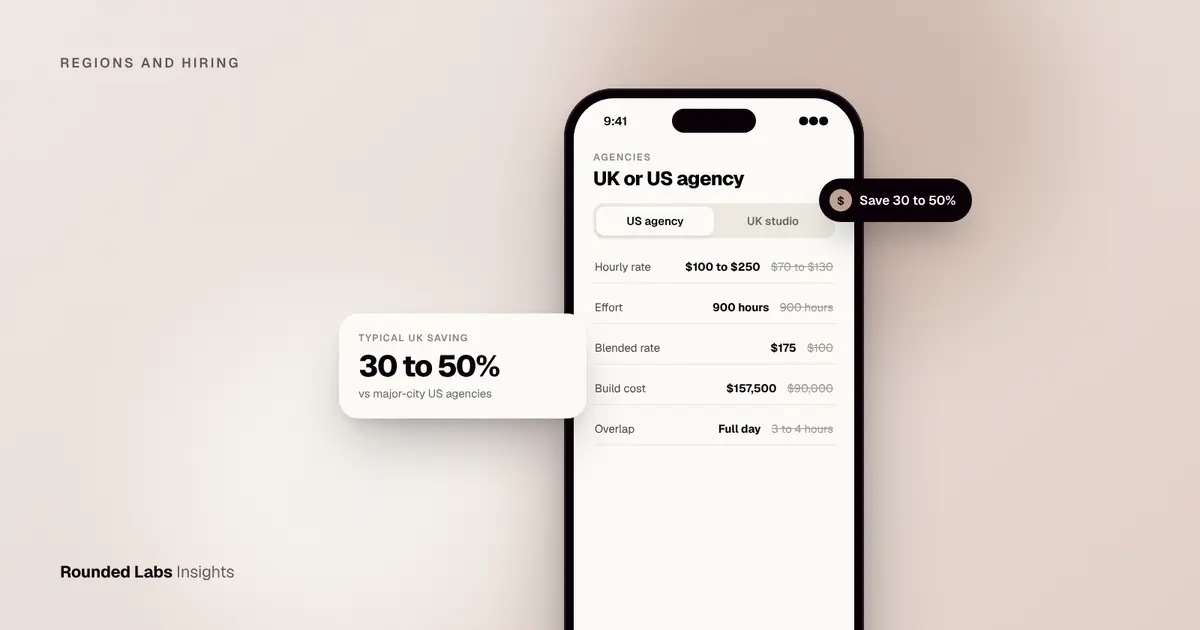


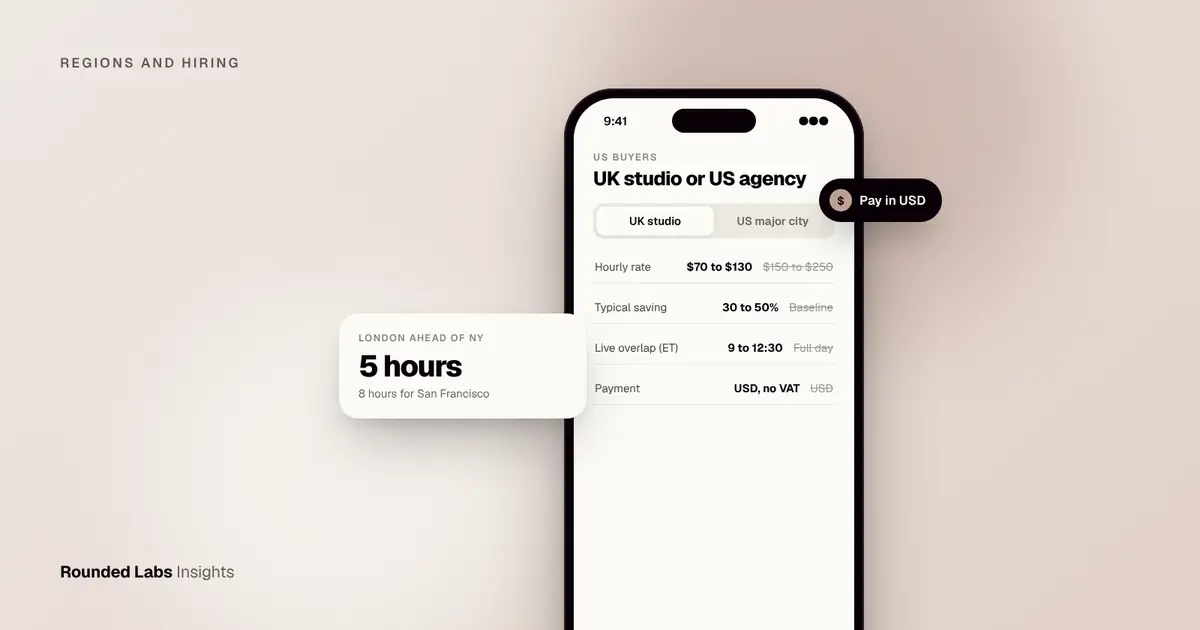
Hiring a UK app development company from the US works well when you want senior product and engineering skills at lower cost than a US agency, and can accept three to four hours of live overlap each day instead of eight. On market estimates, US clients typically save 30 to 50% against major-city US agency rates, keep the same quality bar, and work in English with no language gap worth worrying about.
We have built apps for global brands since 2007, including Superdry, a fashion brand with 768 locations in over 100 countries, and Waterstones, where we delivered an app, a mobile site and an eBooks API in 12 weeks. This guide answers the questions US buyers ask us most: how the time difference really works, what the contract should say, how payment and tax work, what can go wrong and how to check a supplier before you sign. It is general information, not legal or tax advice, so confirm the points that matter with your own advisers.
Key facts
- London is 5 hours ahead of New York and 8 hours ahead of San Francisco for most of the year, but the gap shrinks to 4 and 7 hours for a few weeks each spring and autumn because the two countries change their clocks on different dates.
- Typical live overlap: 9 am to about 12:30 pm Eastern, or about 9 am to 10 am Pacific plus structured async updates.
- Market estimates, not quotes: senior UK studio rates of roughly $70 to $130 an hour, against $150 to $250 at major-city US agencies. Rounded Labs itself works to a fixed price agreed before development starts.
- Contracts can sit under a US state’s law or under English law. IP should transfer to you on payment either way, and your code should live in your own repository from day one.
- Payment is in US dollars by wire or card, and UK VAT is not normally charged on services to US businesses, subject to the current rules.
Why do US companies hire UK app developers?
Three reasons come up again and again, and it helps to be honest about the trade-offs of each.
- Cost. A senior UK team usually costs 30 to 50% less than an equivalent team in New York, San Francisco or Boston. The saving is smaller against agencies in lower-cost US cities, and it disappears if the UK supplier is chosen on brand rather than substance. Our guide to how much it costs to build an app in the US has full dollar ranges, and App development rates 2027: UK vs US vs Eastern Europe vs Asia puts the regions side by side.
- Quality and process. UK studios work to the same standards as US agencies: design systems, automated testing, code review and experience of the App Store and Google Play review processes. Many have worked with international brands for years, which means they have already met US payment methods, privacy rules and accessibility expectations.
- Communication. The same language, a similar business culture and enough working-day overlap for genuine collaboration. That is the main difference from teams ten to twelve hours away, where a simple question can take a full day to answer.
There is a fourth reason that rarely makes the brochure: seniority. A US agency paying New York rents and salaries often staffs a project with a mix of senior and junior people to protect margin. A UK studio of the same size usually has a lower cost base, so more of the hours on your project are worked by experienced people. Ask any supplier for the names and seniority of the people who will be on your project, not just the team they show in the pitch.
For wider comparisons, UK vs US app development agencies: cost, quality and risk sets the two markets side by side, and Onshore, nearshore or offshore: where US companies get apps built places UK teams against nearshore and offshore options.
What does hiring from the UK actually save?
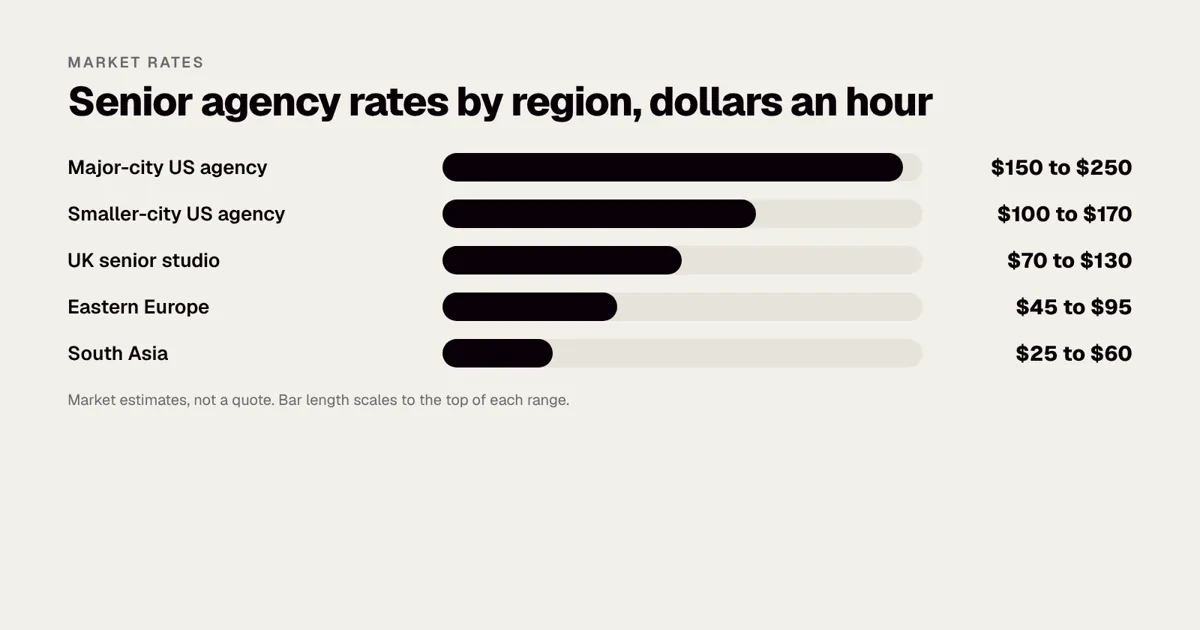
Rates are only one input. A fair comparison looks at the whole project. The table below shows generic market estimates for senior-led teams, not quotes and not Rounded Labs prices. We work to a fixed price, so for us the equivalent figure is the project price, which is why this section is about how the market behaves rather than how we charge.
| Region | Typical senior rate, market estimate | Overlap with US Eastern | Common concerns |
|---|---|---|---|
| Major-city US agency | $150 to $250 an hour | Full | Cost, junior staffing on senior rates |
| Smaller-city US agency | $100 to $170 an hour | Full to near full | Smaller talent pool for niche skills |
| UK senior studio | $70 to $130 an hour | 3 to 4 hours | Shorter live window, US-specific compliance knowledge |
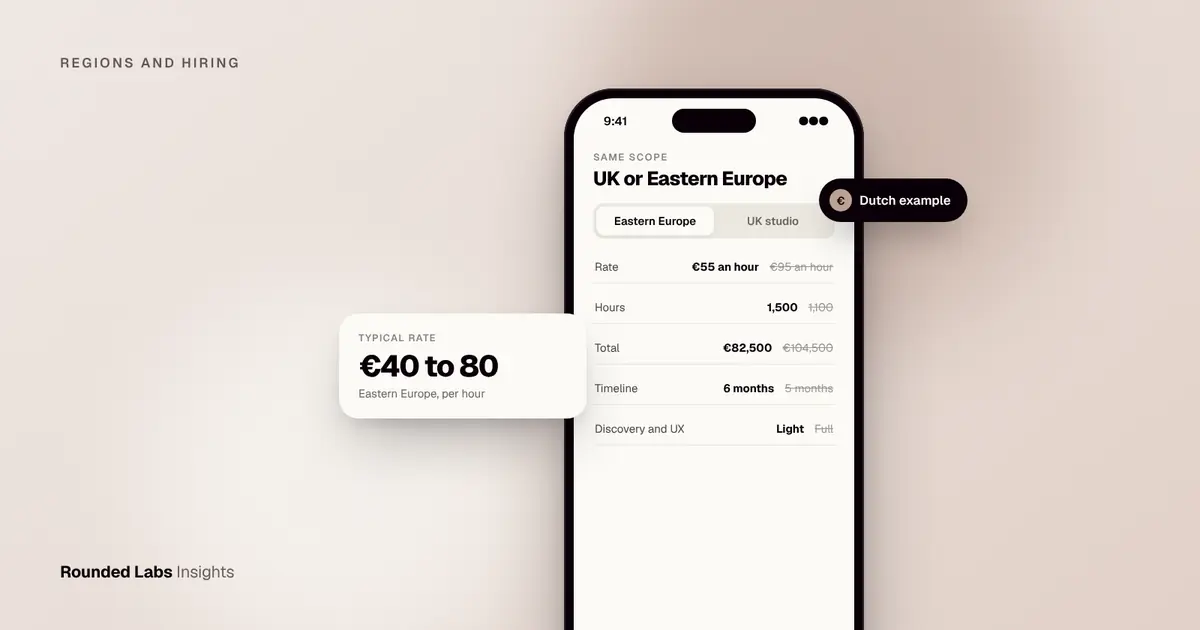
| Eastern Europe | $45 to $95 an hour | 1 to 3 hours | Variable quality, contract and payment complexity |
| South Asia | $25 to $60 an hour | Little or none | Time gap, oversight burden, quality variance |
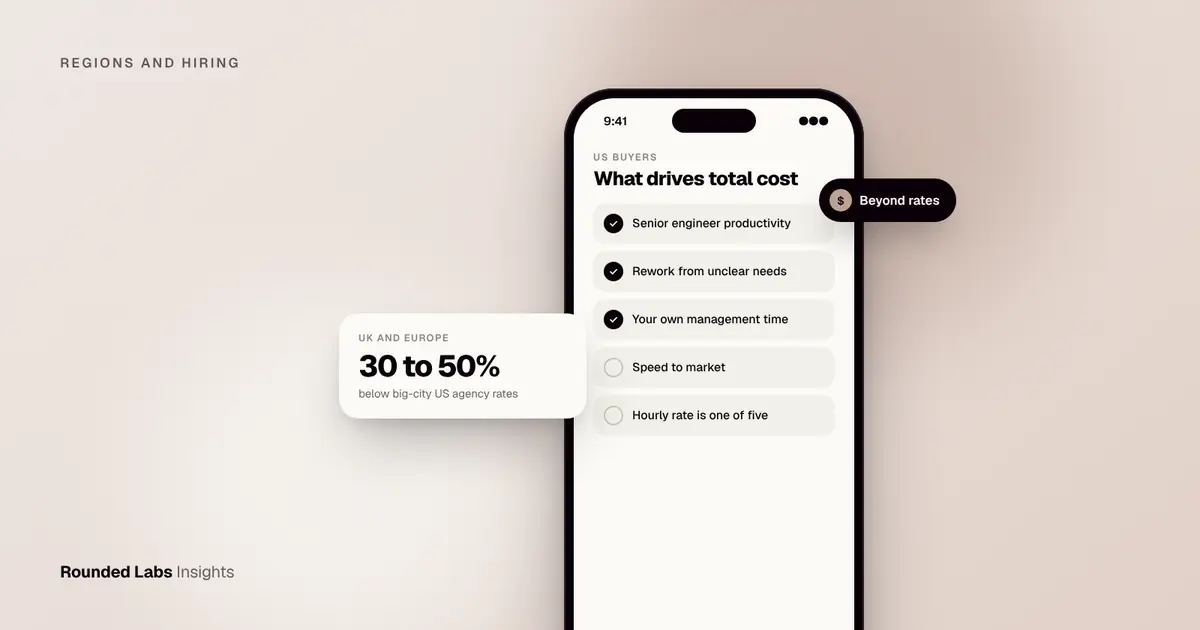
A rate is not a price. A cheaper rate with more hours can cost more than a higher rate that is done properly the first time. The most useful way to compare is to ask each supplier for a fixed price against the same written scope. what rates buy at each price point explains why rates and total cost diverge so often.
A worked cost comparison
Imagine a US founder who needs an iOS and Android app with sign in, a catalogue, payments and an admin panel. Suppose the scope is the same in both cases and a US agency estimates 1,400 hours at a blended $190 an hour, while a UK studio estimates a similar scope at 1,300 hours and a blended $100 an hour. These numbers are illustrative market estimates only.
| Line | US major-city agency | UK studio |
|---|---|---|
| Hours | 1,400 | 1,300 |
| Blended rate | $190 | $100 |
| Build estimate | about $266,000 | about $130,000 |
| Difference | about 50% lower |
Real projects rarely show a gap that wide, and a fair range is the 30 to 50% quoted above. The more important lesson is that the UK saving is mostly a rate difference, not a corner-cutting difference. If one supplier is far cheaper than every other, find out what they have left out. App development quotes compared: why prices range so widely is a useful guide to reading quotes.
Because Rounded Labs works to a fixed price, a project is agreed as a whole before development starts, typically from £30,000 to £250,000+, as shown on our pricing page. We invoice US clients in US dollars, using an agreed conversion at signature so the number does not move during the build.
Want a view on your project from a UK team? We will tell you honestly whether a UK studio fits your scope, timeline and compliance needs. Book a 30-minute call with a co-founder and choose a slot in your own time zone.
How does the time difference work in practice?
The time difference is easier than most buyers expect, provided the team is set up for it from the first week.
| US time zone | Hours behind London (most of the year) | Live overlap with a UK working day |
|---|---|---|
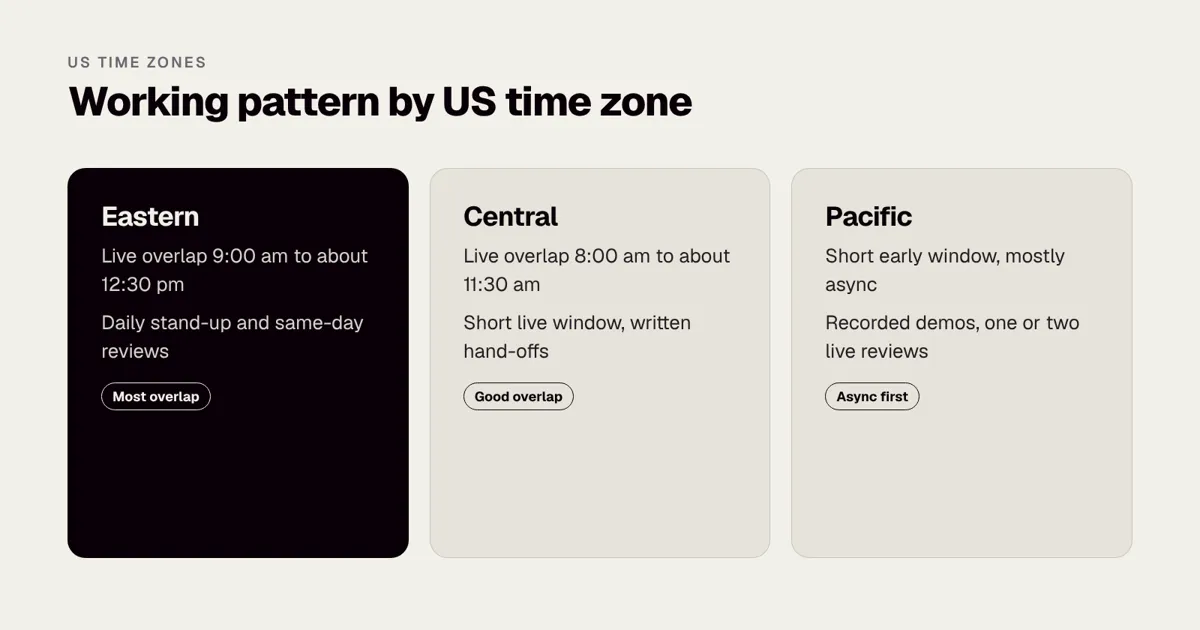
| Eastern (New York, Atlanta) | 5 | 9:00 am to about 12:30 pm Eastern |
| Central (Chicago, Austin) | 6 | 8:00 am to about 11:30 am Central |
| Mountain (Denver) | 7 | 8:00 am to about 10:30 am Mountain |
| Pacific (San Francisco, Seattle) | 8 | A short early window, mostly async |
The daylight saving gap nobody mentions
The United States and the UK move their clocks on different dates. At the time of writing, the US changes in the second week of March and the first week of November, while the UK changes on the last Sunday of March and the last Sunday of October. For about two to three weeks in spring and one week in autumn, London is only 4 hours ahead of New York rather than 5. The overlap window does not disappear, it simply moves by an hour, but it catches teams out when a recurring meeting suddenly lands at the wrong time. Check the official dates each year, and put the stand-up in a calendar that is anchored to one time zone so everyone sees the change at the same moment.
What a working day looks like
Here is a typical rhythm for a New York client with a UK team.
| Time (New York) | Time (London) | Activity |
|---|---|---|
| 4:00 am to 8:30 am | 9:00 am to 1:30 pm | UK team works through the backlog and acts on yesterday’s feedback |
| 8:30 am | 1:30 pm | UK team posts an overnight summary and any questions |
| 9:00 am | 2:00 pm | 15-minute stand-up with your product owner |
| 9:30 am to 12:00 pm | 2:30 pm to 5:00 pm | Live working window: reviews, design calls, unblocking |
| 12:30 pm | 5:30 pm | UK day ends and a written hand-off is posted |
| Afternoon | Evening and night | Your team reviews builds and logs feedback |
The cycle repeats the next morning: feedback logged in your afternoon is waiting for the UK team at the start of their day. The table is a model of the hand-off, not a promise of when every person is online. Teams usually agree a fixed block of one or two hours inside the overlap for live calls, and treat the rest as working time with quick written answers.
Rules that make the overlap work
- Put meetings in the overlap and nowhere else. Daily stand-ups, sprint reviews and design reviews happen in your morning. Anything that needs five people in a room belongs there.
- Use the gap. Your team reviews work in your afternoon, the UK team acts on feedback while you sleep. Many clients find that a fix requested at 4 pm is ready for review by 9 am. That overnight turnaround is a real advantage when the process is disciplined.
- Write things down. Shared Slack channels, Jira or Linear, and recorded demos mean nobody waits for a meeting to get an answer. See How to run a sprint demo for a format that works asynchronously.
- Name a lead in your hours. A delivery lead who starts later on key days gives West Coast clients real-time cover when it matters, such as the day a release goes to the App Store.
- Agree response times. For example: urgent blockers answered within two hours in the overlap, normal questions within one working day.
Rounded Labs also has a team in Kuala Lumpur, which lets us stretch the working day further for urgent releases. Running a remote app team across time zones covers the methods in more detail, including meeting design and hand-off notes.
Eastern, Central, Mountain and Pacific compared
| Your location | Best fit working pattern | What to protect |
|---|---|---|
| Eastern | Daily live stand-up, 2 to 3 hours of overlap | Same-day reviews |
| Central | Daily stand-up, shorter live window, written hand-offs | Early morning availability |
| Mountain | Three live sessions a week plus daily written updates | A fixed weekly review |
| Pacific | One or two live sessions a week, daily async video updates | A named person who can cover urgent issues |
West Coast clients should not assume it is a poor fit. Many Pacific-time founders prefer the model: they set priorities at the end of their day, wake to a build, and keep their live time for the decisions that need them. The failure mode is not distance, it is ambiguity. Clear written requirements, a design signed off before build, and recorded demos cover most of what a live meeting would.
How should the communication be organised?
Time zones are the visible problem, but communication habits are what decide whether the project feels easy or tiring. Set these up in the first week.
- One channel for the team, one for urgent issues. A shared Slack or Teams channel for day-to-day work, and a separate escalation route with named phone numbers for production incidents.
- One backlog, visible to everyone. Use Jira, Linear or a similar tool. Your product owner should be able to see what is in progress without asking.
- A weekly written report. Plain English, covering what shipped, what is next, risks and decisions needed. How to read an agency’s weekly report shows what a useful one contains, and How to tell if an app project is off track lists the early warning signs.
- Recorded demos. A five-minute screen recording of each completed feature, posted when it is ready, is worth more than a one-hour meeting that half the stakeholders miss.
- A decision log. Write down each decision, who made it and why. When a question comes back three weeks later, you have an answer.
A common mistake is to treat the UK team as a black box that receives a brief and returns an app. It works much better as a partnership in which your product owner has a fixed slot each day. Plan for them to spend an hour or two a day on the project during the build, more during design.
What should the contract say?
A good contract protects you whichever country your supplier is in. Use the table below as a checklist when you read a master services agreement and a statement of work.
| Clause | What you want | Why it matters |
|---|---|---|
| IP assignment | All code, designs and documentation become yours on payment, with no licence-back | You can change supplier later |
| Source code access | Your own repository from day one | You are never waiting for a handover |
| Governing law | A law both sides understand, agreed up front | Predictable disputes |
| Payment terms | Milestones tied to delivered work | You pay for progress |
| Acceptance | Written criteria for each milestone | No arguments about “done” |
| Data protection | Controller and processor roles, security standards | Required where personal data is used |
| Confidentiality | Mutual, with a sensible term | Protects your plans |
| Termination | A clear exit and handover of code, credentials and documentation | Limits supplier risk |
| Liability | A cap that matches the project risk | Realistic remedies |
| Third-party software | A list of open source and paid libraries | Avoids licence surprises |
Contracts, IP and payment when you hire an overseas app agency and Who owns the code? IP, contracts and escrow for UK app projects cover these clauses in depth.
Which law should govern the contract?
Many US clients choose their own state’s law, often New York or Delaware, and a US venue for disputes. Others accept English law, which is well understood and widely used in international commercial contracts. There is no single right answer. A practical rule: pick the law your own lawyer is most comfortable with, and make sure the contract names it clearly. If you choose English law, ask your lawyer how a judgment would be enforced in practice. If you choose a US state, ask the same question about enforcing against a UK company. This is a question for legal advice, so use a lawyer for the final decision.
Statement of work: where projects are won or lost
The master agreement sets the rules, but the statement of work sets the project. A good one lists the features included, the platforms and devices supported, the third-party services used, the acceptance criteria and, importantly, what is not included. How to write an app specification (free template) and the app requirements template show the level of detail that prevents arguments later. What a good app development proposal looks like shows how a supplier should present scope and price.
Changes after signature
Every project changes. Agree the process in the contract: a short written change request describing the change, its effect on the price and its effect on the timeline, approved by both sides before work starts. Our guide to managing scope changes without blowing the budget covers this in depth. With a fixed price, a change is priced openly, so nothing is hidden in a timesheet.
How does payment work?
- Currency. We invoice US clients in US dollars, so you know the exact cost. The conversion rate is agreed when the contract is signed.
- Method. International wire or card. Most US companies pay the same way they pay any overseas supplier. Expect your bank to charge an incoming or outgoing wire fee, and ask your finance team whether they prefer ACH-style local payments where available.
- Structure. We work to a fixed price agreed before development starts, paid against milestones, with no timesheets to check. Typical projects run from £30,000 to £250,000+, and our productised services are priced openly: Tech Architecture Audit £7,500, Digital Transformation Prep £7,000, Mobile Product Discovery Sprint £9,500 and Legacy App Rescue Assessment £6,500. See the pricing page for current details. Fixed price vs time and materials for app projects compares the two models.
- Tax on the UK side. At the time of writing, UK VAT is generally not charged on services supplied to businesses outside the UK under the place of supply rules. Check the current position on GOV.UK and the specific guidance on VAT place of supply of services, because the rules and thresholds can change.
- Tax on your side. How you treat the payment for US tax purposes, including any withholding questions and the paperwork your accountant wants from a foreign supplier, is a question for your accountant. The Internal Revenue Service publishes the official guidance. A UK company supplying services to a US business is often asked for a tax form, so ask early.
- Sales tax and use tax. Some US states tax software or digital services in ways that vary by state. Your accountant should confirm how it applies to custom development bought from abroad.
Everything in this section is general information, not tax advice.
A sample milestone schedule
Illustrative only, for a build of about £90,000 agreed at fixed price:
| Milestone | Share of price | Trigger |
|---|---|---|
| Signature and discovery start | 20% | Contract signed |
| Design signed off | 20% | Written approval of the designs |
| First working build on test devices | 25% | Build delivered against the agreed list |
| Feature complete | 20% | All in-scope features working |
| Launch and handover | 15% | App live and documentation delivered |
Each milestone has written acceptance criteria. If a milestone is late, the payment waits.
How should you handle data protection and US compliance?
Hiring abroad does not remove your US obligations. It means you need to make sure the supplier supports them.
- Health data. If the app handles protected health information for a US covered entity, you will need a HIPAA business associate agreement and a supplier that follows the HIPAA Security Rule. See How to build a HIPAA-compliant app and HIPAA business associate agreements: a plain English guide. The US Department of Health and Human Services publishes the official material at HHS HIPAA, including sample business associate agreement provisions.
- State privacy laws. If your users are in California, Colorado, Virginia and other states, the supplier must build consent, deletion and access features. US state privacy laws and your app: CCPA and the rest explains the main ones.
- Children. If children might use the app, see COPPA and apps used by children.
- Accessibility. ADA and WCAG: accessibility rules for US apps explains what US buyers are expected to build.
- Security assurance. Enterprise customers often ask for SOC 2. SOC 2 for startups explains what your app needs, and the AICPA is the body behind the standard.
- Data location. Decide whether personal data stays in US cloud regions. The supplier should build against your chosen region from the start. If you also plan to sell in Europe, see GDPR for US companies launching an app in Europe.
- The Federal Trade Commission. The FTC enforces consumer protection and privacy promises. Whatever your privacy policy says, the app must do.
If your supplier is unfamiliar with any of the above, treat it as a warning sign. The Federal government’s NIST publishes widely used security frameworks that a competent supplier should be able to discuss.
Who owns the Apple and Google accounts?
This is one of the most common avoidable problems. The App Store and Google Play developer accounts should be registered in your company’s name, not your supplier’s.
- Apple Developer Program. Register as an organisation. At the time of writing, Apple requires a D-U-N-S number for organisations, which can take days or weeks to obtain, so start early. Check the current requirements and fee on Apple’s developer site.
- Google Play Console. Register your company, and be aware that Google has specific testing requirements for some new accounts. Check current rules on Google’s developer site.
- Your own repositories and cloud accounts. GitHub or GitLab, your cloud provider and your analytics tools should be owned by you, with the supplier added as a collaborator.
- Shared credentials. Use a password manager with role-based sharing, not email.
If the supplier owns the accounts, you do not own your app in any practical sense. How to switch app agencies without losing your app describes how painful this can be.
Should you start with a small paid pilot?
For many US buyers the safest first step is not the whole build. It is a short, fixed-price piece of work that lets both sides see how the relationship feels before you commit a six-figure budget. Three options work well.
| Starting point | What you get | Fixed price | Best when |
|---|---|---|---|
| Mobile Product Discovery Sprint | Prototype, user flows, prioritised backlog, costed build plan | £9,500 | You have an idea but not a scope |
| Tech Architecture Audit | Review of an existing system, risks and a recommended approach | £7,500 | You already have software and doubts about it |
| Legacy App Rescue Assessment | Honest view of whether to repair, rebuild or retire an app | £6,500 | An app built elsewhere is failing |
A pilot reveals things a sales process hides: how quickly questions are answered, whether the written output is clear, whether the people you were introduced to are the people doing the work, and whether the overlap hours suit your team. If it goes badly, you have lost a small, known amount and you keep the documents. If it goes well, you have a signed-off scope and a fixed price for the build. You can read more about the process in What happens in a discovery phase, and why it saves money, and about choosing between models in Fractional CTO vs app agency for early-stage startups.
What to measure during the pilot
- Response time. How long do written questions take to answer inside the overlap? Outside it?
- Quality of questions. Does the team challenge assumptions or just take notes? Good suppliers push back.
- Clarity of documents. Could a new person on your team understand the output without a call?
- Honesty about scope. Did they tell you what to cut, or only what to add?
- Fit with your people. Does your product owner enjoy working with them? This matters more than most checklists admit.
What does a good hand-off note look like?
Because the live window is short, the written hand-off at the end of each UK day does a lot of work. A useful note is brief and consistent. It has five parts: what was completed and where to see it, what is in progress and its expected finish, what is blocked and who can unblock it, which decisions are needed from you by when, and what the team will do next. A note like that lets your product owner start their day in five minutes. If the notes are long, vague or irregular, raise it in the first fortnight. It is one of the strongest early indicators of how the rest of the project will go.
What are the risks, and how do you remove them?
| Risk | How to reduce it |
|---|---|
| Slow feedback loops | Fixed overlap hours, a named lead, async video demos |
| Unclear scope | A paid discovery phase before the build, see What happens in a discovery phase |
| Losing control of the code | Your own GitHub or GitLab organisation from day one |
| Supplier going quiet | Weekly written reports, milestone payments, clear termination terms |
| Compliance gaps | Agree HIPAA, SOC 2 or state privacy needs before kick-off |
| Currency movement | Agree the conversion rate at signature |
| Cultural misunderstandings | Explicit written acceptance criteria, US English copy reviewed by a US reader |
| Key person leaves | Documentation, two named engineers on every critical area |
| Legal enforcement across borders | Take advice on governing law and dispute route before signing |
Our due diligence checklist for US companies hiring abroad is a longer version of this table, and Red flags when hiring app developers lists the warning signs we see most often.
How do you check a UK agency before signing?
Use this checklist and keep a written record of the answers.
- Case studies and references. Ask to speak to two past clients, ideally one of them from outside the UK.
- Independent reviews. Sites such as Clutch publish client reviews. Read the critical ones as well as the glowing ones.
- Company registration. Check the company is registered at Companies House, the UK’s public company register, and look at how long it has traded and whether accounts are filed on time.
- People. Ask who exactly will work on your project, their seniority and how long they have been with the studio.
- US experience. Ask how they handle dollar payments, US privacy laws, US English copy and US store requirements.
- Process evidence. Ask to see a sample weekly report, a sample statement of work and a sample test plan.
- Security practices. Ask how they protect source code, who has access, and how they handle laptops, credentials and incident reporting.
- Insurance. Ask what professional indemnity and cyber insurance they carry, and the levels of cover.
- Exit. Ask how a handover works if you part ways. A confident supplier answers this easily.
20 questions to ask an app developer before you sign and How to choose an app development company in the UK: a 2026 checklist give longer versions. Our own record is public: we have been in business since 2007, built the UK’s first mobile banking app (MoBank), and modernised the Superdry app across 768 locations in over 100 countries.
What do three realistic scenarios look like?
These are composite illustrations to show how the guidance applies, not client stories.
Scenario 1: a New York fintech start-up
A seed-stage company needs an iOS and Android app with account linking and payments. Its Eastern time team works 9 am to 6 pm, so a UK team’s live window covers its whole morning. The founders choose a short discovery phase to settle scope, then a fixed-price build with five milestones. They keep the App Store account, the repositories and the cloud account in their own name. Because the product touches financial data, they ask for evidence of the supplier’s security practices and agree who is responsible for each compliance task. The main watch point is regulatory scope: they take legal advice on licensing before launch. Fintech app development in the US: licences covers that side.
Scenario 2: a San Francisco health-tech team
A small team in Pacific time wants a patient messaging app. Live overlap is short, so they move to a mostly async rhythm: a written plan on Monday, recorded demos on Wednesday and a live review on Friday morning in the UK’s afternoon, which is their early morning. Because the app handles protected health information, a business associate agreement is signed before any real data is used, and test environments use synthetic data only. Their main watch point is making sure someone is awake and empowered to approve urgent changes. A named backup in their team, and a named lead in the UK team, solve it.
Scenario 3: a Texas retailer with a long list of stakeholders
A retailer with several department heads in Central time wants a loyalty app. The risk here is not time zones but too many opinions. They appoint one product owner with authority to decide, run weekly demos recorded for stakeholders to watch later, and use a change request for every new idea. The result is predictable cost and fewer late surprises. The Waterstones case study shows what a tight, well-managed timeline looks like: an app, a mobile site and an eBooks API in 12 weeks.
When is a UK team not the right choice?
Honesty helps here. A UK team may not be the best fit if:
- You need a team in your office every day. If your culture demands daily in-person work, hire locally or build an in-house team. In-house team vs agency in the US: the real cost with salaries compares the options.
- You need a US-only supplier by regulation or contract. Some government and defence work requires US persons or US-hosted staff. Check your contract and the relevant rules.
- You need continuous live collaboration across eight hours. A West Coast company that wants every decision made in a live room will find the gap tiring.
- Your project is tiny. A very small job may be better served by a freelancer, though that has its own risks. See Freelance marketplaces vs an app studio.
- You are not ready to write down what you want. Any supplier at any distance works poorly with an unclear brief. How to brief an app development agency helps.
If your project fits, the UK model gives you senior people, a lower rate and a team that works while you sleep.
What happens in the first 90 days?
A realistic plan for a US client working with a UK studio, from the first conversation to a working build:
- Weeks 0 to 1: kick-off. Contract signed, access set up, accounts registered in your name, communication rules agreed. Share your brand assets and any research you already have.
- Weeks 1 to 4: discovery and design. Workshops in the shared overlap, user journeys, wireframes, clickable prototype and a technical plan. Our Mobile Product Discovery Sprint at £9,500 fixed covers this stage. What happens in a discovery phase, and why it saves money explains the work.
- Weeks 4 to 5: sign-off. You approve designs and the written scope, and the fixed price for the build is confirmed.
- Weeks 5 to 12: first build cycles. Short cycles with demos, test builds on real devices and written feedback from your team. How to give useful feedback on a test build helps your testers.
- Weeks 12 and beyond: beta, polish, launch. Beta testing, store submission, analytics and monitoring set up, and a handover pack.
Working with an app agency: the first 90 days goes through the same period from the client’s point of view.
Common mistakes US buyers make
- Choosing on rate alone. The cheapest rate is rarely the cheapest project.
- Skipping discovery. Skipping it saves a few thousand pounds and costs tens of thousands later.
- Leaving the product owner role vague. If nobody on your side can say yes or no, the team waits.
- Not owning the accounts. See the section above.
- Treating the time zone as the whole problem. It is a scheduling task, not a quality problem.
- Ignoring compliance until launch week. Plan HIPAA, privacy and accessibility from the first design review.
- No exit plan. Ask how the handover works at the start, not the end.
How do you take the next step?
If you are comparing suppliers, write down your goals, your user groups, your must-have features and your compliance needs, then ask each supplier for a fixed price against that same document. Compare the scope lines, not just the totals. If you would like help with that document, our Mobile Product Discovery Sprint produces a prioritised plan and a clear scope you can use with us or anyone else. If you want to talk it through first, book a call with a co-founder and we will give you a straight answer about whether a UK studio is the right choice. Details of how our fixed-price process works are on the pricing page.
Frequently asked questions
Is it legal for a US company to hire a UK software company?
Yes. US companies routinely buy software services from UK suppliers, and no special licence is needed for ordinary app development. Regulated data such as health or financial data needs the same contractual protections you would require from a US supplier. This is general information, not legal advice, so check any sector-specific rules with your lawyer.
Will a UK team understand the US market?
A good UK studio has worked with international brands and understands US user expectations, payment methods and privacy rules. Copy can be written in US English and checked by a US reader. Ask for examples of products used by US customers and for a reference from a client outside the UK.
How much can a US company save with a UK team?
On market estimates, most US clients save 30 to 50% against major-city US agency rates for comparable seniority. Savings are smaller against agencies in lower-cost US cities. The best way to confirm your own saving is to get fixed-price quotes from both sides against the same written scope.
What hours will the UK team be available?
Expect three to four hours of live overlap with US Eastern time each working day, with written updates and recorded demos covering the rest. West Coast clients usually work mostly async with one or two live sessions a week. Agree response times for urgent issues in the contract.
Can the UK team sign a HIPAA business associate agreement?
A UK supplier can sign a business associate agreement and follow the HIPAA Security Rule when it handles protected health information for a US covered entity. Check the supplier’s security practices and ask for evidence before you sign, as you would with a US vendor.
Who pays the Apple and Google fees?
You do, through accounts registered in your own company’s name. At the time of writing, Apple and Google both charge developer account fees, and Apple takes a commission on digital goods sold in the app. Check the current terms on each store’s developer site, because they change.
Does a fixed price mean no changes are allowed?
No. It means the price is agreed against a defined scope before development starts, and any change is priced in writing before work begins. That is clearer for you than timesheets, because you see the cost of a change before you approve it.
Official sources and further reading
- GOV.UK homepage and guidance
- GOV.UK: VAT place of supply of services (Notice 741A)
- Companies House search
- HHS: HIPAA for professionals
- HHS: Business Associate Contracts
- Internal Revenue Service
- Federal Trade Commission
- NIST: National Institute of Standards and Technology
- AICPA and CIMA
- Clutch: B2B reviews
Talk it through with one of our co-founders. 30 minutes, no pressure.