

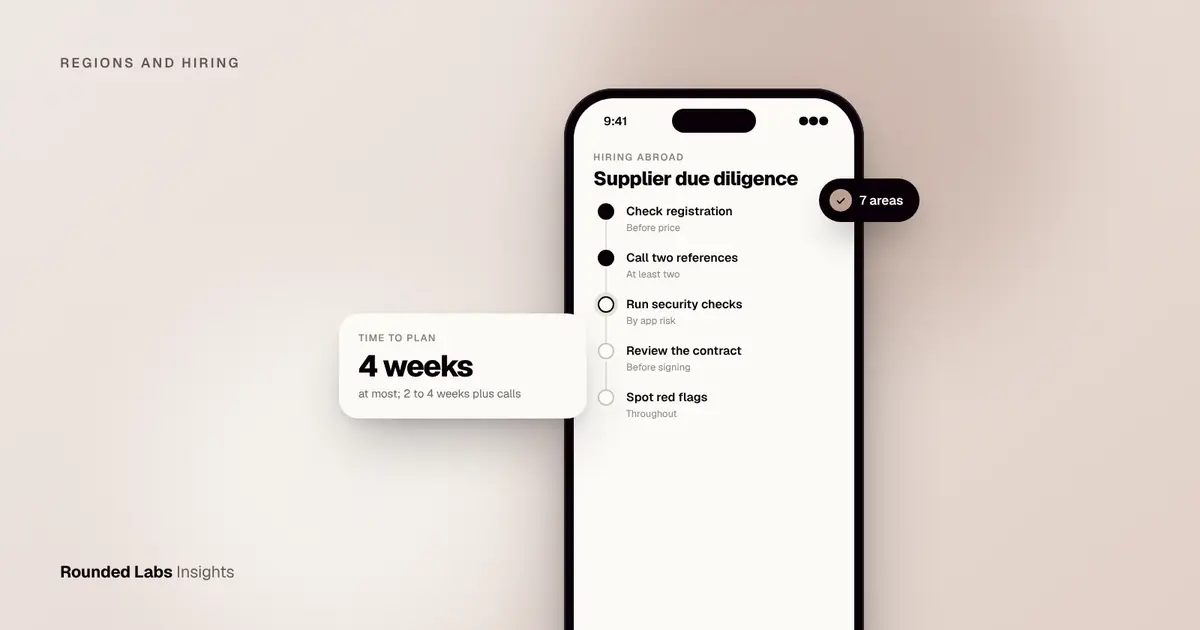
Due diligence on an overseas app agency should cover seven areas: legal entity, track record, security, code ownership, payment terms, team and delivery process. Plan on 2 to 4 weeks and a handful of reference calls before signing. A supplier who answers every item clearly, in writing, is usually safer than the cheapest quote you receive.
We have worked with international clients for 19 years, including Superdry, where we modernised the app in 2014 for a brand with 768 locations in over 100 countries. Buyers on both sides of the Atlantic ask us the same questions, so this guide sets them out as a checklist you can use with any supplier, ours included. It is general information, not legal advice; ask a lawyer to review your final contract. For how we price work, see our mobile app development page.
Most guides on this topic give you a list of questions and stop there. This one goes further. It explains why each check matters, what a good answer sounds like, what a weak answer looks like, and how to weigh the results when two suppliers are close. It also includes a scorecard you can copy, a worked example with three agencies, and a plan for the first 30 days after signing, because due diligence does not end when the contract is countersigned.
Key facts
- Check the supplier is a real, registered company with a verifiable history before you discuss price.
- Speak to at least two past clients yourself, not only the ones the agency lists as happy to talk.
- Code ownership, payment milestones and exit rights belong in the contract, not in an email.
- Security checks should match the data your app handles: a basic questionnaire for a simple app, evidence of controls for finance or health.
- The cheapest quote is a risk signal when it is far below the others. Ask what is missing from the scope.
- Due diligence costs days, not weeks, and is far cheaper than rescuing a failed build.
- Use one written scorecard for every supplier so that the decision rests on evidence rather than on who gave the best presentation.
Why does due diligence matter more when the supplier is abroad?
When a supplier is in another country, the usual safety nets are weaker. You cannot visit the office on a whim, a dispute may sit under foreign law, and a time difference slows every question. None of this makes overseas hiring a bad idea. Onshore, nearshore or offshore explains where each model fits. It does mean that checking up front replaces the informal trust you might build with a local firm over lunch.
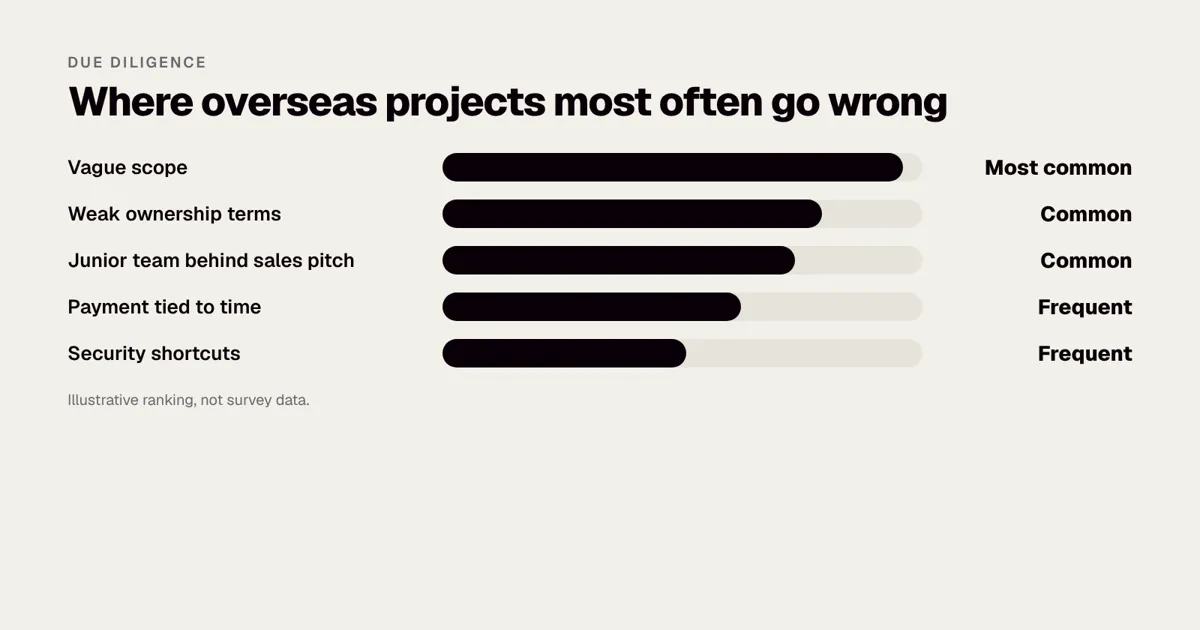
The most common failures we see are not fraud. They are vague scope, weak ownership terms, junior teams behind a senior sales pitch, and payments tied to time rather than finished work. A checklist catches all four. It also gives you a record: if a supplier later says “you never asked about that”, your written questions and their written answers settle the matter.
What actually goes wrong on overseas projects?
It helps to be specific about the failure modes, because each one maps to a check later in this guide.
| Failure mode | What it looks like in practice | Which check catches it |
|---|---|---|
| Vague scope | The quote says “build an app” and every later change is a paid extra | Scope comparison, acceptance criteria |
| Bait and switch on people | The senior team presents, a different and more junior team builds | Named roles, key person clause |
| Weak ownership | The supplier keeps the repository or the store accounts until a final payment is disputed | Code ownership and account checks |
| Time-based billing drift | Hours pass, deliverables do not, and the budget doubles | Milestone payment terms |
| Hidden subcontracting | Work is passed to a third party you never vetted | Subcontractor disclosure, security checks |
| Security shortcuts | Secrets in code, no testing, shared logins | Security questionnaire, penetration test |
| Communication gaps | Questions wait a day for each answer | Working hours overlap, escalation path |
| Exit problems | You cannot leave without losing your code, or leaving costs a fortune | Exit and handover terms |
If you are thinking about the broader decision first, UK vs offshore app development sets out the trade-offs honestly, and App agency vs freelancer vs in-house team helps you decide which type of supplier you need before you start vetting individual ones.
What does a failed build really cost?
It is tempting to treat checking as a cost to minimise. The better comparison is against the cost of getting it wrong. If you pay a supplier £60,000 and receive an app that cannot be released, you have lost the £60,000, the months it took, the market window and the cost of starting again. An independent assessment of a troubled app is often priced in the thousands, and a rebuild can be a large share of the original budget. How to rescue a failing app project and How to switch app agencies without losing your app exist because this happens often enough to need a guide. Two to four weeks of checking, mostly your own time and a few hours of legal review, is the cheap end of the risk.
How should you run the due diligence process, step by step?
Treat it as a short project with an owner, a timeline and a decision date. Without that, due diligence expands to fill the available time, or it gets skipped when the budget holder wants to move fast.
- Define what you are buying. Write a one or two page brief covering the problem, the users, the platforms, the integrations and any regulated data. A supplier cannot be assessed against a moving target. How to brief an app development agency has a structure you can reuse.
- Build a shortlist of three to five. Fewer than three gives you no comparison. More than five makes the reference calls and contract reviews unmanageable.
- Send every supplier the same written questions. Use identical questions so that answers can be compared line by line.
- Run the public checks yourself. Company registers, sanctions screening, store listings and reviews. These take hours, not days.
- Hold reference calls. Two per supplier at minimum, and at least one that the supplier did not hand-pick if you can find one.
- Review security evidence. Scale the depth to the risk of your app.
- Read the draft contract and proposal. Do this before the final commercial negotiation, not after.
- Score and decide. Use the scorecard below, record the reasons, and tell the unsuccessful suppliers why.
How long does each step take?
| Week | Activity | Your effort | Supplier effort |
|---|---|---|---|
| Week 1 | Brief, shortlist, send questions, run public checks | 1 to 2 days | A few hours to answer |
| Week 2 | Supplier calls, reference calls, security questionnaire | 2 to 3 days | 1 to 2 days |
| Week 3 | Proposal comparison, draft contract, legal review | 2 to 3 days plus legal time | 1 to 2 days |
| Week 4 | Negotiation, final checks, signature | 1 to 2 days | 1 day |
Those are planning figures, not guarantees. A simple project with a supplier you already know can move faster. A regulated product with a large budget deserves the full four weeks and sometimes more.
Who should be involved on your side?
One person should own the process, usually the product owner or the head of technology. Bring in a lawyer for the contract, and someone with security knowledge for the technical answers. If nobody on your team has technical depth, a short independent review is worth buying. Our Tech Architecture Audit is a fixed-price £7,500, and it is a way to get a supplier-neutral view of your existing systems and plans before you brief anyone.
What should you check about the company itself?
Start with basics that take an hour. They remove a surprising number of weak candidates.
- Registration. Look up the company in its national register. In the UK that is Companies House; most countries have an equivalent. Check the legal name, incorporation date, registered address, directors and filed accounts. The name on the register should match the name on the contract.
- Age and stability. A firm that has traded for many years has survived client losses and market swings. A new company is not disqualified, but ask who the founders are and what they built before.
- Ownership and group structure. Know which legal entity signs the contract and who owns it. If a trading name belongs to a different legal entity, the contract must name the entity that holds the assets and carries the liability.
- Sanctions screening. US companies should screen any foreign supplier against the sanctions lists published by the US Treasury’s Office of Foreign Assets Control. Rules change, so check the current requirements with your counsel.
- Insurance. Ask for professional indemnity and cyber cover, and the policy limits. A supplier whose cover is far below your project value is asking you to carry the risk.
- Financial health. Filed accounts show whether the business is growing, shrinking or dependent on a single client. Ask how many clients make up most of their revenue.
- Staff and turnover. Ask how many people they employ directly, how many are contractors, and how long the average engineer has been there. High turnover means your project team will change.
How do you read a set of filed accounts without being an accountant?
You do not need to be. In the UK, small companies file abridged accounts that show a balance sheet. Look for three things. First, are net assets positive? A supplier with large liabilities and few assets is fragile. Second, has the company filed on time? Late filings are a sign of disorder. Third, do the figures match the size of the business they describe? A firm claiming forty engineers and a balance sheet that could not pay for four deserves a question. If the accounts raise a concern, ask about it directly. The answer is often reasonable, and if it is not, you have learned something important.
What if the supplier is a one-person company or a freelancer?
Freelancers are not a red flag, but the checks change. You are relying on one person’s health, availability and continuity. Ask who covers holidays and illness, whether there is a second developer who knows the code, and how the repository is protected if the freelancer becomes unavailable. App agency vs freelancer vs in-house team and Freelance marketplaces vs an app studio cover when each model makes sense.
Does company size matter?
Size is not quality, but it affects resilience. A team of eight can be excellent, provided they have a clear process, backups for each role, and do not depend on one founder. A team of eighty can be slow and layered. Ask how the supplier handles the loss of a key engineer mid-project, and ask for a real example. The honest answer tells you more than the headcount.
How do you verify a supplier’s track record?
Case studies on a website are marketing. Verify them.
- Ask for two or three references and call them. Ask what went wrong, how it was handled, and whether they would hire the agency again.
- Ask for a project similar to yours, in size and in sector. A beautiful consumer app does not prove competence at secure payments.
- Check the product exists. Download the apps, read the store reviews and look at how long they have been maintained.
- Ask who actually did the work. Some agencies subcontract, which is fine if they say so and stay accountable.
- Ask how long the client relationship lasted. Repeat work is one of the best signals available.
For example, MoBank was the UK’s first mobile banking app, and Dabbl is a trading app for first-time investors. Both are products you can examine, which is the standard to ask of any supplier. Our Waterstones project delivered an app, a mobile site and an eBooks API in 12 weeks, and it is a good illustration of what a specific, checkable claim looks like: a named client, a named scope and a stated timescale.
What should you ask in a reference call?
Reference calls fail when the questions are too polite. A client who is asked “were you happy?” says yes. Ask questions that need an actual story.
- What did you hire them to do, and how large was the project?
- Did the project finish on the date and price first agreed? If not, why?
- Tell me about the hardest moment. How did they behave?
- Who were the people you worked with day to day? Did the team change?
- How did they handle a change of mind or a scope change?
- What was the quality of the code, tests and documentation when you received it?
- Did you receive everything you needed to own the product, including repositories and accounts?
- What happened after launch? Did they stay responsive?
- What would you do differently if you hired them again?
- Would you hire them again, and would you recommend them to a friend?
Listen for hesitation, qualified praise and unprompted detail. A reference who says “they were fine” is giving you a different answer from one who says “they found a payment bug the week before launch and fixed it without charging us”.
How do you find a reference the supplier did not choose?
Look at the supplier’s published work and find the client’s team on a professional network. Contact a product manager or an engineer who worked with the agency, explain that you are considering a similar project, and ask for ten minutes. Many people will talk. Do this with respect: you are asking for a favour, so keep the call short and never ask for confidential details. The point is a sanity check, not an investigation. Another source is the store listings, where release history and review responses show how a product has been looked after.
How do you check an app really exists and is looked after?
Open the store listing. Look at the date of the last update, the ratings over time, how the developer responds to reviews and whether crashes are mentioned. Check the privacy details the app declares. An app that has not been updated for two years may be fine if it is stable, or may be abandoned. Ask the supplier which of their apps are in active maintenance and who maintains them. If you are building something similar to a product they list, ask what they would do differently if they built it again. The answer shows how much they learned.
What security and data checks should you run?
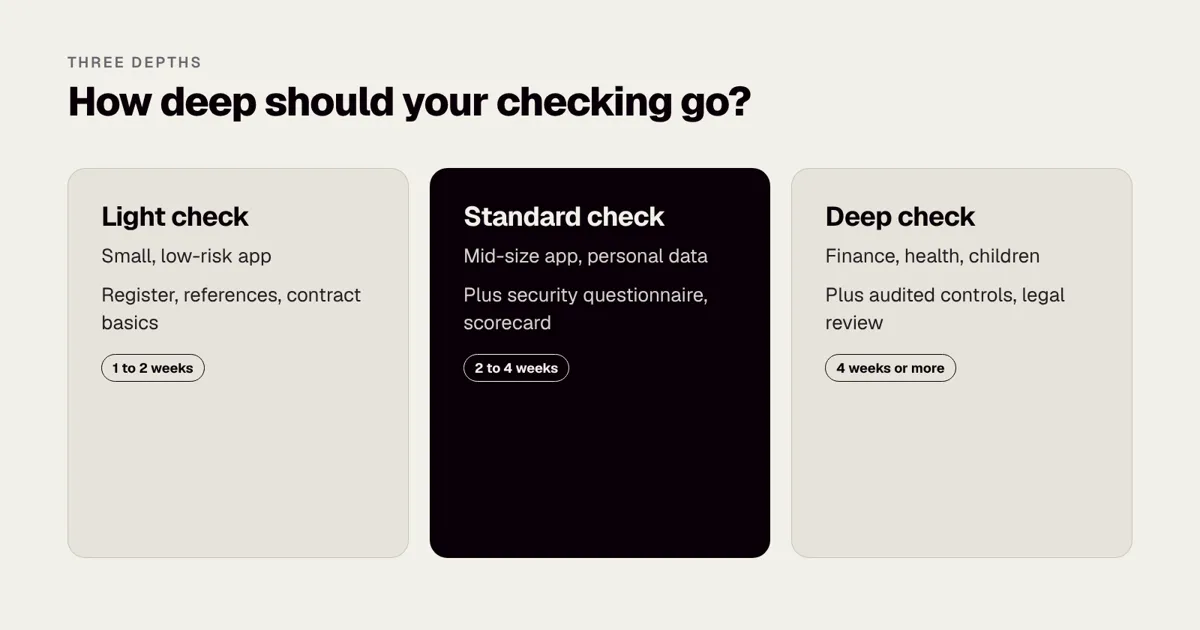
Match the depth to the risk. A booking app that stores names needs less than a payments or health app.
| App type | Reasonable checks |
|---|---|
| Low risk (content, internal tools) | Short security questionnaire, access controls, encrypted storage |
| Medium risk (accounts, personal data) | Written security policy, penetration test on release, data location in contract |
| High risk (finance, health, children) | Evidence of audited controls, such as ISO 27001, plus legal review of data flows |
Ask where your source code and data will be stored, who on the team can reach them, and how access is removed when someone leaves. If your users are in Europe, the supplier’s data handling matters under the GDPR; see GDPR for US companies and UK and EU data transfers for app projects. If your users are in the US, state privacy laws may apply; see US state privacy laws and your app. The NIST Cybersecurity Framework and ISO/IEC 27001 give you a common vocabulary for these conversations, and ISO 27001 vs SOC 2 explains how the two relate.
What should a security questionnaire ask?
Keep it to a page or two. Long questionnaires get copied answers. Useful questions include:
- Who has access to our source code, and how is that access granted and removed?
- Where are development, staging and production environments hosted, and in which country?
- How are secrets such as keys and passwords stored? Are they ever in the code?
- Do you use multi-factor authentication on repositories, cloud consoles and email?
- How do you handle devices used by staff, including personal devices and contractors?
- Do you run automated dependency and vulnerability scans, and who reviews the results?
- Who performs penetration tests, how often, and will you share a summary?
- What happens if there is a security incident? How quickly will you tell us?
- Do you use third-party services or subcontractors that will touch our data?
- How do you delete our data and code when the contract ends?
A supplier with real controls answers quickly and specifically. A supplier without them answers in marketing language. Ask for evidence where it exists, such as a certificate, a policy document or a redacted test summary.
Which certificates are worth asking about?
| Evidence | What it tells you | Limits |
|---|---|---|
| ISO/IEC 27001 certificate | An external auditor has assessed the supplier’s information security management system | Check the scope covers the office and team that will work on your project |
| SOC 2 report | An auditor has tested controls over a period; see SOC 2 Type 1 vs Type 2 | Usually held by SaaS providers more than agencies |
| Cyber Essentials (UK) | A baseline set of technical controls, assessed or self-assessed; see Cyber Essentials for software suppliers | A basic level, not a full security programme |
| Penetration test summary | An independent party tested a real system | Check how recent it is and what was in scope |
| Cyber insurance | Someone priced the supplier’s risk | Check the limit and exclusions |
No certificate guarantees safe code, and the lack of one does not make a small supplier unsafe. The absence of any evidence at all, for a high-risk app, does. For a plain English view on testing, see What is penetration testing for apps? and Mobile app security checklist. The UK’s National Cyber Security Centre publishes practical guidance for supplier security, and it is useful reading even for US buyers.
Where will your code and data actually sit?
Many disputes start with an assumption. You assume the source code lives in a repository under your organisation. The supplier assumes it lives in theirs. Settle this before kick-off. The simplest arrangement is that the repository, cloud accounts and app store accounts are created under your organisation from day one, with the supplier given access as a collaborator. That way, ownership and exit are not a negotiation later. If the supplier insists on holding the accounts, ask why, and write down how and when they transfer.
What should the contract say?
Most disputes trace back to the contract, so read it as part of due diligence. This section is general information, not legal advice, and a lawyer who knows software contracts in the relevant countries should review the final text. Look for:
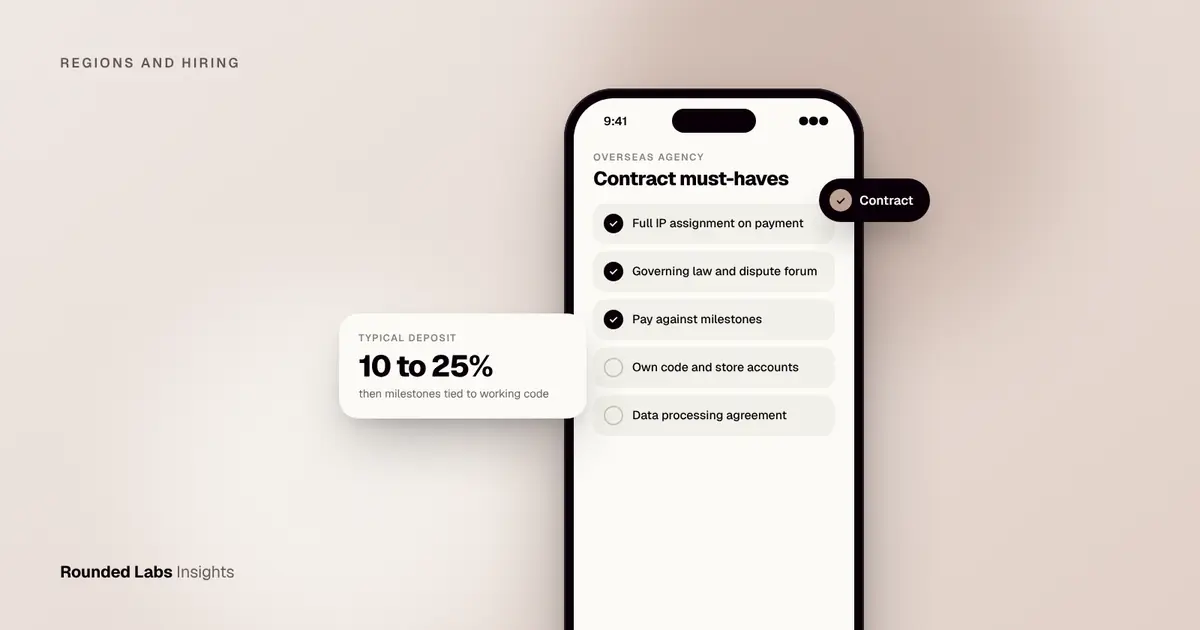
- Intellectual property. You should own the code and designs on payment, and receive the full source code and repository access. See Who owns the code? for the detail.
- Payment tied to milestones. Pay for finished, accepted work, not time that passes. Fixed price vs time and materials compares the models.
- Acceptance criteria. What does “done” mean for each milestone?
- Governing law and dispute route. Know which country’s courts or arbitration apply.
- Confidentiality and data protection terms.
- Exit rights. You should be able to leave and take your code with you, with a handover period.
Contracts, IP and payment when you hire an overseas app agency covers these terms in depth. Time zones also affect how you work day to day; see Running a remote app team across time zones.
Which clauses matter most, and what does a good one look like?
| Clause | What a good version says | What should worry you |
|---|---|---|
| Ownership of work | All code, designs and documents created for the project belong to you once paid for, including work in progress on request | Ownership only “after final payment” with no handover terms, or a licence instead of ownership |
| Background tools | The supplier’s pre-existing tools are licensed to you in a way that lets the app keep running | The app cannot run without a supplier-owned component that you cannot licence |
| Payment | Fixed price split into milestones tied to accepted deliverables | Large upfront payments, payments by calendar date regardless of progress |
| Acceptance | Written criteria and a short test period for each milestone | “Deemed accepted” after a very short silence |
| Warranty | A defect-fixing period after launch at no extra charge | No warranty, or one that excludes everything important |
| Liability | A cap that reflects the project value and carve-outs for data breaches and confidentiality | A tiny cap, or a cap that excludes the risks you care about most |
| Subcontractors | Disclosed in advance, bound by the same terms, supplier stays responsible | Free right to subcontract without telling you |
| Key people | Named roles, with notice and replacement of equivalent skill | No mention of who does the work |
| Termination | Right to end for cause and for convenience, with a clean handover | Penalties for leaving, or no handover duty |
| Governing law | A law and forum that you can realistically use | A distant forum chosen only for the supplier’s benefit |
| Data protection | Roles defined, security measures stated, deletion on exit | Silence on personal data |
Why do payment terms matter so much on an overseas contract?
Paying across borders adds friction: currency conversion, bank fees, delays and tax paperwork. None of this is a problem if you plan for it. State the currency in the contract, state who bears conversion costs, and agree how invoices will be issued. Ask your accountant about tax obligations on payments to a foreign supplier, including any withholding or sales tax questions, because rules vary by country and change over time. At the time of writing, a US company paying a UK supplier for services will usually need to consider paperwork on both sides, so check the current position with a tax adviser rather than assuming.
The bigger point is structural. If you pay by milestone against accepted work, a distant supplier has the same incentive to finish as a local one. If you pay for time, distance makes it hard to see whether the time is being used well. That is the main reason Rounded Labs always works to a fixed price agreed before development, and why we recommend buyers insist on the same from any supplier.
What about escrow and source code safeguards?
Where the stakes are high, some buyers use source code escrow, in which a neutral third party holds a copy of the code. For a bespoke app where you own the repository from day one, escrow is usually unnecessary, because you already have the code. It matters more when the supplier retains ownership of a platform you rely on. Who owns the code? explains the options in detail.
How do you assess the team and the process?
The people matter more than the logo. Ask for:
- Named roles on your project: project lead, designers, engineers, testers.
- Who you will talk to weekly, and their seniority.
- Their delivery process: how often you see working software, how changes are handled, and how bugs are reported.
- A sample plan or estimate from a past project, so you can see how they break work down.
A short paid discovery phase is a low-risk way to test a supplier. Ours are fixed price: for example, a Mobile Product Discovery Sprint is £9,500 (about $12,000, at the time of writing). You see how they think and communicate before committing to the full build. What happens in a discovery phase explains what you should receive at the end.
What does a good delivery process look like from the outside?
You do not need to be an engineer to judge a process. You can see it in the artefacts the supplier produces.
- A plan with milestones you can read, each with a deliverable and a date.
- A regular demo of working software, at least every two weeks, not slides.
- A single place for tasks and bugs that you can open and read yourself.
- A weekly report that says what was done, what is next, what is blocked and what has changed in scope or risk. How to read an agency’s weekly report helps you tell a useful report from a decorative one.
- A change process that records each scope change, its cost and its effect on the date. How to manage scope changes without blowing the budget sets this out.
- Automated testing and a release process that the team can describe without hesitation.
Ask for a sample of each, redacted if needed. If the supplier has never produced a weekly report, they have no habit of telling clients bad news early.
How do time zones change the check?
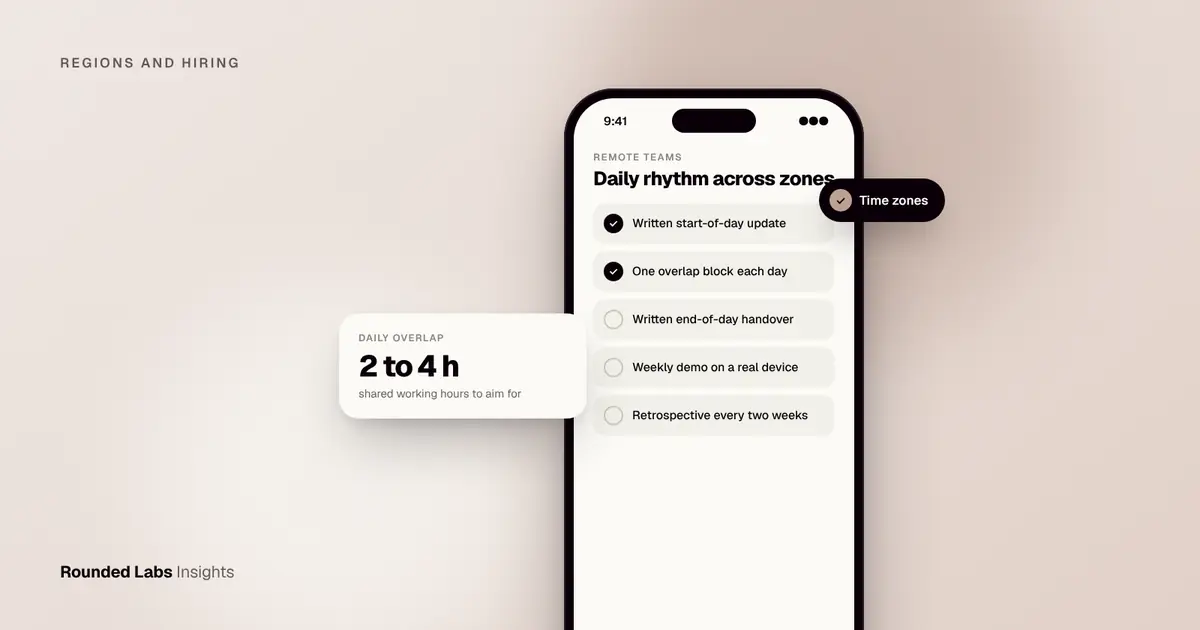
A time difference is manageable when it is planned, and painful when it is ignored. Ask the supplier which hours the team overlaps with yours, who is available during your working day, and how urgent issues are escalated outside it. Agree a fixed weekly rhythm: a planning call, a demo and a short daily written update. Teams with at least three or four hours of overlap with the client work well. Less than that, and you need written habits and a decision log to avoid losing a day per question. Hiring a UK app development company from the US looks at the specific case of the Atlantic gap, and Running a remote app team across time zones covers the working patterns.
Should you ask about languages and communication?
Yes, and directly. Ask who your day to day contact will be and have a short call with that person, not only with the salesperson. You will quickly see whether you can discuss a hard technical trade-off with them. Writing quality matters as much as speaking, because most of your project communication will be written. Ask for a sample of a technical decision note or a project update from a past engagement.
How do you compare quotes fairly?
Price is the loudest number and the least useful one until the scope is equal. A fair comparison needs the same scope, the same assumptions and the same definition of done.
What should a comparable quote contain?
| Item | Why it matters |
|---|---|
| Platforms and versions | iOS only, Android only or both changes the cost |
| Features listed one by one | Avoids arguments about what “login” or “payments” include |
| Back end and admin tools | Often missing from the cheapest quotes |
| Design scope | Wireframes, visual design, design system, accessibility |
| Testing | Manual and automated testing, devices covered, penetration test |
| Store submission | Account setup, screenshots, review rounds |
| Warranty and support | How long defects are fixed at no cost |
| Hosting and third-party costs | Who pays, and who owns the accounts |
| Assumptions and exclusions | The place where hidden costs live |
| Timeline with milestones | Matches payment schedule to progress |
What a good app development proposal looks like and App development quotes compared explain how to read these documents, and How to cut app development costs without cutting quality shows where it is safe to reduce scope.
Why is the cheapest quote usually the most expensive?
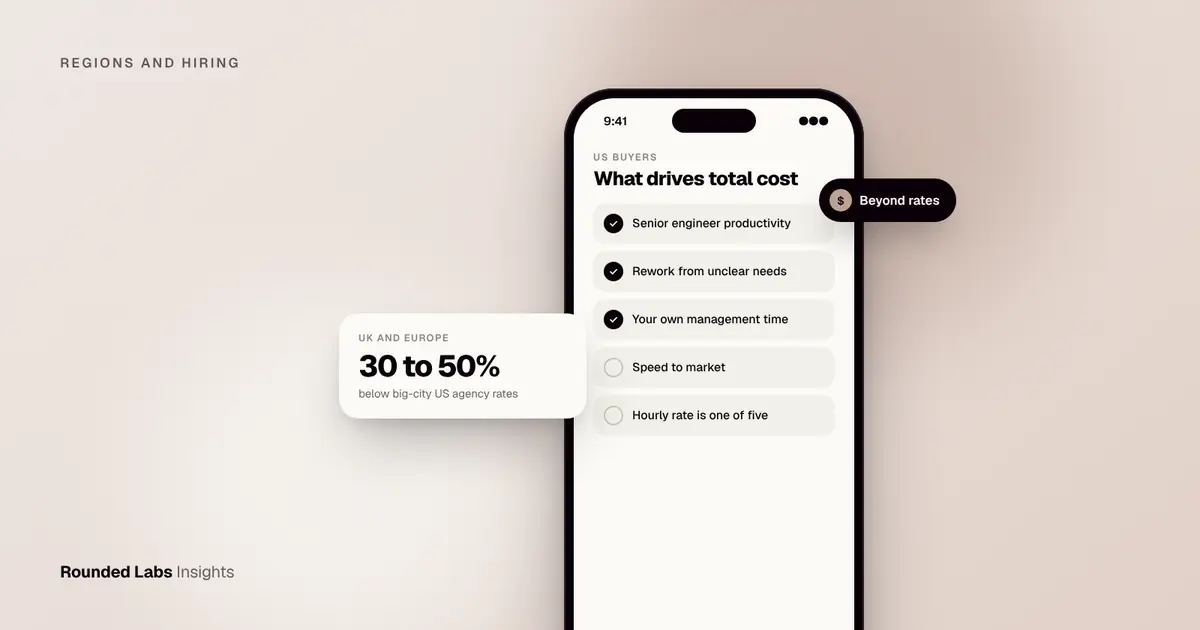
Not always, but often enough to treat it as a signal. If one quote is 40% below the others, one of three things is true: it excludes work the others include, it is staffed by people who are less experienced, or it will grow through change requests. Ask the supplier to explain the gap in writing. A good answer is specific, such as “we reuse our own authentication module”. A poor answer is “we are more efficient”.
What is the difference between market rates and what you will pay?
Market rates vary widely by country, seniority and specialism, and any table of them is a rough guide only. The figures below are illustrative market estimates, not quotes and not Rounded Labs prices.
| Supplier location | Typical blended day rate (market estimate) | What to watch for |
|---|---|---|
| United States | $1,000 to $2,000 | Highest cost, easiest overlap and legal alignment |
| United Kingdom | £600 to £1,100 | Strong engineering depth, partial overlap with US East Coast hours |
| Western and Central Europe | €500 to €1,000 | Good overlap with the UK, less with the US |
| Eastern Europe | $350 to $750 | Strong engineers, check English and project management |
| South Asia and other offshore | $150 to $450 | Widest quality range, check process and seniority carefully |
A lower day rate does not mean a lower project cost. Compare the complete price for the same scope. Rounded Labs does not price by the day: our projects are fixed price, agreed before development starts, typically from £30,000 to £250,000+, as shown on the pricing page.
How can you score suppliers so the decision is not just a feeling?
Use a simple weighted scorecard. Agree the weights before you see the proposals, so that they are not bent to favour a preferred supplier.
| Criterion | Suggested weight | Score 1 to 5 | What a 5 looks like |
|---|---|---|---|
| Company checks | 10% | Verified registration, stable accounts, insurance in place | |
| Relevant track record | 20% | Similar projects, live products, independent references | |
| Team and process | 20% | Named team, regular demos, clear reporting | |
| Security and data | 15% | Evidence of controls matched to your risk | |
| Contract terms | 15% | Ownership, milestones, exit rights all clear | |
| Scope clarity and price | 15% | Line-by-line scope, fixed price, clear exclusions | |
| Communication and fit | 5% | Fast, direct, honest, useful challenge |
Multiply each score by its weight and add the results. The numbers do not make the decision, but they force a discussion of the trade-offs. If a supplier wins on price but loses badly on security and contract terms, the scorecard makes that visible in a way a gut feeling cannot.
What if two suppliers score the same?
Run a small paid trial. A fixed-price discovery sprint or a defined first milestone costs little compared with the full project and shows how each team behaves under real conditions: how they ask questions, how they respond to feedback, how they handle a missed date. You learn more in two weeks of working together than in two months of sales calls.
What does a worked example look like?
Imagine a US fintech founder with a £150,000 (about $190,000) budget and three shortlisted agencies. Agency A quotes £60,000, Agency B £140,000 and Agency C £155,000. These figures are illustrative market estimates, not real quotes.
The due diligence reveals that Agency A’s quote leaves out testing, app store release and backend security work, and that its two references are both from the sales contact’s friends. Agency B has a clear scope but cannot give a named team. Agency C provides two independent references, a milestone payment plan, a clear IP clause and a security summary.
The founder picks Agency C. Two weeks of checking cost almost nothing next to the failed-build risk on the cheapest quote. For a longer list of questions, use 20 questions to ask an app developer.
How would the scorecard look for this example?
| Criterion (weight) | Agency A | Agency B | Agency C |
|---|---|---|---|
| Company checks (10%) | 3 | 4 | 4 |
| Track record (20%) | 2 | 4 | 5 |
| Team and process (20%) | 2 | 2 | 4 |
| Security and data (15%) | 1 | 3 | 4 |
| Contract terms (15%) | 2 | 3 | 4 |
| Scope clarity and price (15%) | 2 | 4 | 4 |
| Communication and fit (5%) | 4 | 4 | 5 |
| Weighted total (out of 5) | 2.2 | 3.3 | 4.2 |
Agency C is the most expensive, and it still wins comfortably, because the scorecard prices risk rather than just cost. Notice also what the founder does next. Rather than simply accepting the higher figure, they negotiate. They ask Agency C to confirm that the price is fixed for the agreed scope, to move the largest payment to the final accepted milestone, and to name the lead engineer in the contract. The due diligence is not just a filter. It becomes the basis for a better contract.
What would change the decision?
If Agency C had refused to name the team, the founder would drop to Agency B and ask it to supply a named team and two independent references. If neither could, the founder would run a paid discovery sprint with both and decide on the evidence. Having a fallback plan before you start prevents the pressure of a deadline from pushing you into a poor choice.
Which supplier model fits which situation?
Different projects suit different suppliers. Due diligence is easier when you know which kind you are looking for.
| Situation | Often a good fit | Main check to emphasise |
|---|---|---|
| First version of a product with an uncertain scope | A studio that offers a fixed-price discovery phase | Quality of the discovery output, ability to challenge your assumptions |
| Well-defined build with clear specifications | A studio or agency working to a fixed price | Scope detail, acceptance criteria, testing |
| Regulated data (health, finance, children) | A supplier with relevant experience and audited controls | Evidence of security and compliance practice |
| Extending or rescuing an existing app | A supplier with code audit experience | Independent audit, handover plan; see How to audit an existing app’s code |
| Ongoing improvement after launch | The original builder or a new supplier after a handover | Documentation quality, support terms |
| Very small budget, simple app | A freelancer or small studio | Continuity and ownership, see Freelance marketplaces vs an app studio |
What red flags should stop you?
- Refusal to name past clients or allow reference calls.
- Pressure to sign quickly or a “discount” that expires this week.
- A quote with no breakdown, or far below every other.
- Code ownership that transfers only “after final payment” with no handover terms, or not at all.
- No named people on your project.
- Vague answers on security or data location.
- A contract that is a template written entirely for the supplier’s benefit, with no willingness to discuss changes.
- Reluctance to put promises in writing, such as delivery dates, team members or support terms.
- Case studies for which no client can be named or contacted.
- A proposal that is mainly about technology choices and says little about your users or your business goal.
Red flags when hiring app developers goes through more warning signs. If you are choosing between UK and US suppliers, UK vs US app development agencies compares them on cost, quality and risk.
Are there green flags worth looking for too?
Yes, and they are worth noting because good suppliers often show them early.
- They ask hard questions about your users and your business case before quoting.
- They tell you what is not worth building yet.
- They point out a risk in your plan without being asked.
- They are happy to put you in touch with clients and say who did the work.
- They give a price range with clear assumptions and a fixed price once scope is agreed.
- They explain what happens at the end of the engagement, including how you leave.
- They treat the contract as a shared document and expect it to be negotiated.
A supplier who tells you that your timeline is unrealistic, and shows why, is more likely to deliver than one who agrees with everything.
What do you do when a supplier fails one check?
One failure does not automatically rule a supplier out. Classify it. A missing certificate on a low-risk app is minor. A refusal to allow reference calls is serious. A contract clause you dislike may be negotiable, and how the supplier responds to the request tells you about the relationship you will have. Write down each failure, ask the supplier to respond in writing, and score the answer. Two or three small gaps with good responses are acceptable. One serious gap with a defensive answer is not.
What should you do in the first 30 days after signing?
Due diligence continues into the project, because the best evidence of how a supplier behaves is how they behave once the money is committed.
- Week 1: set up ownership. Create the repository, cloud accounts and store accounts under your organisation, and give the supplier access. Record who holds each credential. How to set up an Apple Developer account for a company is a useful early task.
- Week 1: confirm the team. Meet the people named in the contract and check that they are the people who turn up.
- Week 2: agree the plan. Confirm milestones, acceptance criteria, communication rhythm and escalation contacts.
- Week 2: baseline security. Confirm multi-factor authentication, secret handling and access lists.
- Week 3: first working software. Ask for a first demo, however small. It shows the process works.
- Week 4: review. Compare reality with the plan. Are reports honest, are questions answered quickly, and is the pace consistent with the milestone schedule?
Working with an app agency: the first 90 days and How to tell if an app project is off track give you ways to keep checking as the work proceeds.
What should you monitor throughout the project?
| Signal | Healthy | Warning |
|---|---|---|
| Demos | Regular, working software | Slides, or demos that avoid real features |
| Reports | Honest, include risks | Only good news |
| Scope changes | Logged, costed, agreed | Argued about at the end |
| Team | Stable | Unannounced changes |
| Questions | Answered within a day | Weeks of silence |
| Quality | Tests run, bugs closed | Growing backlog of defects |
How much does hiring from abroad cost?
Rounded Labs works at a fixed price agreed before development starts. Projects typically run £30,000 to £250,000+; see our pricing page. Other suppliers vary widely, and market rates differ by country, so always compare scope, not just totals. If you want a supplier-neutral technical check before spending, our Tech Architecture Audit is £7,500, our Digital Transformation Prep is £7,000, and a Mobile Product Discovery Sprint is £9,500. For an existing app that worries you, a Legacy App Rescue Assessment is £6,500.
Also budget for the costs that sit outside the supplier’s price: legal review of the contract, an independent penetration test if the risk is high, your own team’s time, store accounts, third-party services and the running costs after launch. The total cost of owning an app over five years shows how large those can become, and The hidden costs of building an app lists the common surprises. If you want a US-side comparison, How much does it cost to build an app in the US? gives market estimates in dollars.
How much should you spend on checking?
A rough guide is to spend one or two working days of internal time per shortlisted supplier, plus a few hours of legal review of the contract. For a project over £100,000, a dedicated security review and a longer legal review are justified. For a small project, a light version of this checklist is enough, as long as ownership, payment and exit terms are still checked, because those three cause the most expensive problems.
What should you do next?
- Write your one-page brief and your list of must-have questions.
- Shortlist three to five suppliers and send the same written questions.
- Run the company, sanctions and store checks yourself.
- Hold at least two reference calls per supplier.
- Match security checks to the risk of your data.
- Review the contract with a lawyer before negotiating price.
- Score each supplier, record the reasons and make the call.
If you want a second opinion on a shortlist, we will tell you honestly what to look for, even if the answer is not us. Book a call with a co-founder and bring your questions and your draft quotes. And if you would like to see how a fixed-price engagement works in practice, start with the pricing page, which sets out the productised services and typical project ranges.
Want a second opinion on a supplier shortlist? We will tell you honestly what to look for, even if the answer is not us. Book a 30-minute call with a co-founder.
Frequently asked questions
How long should supplier due diligence take?
For a mid-size app project, plan 2 to 4 weeks from shortlist to signed contract. Company checks and reference calls take days; contract review and any security evidence take longer. A high-risk or regulated product deserves the full period or more.
Should I visit the supplier in person?
It helps but is not required. A video walkthrough of the team and office, plus meeting the people who will work on your project, gives you most of the benefit. If the project is large, a visit during the discovery phase is a sensible use of travel budget.
Is a lower day rate overseas always a saving?
No. Cheaper rates can mean more days, more rework and more management on your side. Compare total fixed-price quotes against the same scope, and include your own time and the cost of risk in the comparison.
What if the supplier refuses to share references?
Treat it as a serious warning. Agencies with happy clients are usually glad to connect you with them. If confidentiality prevents it, ask for published case studies you can verify and for a supplier-approved reference from a different project.
Do I need a lawyer to review the contract?
For anything above a small project, yes. A short review of IP, payment and dispute terms is inexpensive compared with the project value. Choose a lawyer with software contract experience in the relevant countries. This guide is general information, not legal advice.
How do I check a supplier's security if I am not technical?
Ask the questions in the questionnaire above and look for specific, consistent answers. For a high-risk app, pay for an independent security review or penetration test. You do not need to understand every detail, but you can tell the difference between an evidence-based answer and a vague one.
Can I run due diligence on a supplier I already know?
Yes, and you should for any new project. A past good experience is a useful reference, but staff, financial position and technical practices change. Check that the team, the contract terms and the security evidence still match what you need.
Official sources and further reading
Talk it through with one of our co-founders. 30 minutes, no pressure.