

An app project is off track when you can no longer see working software every two weeks, when the budget spent runs ahead of the features finished, or when nobody can show you a dated plan that still holds. Any one of these is a warning. Two together, for more than a month, usually means the project needs a reset, not more patience.
We have run and rescued app projects for 19 years, including Dabbl, a trading app for first-time investors, and the pattern is consistent: projects rarely fail suddenly. They drift, and the signs are visible weeks before the money is gone. This guide gives you nine checks a non-technical owner can run without reading code, a worked example with numbers, and the steps to take if you spot trouble. If you want hands-on help, see our services.
Key facts
- The most reliable early sign is not a missed date. It is a demo that keeps showing the same screens, or no demo at all.
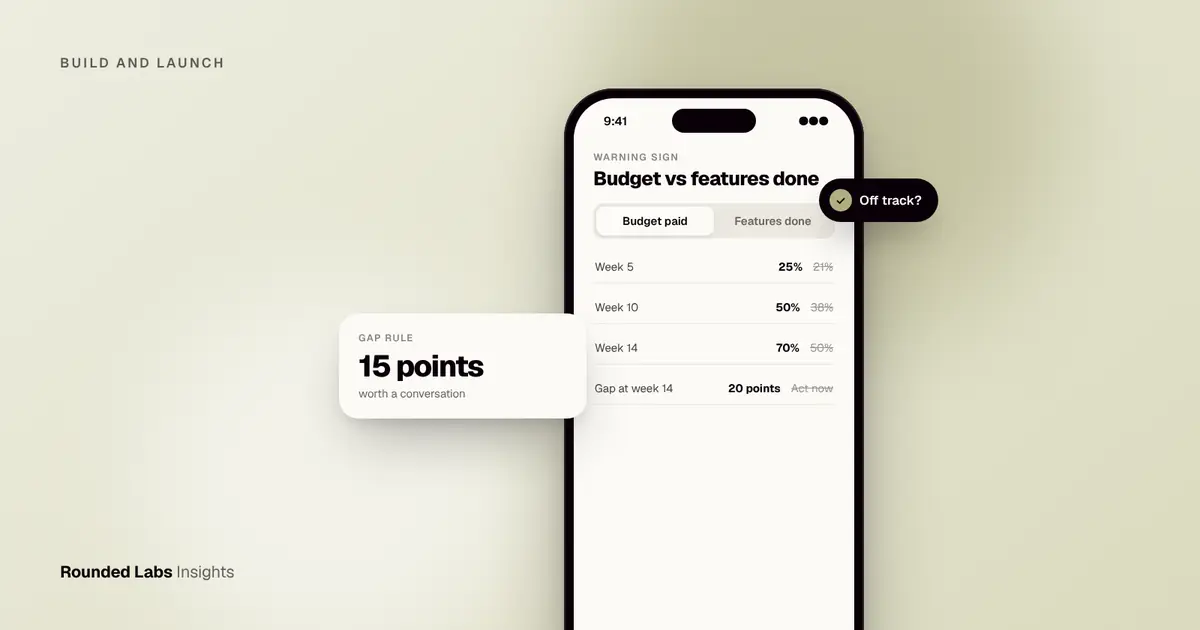
- Compare the percentage of budget spent with the percentage of agreed features finished. A gap of more than 15 points is worth a conversation.
- Weekly reports that list activity (“worked on backend”) but not outcomes (“login now works”) hide drift.
- Most drift traces back to unclear scope, late decisions on your side, or a team that is too thin for the plan.
- A fixed price agreed before development starts makes overspend the supplier’s problem, but it does not stop delay or poor quality, so you still need to check progress.
- Do not act on one symptom alone. Gather facts for a week, then decide whether to fix, re-plan or replace.
- All figures in the examples are illustrative market examples, not client results or quotes.
What does “off track” actually mean?
It means the gap between what you were promised and what is being delivered is widening, not that one sprint went badly. Every project wobbles. The question is whether the wobble is recovering or compounding.
Three things define track for an app project: scope (what gets built), time (when it ships) and quality (whether it works on real phones). A healthy project can flex one of these on purpose. It might cut a feature to hold a date, or move the date to protect quality. An off-track project is slipping on all three without anyone having decided to trade one for another.
| Situation | What it looks like | Verdict |
|---|---|---|
| A single slow sprint with a known cause | The team explains it, adjusts the plan and the next demo shows progress | Normal wobble |
| A deliberate trade | You agree to cut a feature to hold a launch date | Healthy control |
| A slip with no explanation | A date moves and the reason keeps changing | Warning |
| Drift on two or more fronts | Late, over budget or buggy, with nobody owning the plan | Off track |
| Loss of visibility | No demos, no access, vague reports | Serious |
Visibility is the word that matters most. A project you can see, even a troubled one, can be fixed. A project you cannot see cannot be judged, which is why several of the signs below are about access and evidence rather than speed.
What are the nine warning signs?
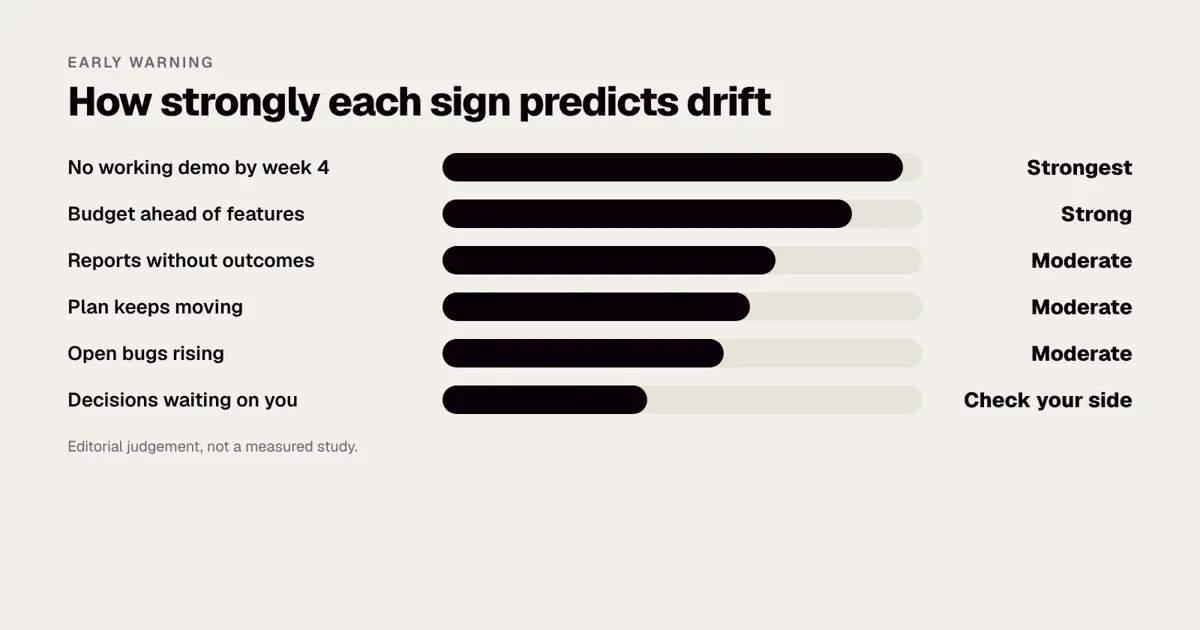
| Warning sign | How to check it | Why it matters |
|---|---|---|
| No working demo in 3 to 4 weeks | Ask to use the build on your own phone | Slides and mock-ups are not progress |
| Budget spent ahead of features done | Compare invoices paid with the feature list | Early sign of underestimating or rework |
| Reports full of activity, no outcomes | Ask “what can a user do now that they could not last week?” | Vague reporting often hides slow progress |
| The plan keeps moving | Compare today’s launch date with the first one | Repeated “small” slips add up |
| Team keeps changing | Ask who has worked on it in the last month | Knowledge leaves with people |
| Bugs rise faster than they close | Ask for the open bug count each week | Quality debt compounds |
| Decisions waiting on you | Count your open questions older than a week | Delay may be on your side |
| Scope grows with no change log | Ask for every change since kickoff, with cost | Uncontrolled scope eats the budget |
| You cannot get the code or accounts | Check you own the repository and store accounts | A control and exit risk |
If you can answer “yes, and it is getting worse” to three or more rows, treat the project as off track. Our guide to reading an agency’s weekly report shows what good reporting looks like, and how to manage scope changes covers row eight in detail.
What does each warning sign look like in practice?
The table is a summary. Here is what each sign looks like on the ground, how to test it and what a healthy answer sounds like.
1. No working demo in three to four weeks
By the end of the first month you should be able to hold something in your hand, even if it is rough. A login screen that works, a list that loads, a button that does something. If instead you have seen designs, architecture diagrams and promises, ask for a build. Teams that avoid showing working software are often behind, unsure of their foundations or waiting on something they have not told you about.
Check: ask for a TestFlight link for iOS or an internal testing link for Android, and install it yourself. Healthy answer: “Here is the link, and here is what works and what does not yet.” Concern: “It is not ready to show” for a second month in a row.
2. Budget spent ahead of features done
Compare the percentage of budget paid or consumed with the percentage of agreed features that are finished and accepted. Early on, a gap is normal because set-up, design and infrastructure come first. After the first third of the project, the two numbers should start to move together. A gap of more than 15 points is worth a conversation, and a gap that widens month after month is the clearest numerical signal of drift.
Check: list the agreed features, mark each one as done, in progress or not started, and compare with the invoice schedule. Healthy answer: “We front-loaded set-up, and here is the plan that closes the gap.” Concern: no feature list that you can count.
3. Reports full of activity, no outcomes
“Worked on backend”, “continued integration work” and “design refinements” describe effort. “Customers can now reset a password” describes an outcome. If every report reads like the first kind, you are being told how busy the team is, not what has been achieved. This is the sign that most often hides the others.
Check: reply to a report with: “What can a user do now that they could not do last week?” Healthy answer: a short list of things you can try. Concern: a longer, vaguer paragraph.
4. The plan keeps moving
One date change with a reason is normal. A date that moves every fortnight, usually by “just a week”, is a pattern. Keep a record of every launch date you have been given, with the day you were told. After three changes the sequence usually tells its own story.
Check: write down the original launch date and today’s, and ask what has to be true for today’s date to hold. Healthy answer: a plan with sprints, dependencies and named owners. Concern: “We are nearly there.”
5. The team keeps changing
Developers move on, and good agencies cope with it. But if the person who agreed your scope disappears, or you meet a different developer every month, knowledge leaks and decisions are re-made. A stable core team, with documented decisions, handles change. A thin team that is repeatedly reshuffled usually signals that your project is not the supplier’s priority.
Check: ask who has committed code in the last month and what each person does. Healthy answer: a named team and a handover note for any change. Concern: nobody can say who is working on it.
6. Bugs rise faster than they close
Every project has bugs. What matters is the trend. If the open count climbs each week, the team is adding problems faster than it fixes them, which is often a sign of rushing or weak testing. Ask for the number of open bugs, how many are serious, and how many were closed in the last two weeks. Our guide on how app testing works explains the stages that should catch these problems.
Check: request a simple weekly chart of bugs opened and closed. Healthy answer: a line that stabilises, then falls. Concern: a team that says “bugs are normal” and has no numbers.
7. Decisions are waiting on you
Honesty is part of the check. Many delays sit on the owner’s side: designs waiting for sign-off, questions about rules, content not supplied, accounts not set up. Count your open questions older than a week. If there are more than two or three, some of the drift is yours, and the fix is cheaper than any other on this list. See how to sign off a design for a routine that keeps decisions moving.
Check: ask the team for a list of everything they are waiting for from you. Healthy answer: a short list with dates. Concern: none, even though the team seems stuck. That means the team is not tracking blockers.
8. Scope grows with no change log
Scope creep is rarely one big request. It is twenty small ones, each reasonable alone. If there is no log of changes since kickoff, with the cost and time effect of each, you cannot tell whether the budget is being consumed by your requests or by poor estimating. Our guide to scope changes shows how to run a simple log.
Check: ask for every change since kickoff, who asked for it and what it cost. Healthy answer: a short table. Concern: “We have been flexible”, with no record.
9. You cannot get the code or accounts
You should be able to see the code repository, the cloud accounts and the Apple Developer and Google Play accounts for your app, and ideally own them. If the supplier holds everything and resists sharing, your exit options shrink and so does your leverage. Who owns the code is a contract question, and it is best settled before the first line is written.
Check: ask for administrator access to the repository and confirm the developer accounts are in your company name. Healthy answer: access within a day. Concern: delay, excuses or a request to “wait until the end”.
How do you check progress without reading code?
You do not need to understand the code. You need to use the product.
- Install the latest build yourself. Ask for a TestFlight (iOS) or internal testing link (Android) and use it weekly. If the team cannot give you one, that tells you something.
- Walk one real journey. For a booking app, search, book, pay, cancel. Note where it breaks.
- Ask for the feature list with status. Each item should be not started, in progress, in testing or done, with “done” meaning tested and accepted.
- Ask who tested it. Developers marking their own work as done is weaker than a separate tester or you accepting it.
- Check dates against evidence. A launch date needs a plan behind it: what ships in each sprint, and what depends on whom.
A short sprint demo every two weeks makes all five steps routine, and it is the single best control a founder has. For the installation side, Apple’s TestFlight and the testing tracks in Google Play’s developer documentation are the official references.
What does “done” mean?
Many arguments about progress are really arguments about this word. Agree a definition at the start and write it down. A workable one has five parts.
- The feature works on the devices you named.
- It has been tested by someone other than the person who built it.
- It meets the acceptance rules you agreed, such as the error message wording or the limit on file size.
- Known bugs are logged and none are serious.
- You have seen it and accepted it.
Anything short of that is “in progress”, whatever the report says. Our guide to writing user stories developers understand shows how to state acceptance rules in a form that is easy to test.
What does a drifting project look like in numbers?
Here is a realistic scenario, with figures that are illustrative market examples, not a client result. A founder agrees a £90,000 build with 24 features over 20 weeks with a supplier that bills in stages.
| Week | Budget paid | Features done (of 24) | Reading |
|---|---|---|---|
| 5 | £22,500 (25%) | 5 (21%) | Normal, small gap |
| 10 | £45,000 (50%) | 9 (38%) | Gap of 12 points, ask why |
| 14 | £63,000 (70%) | 12 (50%) | Gap of 20 points, act now |
At week 14 the founder is 70% through the money and half through the features. A simple way to read this is to divide the share of features done by the share of money spent: 50 divided by 70 gives about 0.71, so each pound is buying about 71 pence of progress. If that rate continues, the remaining 12 features cost roughly the same again as the first 12, and the total lands near £126,000, about 40% over. If the team keeps delivering at the pace of weeks 10 to 14, which is 3 features in 4 weeks, the remaining 12 take about 16 more weeks, so launch lands around week 30 instead of week 20.
Noticing at week 10 rather than week 14 would have saved about a month and several thousand pounds. At week 10 the same method gives 38 divided by 50, or 0.76, which is enough to justify a pointed conversation but not yet a crisis.
Not sure whether your project is drifting? A 30-minute outside view often settles it. Book a 30-minute call with a co-founder and bring your plan, your latest demo and your invoices.
A fixed price project drifts differently
If your project is fixed price, the numbers above do not mean you will pay £126,000. On a fixed price agreed before development starts, as we do, the supplier carries the cost overrun. That is a real protection, but it changes the risks you should watch. The supplier may slow the pace of work on your project to protect its margin, trim quality, push contentious items into “phase two” or argue that your requests are changes. The signs are then delay, rising bugs and disputes about scope, not invoices. So the checks stay the same: demos, a feature list with status, a change log and a plan with dates.
| Contract type | Main financial risk | Main drift symptom | Best control |
|---|---|---|---|
| Fixed price | Delay and quality cuts | Slipping dates, thin testing, scope arguments | Milestones tied to accepted features, change log |
| Time and materials | Overspend | Spend ahead of features, vague reports | Budget cap, weekly burn against features |
| Dedicated team | Both | Unclear ownership of the plan | A named product owner and a written plan |
For the trade-offs between contract types, see fixed price versus time and materials, and for what drives cost differences in the first place, why quotes range so widely.
What does a second scenario look like, with a bug trend?
Numbers on money are only half the picture. Here is a second illustrative scenario, this time on quality, for a fixed price booking app with a launch planned for week 16. The figures are examples, not a client result.
| Week | Bugs opened | Bugs closed | Open now | Serious open | Reading |
|---|---|---|---|---|---|
| 4 | 12 | 8 | 4 | 0 | Fine, early days |
| 6 | 20 | 15 | 9 | 1 | Normal as features land |
| 8 | 26 | 14 | 21 | 3 | Opening faster than closing |
| 10 | 30 | 12 | 39 | 6 | Quality debt is compounding |
Between weeks 6 and 10 the team opened 56 bugs and closed 26. Nothing in the weekly reports mentioned it, because the reports described tasks. What the owner does next matters. A good response is not to demand that the team “fix more bugs”, which usually produces rushed fixes and new bugs. It is to ask three questions.
- Where are the bugs coming from? If most sit in one area, such as payments, that area probably needs redesign, not patching.
- Is testing happening late? If features are built for weeks and only then tested, bugs arrive in a heap. Testing each feature as it is finished spreads the load and finds problems while the code is fresh.
- Is the pace too high for the team’s size? If the plan assumed three developers and there are two, speed is being bought with quality.
A sensible outcome is a short pause on new features, a bug-fixing sprint with a target, and a rule that no new feature starts until the serious bugs are closed. It feels slow for a fortnight, and it usually saves weeks. Compare that with the alternative, where bugs pile up until a launch date arrives and the choice is between shipping a broken app and slipping. Our guide to why Apple rejects apps is a reminder that quality problems also surface at store review, where the cost of finding them is higher.
What questions should you ask for each warning sign?
Questions that are specific and non-accusing get better answers than general worry. Keep this list near your weekly review and use the one that matches what you have seen.
| If you notice | Ask |
|---|---|
| No demo | “Can I install the latest build today, and what works in it?” |
| Spend ahead of features | “Show me the feature list with statuses next to the invoice schedule. Where do you expect the two to meet?” |
| Vague reports | “In each report, can you list what a user can now do that they could not last week?” |
| Moving dates | “What has to be true for the current date to hold, and who owns each item?” |
| Team changes | “Who has worked on this in the last month, and how was knowledge handed over?” |
| Rising bugs | “Where are the new bugs coming from, and when is each feature tested?” |
| Decisions waiting | “What are you waiting for from me, and by which date does it start to affect the launch?” |
| Scope growth | “Can I see every change since kickoff, with its cost and time effect?” |
| Access problems | “Please give me administrator access to the repository and confirm the store accounts are in our company name.” |
Notice that every question asks for something you can see. It is hard to argue with a request to look at the build, and it shows quickly whether the team welcomes oversight or resists it. A team confident in its progress usually answers within a day.
How should you document what you find?
Keep a simple log, because memory is unreliable and disputes, if they come, are settled with records. Each week, note the date, what you saw in the demo, the feature count, the bug count, any promise made and any date given. Save the written status reports and email threads. This is not about building a legal case. It is about knowing what was said. If the project recovers, the log costs you ten minutes a week. If it does not, it makes your reset meeting, your independent review and any conversation with a solicitor far more effective.
What are the usual causes?
Most off-track projects come from a short list. Knowing which one applies tells you what kind of fix to ask for.
| Cause | Typical signs | First fix |
|---|---|---|
| Vague scope | Rework, arguments about what was agreed | Write acceptance rules for each feature |
| Slow decisions | Developers idle, questions unanswered | Agree a response time and a named decision maker |
| Wrong-sized team | Plan assumed three developers, there is one | Re-plan to the real capacity, or add people |
| Unproven integrations | Payments or third-party services turn out harder than assumed | Test the riskiest piece first, in a short spike |
| Technical debt from rushing | Each change is slower than the last | Pay down debt in a planned slot |
| Pressure on a fixed scope | Quality drops first | Watch the bug trend, test earlier |
| Weak product ownership | Priorities change weekly | One accountable owner on your side |
A few notes on these.
- Vague scope. “Social features” or “admin panel” without screens and rules leads to guessing, then rework. Writing user stories developers understand removes much of it, and a full app specification goes further.
- Slow decisions. Designs waiting a fortnight for sign-off stall developers. Agree response times up front.
- Unproven integrations. Ask for these to be tested in the first sprints, not the last. An API integration is a frequent source of late surprises.
- Technical debt. Shortcuts early make every later change slower. We explain it in what is technical debt.
- Weak product ownership. If nobody on your side can say yes or no quickly, the supplier fills the gap with guesses.
Many of these causes start with the supplier choice and the agreement, so compare your set-up with the UK Government Service Manual’s agile guidance, which describes what regular, visible delivery looks like for public services, and which commercial projects can borrow from. Our guides on choosing an app development company and red flags when hiring app developers look at the same problem before the contract is signed.
What should you do in the first week?
Do not fire anyone on day one. Gather facts first. A calm, specific week of checking will give you much better options than a heated call.
- Secure your assets. Confirm you hold the repository, cloud account, Apple Developer and Google Play accounts, and design files. If you do not, ask for access, politely, and note the response.
- Ask for a written status. Done, in progress, not started, with honest dates and the reasons for each slip.
- Run a joint reset meeting. Agree what ships first, what is cut and who decides what, in writing.
- Get an independent review if trust is low. Our Tech Architecture Audit is £7,500 and our Legacy App Rescue Assessment is £6,500, both fixed price, and they give you a written view of code, risk and next steps.
- Decide: fix, re-plan or replace. If the code is sound, re-plan. If it is not, see how to rescue a failing app project and how to take over an app built by someone else.
Day by day
| Day | Action | Output |
|---|---|---|
| 1 | Ask for repository, cloud and store account access; install the latest build | Access list, first-hand view of the product |
| 2 | Write your own list of agreed features and mark each from what you have seen | Your own status table |
| 3 | Request the written status, bug counts, change log and plan | The supplier’s view of the same facts |
| 4 | Compare the two views and the invoices | A list of gaps with numbers |
| 5 | Hold the reset meeting | Written agreement on scope, order, dates and owners |
| 6 to 7 | Decide whether you need an outside review | A yes or no, and a date |
What belongs in a reset meeting?
A good reset meeting is short, factual and ends with a written note. Use this agenda.
- Each side states the facts: what is built, what is not, what is blocked.
- Agree the next demo date, no more than two weeks away.
- Agree what ships first, ranking features by value to users.
- Agree what is cut or deferred, and put it in writing.
- Name who decides what on each side, and how fast.
- Agree the reporting format: outcomes, bug trend, blockers, dates.
- Agree what happens if the next demo misses the plan.
Keep the tone factual. You are trying to restore a working relationship, and you may well need this team to finish the job. At the same time, keep copies of everything, and do not agree to anything verbally that you would want in writing.
What do you say in the first conversation?
A short script helps when emotions are running high. Something like: “I would like to run a reset so that we both see the same picture. Can we look at the build on my phone, the feature list with statuses, the bug count and the plan for the next four weeks? I would also like administrator access to the repository and the store accounts, which should be in my company’s name anyway.” That is polite, specific and hard to refuse. How the supplier responds will tell you a great deal.
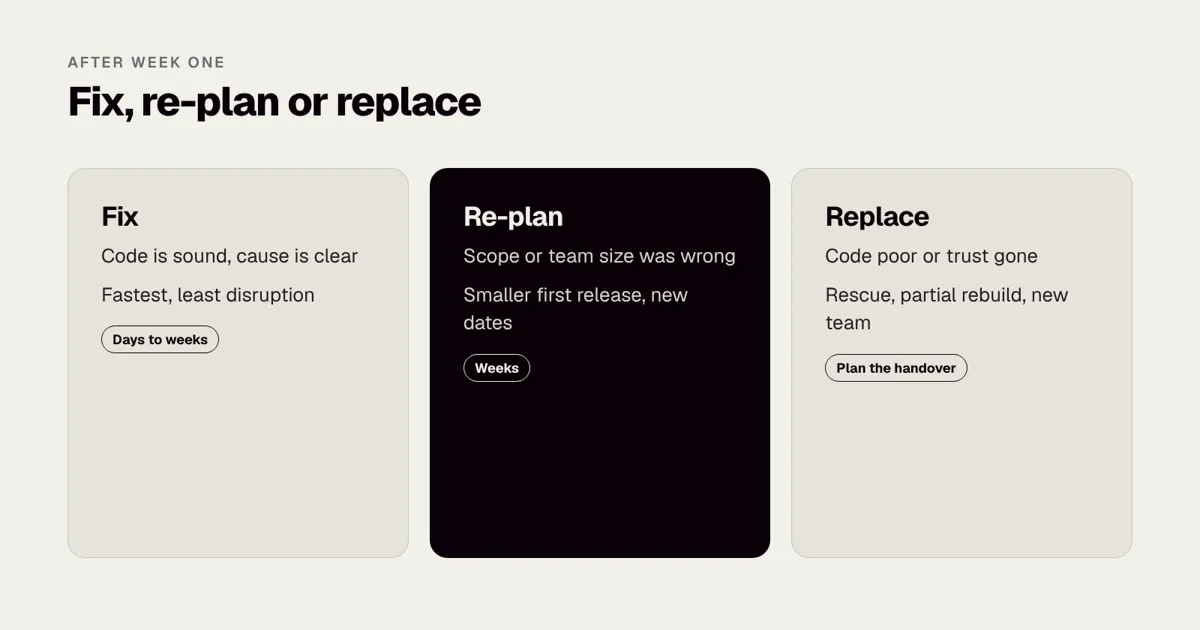
How do you decide: fix, re-plan or replace?
After the first week you should be able to choose between three paths. The right one depends on the state of the code, the state of the relationship and how much runway you have.
| Option | Choose it when | Typical effect | Watch out for |
|---|---|---|---|
| Fix | The code is sound and the problem is communication or a single cause | Fastest, least disruption | Fixing symptoms and not causes |
| Re-plan | Scope or team size was wrong but the base is good | A new plan, possibly a reduced first release | Re-planning without cutting scope |
| Replace | The code is poor, trust is gone or the supplier will not engage | A rescue, partial rebuild or new supplier | Underestimating the cost of handover |
An outside review is the quickest way to tell which applies, because the two most important questions, “is the code worth keeping?” and “is the plan realistic?”, are hard to answer from inside the project. Our guide to how to audit an existing app’s code shows what a review covers. If the answer is to change supplier, the practical steps are in how to switch app agencies without losing your app.
If you decide to replace the supplier
Replacing is rarely a clean break, and the transition is where owners lose most. Before you give notice, do the following.
- Check your contract for notice periods, payment terms and what you are owed on exit.
- Secure the code, the data and the accounts.
- Get an independent view of what is built and what is reusable, so a new team is not guessing.
- Agree a handover, with documentation and a call between the old and new teams if possible.
- Plan for a ramp-up period, since a new team needs time to learn the system.
If you are unsure about your legal position, take advice from a solicitor. This is general information, not legal advice.
How do you stop it happening again?
Build the controls into the contract and the routine. A fixed price agreed before development starts, as we do on projects typically £30,000 to £250,000+ (see our pricing page), pairs well with milestone payments tied to working, accepted features. The Scrum Guide explains the review and planning rhythm behind this.
| Control | What it is | How often |
|---|---|---|
| Sprint demo | A live walk-through of working software | Every two weeks |
| Written status | Outcomes, bug trend, blockers, dates | Weekly |
| Change log | Every scope change with cost and time effect | Updated as changes occur |
| Decision log | What was decided, by whom and when | As decisions occur |
| Milestone acceptance | Payment tied to accepted features | At each milestone |
| Named decision makers | One person each side who can say yes or no fast | Always |
| Account ownership check | Confirm repository and store accounts are yours | At kickoff and quarterly |
Our guide to the first 90 days with an agency sets out a routine that works, and what a good proposal looks like shows how to write these controls into the agreement. Our work with Superdry, across 768 locations in over 100 countries, depended on exactly this kind of steady cadence. For a view of what we mean by quick, visible delivery, Waterstones is an example: an app, a mobile site and an eBooks API in 12 weeks. If you want us to review your current plan, talk to a co-founder.
What does a good weekly status look like?
Ask for a one-page format, and use the same one every week so that you can compare. A useful template has six lines.
- Delivered this week: things a user can now do.
- Planned next week: the same, in outcome form.
- Feature count: done, in progress and not started, against the total.
- Bugs: opened, closed and open now, with the number of serious ones.
- Blockers: anything waiting on you, with a date.
- Dates: the current launch date and whether it has moved, with a reason.
If you receive this for four weeks in a row, you will know more about your project than most owners ever do.
How do the signs differ for different kinds of project?
The nine signs apply to nearly every app, but the weighting changes with the type of product.
| Project type | Signs to watch most closely | Why |
|---|---|---|
| A first version or MVP | No demo, plan keeps moving, scope growth | Speed and focus are the point. See what an MVP is |
| A payments or regulated product | Bugs, accounts and code access, decisions waiting | Mistakes are costly and review takes time |
| A rebuild of an existing app | Budget ahead of features, scope growth | Hidden complexity in the old system is common |
| An integration-heavy product | Plan moving, bugs | Third-party behaviour is hard to predict |
| A fixed deadline, such as a campaign | Plan moving, team changes | Late discovery has a hard cost |
For an early-stage idea, check first whether it needs a full build at all. How to validate an app idea describes cheaper ways to test demand before you commit.
What mistakes do owners make once they are worried?
- Waiting too long. Hoping a slipping project will recover without a change is the commonest error. Act at the first sustained gap.
- Acting on one symptom. One missed date does not condemn a project. Look for a pattern.
- Making it personal. Accusations harden positions. Stay with facts: builds, numbers, dates.
- Changing everything at once. Adding scope, changing the team and moving the date together makes it impossible to see what helped.
- Withholding payment without reading the contract. You may weaken your position. Check the terms and talk first.
- Ignoring your own part. Slow decisions and shifting requirements are real causes. Audit yourself first.
- Not securing accounts. If you do nothing else this week, make sure the repository and store accounts are yours.
- Skipping the independent view. An outside review costs a small part of what a failed project will.
- Letting a reset pass without a written note. If it is not written down, it will be remembered differently.
What if you are a first-time buyer with no technical background?
You do not need technical knowledge to run these checks, but you do need a routine. Block 30 minutes every Friday. Open the latest build and walk one journey. Read the weekly status and compare it with the feature list. Update your own table of dates. Write down one question for Monday. After a month you will have a record that is hard to argue with and an instinct for what normal looks like.
If you want help establishing that routine, or a second pair of eyes on your plan, our Mobile Product Discovery Sprint at £9,500 fixed price is designed to turn an idea into a costed plan. The same structure of journeys, priorities and a costed plan is a useful way to re-plan a stalled project. For planning a redesign of an app that is live but tired, see how to plan an app redesign.
Frequently asked questions
How early can you spot a project going wrong?
Usually within the first four to six weeks. If there is no working build to try by then, or the feature list has no statuses, ask questions immediately. The earlier you ask, the more options you keep.
Is a missed deadline always a bad sign?
No. One slip with a clear cause and a fix is normal. A pattern of slips with changing explanations is the concern, especially if the reports do not describe outcomes.
Should I stop paying a supplier I am worried about?
Check your contract first and talk to the supplier before withholding anything. Milestone-based payments make this easier, because you pay for accepted work. If you are unsure of your position, take legal advice, since withholding payment wrongly can weaken your case.
Can an off-track project be saved?
Often, yes. If the core code is sound, a re-plan and tighter scope can recover it. If the foundations are poor, a partial rebuild may be cheaper than patching. An independent review will tell you which, before you spend more.
Who should own the code and accounts?
You should. The repository, cloud hosting and store developer accounts should be in your company name, with the supplier given access. Settle it in the contract before work starts.
How much should an independent review cost?
Reviews vary in depth, so compare what each includes. Ours are fixed price and agreed before work begins: a Tech Architecture Audit is £7,500 and a Legacy App Rescue Assessment is £6,500. Either is small against the cost of continuing a project that is heading the wrong way.
What is the single best control for a non-technical owner?
A working demo every two weeks, on your own phone. It cuts through reporting language and shows progress or the lack of it. Combine it with a feature list that has honest statuses and you will see most problems early.
Official sources and further reading
Talk it through with one of our co-founders. 30 minutes, no pressure.