

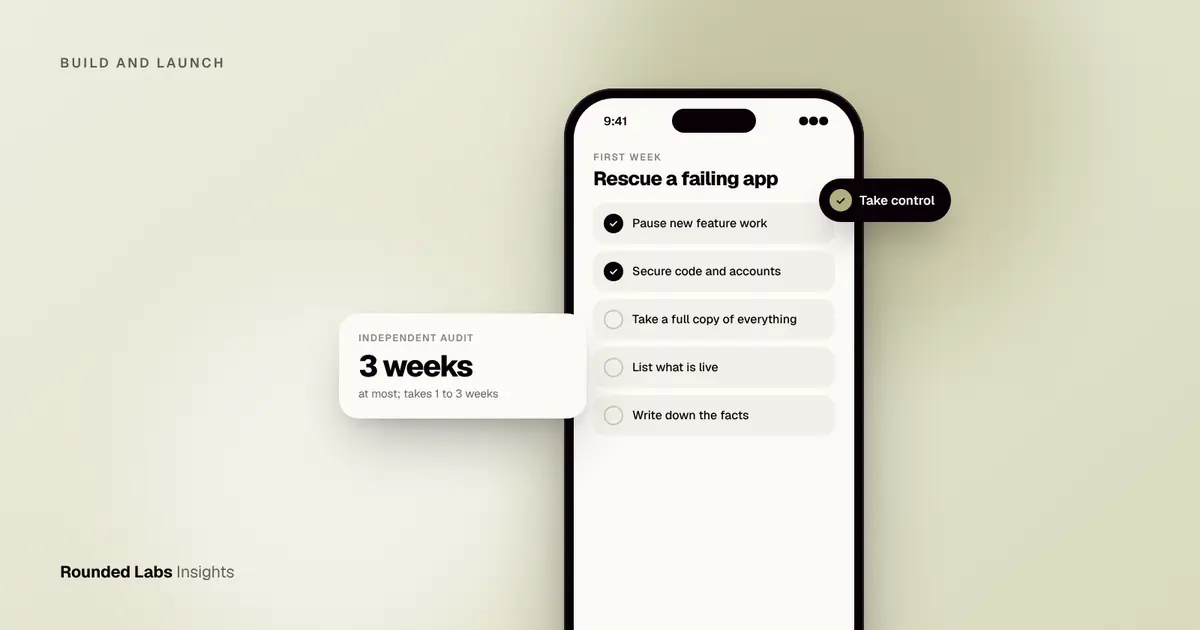
To rescue a failing app project, freeze new features, secure your code and accounts, get an independent audit of what exists, then choose to refactor, rebuild part of it or change supplier. A paid assessment usually takes 1 to 3 weeks and costs roughly £5,000 to £10,000 (a market estimate, not a quote), which is far cheaper than another six months of unmanaged spend.
Rounded Labs has been building, rescuing and modernising apps since 2007, including the Superdry app, which we modernised for a brand trading in 768 locations across more than 100 countries. The pattern is nearly always the same: the project did not fail suddenly, it drifted. This guide covers the warning signs, a 30-day recovery plan, how to decide between repair and rebuild, what a rescue costs, how to deal with the old supplier and how to avoid a repeat. Our services page lists the audit and rescue work we do. Where this guide touches on contracts and disputes it is general information, not legal advice, so take advice from a qualified lawyer before you act on a contractual point.
Key facts
- Most failing projects show warning signs months before the crisis: missed demos, vague status reports and no working software on a test device.
- The first priority is control: your code repository, app store accounts, cloud hosting and domain should be in your name.
- An independent audit of the code and plan takes 1 to 3 weeks and tells you whether to refactor, rebuild or stop.
- Partial rescues (fixing the worst modules) usually cost 20 to 50% of a full rebuild; these are market estimates, varying by app.
- Money already spent is gone either way. The only useful question is the cheapest route from where you are to a working product.
- Rounded Labs offers a Legacy App Rescue Assessment at a fixed price of £6,500, agreed before any work starts, and a Tech Architecture Audit at £7,500.
How do you know an app project is failing?
Failure rarely looks like one bad day. It looks like a run of small, explainable delays that never quite add up to a crisis, until one day you realise you have spent most of a budget and cannot show anyone a working app. Look for several of these together:
- No working build. You cannot install a recent version on your own phone.
- Moving dates. The launch date has slipped more than twice without a clear reason.
- Status without evidence. Reports say “80% done” but nothing new can be tested.
- Budget burn with no scope change. Spend is rising while the feature list is not.
- Bug counts grow. Every fix breaks something else, a sign of fragile code.
- Key people leave. Your lead developer or project manager has gone and nobody explains who replaced them.
- Defensive supplier. Questions about code access or hosting are met with delay.
Two or three of these is a conversation. Five or more is a rescue.
A quick scoring check
Score one point for each statement that is true today. This is a rough guide, not a diagnosis.
| Statement | Point |
|---|---|
| I cannot install a current build on my own device | 1 |
| The launch date has moved twice or more | 1 |
| I do not know who is working on my project this month | 1 |
| Progress reports use percentages, not demos | 1 |
| The supplier has asked for more money without a scope change | 1 |
| I do not have admin access to the code repository | 1 |
| Bugs seem to reappear after being fixed | 1 |
| The supplier is slow or vague when I ask technical questions | 1 |
| Nobody has written down what “done” means | 1 |
| I have lost trust that the plan is real | 1 |
A score of 0 to 2 means keep a close eye and ask for a demo. A score of 3 to 5 means you need an independent view soon. A score of 6 or more means act now: secure access and commission an assessment. How to tell if an app project is off track gives a longer early-warning checklist, and How to read an agency’s weekly report shows what honest reporting looks like.
Why do app projects fail?
Understanding the cause helps you choose the cure. Most failures have one or more of these roots.
| Root cause | How it shows up | What the rescue must change |
|---|---|---|
| Unclear scope | Constant disputes over what was included | Write a scope and acceptance criteria |
| No discovery | Big assumptions were never tested | Run discovery before spending again |
| Wrong architecture | Slow, fragile, hard to extend | Rebuild the affected layers |
| Weak engineering practice | No tests, no code review, no releases | Introduce automated tests and release routines |
| Poor communication | Surprises at every milestone | Fortnightly demos and written reports |
| Key person risk | One developer holds all the knowledge | Documentation and a second pair of eyes |
| Over-ambitious plan | Too many features for the budget | Cut to a version one that works |
| Supplier capability gap | Team lacks the skill the app needs | Change or add suppliers |
| Client-side delays | Late decisions, changing requirements | Agree decision times and a change process |
Notice that the last row is about you. Many failing projects have causes on both sides, and an honest assessment will say so. A rescue works best when the client treats the audit as a fact-finding exercise and not as an exercise in blame. Working with an app agency: the first 90 days describes how a healthy project should feel, and How to manage scope changes without blowing the budget covers the change process.
What should you do in the first week?
Do these in order, and do them before any argument about blame.
- Pause new feature work. Adding scope to a shaky base makes everything worse.
- Secure access. Confirm you hold admin rights to the code repository, Apple Developer and Google Play accounts, cloud hosting, analytics, push notification keys, domain and DNS. Read your contract on ownership; see Who owns the code?.
- Take a full copy. Export the repository, database backups, design files and documentation to storage you control.
- List what is live. Is anything in production? Are real users or payments affected? That decides how urgent fixes are.
- Write down the facts. Dates, payments made, milestones promised and delivered. You will need them for the audit and, if it comes to it, a dispute.
Do not start by sacking the supplier. You may need their help for a handover, and a calm exit protects your code. How to switch app agencies without losing your app covers the handover in detail.
An access checklist you can use today
| Asset | What to confirm | Who should own it |
|---|---|---|
| Source code repository | You are an owner or admin, not just a viewer | Your company |
| Apple Developer account | Your company is the account holder | Your company |
| Google Play Console | Your company is the owner | Your company |
| Cloud hosting (AWS, Azure, Google Cloud or other) | Billing and root access are yours | Your company |
| Domain and DNS | Registered in your name | Your company |
| Push notification keys and certificates | You hold copies | Your company |
| Third-party services (payments, maps, email) | Accounts are in your name | Your company |
| Analytics and crash reporting | You are an admin | Your company |
| Design files | You hold the source files, not only exports | Your company |
| Documentation and credentials | Stored in a shared password manager | Your company |
If anything on this list belongs to the supplier, ask for it to be transferred now, in writing and in a friendly tone, citing your contract. Do not wait until relations sour. For accounts you cannot transfer immediately, ask for you to be added as an admin and keep evidence of the request.
What does the first 30 days look like?
A rescue has a rhythm. This is the plan we recommend for a project that has lost control, whether you work with us or someone else.
| Days | Focus | Outputs |
|---|---|---|
| 1 to 3 | Stop and secure | Feature freeze; access list; full copies of code, data and design files |
| 4 to 7 | Gather facts | Contract, payment record, milestone history, bug list, user impact |
| 8 to 20 | Independent assessment | Code review, architecture review, security check, plan review |
| 21 to 24 | Options and costs | Report with refactor, partial rebuild and rebuild options, each priced |
| 25 to 27 | Decision | Choose the route; agree the supplier approach and exit terms |
| 28 to 30 | Mobilise | New scope and fixed price agreed; handover plan; first sprint set |
The plan assumes an assessment of two to three weeks, so the first build days of recovery work start in week five. If your app is live and customers are affected, add a stabilisation track in parallel: a short list of must-fix defects handled by whoever can safely change the code. How to take over an app built by someone else explains how a new team learns an unfamiliar codebase.
Talking to stakeholders
Everyone around the project needs to hear from you, and the message should be short and honest. Staff, investors, board members and customers do not need the technical detail. They need to know that you have identified problems, that you have taken control, when you will have a plan and when the next update is. Avoid promising a launch date until the assessment is done. A new date that slips again does more damage than a short, clear delay. How to get board approval for an app project is useful when you must ask for extra money.
What does an independent audit look at?
An audit gives you an honest view from someone with no stake in the old work. It should answer three questions: what exists, how good it is and what it would take to finish.
| Area | What the auditor checks | Typical finding |
|---|---|---|
| Code quality | Structure, tests, dependencies, duplicated logic | Out of date libraries, no automated tests |
| Architecture | Backend design, data model, scalability | A design that works for 100 users but not 10,000 |
| Security | Authentication, data storage, API exposure | Keys in the code, weak login handling |
| App store readiness | Compliance with Apple and Google rules | Missing privacy labels, unsupported OS versions |
| Plan | Backlog, scope against contract, estimates | Large unplanned areas still to build |
| Team and process | Releases, version control, documentation | One developer who holds all the knowledge |
The output should be a short written report with a clear recommendation and a priced plan. Our Tech Architecture Audit is £7,500 and our Legacy App Rescue Assessment is £6,500, both fixed price. For a code-only review, see How to audit an existing app’s code.
Not sure whether your project is salvageable? Tell us where it stands and we will give you an honest view before you spend anything more. Book a 30-minute call with a co-founder.
What good evidence looks like
A credible audit does not simply give an opinion. It shows what it examined and how. Expect to see:
- counts and examples, such as “41 of 63 dependencies are out of date, 6 with known security issues”;
- a view of test coverage, including whether any automated tests exist and whether they run;
- a sample of real code, with explanations a non-technical reader can follow;
- a description of how the app is built, deployed and hosted, including who can release it;
- a comparison of what the contract promised and what exists;
- a list of risks, rated by likelihood and impact;
- a plan with options, effort ranges and the assumptions behind them.
If a report is vague or full of jargon, ask for it to be rewritten. You are paying for a decision, and you must understand it. Technical debt is a common finding, and our explainer shows how to read that part of a report.
Do not skip the security check
Failing projects are often insecure ones, because security is among the first things squeezed when time runs out. Ask the auditor to look at how the app stores credentials, how it talks to the backend, what the API exposes and where secrets are kept. The OWASP Mobile Application Security project is the usual reference, and our guides to the mobile app security checklist and penetration testing for apps explain what a deeper test involves. If the app handles personal data, also read the guidance from the data protection authority in your country, such as the UK Information Commissioner’s Office, and for UK businesses the National Cyber Security Centre. A breach caused by an unfinished app is a bigger problem than a late one.
Should you refactor, rebuild or start again?
This is the central decision, and the audit evidence should drive it, not frustration.
| Situation | Usual best option | Why |
|---|---|---|
| Code is sound but unfinished | Complete and refactor | The foundation is worth keeping |
| Good backend, poor app screens | Rebuild the front end | Reuse the data layer and APIs |
| Fragile code, no tests, wrong architecture | Rebuild | Repairs cost more than starting clean |
| Product idea is unproven | Pause and run discovery | Fixing code does not fix a weak idea |
| Live app, real users, mounting bugs | Stabilise first, then phase the rebuild | Protect users while you plan |
A useful rule: if repair costs more than about 60% of a rebuild, rebuild, because you also get a codebase you understand. Rebuild or refactor sets out the cost side, and What happens in a discovery phase explains how to test the idea before spending again.
A decision score for repair or rebuild
Answer each question with yes or no, and count the yeses in each column.
| Question | Yes favours |
|---|---|
| Does the app architecture match what you need now? | Repair |
| Are there automated tests that run and pass? | Repair |
| Can a new developer build and run the app in a day? | Repair |
| Is the data model sound and the backend documented? | Repair |
| Are the libraries and frameworks supported and current? | Repair |
| Does fixing one bug often break something else? | Rebuild |
| Is key knowledge held by one person who has left? | Rebuild |
| Would the app need to scale well beyond its current design? | Rebuild |
| Is the framework unsupported or being retired? | Rebuild |
| Is security fundamentally weak, not just patchable? | Rebuild |
If repair has at least three more yeses than rebuild, repair. If rebuild has at least three more, rebuild. Anything in between points to a hybrid: keep the backend and data, rebuild the app layer, or rebuild one module at a time. A phased approach also spreads risk. What is technical debt? explains how a codebase gets into this state, and How to plan an app redesign helps if the main problem is the interface.
Keep what has value
Rebuilding is not the same as throwing everything away. Many valuable assets survive a rebuild: the product idea, user research, designs, the data model, API contracts, copy, test cases, brand assets and customer accounts. Ask the auditor which pieces are worth keeping, and write the list into the new scope. Moving existing users to a new version needs its own plan; see How to migrate users to a new app version.
A worked example: the half-built delivery app
A UK business paid £90,000 over nine months to a supplier for a customer ordering and delivery app. The launch has slipped three times, the latest build crashes on older iPhones, and nobody can show the order flow end to end.
| Step | Time | Cost |
|---|---|---|
| Secure repository and store accounts | 2 days | Internal time |
| Independent rescue assessment | 2 weeks | £6,500 fixed |
| Finding: payments and ordering sound, driver screens poor, no tests | Report | Included |
| Rework driver screens, add tests, fix crashes | 8 to 10 weeks | £25,000 to £40,000 |
| Launch and monitor | 2 weeks | £3,000 to £6,000 |
Total new spend is roughly £35,000 to £52,000, against £90,000 to £130,000 for a full rebuild. The sunk £90,000 is gone either way; the question is only the cheapest route to a working product. These figures are illustrative market estimates, and your result depends on what the audit finds.
The same project with a different finding
Suppose the assessment found something worse: the order logic is spread across the app and the backend, there are no tests, the database design cannot handle more than a few hundred orders a day, and the libraries are unsupported. The advice changes.
| Option | Estimate | Result |
|---|---|---|
| Patch and launch | £15,000 to £25,000 | Launches, then fails under load; likely to cost more later |
| Phased rebuild, reusing designs and requirements | £60,000 to £110,000 | A codebase the team understands, with tests |
| Stop and rethink | Small | Right only if the business case is also in doubt |
In this case a rebuild is the cheaper route over two years, even though it looks more expensive today. The point of an independent assessment is that it lets you see the second table, not just the first. The total cost of owning an app over five years shows why the lowest short-term cost is not always the lowest overall.
What does a rescue cost?
All figures here are market estimates, not quotes, and depend heavily on the size and state of the app.
| Item | Typical market range | Notes |
|---|---|---|
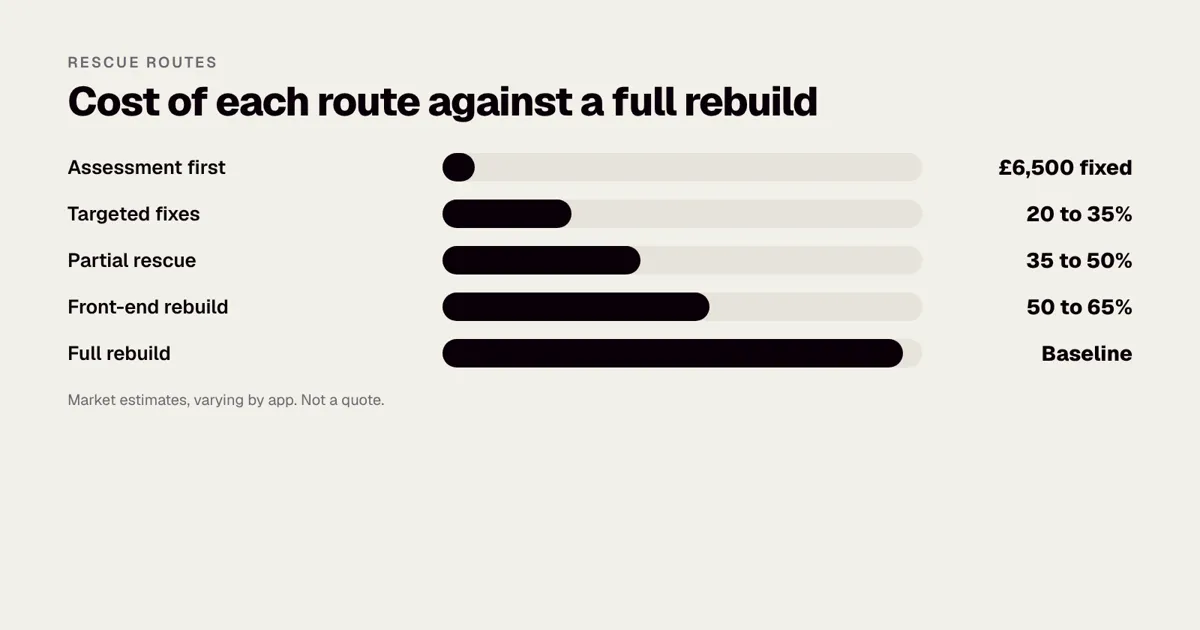
| Independent assessment | £5,000 to £10,000, 1 to 3 weeks | Rounded Labs: £6,500 fixed for the Legacy App Rescue Assessment |
| Targeted fixes to the worst modules | 20 to 35% of a full rebuild | Needs a sound base |
| Partial rescue and completion | 35 to 50% of a full rebuild | Reuses backend and much of the front end |
| Front-end rebuild on a good backend | 50 to 65% of a full rebuild | Common when the backend is sound |
| Full rebuild | 100% baseline | Choose when repair exceeds about 60% of rebuild |
| Legal advice on contract or dispute | Varies widely | Take early, before relations break down |
Rounded Labs projects are fixed price, agreed before development starts, and typically run from £30,000 to £250,000+. A rescue is no different: after the assessment, each phase has a written scope, a price and deliverables, so you never find yourself paying by the month for work you cannot see. The pricing page explains how this works. For a comparison of approaches, see Fixed price vs time and materials.
Where the money goes in a rescue
| Activity | Typical share of a rescue budget |
|---|---|
| Assessment and planning | 5 to 10% |
| Fixing foundations (architecture, security, tests) | 20 to 30% |
| Rebuilding or completing features | 40 to 50% |
| Testing and release | 15 to 20% |
| Handover and documentation | 5 to 10% |
Rescue budgets are often higher in testing than first-time builds, because the aim is to prove the app is sound, not to assume it. App testing explained covers what a proportionate test plan includes.
How do you deal with the old supplier?
Relations with the old supplier are the hardest part of a rescue for many founders, because trust has gone and money is at stake. Some principles help.
- Separate the product from the dispute. Recovering a working app and recovering money are different goals, and the first usually matters more.
- Stay factual and in writing. Send short emails that state what you need and by when. Keep a record of the replies.
- Ask for a structured handover. Request source code, documentation, credentials, build instructions and a call with the developers.
- Check the contract. Look at acceptance criteria, warranty periods, ownership of intellectual property, notice periods and dispute clauses. Who owns the code? explains the ownership questions.
- Do not threaten before advice. A letter that starts a dispute can end a handover. Take legal advice from a solicitor, for example through the Law Society in England and Wales, before you threaten action.
- Pay for delivered work, withhold carefully. Withholding payment can be justified or can put you in breach, so check before you do.
If the supplier is cooperative, a clean handover costs a few days. If not, a rescue team can work from the repository history, the live app, the hosting setup and your designs, and so the first week’s access and copies are the most valuable thing you do. 20 questions to ask an app developer before you sign will help you avoid a repeat, and Red flags when hiring app developers lists the signals you may now recognise.
How do you choose a rescue partner?
Be wary of anyone who quotes a rebuild before reading your code. A good partner will:
- Review the code and give a written assessment first, for a fixed fee.
- Show recent rescue or modernisation work you can verify, such as the Superdry app or the Waterstones app, mobile site and eBooks API delivered in 12 weeks.
- Quote fixed prices for each phase, with the deliverables listed. Compare approaches in Fixed price vs time and materials.
- Agree your ownership of the code and accounts in writing.
- Work in short releases, so you see working software every two weeks.
- Be willing to tell you when the right answer is not to hire them, or not to build at all.
If you would like a second opinion first, talk to a co-founder. For checks that apply to any supplier, use How to choose an app development company in the UK, What a good app development proposal looks like and How to brief an app development agency.
Questions to ask a rescue partner
| Question | A good answer sounds like |
|---|---|
| How will you decide between repair and rebuild? | “From the audit evidence, with options and prices side by side” |
| Who will do the work? | Named people and their experience |
| What will I see and when? | A working build every two weeks, with demos |
| What do I own at the end? | Code, designs, accounts and documentation, in writing |
| How do you price? | A fixed price for a written scope |
| What are the biggest risks? | Specific ones, with how they will be reduced |
| What will you not do? | A clear boundary, such as not changing scope without a priced change |
| Can I speak to someone you rescued? | Yes, or a verifiable example |
Our own experience includes modernising Superdry, building the UK’s first mobile banking app for MoBank before the iPhone, delivering for German enterprise software company Cubeware, and the AI land classification work for the Bavarian government. That range is why we are comfortable looking at an unfamiliar codebase, but it does not replace evidence about your own app. The audit is where that evidence comes from.
What if the app is already live?
A live app complicates a rescue, because users, revenue and reputation are at stake. The rule is to protect users first, then fix the system.
- Keep it running. Do not take down a working app to start a rebuild.
- Triage defects. Sort bugs into crashes and data loss, payment or login failures, and everything else. Fix the first two groups immediately.
- Add monitoring. Install crash reporting and basic analytics if you do not have them, so you can see what users experience.
- Freeze risky changes. Limit releases to fixes you can test.
- Watch store compliance. Apple and Google can remove apps that no longer meet their rules, and a rejected update can strand a live app. Review the Apple App Review Guidelines and Google Play Console Help for what is required, and see Why Apple rejects apps.
- Plan a parallel rebuild if the audit says so, and migrate users once the new version is ready.
For a public-sector app, the GOV.UK Digital Service Standard is a useful measure of what good looks like, including how to run a service in live, even if it does not formally apply to you.
Which scenario looks most like yours?
These are illustrative scenarios, not clients, and the numbers are market estimates.
A start-up with a half-built MVP
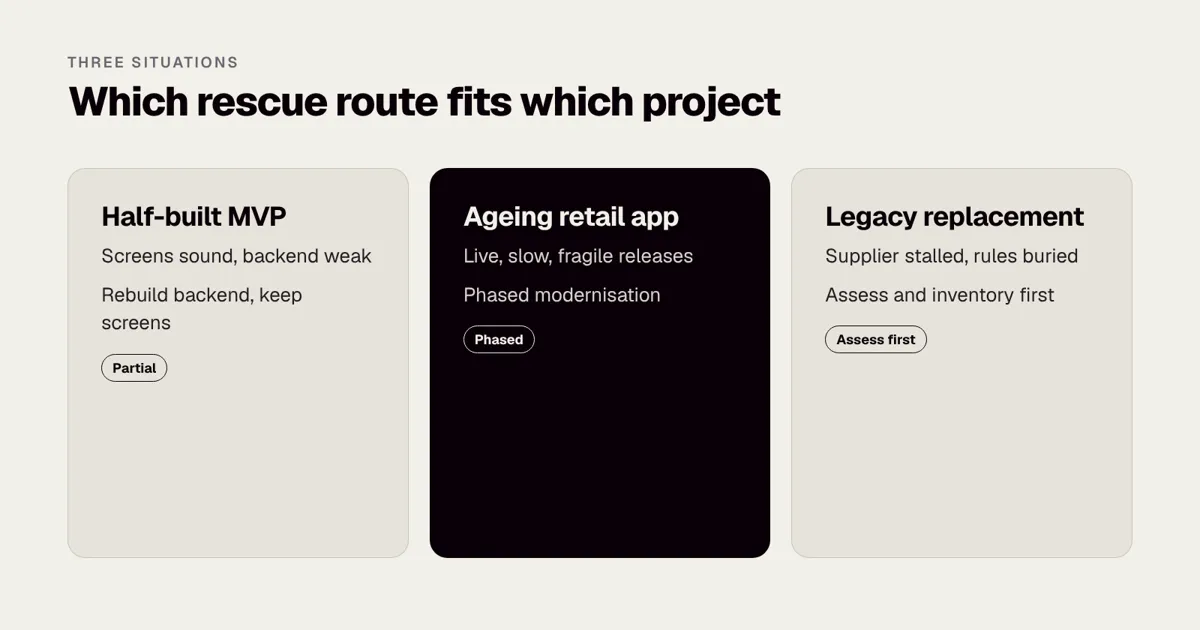
A seed-funded founder has spent £60,000 and has an app that works on the developer’s phone only. The assessment finds sound screens but a backend that cannot be hosted reliably. The recommended path is to rebuild the backend on a managed service, reuse the screens, and cut scope to the core journey. New spend is £25,000 to £40,000, and the founder uses a short test to confirm users want the first version. See What is an MVP? and How to validate an app idea before you spend £50k.
A retailer with an ageing app
A retailer’s app, built several years ago, still takes orders but is slow, and each fix causes new bugs. The audit shows an unsupported framework and no tests. The best route is a phased modernisation: keep the live app stable, rebuild the checkout and account areas first, then migrate the rest. We took a similar phased approach to the Superdry app. For wider context, see Retail app features that drive sales.
A business replacing a legacy system
A company’s old desktop software is being replaced by an app, and the supplier has stalled. The key risk is data migration and the business rules buried in the old system. The first step is an assessment of the legacy system and an inventory of rules, before any new build. Turning legacy software into SaaS covers the pattern.
How do you stop it happening again?
- Ask for working software every two weeks, installable on your own device, and run a short demo each time (How to run a sprint demo).
- Hold a paid discovery phase first so scope and risks are written down.
- Keep ownership yours: repositories, store accounts and hosting in your company name from day one.
- Pay against milestones tied to delivered features, not elapsed time.
- Hold a monthly independent check on larger projects, a short review of code and plan by someone outside the delivery team.
- Write down what done means for each feature, so acceptance is not an argument.
- Insist on automated tests and a release pipeline, which make drift visible; see What is CI/CD for apps?.
- Name one decision maker on your side who answers questions within an agreed time.
How to write an app specification gives you a way to define scope, and How to give useful feedback on a test build makes your side of the process faster.
What should the recovery contract and plan contain?
A rescue is a fresh start, and it is the moment to fix the weaknesses of the first agreement. Whoever you work with, ask for these items in writing before the first recovery sprint starts.
| Item | What it should say |
|---|---|
| Scope | A feature-by-feature list of what will be delivered, and a list of what will not |
| Acceptance criteria | How each feature will be judged complete, in terms you can test on a device |
| Price | A fixed price per phase, agreed before development starts, with deliverables listed |
| Milestones | Dates tied to working software you can install, not to elapsed time |
| Ownership | Code, designs, accounts and documentation belong to you from the first day |
| Change process | New requests are priced and agreed in writing before work begins |
| Reporting | A demo and a short written update every two weeks |
| Exit terms | What happens if either side ends the arrangement, including handover of code |
| Quality | Automated tests for key flows, a security review and a release checklist |
A short first phase is wise. Many rescues begin with a four to six week stabilisation phase with a small fixed price, and a decision point at the end. If the evidence shows the new team is delivering, you commit to the next phase. If it does not, you have limited your exposure and you still own what was produced. This staged approach is also kinder to cash flow, because you are never funding months of work you cannot see.
What to track during the rescue
Keep a one page dashboard that you update every fortnight. It should show:
- what was demonstrated working this fortnight, with a short recording or a build you installed yourself;
- the number of open defects by severity, and whether the trend is falling;
- the share of key journeys covered by automated tests;
- spend to date against the fixed price for the phase;
- the three biggest risks and who owns each;
- decisions you need to make and by when.
These are simple measures, but they restore something the failing project lacked: visible evidence of progress. If a number cannot be produced, that is itself a finding. How to read an agency’s weekly report explains how to challenge a report that offers percentages without proof.
How do you protect your team and your business during a rescue?
A failed project hurts the people involved as well as the budget, and it is easy to lose good staff or customers in the middle of recovery. A few practical steps help.
- Appoint one internal owner. Someone with authority should speak for your business, answer questions within a day or two and make scope decisions. Rescue projects that need a committee for every choice stall again.
- Be clear about what you can and cannot say to customers. If an app is live, a short note about planned improvements is usually better than silence, but do not promise features or dates until the plan is firm.
- Protect knowledge. Ask for the old team’s documentation, notes and diagrams while people are still available, and record a handover call. Knowledge loss is one of the largest hidden costs of a failed supplier relationship.
- Keep morale up on your side. Internal staff who sponsored the project may feel exposed. Frame the rescue as fixing a process problem, and share early wins such as the first working build on a real device.
- Check your insurance and funding conditions. If the app was funded by a grant or investor with conditions on delivery, tell them early and take advice on any obligations. Honest early notice usually goes better than a late surprise.
When is the right answer to stop?
Sometimes the honest finding is that the product should not continue. Signals include a product idea that users showed no interest in, a market that has moved, a cost to complete that exceeds the value of the opportunity, or a team without the capability to deliver and no budget to replace it. Stopping is not a failure of the rescue; it is the result of an assessment that spared you from throwing good money after bad. A short paid discovery, such as our fixed-price Mobile Product Discovery Sprint at £9,500, is a sensible way to test whether the idea deserves a second attempt before you commit to a rebuild. If you do stop, take the assets with you: designs, research, data and code remain yours and may support a later restart.
What mistakes make a rescue worse?
| Mistake | Why it hurts | Better approach |
|---|---|---|
| Sacking the supplier on day one | You lose knowledge and may lose access | Secure access first, then manage the exit |
| Adding features during the rescue | The base gets shakier | Freeze scope until the plan is agreed |
| Letting the old supplier mark their own homework | No independent view | Commission an independent audit |
| Choosing a rebuild before reading the code | May discard good work | Decide from evidence |
| Hiring on the lowest price alone | Repeats the same failure | Compare scope, evidence and fixed prices |
| Ignoring the product question | Fixed code does not fix a weak idea | Test demand before spending again |
| Keeping stakeholders in the dark | Trust falls and funding is at risk | Short, regular, honest updates |
| Skipping tests on the rescue itself | Problems return | Make tests part of the scope |
| Forgetting users on the live app | Reputation damage | Protect live users first |
What should you do next?
- Run the scoring check above and write down the facts.
- Secure your code, accounts and hosting this week, using the access checklist.
- Freeze new features until the assessment is complete.
- Commission an independent assessment, from us or from another supplier you trust.
- Choose repair, partial rebuild or rebuild based on the evidence and the decision score.
- Agree a fixed price and a written scope for each phase, with a demo every two weeks.
If you would like to talk it through first, book a call with a co-founder. We will tell you honestly whether we think the project is salvageable, and what we would look at first.
Frequently asked questions
How long does it take to rescue a failing app?
An assessment takes 1 to 3 weeks. Recovery work then runs from about 6 weeks for targeted fixes to 6 months or more for a substantial rebuild, depending on size and what the audit finds. Phasing the work means you see working software earlier.
Can I get my money back from the failed supplier?
Sometimes, but it is slow and uncertain. Check your contract for acceptance criteria, warranty and dispute terms, keep a record of milestones, and take legal advice before you threaten action. Most founders find it faster to recover the product first and pursue any claim in parallel.
Do I need the original developers' help?
It helps, mainly for knowledge transfer: how the app is built, where it is hosted and what is left undone. If the relationship has broken down, a good rescue team can work from the code, the repository history and the hosting setup alone.
Is it worth saving an app built on old technology?
Only if the core logic and data are valuable. Often the answer is to keep the backend and data and rebuild the app layer on a current framework, which preserves what works. The audit should show which parts are worth keeping.
What if I do not have the code at all?
Ask the supplier for it in writing, quoting your contract. If it is withheld, take legal advice quickly. Without code you may have to rebuild from the live app, your designs and your specification, which is slower but possible.
Should I stop paying the supplier while we investigate?
Be careful. Withholding payment can strengthen or weaken your position depending on the contract, and it can also provoke the supplier to cut off access. Get access and copies first, then take advice on payments, and pay for work that is clearly delivered.
How do I know the audit is independent?
Choose an auditor who is not hoping to win the rebuild on a time-and-materials basis, or at least one who prices the assessment separately and gives you a report you can take to other suppliers. A fixed-fee assessment with a written report is the clearest signal.
Can a failing project be saved without extra money?
Occasionally, by cutting scope and fixing the process. If the base is sound and the plan was the problem, you may only need to reset priorities. But a project that has lost control usually needs some new spend, and the assessment tells you how much.
Official sources and further reading
Talk it through with one of our co-founders. 30 minutes, no pressure.