

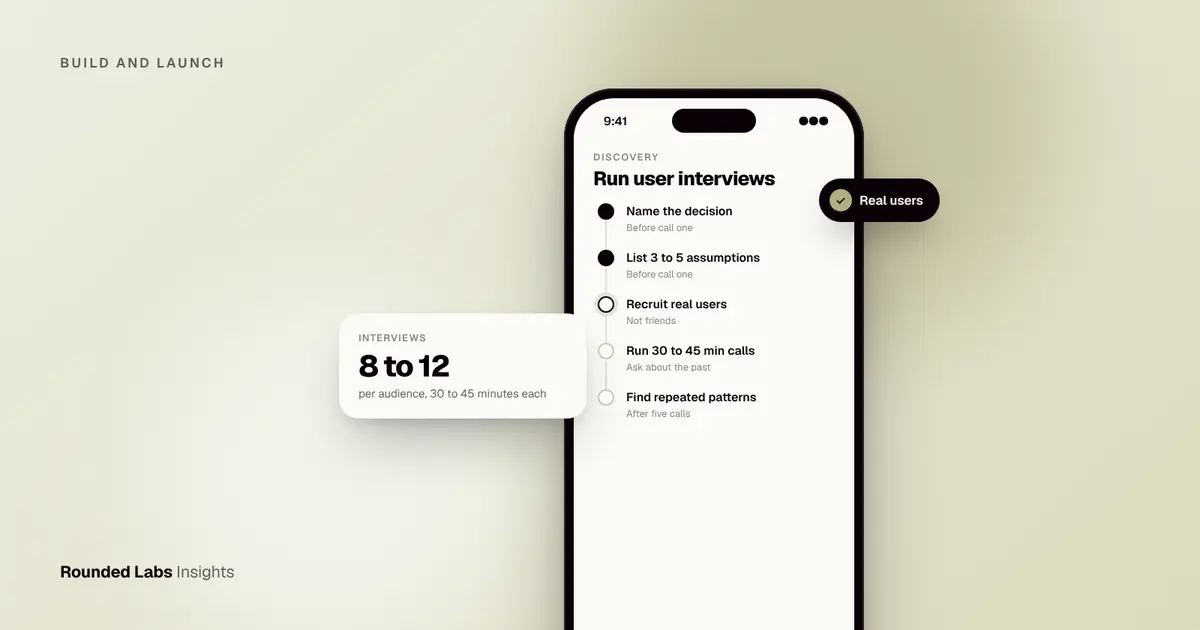
Run 8 to 12 interviews of 30 to 45 minutes each with people who have the problem your app solves, ask about what they did last time rather than what they would do in future, and look for repeated patterns across at least five people before you commit to features. It costs a few days of effort and a small thank-you fee, and it is far cheaper than building the wrong thing.
We take founders through this before any design starts, including on Dabbl, a trading app aimed at first-time investors, where understanding how nervous beginners actually think shaped the product. Rounded Labs has been building apps since 2007, and the projects that go well almost always began with someone listening carefully to real users. This guide covers who to talk to, how to write questions, how to run the call, how to analyse what you hear and how to turn it into scope decisions. It is a core part of our product and discovery services.
Key facts
- Eight to twelve interviews are usually enough to see strong patterns in one customer group, and five often show the biggest problems.
- Ask about past behaviour and real examples. Opinions about imagined features are unreliable.
- Interview people who match your target user, not friends, family or colleagues.
- Keep each call to 30 to 45 minutes and record it only with clear consent.
- Write down the decision each interview round should inform, before you book the first call.
- A typical budget is £0 to £1,500 for recruitment and thank-you payments (about $0 to $1,900, or €0 to €1,700), plus your time. This is a market estimate, not a quote.
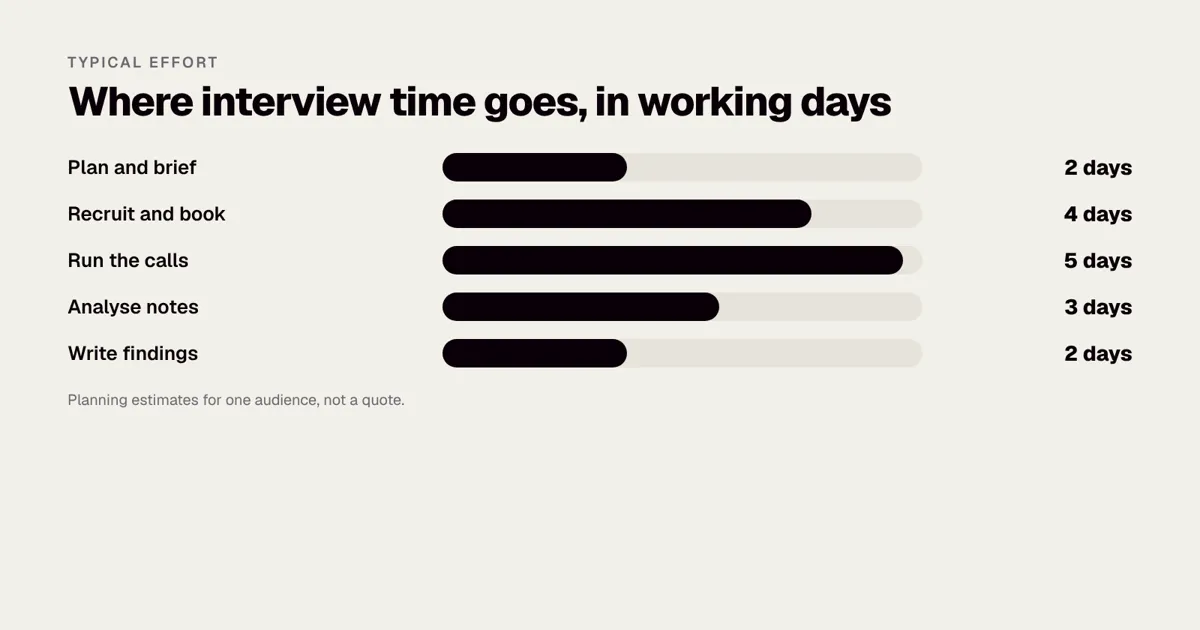
- Allow about two to three weeks from first plan to a written summary.
Why interview users before you build?
An app idea is a bundle of guesses: who has the problem, how often it happens, how people cope today and whether they would change their habits for a new tool. Interviews test those guesses while changing them still costs nothing. A wrong guess found in week one costs an afternoon. The same guess found after launch costs a rebuild, a marketing reset and, often, the goodwill of early users.
There are three things interviews do better than any other method at this stage.
- They reveal the real problem. Founders often describe a solution (“an app that books appointments”) when the underlying problem is something else (“our receptionist spends two hours a day on the phone and still gets double bookings”). The problem decides what to build.
- They show the current alternative. Your real competitor is rarely another app. It is a spreadsheet, a WhatsApp group, a paper diary, a favour from a colleague or doing nothing. You can only beat an alternative you understand.
- They give you language. The words people use to describe their frustration become your app store listing, your onboarding copy and your first advert.
Interviews are not a replacement for other validation. They tell you why people behave as they do. Landing pages and prototypes tell you whether they will act on it. For the wider process, see How to validate an app idea before you spend £50k and How to test demand with a landing page.
When are interviews the wrong tool?
Interviews are weak at three jobs, and it helps to know where to stop.
- Predicting demand. Eight people saying they would use something does not mean eight people will download it. Use a landing page test or a pre-sale for that.
- Measuring size. Ten conversations cannot tell you how many people have the problem. Public data and surveys do that. Our guide to sizing your opportunity in the UK using public data covers it.
- Judging design details. Whether a button is easy to find is a usability question, not an interview question. Use a usability test on a budget once you have something to show.
Think of interviews as the front of a sequence: understand the problem, size it, test demand, then test the design.
How do interviews compare with other research methods?
| Method | Best question it answers | Typical effort | Weakness |
|---|---|---|---|
| One to one interviews | Why do people behave this way? | 2 to 3 weeks | Small samples, no size estimate |
| Survey | How many people share this view? | 1 to 2 weeks | Shallow answers, hard to probe |
| Landing page test | Will people take a step towards this? | 1 to 2 weeks | Tells you what, not why |
| Observation or shadowing | What do people really do, not just say? | 1 to 2 weeks | Needs access, time intensive |
| Prototype usability test | Can people use this design? | 1 to 2 weeks | Needs something to show |
| Analytics on an existing product | What do users do in the app today? | Ongoing | Only works once you have users |
What should you decide before the first call?
Write down three things on one page before you recruit anyone.
- The decision at stake. For example, “Should version one be for clinic managers or for receptionists?” or “Is booking or reminders the main problem?” A decision has at least two possible answers, and you should be willing to be surprised.
- The assumptions you want to test. Three to five is plenty, such as “People double book because paper diaries are shared.” Phrase each one so it could be proven wrong.
- The person you want to hear from. Describe them by behaviour, not age or job title alone: “Has booked a tradesperson in the last three months and was unhappy with the process.”
If you cannot name the decision, the interviews will produce a pile of interesting comments and no direction. Many founders skip this page because it feels bureaucratic. It takes thirty minutes and it is the single biggest predictor of useful findings.
What does a good one page research brief look like?
| Heading | Example for a home services app |
|---|---|
| Decision | Do we build for homeowners first, or for tradespeople first? |
| Assumption 1 | Homeowners struggle to find someone reliable for small jobs |
| Assumption 2 | Tradespeople lose jobs because they reply too slowly |
| Assumption 3 | Both sides would pay a small fee for guaranteed attendance |
| Who to hear from | Homeowners who hired a tradesperson in the last 90 days; sole traders with up to three staff |
| Number of calls | 8 homeowners, 8 tradespeople |
| What would change our mind | If most tradespeople already have a full diary through word of mouth |
That last row matters. Agreeing in advance what would change your mind protects you from reading every answer as support.
Who should you recruit, and how many?
Aim for people who have recently done the thing your app helps with. Recent experience means they remember details rather than guessing. Someone who booked a plumber last week can tell you what happened. Someone who “might” book one next year can only tell you what they imagine.
| Source | Good for | Watch out for |
|---|---|---|
| Your own customers or email list | Existing businesses adding an app | They already like you, so ask them to be critical |
| LinkedIn or industry groups | Business and professional apps | Low reply rates, so message 40 to get 8 |
| Online communities and forums | Hobbies, health, parenting, finance | Read the group rules before posting |
| Recruitment panels | Consumer apps when speed matters | Screen carefully so you do not get professional respondents |
| Intercepts at the place of use | Retail, venues, transport | Keep it short and ask permission |
| Referrals from earlier interviewees | Hard to reach groups | Referrals come from similar people, so mix in other sources |
How do you write a screener?
A screener is a short form, usually three to five questions, that decides who you book. Good screeners ask about behaviour and avoid revealing the answer you want.
- Ask about a recent event. “In the last three months, which of these have you done?” with a list that includes things you do not care about.
- Include a disqualifier that is not obvious. If you want people who have not used an existing product, list several products and see who ticks which.
- Collect only what you need. Name, contact method, and the answers that decide fit. Do not ask for data you will not use.
- Check for professional respondents. If someone claims to use every product in a category, treat the answer with caution.
What do you say in the invitation?
Keep the message short, honest and specific. Here is a structure that works for both email and direct message.
- Say who you are and what you are doing: “I am researching how people arrange small home repairs.”
- Say it is not a sales call: “I am not selling anything.”
- Say how long it takes and what they get: “30 minutes by video, with a £40 voucher as thanks.”
- Make it easy to reply: a link to book a slot, or a single yes or no.
How much should you pay participants?
Offer a thank-you of roughly £25 to £75 (about $32 to $95, or €29 to €87) per 30 to 45 minute session for consumers, and more for senior professionals, whose time is worth more and who are harder to reach. These are market estimates and vary by audience. Vouchers are simpler to administer than cash. If your participants are public sector employees or work for companies with gift rules, check what they are allowed to accept.
How many interviews do you need?
Plan for eight to twelve interviews per audience. If you have two quite different audiences, such as buyers and daily users, treat each as its own set. The reason for these numbers is practical: after the first five or six calls most of the dominant themes have appeared, and the remaining calls confirm them, add detail and uncover less common cases. Stop early if the last three calls told you nothing new. Continue if each call still surprises you.
| Situation | Suggested number of calls |
|---|---|
| One clear audience, one clear problem | 8 to 10 |
| Two audiences (for example buyer and user) | 6 to 8 for each |
| Marketplace with supply and demand sides | 8 for each side |
| Very specialist audience, hard to reach | 5 to 6, plus follow ups |
| Exploring a vague area with no clear problem | 10 to 15, in two rounds |
What about business to business (B2B) interviews?
Business apps add a wrinkle: the person who uses the product, the person who buys it and the person who signs it off may be three different people. Interview all three. The user tells you about daily friction. The buyer tells you what budget exists and what needs to be proven. The approver tells you which risks stop deals, such as security reviews or data location. Ask each one about the last time something similar was bought, who was involved and what nearly stopped it.
How do you write good interview questions?
The most common mistake is asking people to predict their own behaviour. “Would you use an app that does this?” almost always gets a polite yes. People are not lying. They are being kind, and they cannot easily imagine the effort of changing a habit. Instead, ask about the last time something happened.
| Weak question | Better question |
|---|---|
| Would you pay for an app like this? | What do you use today, and what does it cost you in money or time? |
| Do you find booking annoying? | Tell me about the last time you booked one. What happened first? |
| What features would you want? | What did you try when that did not work? |
| Would you recommend it to friends? | Who else was involved, and how did you tell them? |
| How often do you do this? | When did you last do it? And before that? |
| Is price important to you? | Tell me about the last time you compared prices. What did you do? |
What is a good running order?
A simple running order for a 40 minute call:
- Warm up (5 minutes). Explain you are learning, not selling, and that there are no wrong answers. Ask permission to record.
- Context (5 minutes). Their role or situation, in their words.
- The last time (15 minutes). Walk through a recent real example step by step. Ask “What happened next?” and “How did that feel?”
- Workarounds and money (10 minutes). Tools, spreadsheets, paid services and favours they use now.
- Close (5 minutes). “Is there anything I should have asked?” and “Who else should I talk to?”
Keep your idea out of the conversation until the end, if at all. The more you describe your solution, the more people will be kind about it. Our user interview script template gives a ready-made version you can adapt.
What follow up questions do you need?
Prepared follow ups are what turn a polite chat into useful evidence. Keep these on a card beside you.
- “Can you walk me through that step by step?”
- “What happened just before that?”
- “What did you do next?”
- “How did you feel at that point?”
- “Who else was involved?”
- “What did that cost you, in money or time?”
- “What else did you try?”
- “Why was that important?”
- “Can you show me?”
- “Is that typical, or was it unusual?”
What does a topic guide look like for different app types?
You are not reading from a script. A topic guide is a short list of areas, each with one or two opening questions and the follow ups above.
| App type | Topic 1 | Topic 2 | Topic 3 |
|---|---|---|---|
| Booking or scheduling | The last time they booked or took a booking | What goes wrong: double bookings, no shows, delays | How they remind people and take payment |
| Internal staff app | A typical day, step by step | Where paper or spreadsheets are used | What happens when information is wrong or late |
| Retail or loyalty | The last time they bought in this category | How they compare, choose and return | What makes them go back to a shop or brand |
| Finance or investing | The first time they thought about this | What they were afraid of or did not understand | Who they asked for help |
| Health or wellbeing | When they last tried to change a habit | What helped or stopped them | Who supports them, and what they track |
Not sure which questions matter for your idea? We can help you choose the decisions to test and the people to ask before you spend anything on design. Book a 30-minute call with a co-founder.
How do you handle sensitive topics?
Money, health, family and work performance can be uncomfortable. Tell people they can skip any question or stop at any time. Ask about behaviour in neutral terms (“How do you keep track of what you owe?”) rather than judgements (“Are you bad with money?”). If someone becomes upset, slow down, acknowledge it and offer to move on. Do not push for detail you do not need. If your product involves health, finance or children, plan extra care with consent and data, and consider getting professional advice on your approach.
How do you run the call itself?
- Get consent first. If you record audio or video, say so, say why, say who will hear it and how long you will keep it. In the UK and EU, recordings of identifiable people are personal data under UK GDPR or GDPR, so keep them secure and delete them when you are done. The ICO’s guidance for organisations is a good starting point. In the US, state recording laws vary, and some require all parties to consent, so ask on the record. This is general information, not legal advice.
- Talk less than 20% of the time. Use silence. People often fill a pause with the most useful detail.
- Ask for stories, not summaries. “Can you show me?” beats “How do you usually do it?”
- Follow the emotion. If someone sighs or laughs, ask why.
- Do not defend the idea. If they criticise it, thank them and ask what they would do instead.
- Take notes or use a second person. One person asks, one writes. If you are alone, record and note timestamps.
Should you interview in person or by video?
Both work. Video is cheaper, easier to schedule and lets you reach people in other regions. It also lets you record cleanly and ask people to share their screen to show a tool or spreadsheet. In person is better when the context matters, such as a shop floor, a van, a clinic or a kitchen, because you see the environment and the workarounds that people forget to mention. Where it is practical, visiting the place of use for two or three of your calls is worth the travel.
What does the person taking notes do?
Having a second person helps because the interviewer can concentrate on listening. The note taker records direct quotes, timestamps for key moments, observations about behaviour and any questions that were skipped. They should stay silent until the end, when they can ask one or two follow ups. If you are on your own, record the call, jot down only keywords while talking, and write up the full notes within 24 hours while memory is fresh.
What should you do if the interview goes badly?
| Problem | What to do |
|---|---|
| Participant gives one word answers | Ask for a specific example: “Tell me about the last time” |
| Participant keeps asking about your app | Say you will explain at the end, and return to their story |
| Participant wanders off topic | Let them go a little, then link back: “That is interesting. How does it affect the booking?” |
| Participant is a poor fit | Finish politely, thank them, pay them, and exclude the notes from your count |
| Technical failure | Reschedule once, and keep a phone or backup tool ready |
| You catch yourself leading | Stop, say “Let me ask that differently”, and repeat the question neutrally |
How do you turn interviews into decisions?
Within 24 hours of each call, write down the three most important things you heard, using the person’s own words where possible. After all calls, put those notes on one sheet and group similar points. Many teams do this with sticky notes or a shared spreadsheet, with one row per observation and one column per participant.
How do you analyse the notes step by step?
- Extract observations. Go through each transcript or note set and pull out single facts: “Wrote quote by hand in the van”, “Lost job because replied after two hours”, “Uses WhatsApp to confirm times”.
- Tag each one. Use simple tags such as problem, workaround, trigger, emotion, cost and tool.
- Group similar items. Move observations next to each other until a theme appears, then name it in a short sentence.
- Count the participants, not the mentions. A theme that one person repeats ten times is still one person.
- Rate each theme using the scoring approach below.
- Write the findings page. One page, themes in order of strength, each with two or three real quotes.
How do you score what you found?
A simple scoring approach works well:
- Frequency: how many of your interviewees mentioned it?
- Severity: did it cost them money, time or embarrassment, or was it a mild irritation?
- Current workaround: are they already paying or working hard to solve it?
| Theme | Mentioned by | Severity | Workaround | Verdict |
|---|---|---|---|---|
| Quotes written up in the evening | 8 of 10 | High, costs jobs | Notes, spreadsheet | Version one |
| Customers choose whoever replies first | 6 of 10 | High | Phone on at all times | Version one |
| Invoicing is slow | 2 of 10 | Medium | Accountant | Later release |
| Wants a shared calendar | 0 of 10 | None raised | None | Leave out |
A problem mentioned by seven of ten people, with a costly workaround, belongs in version one. A problem mentioned by one person, however vividly, goes on a later list. This feeds directly into How to choose features for version one, and you can sort what remains with MoSCoW prioritisation.
How strong is your evidence?
Not all findings deserve equal trust. Use a rough ladder.
| Evidence | Strength |
|---|---|
| Someone paid money or gave significant time to solve the problem | Strong |
| Someone described a specific, recent event in detail | Good |
| Several people independently mentioned the same issue | Good |
| Someone said it is a problem but cannot give an example | Weak |
| Someone said they would use or pay for your solution | Very weak |
| Someone said it sounds like a great idea | Almost none |
A worked example
A founder wants an app for small plumbing firms to send quotes from site. She interviews ten firm owners. Eight describe writing quotes in the evening from notes, and six say they lose jobs because the customer chose whoever replied first. Only two mention invoicing as a problem. Nobody asks for a calendar. Her version one becomes quote capture on site, a photo attachment and a send button, and invoicing moves to a later release. She has saved the cost of two features nobody was asking for, and her launch message (“Quote before you leave the driveway”) comes straight from the interviews.
What do you do when people disagree?
Disagreement is information. If half your interviewees want one thing and half want the opposite, you probably have two segments. Look for what distinguishes the groups: company size, experience, how often they do the task, or the tools they already use. Then decide which segment you serve first. Trying to satisfy both in version one usually produces something that suits neither.
How do you share the findings?
A findings page should fit on one or two sides. Put the decision at the top, then the recommendation, then the three to five themes with quotes, then what you are still unsure about. Share it with the designer, the developer and anyone who will fund the build. Keep the raw notes available, but do not expect others to read them. If you plan to brief an agency, our guide on how to brief an app development agency shows how research findings fit into a brief, and How to write an app specification shows how they feed requirements.
How do you go from findings to scope?
Findings are only useful if they change what you build. Work through this sequence.
- List the problems in order of strength using the table above.
- Write one outcome per problem. “Send a quote before leaving the customer’s driveway.”
- Turn each outcome into the smallest feature that delivers it. Not a full quoting system, but a template, a photo and a send button.
- Mark what you will not do yet. A visible “not now” list keeps the scope honest.
- Check against your assumptions. Which assumptions were confirmed, which were wrong, and which are still unknown?
- Decide the next test. Perhaps a landing page, perhaps a clickable prototype, perhaps another round of interviews with a different group.
If your findings point towards a minimum viable product, our guide to what an MVP is explains how to draw the line, and what happens in a discovery phase shows how this work fits into a longer process.
How did this approach shape a real product?
On Dabbl, the audience was first-time investors, people who were curious about trading but nervous about losing money and confused by jargon. A founder’s instinct in that situation is to add more charts, more order types and more data, because that is what existing trading apps do. Listening to beginners pointed the other way. The recurring themes were fear of making an irreversible mistake, uncertainty about what words meant and a wish for the app to feel calm rather than urgent. Those themes become design principles: plain language, clear confirmation before anything costs money, and an interface that does not shout.
You do not need a trading app to apply the lesson. The questions that mattered were the ones about emotion and past behaviour: what did you do the first time, what stopped you, who did you ask. Those are available to any founder with a notepad and a willing participant.
What if your audience is hard to reach?
Some groups, such as senior clinicians, procurement officers or business owners with full diaries, rarely answer cold messages. Try these routes.
- Go through someone they trust. A trade association, a supplier, a former colleague or a customer who can make a warm introduction.
- Offer short slots. Fifteen to twenty minutes by phone is easier to say yes to than forty-five by video.
- Meet them where they are. Conferences, trade shows and industry meetups give you ten conversations in a day.
- Pay properly. A senior specialist may expect £100 to £200 or a donation to a charity of their choice. These are market estimates.
- Be clear about confidentiality. Many professionals worry about naming their employer or clients. Say you will anonymise what they tell you.
How do you interview people who use assistive technology or have access needs?
If your app is for the public, some of your users will rely on screen readers, voice control, larger text or other support. Include them from the start. Ask how they would like to take part, offer phone or text options, send questions in advance if that helps and allow extra time. Their experience of apps today is some of the most useful evidence you can gather, because it shows where common patterns fail. Our guide to app accessibility and the European Accessibility Act explains why this also matters for compliance.
How do you handle stakeholders who disagree with the findings?
Founders, investors and senior colleagues often have strong views on what the app should do. Interview findings can feel like an attack on those views. A few habits help.
- Involve them early. Invite stakeholders to watch a call or read a transcript. Hearing a customer describe a problem is far more persuasive than a slide.
- Separate evidence from interpretation. Present what people said and did first, then your reading of it.
- Admit what you do not know. If ten calls cannot answer a question, say so and propose the next test.
- Frame it as risk reduction. “This feature has no evidence yet. Shall we test it cheaply before we build it?” is easier to hear than “this is wrong”.
- Keep a decision log. Record what you decided, the evidence behind it and the date, so you can revisit it later with new facts.
If a stakeholder remains convinced, treat it as an assumption to test, not an argument to win. A landing page, a prototype or a small pilot can often settle it in a fortnight. For how to present a case to people who control the budget, see How to build a business case for a mobile app and How to get board approval for an app project.
How often should you keep talking to users?
Interviews before building are the start, not the end. Once the app exists you will want to keep a light rhythm of conversations. Many teams book two or three short calls a month with a mix of new and long standing users. This keeps assumptions fresh as the market, competitors and your own product change. After launch, combine what people say with what they do by reading your analytics, and our guide to what to track from day one explains how. Ask for reviews and handle feedback thoughtfully, as described in How to get more app reviews and handle bad ones.
What mistakes should you avoid?
- Interviewing only friendly people. Include sceptics and people who have switched away from tools like yours.
- Treating one loud voice as the market. Count patterns, not volume.
- Asking leading questions. “Don’t you hate waiting?” will always get a yes.
- Skipping the follow up. The first answer is often a surface answer. Ask “Why?” or “Can you give me an example?” at least twice.
- Letting findings sit in notes. Share a one page summary with whoever will design and build, and keep the original quotes.
- Pitching in the middle. Once you start selling, people stop being honest.
- Running all calls in one day. You need time to reflect and adjust your questions between sessions.
- Recruiting by convenience. If everyone you speak to works in your industry, you may miss how outsiders see the problem.
- Hearing only what you hoped for. Write your assumptions down first, then look for evidence against them.
- Changing the question set every call. Small improvements are fine. Rewriting everything makes comparison impossible.
What ethical and legal points should you keep in mind?
Be honest about why you are asking. Tell people how you will use their answers, do not collect more personal data than you need, and let them withdraw. Store recordings securely, restrict who can access them and delete them when no longer needed. Do not interview children without proper safeguards and parental consent, and take advice if your topic is sensitive. Trade bodies such as the Market Research Society publish codes of conduct for research that are a helpful reference. Check the current official guidance for your country, as laws change. This is general information, not legal advice. The GOV.UK site lists current UK guidance on data protection and equality duties.
What does a two week interview plan look like?
| Days | Activity | Output |
|---|---|---|
| 1 to 2 | Write the research brief, topic guide and screener | One page brief, 10 questions |
| 2 to 5 | Recruit through two or three sources, book slots | 10 to 14 booked calls |
| 5 to 9 | Run the calls, two or three a day at most | Notes within 24 hours of each |
| 9 to 11 | Group observations, score themes | Theme sheet |
| 11 to 12 | Write the findings page and recommendation | One to two page summary |
| 12 to 14 | Share findings and agree next steps | Decision on scope or next test |
Rushing recruitment is the usual reason timelines slip, so start inviting people as soon as the brief is done.
What is the checklist before your first call?
- [ ] You have written the decision the interviews will inform
- [ ] You have three to five assumptions that could be proven wrong
- [ ] You can describe your target interviewee by behaviour
- [ ] You have a screener with three to five questions
- [ ] You have a consent wording that covers recording, storage and deletion
- [ ] You have a topic guide with a card of follow up questions
- [ ] You have a thank-you budget and a way to deliver it
- [ ] You have a second person or a recording tool for notes
- [ ] You have a place to store notes securely
- [ ] You have blocked time within 24 hours of each call to write up
Can an agency help, and what does it cost?
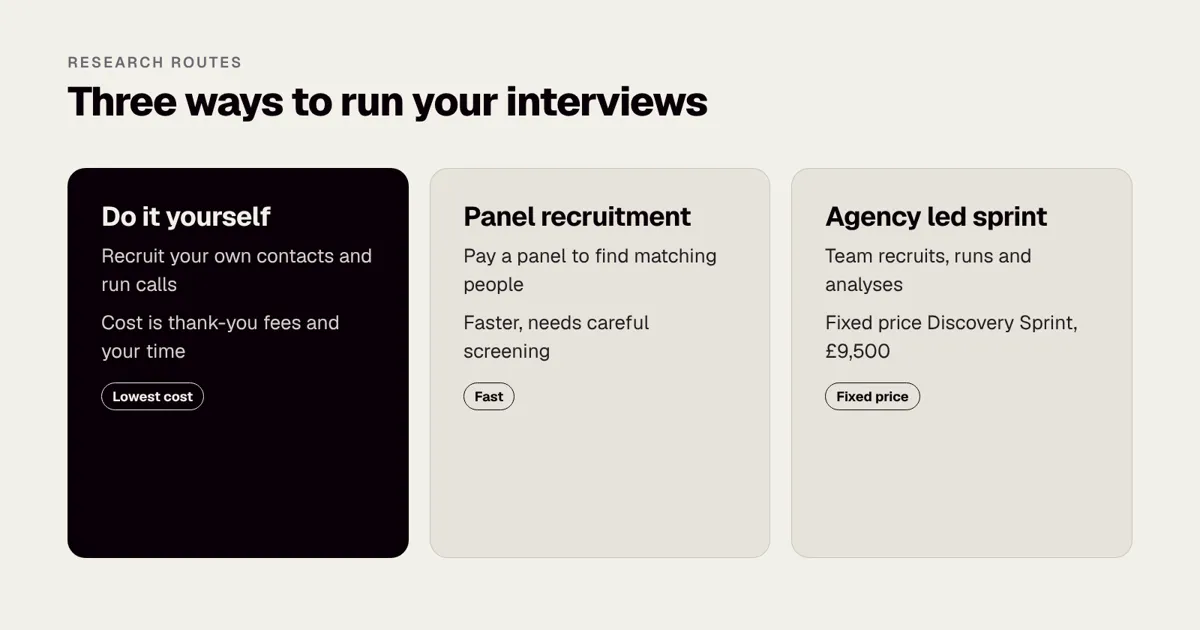
You can run interviews yourself for the price of some thank-you payments. If you want a team to recruit, facilitate and turn the findings into a scoped plan, that is part of our Mobile Product Discovery Sprint at £9,500. For some founders, the cheaper route is to run the first six calls alone and bring in help when it is time to turn findings into designs and a costed plan.
All our work is fixed price agreed before development starts, and projects typically run from £30,000 to £250,000+. Fixed price only works when the scope is understood, which is exactly what good interviews give you. See our pricing page for how this works, and Fixed price vs time and materials for app projects for why we work this way. If you want to see which route suits your idea, talk to a co-founder. You may also like to read how our approach worked on Waterstones, where an app, a mobile site and an eBooks API reached launch in 12 weeks.
Frequently asked questions
How many user interviews are enough?
For one audience, eight to twelve is a good target. Many of the biggest problems show up within the first five. Stop when new calls stop adding new themes, and continue if each call is still surprising you.
Can I interview friends and family?
It is best not to. They tend to be kind and agree with you, and they often do not match your target user. Use them to practise your questions, then recruit real users.
Should I show a prototype in the interview?
Not in the first round. Early interviews are about understanding the problem. Once you have a clear picture, a later round with a simple prototype can test whether your solution makes sense.
Do I need to pay participants?
Paying is fair and improves show-up rates. A voucher or fee of £25 to £75 for consumers is common, with more for specialists. Check the rules if you interview public sector staff, as some cannot accept payment.
How long should it take?
Allow about two weeks: a few days to recruit, a week of calls, and a few days to analyse. Rushing recruitment is the usual reason timelines slip.
What if nobody agrees to be interviewed?
Low response usually means the invitation is unclear or the audience is hard to reach. Shorten the message, increase the thank-you, and try a different source. Asking existing contacts to introduce you often works better than cold messages.
Can I use AI tools to transcribe or summarise calls?
They can save time, but check how the tool stores and uses the data before you upload anything with personal details, and tell participants if their recording will be processed by a third party. Always read the output yourself, because summaries can miss emotion and nuance.
Official sources and further reading
Talk it through with one of our co-founders. 30 minutes, no pressure.