

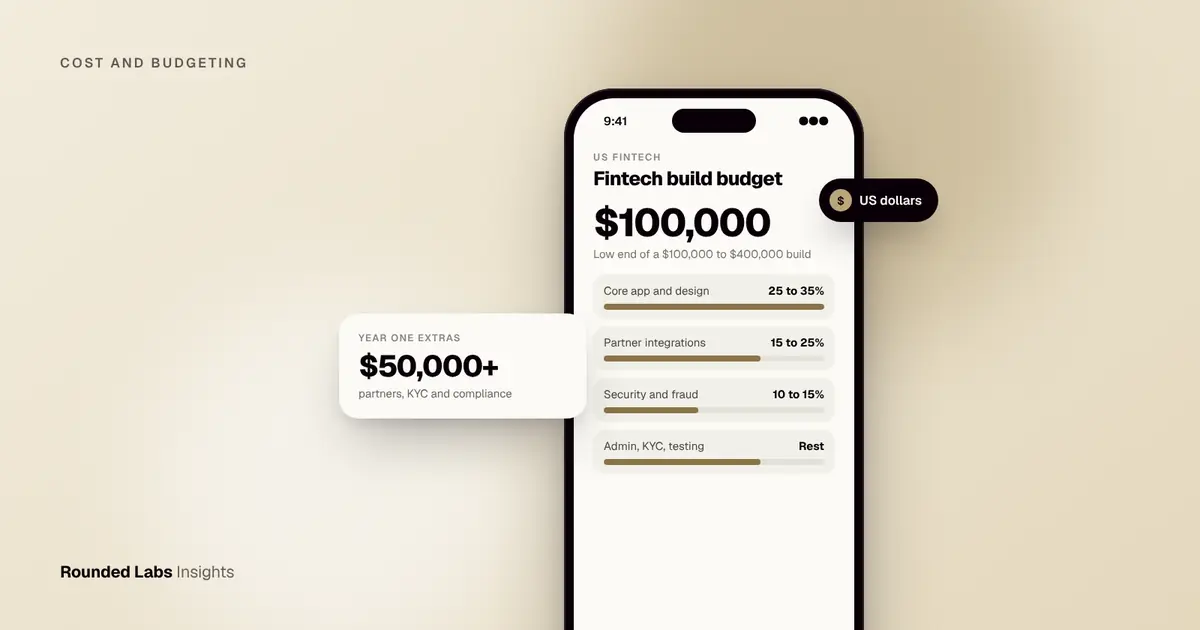
A US fintech app typically costs $100,000 to $400,000 to build, with simpler personal finance apps at the low end and card, banking or trading products at the high end. On top of the build, budget for partner set-up fees, identity verification and fraud tools, legal and compliance advice, and security assessments, which together often add $50,000 to $250,000 in the first year. All figures are market estimates.
We have built financial apps since MoBank, the UK’s first mobile banking app, and more recently Dabbl, a trading app for first-time investors. This guide breaks down US fintech costs in dollars: what each type of product costs, where the build budget goes, what you pay beyond the build, how partner choices change the total, and how to plan a realistic first year. All figures are market estimates for planning, not quotes, and partner and vendor prices change, so check each provider’s current pricing. Regulatory points are general information, not legal advice. For how these products are structured, see Fintech app development in the US.
Key facts
- Personal finance app with account linking: $80,000 to $220,000.
- Payments or wallet app via a licensed partner: $150,000 to $350,000.
- Card or spending account via a sponsor bank: $150,000 to $450,000.
- Investing or trading app via a broker partner: $180,000 to $500,000.
- First-year compliance, partner and tooling costs: often $50,000 to $250,000.
- Rounded Labs works to a fixed price agreed before development starts. Projects typically run £30,000 to £250,000+ (roughly $38,000 to $318,000 at recent exchange rates, which move).
- The biggest swing factor is not the screens. It is whether you hold money, move money or only read data, and which partner carries the licences.
What does a fintech app cost by type?
Cost depends first on what the product does with money. An app that only reads bank data and shows charts is a very different build from one that issues cards or places trades. The table shows typical ranges, split between UK studio pricing converted into dollars and US agency pricing. All are market estimates.
| Product | UK studio (in $) | US agency | Timeline |
|---|---|---|---|
| Budgeting and personal finance | $80,000 to $150,000 | $120,000 to $220,000 | 4 to 6 months |
| P2P payments or wallet (partner-led) | $150,000 to $250,000 | $200,000 to $350,000 | 6 to 9 months |
| Spending account and debit card (BaaS) | $150,000 to $300,000 | $220,000 to $450,000 | 6 to 10 months |
| Investing or trading (broker partner) | $180,000 to $350,000 | $250,000 to $500,000 | 7 to 12 months |
| Lending app | $150,000 to $300,000 | $220,000 to $450,000 | 6 to 10 months |
How much does it cost to build an app in the US? 2027 prices in dollars covers general US app costs, and How much does an MVP cost in the US? shows how a first version changes the picture. If you are comparing with the UK market, How much does a fintech app cost in the UK? puts the same categories in pounds.
Why do ranges look so wide?
A range of $150,000 to $450,000 for a card product can look unhelpful, so it is worth saying what moves a project within it.
- Who owns the ledger. If your partner holds accounts and balances, your app displays and instructs. If you hold your own ledger, the work grows sharply.
- How many user types. Consumers only is simpler than consumers, businesses and support staff each with different permissions.
- How many partners. Each integration (bank, card processor, KYC, data aggregator, fraud) needs building, testing and monitoring.
- How polished the experience must be. Custom animation and bespoke onboarding add cost but rarely add trust. Clear wording and fast response times do.
- Evidence for partners. Partners increasingly want to see audit trails, access controls and security testing before they go live with you.
Which kind of fintech are you building?
| If your product mainly… | Closest category | Main cost driver |
|---|---|---|
| Reads accounts and shows insights | Budgeting and personal finance | Data aggregator quality, categorisation, design |
| Moves money between people | P2P or wallet | Payment partner, limits, fraud rules, disputes |
| Holds money and issues cards | Spending account (BaaS) | Sponsor bank onboarding, card controls, ledger, support tooling |
| Buys and sells securities | Investing or trading | Broker partner, market data, suitability and disclosures |
| Offers credit | Lending | Underwriting rules, fair lending checks, servicing, collections |
If you are not sure which row you sit in, that is a useful finding in itself, and it is the sort of question a short discovery piece of work answers before you commit to a build. Our Mobile Product Discovery Sprint is a fixed-price £9,500 service (roughly $12,000) designed for exactly that.
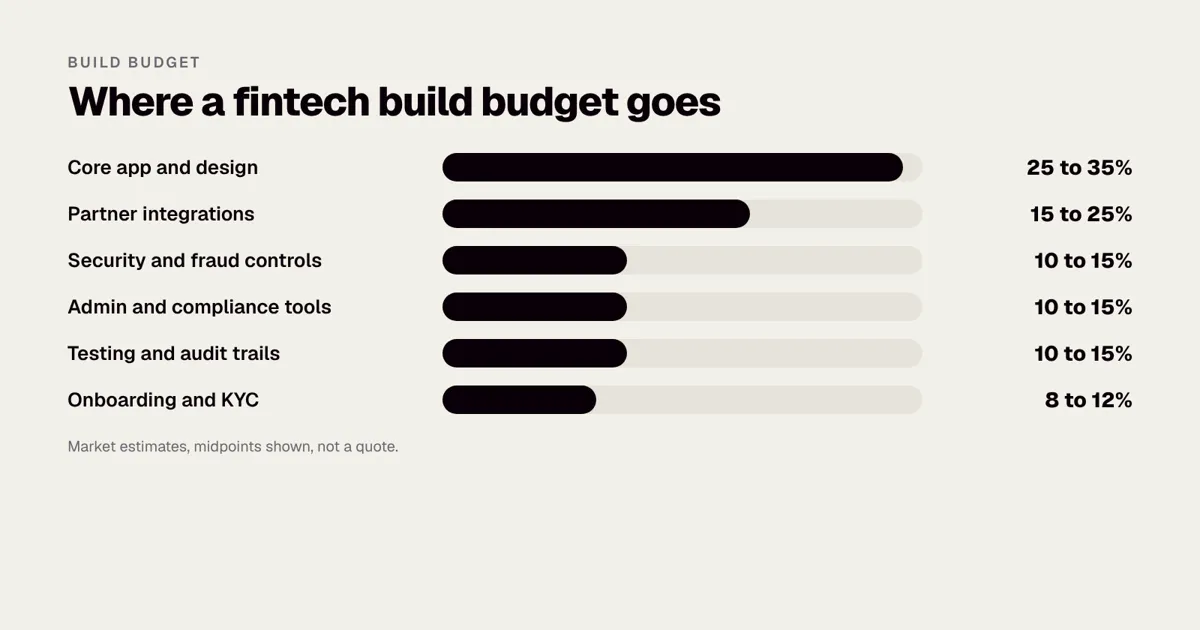
Where does the build budget go?
Within the build, the share of effort tends to follow a pattern. The table shows typical splits.
| Area | Share of build |
|---|---|
| Core app experience and design | 25 to 35% |
| Onboarding and KYC flows | 8 to 12% |
| Partner integrations (bank, card, payments, data) | 15 to 25% |
| Security, fraud controls and authentication | 10 to 15% |
| Admin, support and compliance tooling | 10 to 15% |
| Testing, audit trails and release | 10 to 15% |
Core app experience
This covers navigation, the main journeys, notifications and the design system. In fintech, the quality of wording matters more than visual flair. People want to know what will happen to their money, when, and what it will cost. A good designer spends as long on error states and confirmation screens as on the home screen.
Onboarding and KYC
Opening an account usually requires identity verification, sanctions screening and answers to risk questions. Each step can lose users, so the flow needs careful design and plenty of testing. Expect work on document capture, selfie checks, address verification, manual review queues and clear messages when a check fails. How to design a good onboarding flow covers the general principles, and Mobile app security checklist: OWASP MASVS in plain English covers the app side of identity and device security.
Partner integrations
A modern fintech app is often a front end to several services. A typical stack may include a bank or card programme provider, a payments processor, a data aggregator such as Plaid, a KYC provider and a fraud tool. Every integration has its own sandbox, webhooks, error codes and rate limits. The build effort includes handling failures: what the app shows when a partner is down, how a pending transaction is reconciled and how support staff can see what happened. See What is an API integration? for background.
Security and fraud controls
Beyond secure coding, expect strong authentication, device checks, rate limiting, encryption of sensitive data, secure key handling and monitoring. Biometric login is expected by many users and is a defined feature to cost, see How to add biometric login to your app and What does biometric login cost to build in an app?. Two-factor authentication is another common line, covered in What does two-factor authentication cost to build in an app?.
Admin, support and compliance tooling
This is the line first-time fintech founders most often leave out. Staff need a back office to look up users, review flagged transactions, handle disputes, freeze accounts, export records for auditors and answer regulators’ questions. Role-based access and audit logs are part of it, see What does role-based access cost to build in an app? and What does audit logs cost to build in an app?. A typical share of 10 to 15% of the build is reasonable, and for lending or card products it can reach 20%.
Testing, audit trails and release
Financial software needs more testing than most. That includes payment edge cases, partner failure scenarios, reconciliation checks and security testing. Audit trails must record who did what and when, in a form that cannot be quietly changed. App testing explained: QA, UAT and beta testing explains the layers of testing, and you should expect a longer beta than with a typical consumer app.
What do you pay beyond the build?
The build is only part of year one. The costs below are market estimates and vary widely with partner and volume.
| Item | Typical first-year cost |
|---|---|
| Banking or BaaS partner set-up and minimums | $10,000 to $100,000+ |
| Identity verification (per check) | $1 to $5 per user, plus minimums |
| Fraud and transaction monitoring tools | $10,000 to $60,000 |
| Legal and compliance advice | $20,000 to $100,000+ |
| Penetration test and security assessment | $10,000 to $40,000 |
| SOC 2 (if partners or customers require it) | $20,000 to $80,000 (see SOC 2 for startups) |
Partner pricing varies widely and is often negotiated, so treat these as planning ranges.
Budgeting a US fintech product? We cost the build, partner integrations and security work in dollars so you can plan the whole first year. Book a 30-minute call with a co-founder.
Partner set-up and minimums
Banking and card programme partners often charge set-up fees, platform fees and monthly minimums, and some require minimum volumes. These are commonly negotiated and depend on your size and risk. When a quote looks cheap, look for the minimum monthly commitment and for fees per account, per card and per transaction, because these add up once you have users.
Identity verification
Per-check pricing can look small, but it scales with every sign-up, including the ones who abandon. If 100,000 people start onboarding and 40,000 finish, you may pay for the checks on all 100,000. Build the funnel so that cheap checks come first and expensive ones only run when needed.
Legal and compliance advice
A fintech founder needs advice from a lawyer who knows the sector. The cost depends on your model, and it is typically highest when you hold funds, lend or touch securities. Keep advice separate from the build budget. A good adviser will tell you which licences you need or whether a partner’s licence covers you, how to word disclosures and what records to keep.
Security assessments
A penetration test by an independent firm is a standard expectation for financial apps. Partners often ask for the summary. Allow time to fix findings and to retest, since a first test usually finds something. See What is penetration testing for apps? for what a test covers.
What does the regulatory picture add?
Regulation is the reason fintech takes longer than other apps. The rules differ by product and by state, and they change, so this section is only a map. At the time of writing, you should check each point against the official source or take legal advice for your model. This is general information, not legal advice.
| Area | What it can mean for your build | Where to look |
|---|---|---|
| Money transmission | State licences, or relying on a licensed partner | State regulators and FinCEN |
| Anti-money laundering | Customer identification, monitoring and reporting processes | FinCEN |
| Sanctions screening | Checks against government lists at onboarding and over time | US Treasury (OFAC) |
| Consumer financial protection | Clear disclosures, complaint handling, no unfair or deceptive practices | Consumer Financial Protection Bureau |
| Data and privacy | Safeguards for customer information, privacy notices | Federal Trade Commission |
| Deposit insurance wording | Careful claims about what is and is not FDIC insured | FDIC |
| Securities | Broker-dealer and adviser rules, usually handled through a partner | SEC and FINRA |
| Card payments | Security standards for card data | PCI Security Standards Council |
Who holds the licence?
The most important early decision is who holds the regulatory permissions. There are three common arrangements.
- You use a partner’s licences. A sponsor bank, a money transmitter or a broker-dealer holds the permissions, and your product operates under their programme. This is how most start-ups launch.
- You hold some licences yourself. This takes longer and costs more, with legal fees, bonding, capital and compliance staff.
- You avoid regulated activity. You show data or give guidance without holding or moving money, which keeps the build and compliance load lower.
Many founders assume the third arrangement is possible and later discover that a feature, such as holding balances for a few days, crosses a line. Take advice on the exact flow before you build it. Our guide to state money transmitter licences explains how state rules work, and Fintech app development in the US explains licensing and partner models in more depth.
Privacy and security obligations
Financial companies in the US are generally subject to the Gramm-Leach-Bliley Act and the FTC’s Safeguards Rule, depending on their type. In practice this means a written security programme, access controls, encryption, vendor oversight and incident response. Our plain English guide to GLBA for fintech apps covers the app-side implications. State privacy laws apply as well, and US state privacy laws and your app: CCPA and the rest explains how they interact. If your app collects fingerprints, face scans or similar identifiers for login or identity checks, look at BIPA and biometric data in apps because some states regulate this strictly.
Open banking in the US
Data aggregation is a large part of personal finance apps. At the time of writing, the CFPB’s personal financial data rights rule under section 1033 of the Dodd-Frank Act has been the subject of legal challenge and reconsideration, so its final shape and timing should be checked on the CFPB site. In the meantime, most apps rely on contracts with aggregators and banks. Plan for the possibility that fees, access rules or consent wording change, and avoid building a product whose economics depend on free access to data.
Card and payment security
If your app handles card numbers, payment card security standards apply, and the scope depends on how you design the flow. Using a provider that handles card data for you can reduce your own burden considerably. See PCI DSS for apps that take payments for what changes with your design, and the PCI Security Standards Council for the standard itself.
Why do partner choices change the budget so much?
Your banking, card and data partners decide a large part of both build and running costs. Some offer ready-made onboarding screens, KYC, ledgers and dispute tools. Others give low-level APIs and leave you to build those yourself. A partner with more built-in components can cut build cost by tens of thousands of dollars but may charge higher per-user fees and limit your design. Compare at least two or three partners on total cost over three years, including minimum monthly fees, per-account and per-transaction charges, and how hard it would be to switch later.
| Factor | Full-service programme | Low-level API partner |
|---|---|---|
| Build cost | Lower: ready-made screens and tools | Higher: you build onboarding, ledgers and tools |
| Per-user and per-transaction fees | Often higher | Often lower at scale |
| Design freedom | More limited | Greater |
| Speed to launch | Faster | Slower |
| Switching cost later | Can be high | Can be high but more portable if you own the data model |
| Best for | Fast validation, small teams | Differentiated products with scale ambitions |
A simple three year comparison
Take a hypothetical spending account for freelancers expecting 10,000 active users by the end of year two. Illustrative figures only, not quotes.
| Cost line | Full-service programme | Low-level API partner |
|---|---|---|
| Build | $200,000 | $290,000 |
| Partner platform fees, three years | $240,000 | $150,000 |
| Per-user fees, three years | $180,000 | $90,000 |
| Extra support and compliance tooling | $20,000 | $60,000 |
| Three year total | $640,000 | $590,000 |
In this illustration, the cheaper build is not the cheaper option over three years, but the gap is small and depends on assumptions about volume. If volume is half as large, the full-service route wins. The right answer comes from modelling your own numbers, not from a rule of thumb. How to estimate your app budget in pounds, dollars or euros shows how to set up that kind of model, and The total cost of owning an app over five years is a useful companion.
Questions to ask a partner
- What are the minimum monthly fees, and when do they start?
- Which fees apply per account, per card and per transaction?
- Who owns the customer relationship and the data?
- What do you need from us before go-live, and how long does your review usually take?
- How do disputes, chargebacks and fraud claims work, and who staffs them?
- What happens to our customers if we part company?
- Which other products and regulators do you serve, and have you had recent supervisory findings you can describe?
Partner reviews often take weeks. If a partner cannot give a straight answer about timelines, plan for the long end.
How should you cost KYC and fraud tools?
Identity verification and fraud tooling are volume-driven, so a worked calculation is more useful than a price list. These are illustrative figures. Check each provider’s current pricing.
Suppose 30,000 people begin onboarding in year one. Of those, 18,000 finish document and selfie checks, and 12,000 become active users.
| Step | Count | Assumed unit cost | Cost |
|---|---|---|---|
| Basic data and address check on all starters | 30,000 | $0.50 | $15,000 |
| Document and selfie verification | 18,000 | $2.50 | $45,000 |
| Manual review of flagged cases (10%) | 1,800 | $4 (staff time) | $7,200 |
| Ongoing sanctions screening of active users | 12,000 | $0.20 a year | $2,400 |
| Year one verification cost | $69,600 |
The figures suggest why the onboarding funnel matters. A change that raises completion from 60% to 70% affects not only revenue but cost per active user. Add fraud monitoring, device intelligence and transaction monitoring, which are often priced by volume or on an annual contract with a minimum. For small products, a fraud tool from $10,000 to $60,000 a year is a typical planning range (market estimate).
Fraud is also a people cost
Software flags suspicious behaviour, but someone has to review it. In the early months, that person may be a founder. As volume grows, you will need trained staff or an outsourced team, plus clear rules about when accounts are frozen, how customers appeal and what is reported to partners. Budget for this under running costs, because it is not a one-off build item.
What do security and compliance evidence cost?
Banking partners and business customers often ask for evidence that you protect data properly. The most common items are a penetration test, a policy set, an access review and, for some customers, a SOC 2 report. SOC 2 is a voluntary audit framework from the AICPA rather than a law. See SOC 2 for startups and SOC 2 Type 1 vs Type 2 for how the two report types differ. For a wider framework, ISO 27001 vs SOC 2 compares them.
| Evidence | Typical cost | When it is asked for |
|---|---|---|
| Penetration test | $10,000 to $40,000 | Before launch and yearly |
| Policies and procedures | $5,000 to $20,000 | At partner due diligence |
| SOC 2 Type 1 | $20,000 to $50,000 | When business customers or partners ask |
| SOC 2 Type 2 | $30,000 to $80,000 or more | After a period of controls operating |
| Compliance tooling subscription | $5,000 to $25,000 a year | When preparing for audit |
These are market estimates. Doing the work in the right order saves money: build access controls and logging into the app from day one, and the audit later becomes a documentation exercise, not a rebuild.
How long does a fintech app take to build?
Timelines are longer than for many apps because of partner onboarding and reviews. A sample plan for a partner-led card product shows how the phases fit.
| Phase | Typical length | What happens |
|---|---|---|
| Discovery and compliance mapping | 3 to 6 weeks | Product definition, partner shortlist, regulatory map |
| Partner selection and contracts | 4 to 10 weeks, partly in parallel | Due diligence, pricing, sandbox access |
| Design and prototype | 4 to 8 weeks | Journeys, onboarding, error states, test with users |
| Build of the first release | 12 to 24 weeks | App, integrations, admin tools, audit logs |
| Security testing and fixes | 3 to 6 weeks | Penetration test, retest, partner review items |
| Partner go-live review | 3 to 8 weeks | Submission, questions, sign-off |
| Controlled launch | 4 to 8 weeks | Limited users, monitoring, fixes |
Several phases overlap, which is how six to ten months is possible. The risk is on the partner side: a slow review adds weeks you cannot control. Plan the launch date after you have the partner’s review window in writing.
For a related look at how a US project changes when the studio sits in another time zone, see Hiring a UK app development company from the US, and Due diligence checklist for US companies hiring abroad.
What does it cost to run?
Running costs are significant in fintech, and they are the line most often underestimated.
- Hosting and infrastructure: $1,000 to $10,000 a month, higher with heavy data processing.
- Per-transaction and per-user partner fees: usually the largest variable cost.
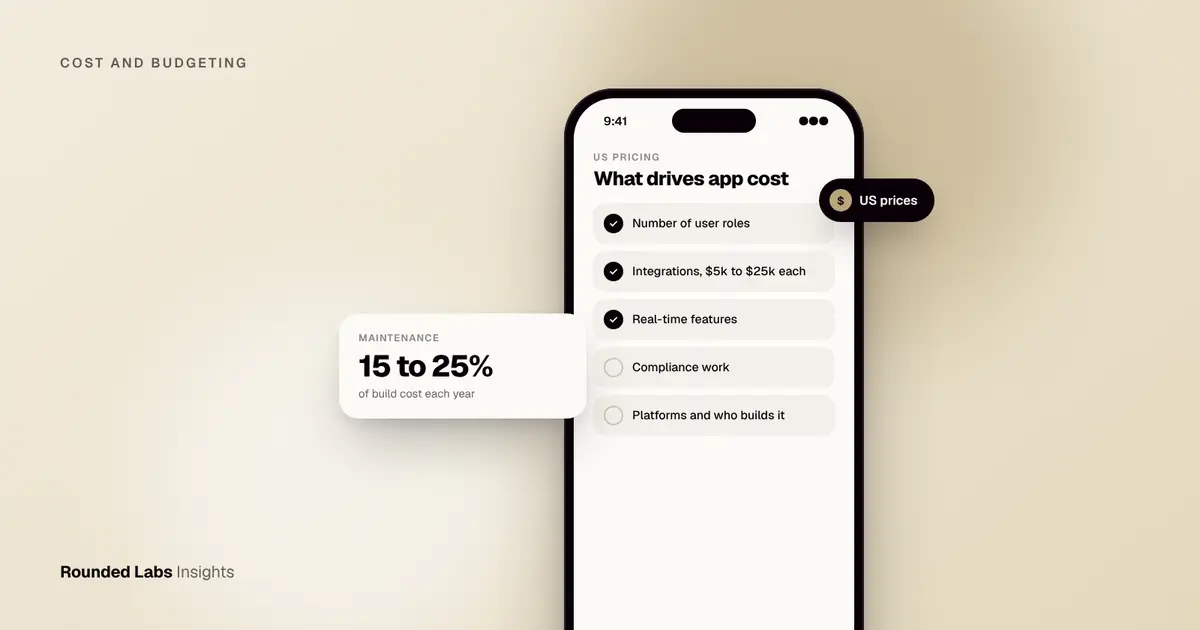
- Maintenance and compliance updates: 15 to 25% of build cost a year (see App maintenance cost in the US: a yearly budget in dollars).
- Ongoing monitoring and support staff for disputes, fraud reviews and customer service.
- Annual security testing and audits.
- Data and aggregator fees, which can grow with active users.
A sample year-two budget
For a hypothetical partner-led spending account with a $220,000 build and 10,000 active users, illustrative figures:
| Line | Yearly estimate |
|---|---|
| Maintenance and updates (20% of build) | $44,000 |
| Hosting and monitoring | $36,000 |
| Partner platform fees | $60,000 |
| Per-user and per-transaction fees | $60,000 |
| Fraud and KYC tooling | $50,000 |
| Support and disputes team (part time start) | $70,000 |
| Annual penetration test and audit support | $30,000 |
| Total | $350,000 |
A founder who budgeted only the build would be surprised by a running cost larger than the build itself. This is not unusual in financial products with real transaction volume, because revenue per user needs to cover the service costs. If your business case depends on interchange or subscription revenue, check that unit economics work at 10,000 users, not only at 1,000,000. How to calculate app ROI and How to build a business case for a mobile app give a method.
What do worked examples look like?
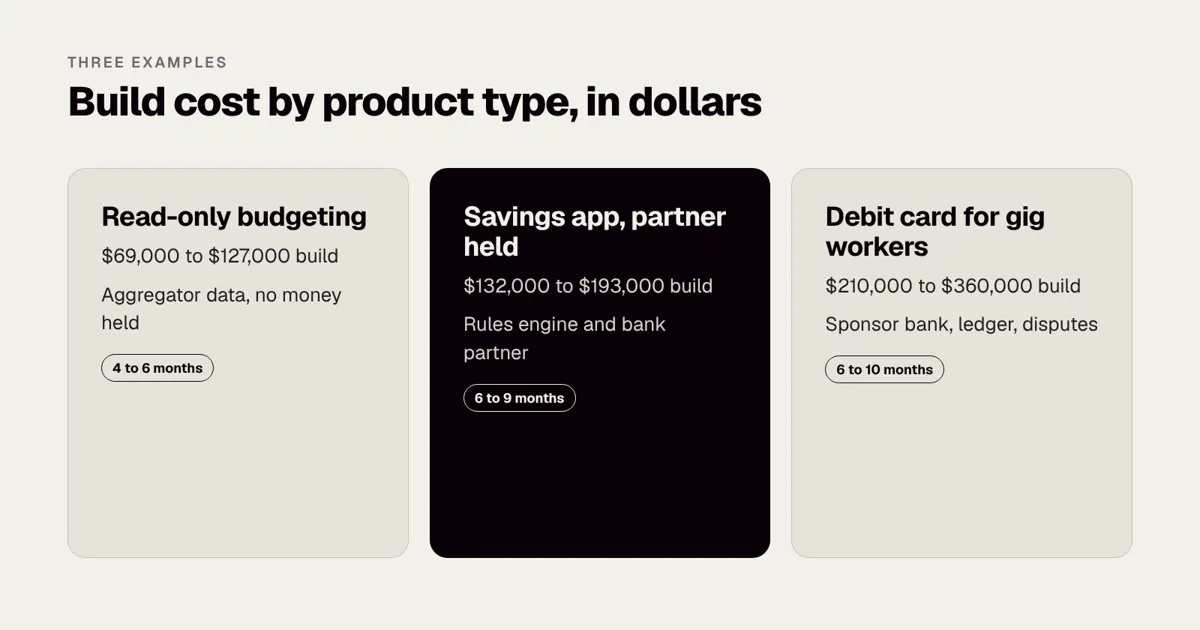
Three examples show how the numbers fit together. All are hypothetical and rounded.
Example one: a savings app for freelancers
A startup wants a savings app for freelancers: link bank accounts, set rules to move money into a partner-held savings account, and show tax estimates.
| Item | Cost at UK studio rates |
|---|---|
| Discovery and design | $15,000 to $22,000 |
| App and onboarding with KYC | $45,000 to $65,000 |
| Bank partner and account-linking integrations | $30,000 to $45,000 |
| Rules engine and notifications | $18,000 to $26,000 |
| Admin, support tools and audit logs | $14,000 to $20,000 |
| Security testing and launch | $10,000 to $15,000 |
| Total build | $132,000 to $193,000 |
Beyond the build, the team should allow roughly $20,000 to $40,000 for legal and compliance advice, $10,000 to $25,000 for a penetration test and first-year tooling, and partner fees from the partner’s own schedule. A realistic first-year total, including build, is $190,000 to $300,000. At US agency rates the same build could be $190,000 to $300,000 for the build alone.
Example two: a read-only budgeting MVP
A team wants a budgeting app that links accounts, categorises spending and shows monthly summaries. It never holds or moves money.
| Item | Estimate |
|---|---|
| Discovery and design | $8,000 to $15,000 |
| App for iOS and Android | $35,000 to $60,000 |
| Data aggregator integration and categorisation | $12,000 to $25,000 |
| Security, privacy and admin basics | $8,000 to $15,000 |
| Testing and launch | $6,000 to $12,000 |
| Total build | $69,000 to $127,000 |
This is the cheapest route into fintech and the one most able to come in under $80,000 if the scope is held tight. The trade-off is that a read-only product earns less per user and competes with many similar apps, so the validation work matters. See How to validate an app idea before you spend £50k and How to test demand with a landing page for ways to check demand first.
Example three: a debit card for gig workers
A company wants a spending account and debit card for delivery drivers, with instant pay-outs from platforms and spending categories.
| Item | Estimate |
|---|---|
| Discovery, compliance mapping and design | $20,000 to $35,000 |
| App with onboarding and KYC | $60,000 to $95,000 |
| Sponsor bank and card programme integration | $40,000 to $70,000 |
| Instant pay-out and ledger reconciliation | $25,000 to $45,000 |
| Fraud controls and card management features | $20,000 to $35,000 |
| Admin, disputes and compliance tooling | $30,000 to $55,000 |
| Security testing and launch | $15,000 to $25,000 |
| Total build | $210,000 to $360,000 |
First-year extras might add $100,000 to $250,000 for partner set-up, legal work, fraud tools and security evidence. The chosen range depends mostly on how much of the dispute and ledger tooling the programme manager supplies. This kind of product should not be started without a partner who has agreed the timeline in writing.
How can you reduce fintech costs?
- Launch through a partner rather than seeking your own licences first.
- Start with one product and one customer segment. A card for one type of worker is easier than a general account.
- Use proven KYC, fraud and payments providers rather than building your own.
- Design compliance into onboarding so you avoid expensive rework after partner reviews.
- Plan partner reviews into the timeline; they often take weeks.
- Launch in a limited number of states or with limited balances while you learn.
- Keep the admin tools simple but real. A basic queue with filters beats spreadsheets, and a full case-management system can wait.
- Document as you go. Policies, decisions and test evidence are far cheaper to write while the work is fresh.
Where cuts backfire
Some savings cost more later. Skipping an admin back office means developers pull data by hand when a regulator or partner asks. Skipping audit logs means rebuilding the data model when an auditor asks who changed a record. Skipping penetration testing risks a failed partner review that delays launch by weeks. Scope reduction should come from features users do not need yet, not from controls partners will ask for. How to cut app development costs without cutting quality discusses this trade-off in general terms, and How to manage scope changes without blowing the budget explains how to hold a reduced scope steady.
Cheaper ways to learn before you build
If the idea is still uncertain, cheaper options sit before a full build. A clickable prototype with realistic data shows partners and users what you intend. A landing page can test whether the audience cares. A small manual service, where you do the work behind the scenes, can show how people behave with money before software exists. Fintech is a field where the cost of a wrong guess is high, so the early evidence is worth buying.
Should you hire a UK studio or a US agency?
Both can work. The honest comparison is about fit, not geography.
| Factor | UK studio | US agency |
|---|---|---|
| Price level | Often lower for similar seniority (market estimate) | Often higher |
| Time zone | Overlap with US East mornings, less with the West Coast | Same time zone |
| Regulatory familiarity | Varies: ask about US partner and compliance experience | Often stronger in US-specific flows |
| Contract and legal | Usually English law unless agreed otherwise | US state law |
| Pricing model | Rounded Labs: fixed price agreed before development | Varies |
| Financial product track record | Rounded Labs built MoBank and Dabbl | Varies |
Rounded Labs does not claim US regulatory expertise as a substitute for your lawyer. What a studio like ours offers is 19 years of building mobile products since 2007, a fixed price agreed before development starts, and experience of financial interfaces. You should still have a US financial services lawyer and a compliance lead. Read UK vs US app development agencies: cost, quality and risk and Contracts, IP and payment when you hire an overseas app agency before you decide, and see how Dabbl handled the design problem of making trading approachable for people who had never invested.
How a fixed price helps in fintech
Fintech scope changes often, because partner reviews and legal advice send you back to the design. A fixed price only works when scope is defined, which is why the first piece of work is usually a discovery phase or a Tech Architecture Audit at £7,500 (roughly $9,500) for an existing product. After that, the price covers a described scope, and changes are agreed in writing before they are built. See Fixed price vs time and materials for app projects for how the two models differ in practice. For payment structure, Contracts, IP and payment explains milestone-based approaches.
What questions should you ask before you budget?
- Will we hold customer funds, move money, lend, or only read account data?
- Which partner will hold the licences, and what will they require from us?
- Which states or customer segments will we launch in first?
- What security evidence will partners and customers expect, and when?
- Who on our side owns compliance, disputes and fraud review?
- What does success look like after six months, so we can size version one to reach it?
- How many users do we need for the unit economics to work?
- What happens if a partner changes its terms or pulls out?
Clear answers to these usually remove 20 to 30% of the uncertainty in a fintech estimate. Fintech app development in the US explains licensing and partner models in more depth, and US state privacy laws and your app: CCPA and the rest covers state privacy laws that also apply to financial apps.
How do you tell a good quote from a poor one?
Fintech quotes vary because the scope is easy to read in different ways. Use this checklist when comparing.
- Does it name the partners and integrations? “Payments” or “banking” alone is not a scope.
- Does it include the admin and compliance tooling? If not, you will pay for it later.
- Does it cover security testing and fixes? Ask who pays for retesting.
- Does it state what is excluded? Legal advice, partner fees and audits are usually outside the build.
- Is it a fixed price against a written scope? Compare like with like.
- Who owns the code and the documentation? You should. See Who owns the code?.
- What happens after launch? Look at warranty, support and update terms.
Warning signs include a price offered in the first call before anyone asks about your partner, a promise of a regulated product in six weeks, a team with no experience of financial partners, and a refusal to put exclusions in writing. For a wider view, read App development quotes compared and Red flags when hiring app developers.
What should you do next?
If you are budgeting a US fintech product, work through these steps.
- Write one paragraph describing what the product does with money and which customers it serves first.
- Decide whether you will hold funds, move funds, lend, or read data only.
- Shortlist two or three partners and request their pricing and timelines in writing.
- Take legal advice on the model before you design the flows.
- List the features a partner will require before go-live.
- Build a three year cost model that includes running costs, not only the build.
- Ask at least two studios to quote against the same written scope.
Following these steps will give you a firmer number than any online calculator. If you would like us to look at your scope, our pricing page explains the fixed-price services, and you can book a call with a co-founder to talk through your product first.
Frequently asked questions
How much does it cost to build a fintech app in the US?
Most US fintech apps cost $100,000 to $400,000 to build, plus first-year partner, compliance and security costs that can reach $250,000 for regulated products. These are market estimates, and the figure depends on whether you hold money, move money or only read data.
Why are fintech apps more expensive than other apps?
They need identity checks, fraud controls, partner integrations, audit trails and security testing, and they must pass partner and regulatory reviews. Each of these adds build effort and running cost that a typical consumer app does not have.
Can I build a fintech MVP for less?
Yes, by narrowing scope, launching in one state or segment, and using a partner’s ready-made components. A read-only budgeting MVP can cost under $80,000. Cutting controls that partners will ask for usually costs more later.
How long does a fintech app take to build?
Six to twelve months for most regulated products, including partner onboarding. Simpler data apps take four to six months. Partner reviews are the least predictable part of the schedule, so get timelines in writing.
Do I need SOC 2 for a fintech app?
Not by law, but banking partners and business customers often ask for it. See SOC 2 for startups. Building access controls and logging into the app from the start makes the audit much cheaper.
Do I need a licence to run a fintech app in the US?
It depends on what the app does. Many start-ups operate under a partner’s licences, while holding funds or lending yourself can require state or federal permissions. Take advice from a financial services lawyer and check the regulators’ sites, since this is general information, not legal advice.
Is a UK studio suitable for a US fintech project?
It can be, provided you have US legal and compliance advice on your side and the studio has experience of financial interfaces and partner integrations. Ask for relevant examples, agree a fixed scope in writing and check how time zones will work for your team.
Official sources and further reading
Talk it through with one of our co-founders. 30 minutes, no pressure.