

Buy off-the-shelf SaaS when your process is standard and the tool fits 80% or more of your needs; build custom software when the process is what makes your business different, when no product fits, or when subscription costs and workarounds over five years would exceed the cost of building. Many companies end up with a hybrid: SaaS for commodity functions such as accounting and email, and custom software for the workflows that win customers.
We build custom apps and platforms, but we often tell clients to buy instead. For DRSR, a social commerce platform where users earn commission when others buy the products they tag, no off-the-shelf tool could deliver the core idea. For many internal processes, a well-chosen SaaS product is faster and cheaper. This guide helps you decide.
Key facts
- SaaS: low upfront cost, fast start, ongoing subscription, limited control.
- Custom: higher upfront cost, fits exactly, you own it, ongoing maintenance.
- Compare total cost over five years, not just year one.
- Customising SaaS heavily can cost as much as building, with less control.
- Integration costs apply to both options.
How do the options compare?
| Factor | Off-the-shelf SaaS | Custom software |
|---|---|---|
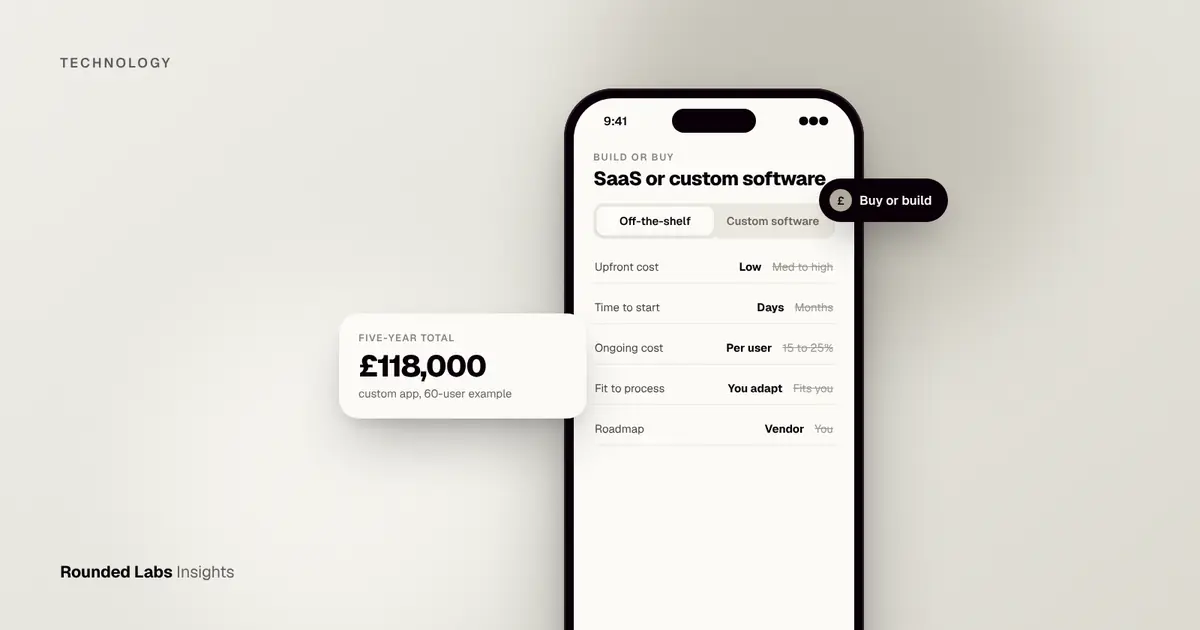
| Upfront cost | Low | Medium to high |
| Ongoing cost | Subscription per user or usage, rising with growth | Hosting and maintenance, 15 to 25% of build a year |
| Time to start | Days to weeks | Months |
| Fit to your process | You adapt to the tool | Tool fits your process |
| Competitive advantage | Same tools as competitors | Can be a differentiator |
| Control and roadmap | Vendor decides | You decide |
| Data ownership and location | Vendor terms | Your choice |
| Risk | Vendor price rises, changes or shutdown | Delivery risk, key-person risk |
When should you buy SaaS?
- The process is standard across industries: accounting, payroll, email, basic CRM, help desk.
- A product fits most of your needs without heavy customisation.
- You need something working this month.
- Your team is small and you do not want to manage software.
- The function is not a source of competitive advantage.
When should you build custom software?
- The workflow is unique to your business or is your product.
- You are working around SaaS limits with spreadsheets and manual steps every day.
- Per-user subscription costs grow painfully as you scale.
- You need deep integration across several systems.
- You need control over data location, security or compliance that SaaS vendors cannot offer.
- You want to sell the software to others, which turns it into a product (post:A22).
Internal staff apps: replacing spreadsheets and paper covers replacing spreadsheets with internal apps, and Low-code vs custom app development compares low-code with custom development.
Not sure whether to build or buy? We will look at your process and tell you honestly, even if the answer is a SaaS product. Book a 30-minute call with a co-founder.
How do the five-year costs compare?
Take a field service business with 60 staff that needs job scheduling, mobile checklists and customer reports. The figures below are illustrative market estimates, not quotes, and subscription prices vary widely by vendor and plan.
| SaaS with customisation | Custom app | |
|---|---|---|
| Year 1 set-up | £8,000 configuration and integration | £70,000 build |
| Subscription | 60 users at £45 a month = £32,400 a year | None |
| Maintenance and hosting | Included | £12,000 a year |
| Workarounds and admin time | £10,000 a year | Minimal |
| Five-year total | About £220,000 | About £118,000 |
The numbers flip for a smaller team or a more standard process. With 10 users, the SaaS option costs around £50,000 over five years and is the better choice. Run the calculation with your own user numbers and growth plans.
What about hybrid approaches?
- SaaS core with custom extensions: use a platform’s API to build the parts it lacks.
- Custom front end on SaaS back end: a branded customer app on top of systems such as Shopify, Salesforce or your ERP.
- Custom core, SaaS for commodity features: build your unique workflow and plug in SaaS for payments, email, analytics and authentication.
Most of the apps we build are hybrids of this kind. What is an API integration explains API integrations.
What are the risks of each?
SaaS risks: price increases, vendor changes to features, data lock-in, limited integration, and in rare cases the vendor shutting down. Check data export options and contract terms before committing. In the EU, the Data Act includes rules intended to make it easier to switch data processing services, such as cloud and some SaaS providers (post:G11). Check the current official text to see how it applies to your contract.
Custom risks: delivery delays, budget overruns and dependence on the developers who built it. Reduce them with a discovery phase (post:B7), fixed-price scope where possible (post:A3), and full ownership of code and accounts (post:H6).
A simple decision framework
Score each statement from 0 (disagree) to 2 (agree):
- This process is what makes us different from competitors.
- No product fits more than 70% of our needs.
- We expect to grow users or volume significantly.
- We need tight integration across several systems.
- We have specific data, security or compliance needs.
- We can wait three months or more for a solution.
A total of 8 or more points towards custom software; 4 or less towards SaaS; in between, consider a hybrid.
Who should be involved in the decision?
Include the people who do the work every day, not only managers and IT. Ask them where current tools slow them down and what they work around. Finance should model five-year costs, IT should check security and integration, and someone senior should own the final decision and the budget.
Frequently asked questions
Is custom software more expensive than SaaS?
Upfront, yes. Over five years it can be cheaper when you have many users, need heavy customisation or rely on workarounds. Compare total cost of ownership, not year-one cost.
How long does custom software take to build?
A focused internal app takes 2 to 4 months; a larger platform 6 to 12 months. A SaaS tool can be running in days, which is its biggest advantage.
Can we start with SaaS and move to custom later?
Yes, and many companies do. Choose SaaS with good data export and APIs so moving later is easier.
Who owns custom software?
You should, under a contract that assigns all IP to you on payment. Check this before signing. See Who owns the code? IP, contracts and escrow for UK app projects.
What is the biggest mistake in build vs buy decisions?
Comparing only the first year’s costs, and underestimating how much time staff spend working around a tool that does not fit.
Official sources and further reading
Talk it through with one of our co-founders. 30 minutes, no pressure.