

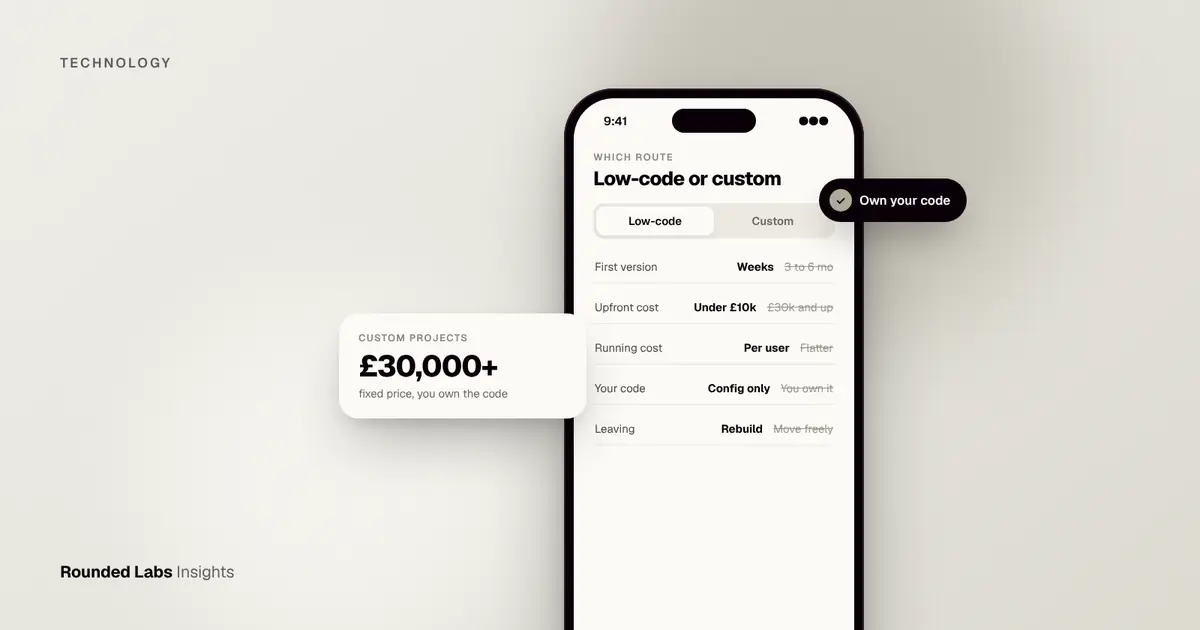
Low-code suits internal tools and simple workflows, shipped in weeks for a few thousand pounds a year in licences. Custom development suits products that customers use, that must scale or that set you apart. Low-code can cost more over five years as users grow, while custom projects typically start around £30,000 and give you full ownership of the code.
Low-code is a real option, and we tell clients so when it fits. With 19 years of experience (our web app development service is fixed price), including a Superdry app serving a brand with 768 locations in over 100 countries and a SaaS move for Cubeware‘s 4,000+ enterprise customers, we have seen where platforms help and where they run out of road. This guide compares the two routes on cost, speed, limits and lock-in, and gives you a test to choose. Custom prices are agreed before development starts. Other figures in this guide, including platform prices and the five-year example, are market estimates, not quotes, and vendors change their pricing often.
Key facts
- Low-code platforms let you build with visual tools and ready-made components, with code only where needed. No-code is the same idea with no code at all.
- Low-code is usually priced per user or per app each month, so costs rise as you grow.
- Custom software is built to your specification, you own the code, and you are not tied to a vendor’s roadmap.
- Fixed-price custom projects with Rounded Labs typically run from £30,000 to £250,000+, see the pricing page.
- Many businesses use both: low-code for internal tools, custom for the customer-facing product.
What is the difference between low-code and custom development?
Low-code means you assemble an app on a vendor’s platform using drag-and-drop screens, forms and workflow builders. The platform hosts the app, handles the database and provides pre-built login and integrations. Examples of the category include Microsoft Power Apps, OutSystems, Mendix and Bubble.
Custom development means engineers write the app for you, usually in frameworks such as Swift, Kotlin, React or Flutter, with a backend you control. You choose the hosting, the architecture and how every screen behaves.
The practical difference is who controls the limits. On a low-code platform the vendor sets them: what components exist, how fast it runs and what the licence costs. In custom software you set them, at the price of more upfront work.
How do the two compare on cost, speed and control?
| Factor | Low-code | Custom development |
|---|---|---|
| Time to a first working version | Days to a few weeks | Typically 3 to 6 months for a full product |
| Upfront cost | Low, often under £10,000 for a simple app | Fixed price, typically £30,000 and up |
| Running cost | Licences per user or per app, rising with growth | Hosting and maintenance, usually flatter per user |
| Design freedom | Limited to the platform’s components | Unlimited |
| Performance | Fine for light use, can struggle at scale | Tuned to your needs |
| Code ownership | You own the configuration, not the platform | You own the code |
| Leaving the platform | Often means a rebuild | You can move hosting or suppliers |
| Offline and device features | Often limited | Full access to the phone’s features |
These ranges are market estimates, not quotes, and platform pricing changes often. Always check the vendor’s current price list.
When is low-code the right choice?
Low-code works well when most of these are true:
- The users are your own staff, in the tens or low hundreds.
- The job is a form, an approval chain, a dashboard or a data capture tool.
- Speed matters more than polish.
- The app is not your product and customers will not judge it.
- You already use the vendor’s ecosystem, for example Microsoft 365.
A good example is replacing a shared spreadsheet and email chain for holiday requests or equipment checks. It is also a sensible way to test a process before investing more. Our post on internal staff apps covers this kind of project.
When is custom development the right choice?
Choose custom when one or more of these apply:
- Customers pay for it or use it daily. A slow, generic experience costs you sales.
- It must work offline or use phone hardware such as the camera, Bluetooth or biometrics.
- You expect thousands of users. Per-user licences can overtake the cost of a build.
- The app is your competitive edge. If a rival can copy it on the same platform in a month, it is not much of an edge.
- You face strict security or data rules. You may need control over where data lives and how it is encrypted. The UK’s National Cyber Security Centre publishes guidance worth reading first.
- You plan to raise investment or sell the business. Buyers and investors look closely at who owns the technology.
For the technology choices inside a custom build, see Native vs cross-platform and Flutter vs React Native in 2026.
Not sure which route fits your idea? We will tell you honestly if low-code is enough, even when it means no project for us. Book a 30-minute call with a co-founder.
What does each route cost over five years?
Here is a worked example. It is illustrative, using round numbers, and your figures will differ.
A business wants a customer ordering app. Option A is a low-code platform at an assumed £15 per user per month, a round figure in line with typical list prices at the time of writing. Option B is a custom build at a fixed price of £60,000.
| Customer users | Low-code licences per year | Low-code over 5 years | Custom: build plus hosting and upkeep over 5 years |
|---|---|---|---|
| 100 | £18,000 | £90,000 | about £90,000 |
| 500 | £90,000 | £450,000 | about £100,000 |
| 2,000 | £360,000 | £1.8 million | about £130,000 |
At 100 users the two routes are close, and low-code gets you live sooner. At 500 users or more, licences dominate. In practice vendors offer volume discounts, and some price per app or per transaction, so negotiate. But the shape holds: low-code costs scale with users, while custom costs mostly do not. Our guide to the total cost of owning an app over five years explains the maintenance side, and fixed price vs time and materials shows how to compare quotes.
What are the hidden risks of low-code?
- Vendor lock-in. Your logic lives in the vendor’s format. If prices rise or the product is retired, moving usually means rebuilding from scratch.
- Per-user pricing changes. Licence terms can be revised at renewal, and you have limited bargaining power once the business depends on the tool.
- The last 20%. Platforms handle common cases quickly, then slow down on the awkward ones, such as unusual approval rules or a legacy integration.
- Performance ceilings. Complex screens and large data sets can become slow, with few levers to fix them.
- App store limits. Apps from some platforms look generic and may be harder to get through Apple’s review if they add little beyond a website wrapper.
- Shadow IT. Staff building their own apps can create unmanaged data stores, which is a concern under UK GDPR. The ICO’s guidance explains your duties.
What are the risks of custom development?
Custom is not risk-free either, and it is only fair to say so:
- Higher upfront cost and longer time to launch. You pay before you see users.
- Supplier dependence. A poor agency leaves you with code nobody understands. Make sure your contract gives you the source code and documentation.
- Scope creep. Without a clear specification, budgets drift. A fixed price agreed before development starts, based on a written scope, reduces this.
- Maintenance. Operating systems and libraries change every year, so budget for upkeep.
If you have an old custom app that is struggling, read Rebuild or refactor before deciding anything.
Can you start with low-code and move to custom later?
Yes, and it is a sound strategy if you plan for it. Use low-code to test the idea with real users, keep a record of the rules and data your app relies on, and treat the first version as a prototype. When the idea is proven and licence costs or limits start to bite, rebuild it as custom software with that evidence in hand. The learning from the first version is valuable, because you know which features people use.
Be realistic about the move. You will not usually convert a low-code app to code; you rebuild it, so budget for that from the start. If you are earlier than this, a smaller step may be better: see What is an MVP? for how to test an idea cheaply, or Off-the-shelf SaaS vs custom software if a ready-made product already does most of the job.
How do you decide? A five-question test
- Will customers, rather than only staff, use it?
- Will it have more than about 500 users within two years?
- Does it need offline use, device features or a distinctive design?
- Is it central to how your business competes or is valued?
- Do you have security or data location rules that limit third-party platforms?
If you answered yes to two or more, plan for custom. If you answered no to all five, low-code is probably the better first step. One yes sits in between: price both routes for five years before committing. If the numbers are close, our guide to cutting app costs without cutting quality shows how to trim a custom scope.
Frequently asked questions
Is low-code cheaper than custom development?
At the start, usually yes. Over five years it depends on user numbers, because low-code licences grow with users while custom running costs stay flatter. Below around 100 users low-code often wins, and above several hundred custom often does.
Can low-code build a customer-facing mobile app?
Some platforms can, but results are often generic and limited on performance, offline use and device features. For a public app where design and speed affect sales, most businesses are better served by custom or cross-platform code.
Do I own a low-code app?
You own your data and configuration, but the app runs on the vendor’s platform under its licence. If you stop paying or the vendor changes terms, you may lose the running app, so check the contract and export options.
Is custom development safer than low-code?
Not automatically. Reputable low-code platforms invest heavily in security, and a badly built custom app can be weaker. Custom gives you more control over where data sits and how it is protected, which matters in regulated sectors.
How much does a custom app cost?
Rounded Labs projects are fixed price, agreed before development starts, and typically run from £30,000 to £250,000+. Other suppliers vary widely, as the quotes guide explains. See our pricing page for details, or talk to a co-founder about your idea.
Official sources and further reading
Talk it through with one of our co-founders. 30 minutes, no pressure.