



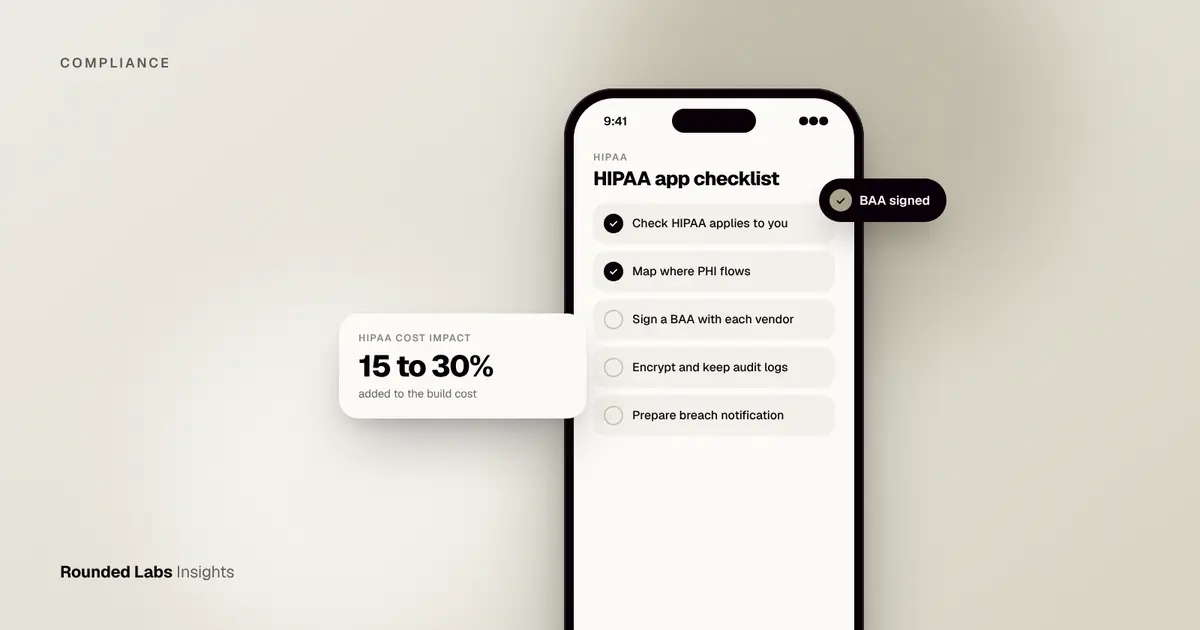
HIPAA applies to an app when it creates, receives, stores or transmits protected health information (PHI) for a covered entity, such as a healthcare provider, health plan or clearinghouse, or for one of their business associates. If it does, you need a business associate agreement with each supplier that touches PHI, administrative, physical and technical safeguards under the HIPAA Security Rule, and a breach notification process. Consumer wellness apps that people use on their own usually fall outside HIPAA, but are covered by FTC rules instead.
We have built apps that handle sensitive personal and financial data since MoBank, and healthcare staffing workflows for First Agency Direct. This guide explains what a HIPAA-compliant app needs, in the order you will meet it. It is not legal advice, and the rules change, so check the current official text.
Key facts
- HIPAA covers PHI handled for covered entities and business associates, not all health data.
- Every vendor that handles PHI for you needs a signed business associate agreement (BAA).
- The Security Rule sets administrative, physical and technical safeguards; encryption and audit logs are expected in practice.
- Civil penalties are tiered by culpability and adjusted for inflation each year; check HHS for the current amounts.
- HIPAA work typically adds 15 to 30% to an app’s build cost (a market estimate, not a quote). See How much does a HIPAA-compliant app cost.
Does HIPAA apply to my app?
| Scenario | HIPAA applies? | Why |
|---|---|---|
| Telehealth app used by a clinic to see its patients | Yes | The app handles PHI for a covered entity |
| Patient portal built for a hospital | Yes | You are a business associate of the hospital |
| Remote monitoring app prescribed by a doctor, data sent to the practice | Usually yes | Data flows to and from a covered entity |
| Fitness tracker people download themselves | Usually no | No covered entity involved; FTC rules apply |
| Period tracking or mental health app sold direct to consumers | Usually no | FTC Act and Health Breach Notification Rule apply, plus state laws |
HHS publishes guidance on when health apps fall under HIPAA (HHS: Health app use scenarios). If you are outside HIPAA, look at the FTC’s Health Breach Notification Rule and state privacy laws such as Washington’s My Health My Data Act; US state privacy laws and your app: CCPA and the rest covers state laws.
What counts as protected health information?
PHI is individually identifiable health information: anything about a person’s health, care or payment for care that can identify them. In an app that includes names with appointment data, device readings linked to an account, messages with a clinician, insurance details, and even IP addresses or device IDs when combined with health data.
Step 1: Map your data and sign BAAs
Draw how PHI moves through the app: the device, your API, the database, backups, logs, analytics, email and SMS providers, crash reporting and support tools. Then:
- Remove PHI where you can. Keep it out of push notification text, analytics events, crash reports and logs.
- Sign a BAA with every vendor that handles PHI. AWS, Google Cloud and Microsoft Azure offer BAAs for eligible services; check that each service you use is on their eligible list.
- Avoid vendors that will not sign one. Many analytics, chat and email tools will not.
Step 2: Build the technical safeguards
The Security Rule’s technical safeguards (45 CFR 164.312) translate into these build items:
| Safeguard | What we build |
|---|---|
| Access control | Unique user IDs, role-based access, automatic logoff, emergency access procedure |
| Audit controls | Tamper-resistant logs of who viewed or changed PHI and when |
| Integrity | Checks that PHI is not altered or destroyed improperly |
| Authentication | Strong login, multi-factor authentication for staff, biometrics on device |
| Transmission security | TLS 1.2 or higher everywhere, certificate pinning in the mobile app |
| Encryption at rest | Encrypted databases, storage and backups; secure enclave or keystore on device |
On the device, avoid storing PHI in plain files or caches, clear sensitive screens from app switcher snapshots, and support remote logout. Mobile app security checklist: OWASP MASVS in plain English has a broader mobile security checklist.
Step 3: Put administrative and physical safeguards in place
Technology alone does not make you compliant. You also need:
- A documented risk analysis and risk management plan, reviewed regularly.
- A named security official and written policies.
- Workforce training and access reviews.
- Contingency planning: backups, disaster recovery and an emergency mode.
- Physical safeguards, which your cloud provider covers for its data centres, and you cover for offices and staff devices.
In January 2025 HHS proposed updates to the Security Rule that would make several of these more prescriptive, including mandatory encryption and multi-factor authentication. A proposal is not final law, so check the status on HHS’s Security Rule page before you plan.
Building a health app for the US? We design HIPAA safeguards in from the first sprint and price them up front. Book a 30-minute call with a co-founder.
Step 4: Plan for breaches
The Breach Notification Rule requires notifying affected individuals without unreasonable delay and within 60 days of discovery, notifying HHS, and for breaches affecting more than 500 residents of a state, notifying prominent media. Build an incident response plan, and make sure your logs can tell you who was affected.
Step 5: Test and document
- Penetration test before launch and after major changes (post:C22).
- Keep evidence: risk analysis, policies, training records, BAAs, test reports.
- Consider an independent assessment such as HITRUST or SOC 2 if you sell to large health systems; SOC 2 for startups covers SOC 2.
How much does HIPAA compliance add to an app?
For a typical telehealth or patient app, HIPAA work adds 15 to 30% to the build: compliant hosting and vendors, audit logging, encryption, extra security testing and documentation. Running costs rise too, because BAA-eligible services and security monitoring cost more. How much does a HIPAA-compliant app cost breaks the numbers down, and Healthcare app development in the US covers US healthcare apps more widely.
Frequently asked questions
Is there a HIPAA certification for apps?
No. HHS does not certify apps or vendors. Third-party assessments such as HITRUST or SOC 2 can show good practice, but compliance is something you maintain, not a badge you get once.
Can I use AWS for a HIPAA-compliant app?
Yes. AWS signs a BAA and lists HIPAA-eligible services. You must use only eligible services for PHI and configure them securely; the BAA does not make your app compliant on its own.
Can push notifications contain health information?
Avoid it. Notification text can appear on a lock screen and passes through Apple and Google services. Send a generic message, such as “You have a new message”, and show details only after login.
Does HIPAA apply to a UK company building a US health app?
HIPAA applies to the handling of PHI for US covered entities and their business associates, wherever the business associate is located. A UK developer handling PHI should sign a BAA and follow the Security Rule.
What are the penalties for HIPAA violations?
Civil penalties are tiered by level of culpability and adjusted for inflation each year, so check HHS for the current amounts. Criminal penalties can apply to knowingly obtaining or disclosing PHI.
Official sources and further reading
Talk it through with one of our co-founders. 30 minutes, no pressure.