

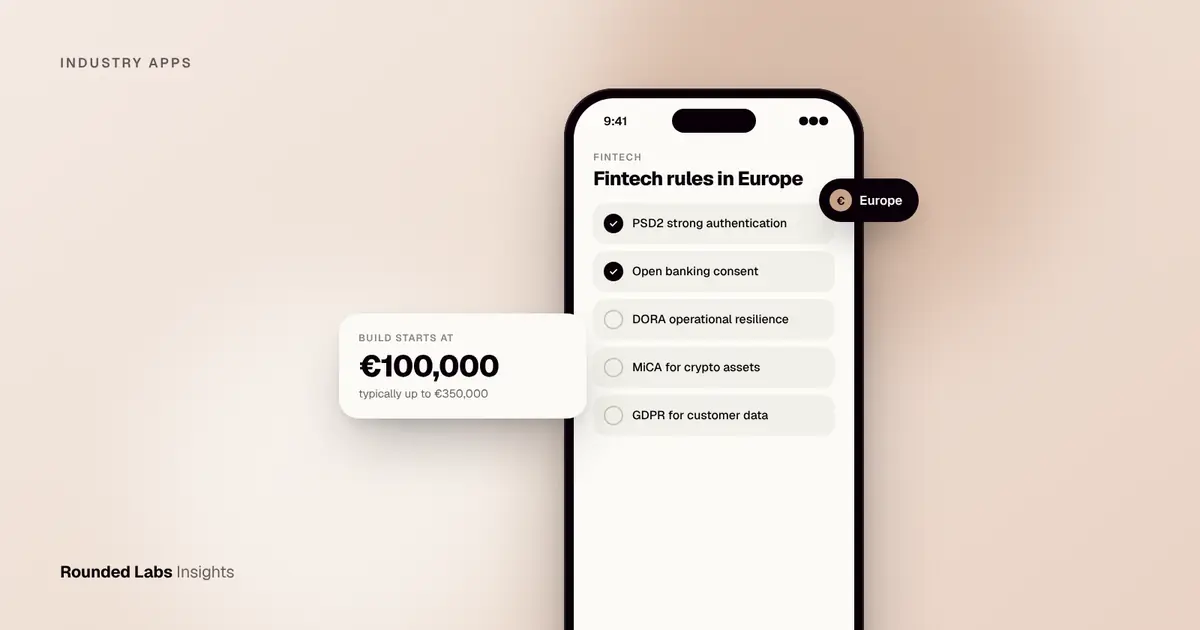
Fintech apps in Europe are shaped by a common EU rulebook: payment and e-money licences that can be passported across member states, PSD2 rules for strong customer authentication and open banking, DORA for operational resilience, MiCA for crypto-assets, and GDPR for data. A European fintech app typically costs €100,000 to €350,000 to build, and the fastest route to market is often through a licensed partner rather than your own licence.
We built MoBank, the UK’s first mobile banking app, and have worked on regulated financial products ever since, including the trading app Dabbl. This guide explains the European fintech landscape for founders and product teams, and what it means for the app.
Key facts
- A payment or e-money institution licence from one EU member state can be passported to others.
- PSD2 requires strong customer authentication (SCA) for most electronic payments and gives licensed providers access to bank account data and payment initiation.
- DORA has applied since 17 January 2025 to most EU financial entities.
- MiCA applies to crypto-asset service providers; the transitional periods allowed to member states have now ended, so authorisation is needed to operate.
- The EU is reforming payment rules (PSD3 and a Payment Services Regulation); check the current status and application dates before you plan around them.
Licence or partner?
| Route | Time to launch | Best for |
|---|---|---|
| Own payment or e-money institution licence | Often 6 to 18 months | Companies planning scale and control |
| Agent or distributor of a licensed institution | Often 3 to 6 months | Startups testing a market |
| Banking-as-a-service or embedded finance partner | Often 3 to 9 months | Card, account and payment products |
| Account information service registration | Often 3 to 9 months | Budgeting and data apps using open banking |
National regulators, such as BaFin in Germany, De Nederlandsche Bank in the Netherlands or the Central Bank of Ireland, grant licences, and the European Banking Authority coordinates rules across the EU (EBA).
What does PSD2 mean for the app?
Strong customer authentication. Most electronic payments and account access need two of three factors: something the user knows (PIN or password), has (a registered device) or is (biometrics). For apps, that usually means device binding plus biometrics or PIN, with exemptions for low-value or trusted transactions defined in the regulatory technical standards.
Open banking. Licensed account information and payment initiation providers can access bank accounts through bank APIs with the customer’s consent. In practice most apps use an aggregator that connects to thousands of European banks.
Design implications. SCA flows must be fast and clear, consent screens must explain what data is shared and for how long, and the app must handle failures and re-authentication gracefully.
Which other rules apply?
- DORA: ICT risk management, incident reporting, testing and supplier controls for regulated entities (post:G9).
- AML: customer due diligence, transaction monitoring and reporting under EU anti-money-laundering rules, with a new EU AML Authority (AMLA) taking on supervisory roles.
- MiCA: licensing and conduct rules for crypto-asset services.
- GDPR: lawful processing, data minimisation and security for customer data (post:G8).
- European Accessibility Act: banking services and ecommerce in scope since June 2025 (post:C5).
- Consumer credit rules if you lend, including the revised Consumer Credit Directive.
Building a fintech app for European users? We design SCA, consent and resilience into the product and quote the build in euros. Book a 30-minute call with a co-founder.
What must a European fintech app include?
| Feature | Why |
|---|---|
| Digital onboarding with KYC | AML rules; often video or document plus selfie checks |
| Strong customer authentication | PSD2 |
| Consent management for data sharing | PSD2 and GDPR |
| Transaction monitoring and alerts | AML and fraud prevention |
| Secure device binding | SCA and fraud prevention |
| Audit logs and reporting | Regulators and partners |
| Incident monitoring and runbooks | DORA |
| Accessible design to WCAG 2.2 AA | European Accessibility Act |
| Multi-language and multi-currency support | Passporting across markets |
How much does a European fintech app cost?
These are market estimates, not quotes.
| Scope | UK studio (in €) | Western European agency | Timeline |
|---|---|---|---|
| Budgeting app with open banking | €70,000 to €130,000 | €100,000 to €180,000 | 4 to 6 months |
| Payment or wallet app via licensed partner | €120,000 to €250,000 | €170,000 to €350,000 | 6 to 9 months |
| Digital bank or card product via BaaS partner | €180,000 to €350,000+ | €250,000 to €500,000+ | 8 to 12 months |
Licensing, legal, partner and compliance costs come on top. App development cost in Europe covers general European app costs.
How do you launch across several countries?
Passporting lets a licensed firm serve other member states, but each market still has differences: languages, local payment methods, bank coverage in open banking, tax reporting and consumer expectations. Plan a first market, prove the product there, then expand. Build localisation, multi-currency and country configuration in from the start so expansion is a configuration task, not a rebuild.
What did early mobile banking teach us?
When we built MoBank, phones were small, networks were slow and there was no App Store. Security and trust had to be designed into every screen. Two decades on, the tools are better, but the principle is the same: in financial apps, clarity about money, fees and security is the user experience.
Frequently asked questions
Do I need a licence to launch a fintech app in Europe?
If the app holds or moves customer money, provides payment services or accesses bank data as a service, you need a licence or a licensed partner. Some products can launch as agents or through embedded finance providers.
What is passporting?
The right of a firm licensed in one EU member state to provide services in others, after notifying regulators, without a separate licence in each country. UK firms lost passporting rights after Brexit.
What is strong customer authentication?
A PSD2 requirement that most electronic payments and account access use two independent factors from knowledge, possession and inherence, such as a registered phone plus a fingerprint.
Does DORA apply to fintech startups?
It applies to regulated EU financial entities such as payment and e-money institutions, with proportionality for smaller firms. Unregulated suppliers feel it through their clients’ contracts.
Can a UK company build a fintech app for the EU?
Yes. A UK studio can build the app and integrate with EU-licensed partners. The regulated entity must be authorised in the EU, and data protection rules must be followed. See Hiring a UK studio from the EU after Brexit.
Official sources and further reading
Talk it through with one of our co-founders. 30 minutes, no pressure.