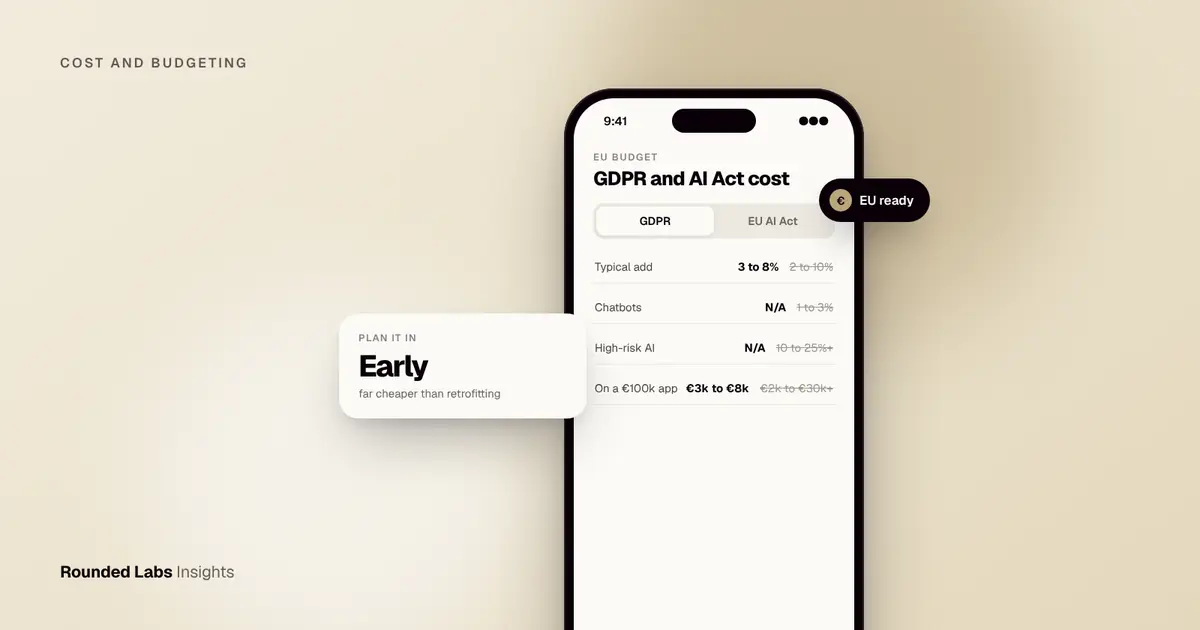
Making an app GDPR ready typically adds 3 to 8% to the build cost, and meeting EU AI Act duties adds a further 2 to 10% for apps with AI features, depending on whether the system is minimal-risk, subject to transparency rules or classed as high-risk. For a €100,000 app that means roughly €3,000 to €8,000 for GDPR and anywhere from €2,000 to €30,000 or more for the AI Act, plus legal advice. Designing for both from the first sprint costs far less than retrofitting after launch.
We built an AI prototype for the Bavarian government and moved Cubeware‘s analytics product to SaaS for 4,000+ enterprise customers across the DACH region, so we plan privacy and AI governance into projects from the start. This guide shows what the work involves, what each rule asks of your product, who is responsible for what, and what to budget. It is general information, not legal advice. All cost figures are market estimates, not quotes, and vary by supplier, scope and legal adviser. Laws, fees and dates change, so check the official sources linked below at the time you decide.
Key facts
- GDPR readiness: usually 3 to 8% of the build, plus a legal review.
- AI Act, minimal-risk AI features: close to zero extra cost beyond good practice.
- AI Act transparency duties (chatbots, generated content): small, often 1 to 3%.
- AI Act high-risk systems: 10 to 25% or more, with documentation, testing and oversight needs.
- The AI Act applies in stages, with some dates for high-risk systems subject to proposed changes, so check the current timetable on the European Commission’s AI Act page.
- Retrofitting is almost always more expensive than designing the controls in during discovery.
- Rounded Labs works to a fixed price agreed before development starts, and lists compliance work as its own lines. See the pricing page.
What does GDPR readiness cost?
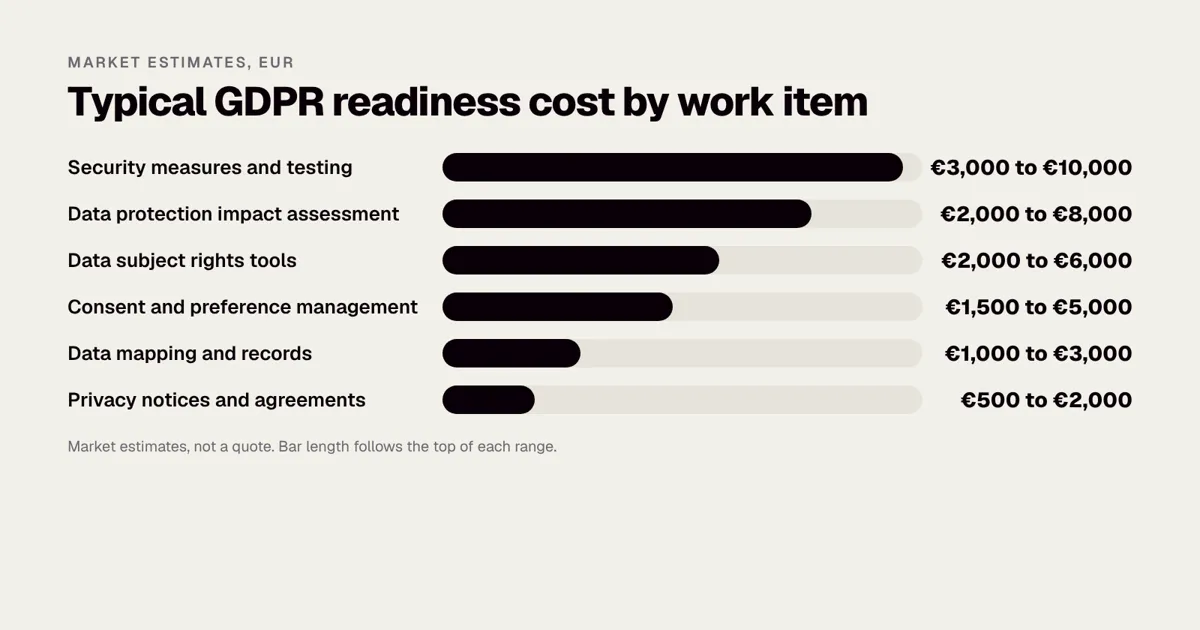
The General Data Protection Regulation applies to any app that processes personal data of people in the EU, whatever the size of the business and wherever the developer sits. The cost is not one item. It is a set of small pieces of work, some legal, some technical and some organisational. The table below shows typical market estimates for a mid-size business app.
| Work item | Typical cost for a mid-size app |
|---|---|
| Data mapping and records of processing | €1,000 to €3,000 |
| Consent and preference management in the app | €1,500 to €5,000 |
| Data subject rights tools (export, delete, correct) | €2,000 to €6,000 |
| Privacy policy and in-app notices | €500 to €2,000 |
| Data protection impact assessment, when required | €2,000 to €8,000 |
| Security measures and testing | €3,000 to €10,000 |
| Data processing agreements with suppliers | €500 to €2,000 |
The total usually lands between €5,000 and €25,000 for a mid-size business app, with larger platforms costing more. Hosting in EU regions such as Frankfurt, Dublin or Amsterdam keeps most data inside the EU and removes the need for extra transfer safeguards. For the full list of requirements see How to build a GDPR-compliant app.
Why do the percentages and the euro ranges not match exactly?
Two lenses are used in this guide, and they will not always line up. The percentage view (3 to 8% of the build) is a rule of thumb for planning. The line-item view is what you would see in a quote. A small app of €40,000 will sit at the high end in percentage terms, because the legal and structural work does not shrink in proportion to the code. A very large platform of €400,000 will sit at the low end in percentage terms, but the euro figure will be well above the table. Use the percentage to set an early budget line, then replace it with the line items once discovery is done.
What drives the figure up or down?
| Factor | Pushes cost up | Pushes cost down |
|---|---|---|
| Type of data | Health, biometric, children’s or financial data | Basic contact details only |
| Number of suppliers | Many analytics, advertising and AI vendors | A small, well-documented stack |
| Where data goes | Transfers outside the EU | Hosting and processing within the EU |
| Features | Profiling, tracking, user-generated content | Simple, single-purpose features |
| Starting point | Existing app with unclear data flows | New build with a clean data map |
| Users | Several countries, languages and consent rules | One market, one language |
What do you get for the money?
The point of readiness work is not a certificate. There is no GDPR certificate that proves compliance, and nobody can sell you one that makes you compliant. What you pay for is a product that can do the things the law expects: tell people clearly what you do with their data, collect only what you need, let them see, correct, export and delete it, protect it properly, and show a regulator your reasoning if asked. That is mostly good engineering and good documentation, and much of it makes the product better.
What does the EU AI Act add?
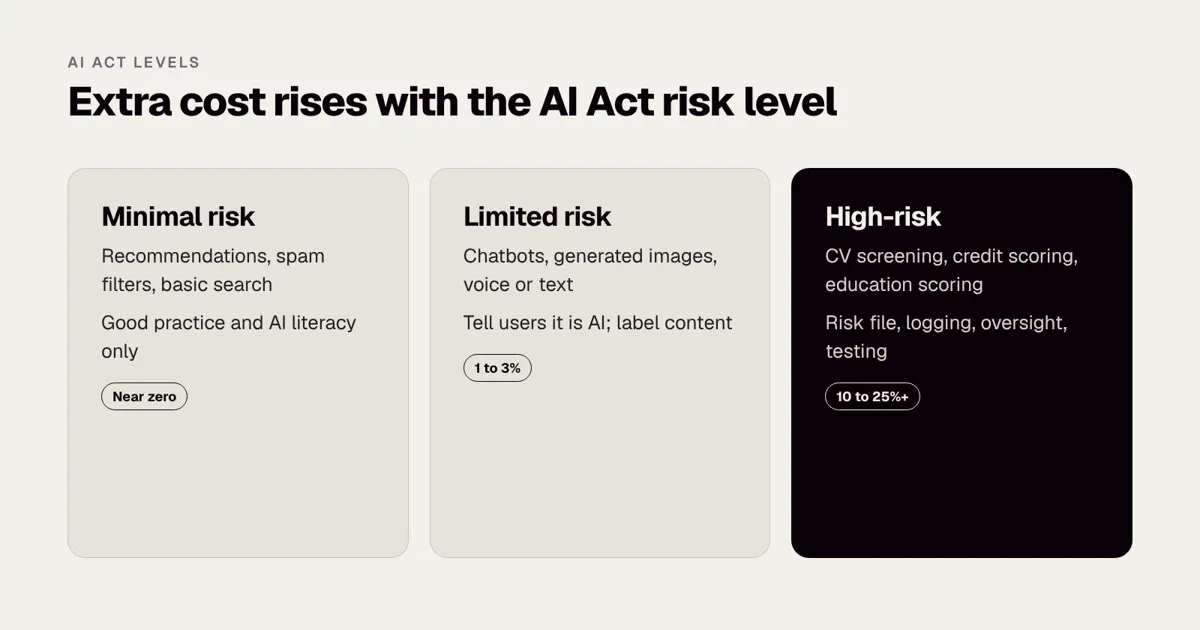
The EU AI Act sorts AI systems into risk levels, and costs rise with the level.
| Risk level | Examples | What the law asks for | Extra cost |
|---|---|---|---|
| Minimal | Spam filters, recommendations, basic search | Nothing mandatory; voluntary codes | Close to zero |
| Limited (transparency) | Chatbots, AI-generated images, voice or text | Tell users they are dealing with AI; label generated content | 1 to 3% |
| High-risk | CV screening, credit scoring, medical devices, education scoring | Risk management, data governance, logging, human oversight, technical documentation, conformity assessment | 10 to 25% or more |
| Prohibited | Social scoring, certain biometric uses, manipulative systems | Banned | Not allowed |
Most business apps with AI features fall into the first two rows. Our guide The EU AI Act for app and SaaS owners: what applies and when helps you work out where your product sits, and The EU AI Act and UK rules for AI apps, in plain English compares the EU and UK positions.
Not sure which rules apply to your product? We run a short scoping session that maps your data flows and AI features to GDPR and AI Act duties, then prices the work. Book a 30-minute call with a co-founder.
What does “AI system” mean for an app?
The Act defines an AI system broadly: a machine-based system that, for explicit or implicit objectives, infers from the input it receives how to generate outputs such as predictions, content, recommendations or decisions that can influence physical or virtual environments. In practice, a large language model feature, a classifier that scores applications, a recommendation engine that learns from behaviour and a computer vision model are all in scope in principle. A fixed set of if-then rules without learning is usually not. If you are unsure, ask your supplier to describe in one paragraph how each feature produces its output, and take advice on the borderline cases.
Which risk level is your app?
Classification is the single most useful piece of work you can do early, because it sets the budget. The questions below help you reach a first view. They are not a legal test, and you should confirm the result with a specialist.
- Does the feature fall into a banned practice? Examples in the Act include social scoring and certain manipulative or exploitative techniques. If yes, do not build it.
- Is the feature used in a field the Act lists as high-risk? The listed areas include biometrics, critical infrastructure, education and training, employment and worker management, access to essential services such as credit, law enforcement, migration and the administration of justice. A feature that decides, ranks or scores people in these fields is a candidate for high-risk.
- Is the AI part of a regulated product? Software in a medical device, for example, can bring in the product safety rules as well.
- Does the user interact with the AI directly, or see AI-generated content? If yes, transparency duties are likely to apply.
- None of the above? Then the feature is likely minimal-risk, and the main duties are good practice, plus AI literacy for your staff.
What are the common borderline cases?
| Feature | Likely level | Why it needs a second look |
|---|---|---|
| Customer-service chatbot | Limited | Must disclose AI; becomes more sensitive if it decides refunds or credit |
| Product recommendations | Minimal | Profiling still raises GDPR questions |
| CV or application ranking | High-risk | Employment is a listed area |
| Fraud detection on payments | Depends | Check whether it blocks access to an essential service |
| Photo or video analysis | Depends | Biometric use is tightly controlled; object detection is not |
| Learning app that scores pupils | High-risk | Education scoring is a listed area |
| Internal document summariser | Minimal or limited | Check what data goes into the model |
| Voice assistant | Limited | Disclosure and recording rules apply |
For deeper reading, see EU AI Act high-risk systems, EU AI Act transparency duties for chatbots and General-purpose AI models under the EU AI Act. If you are still shaping the feature, How to scope an AI MVP and How to add AI features to an existing app show how to keep risk visible from the start.
What if you use a third-party model such as a large language model?
If you build on a general-purpose model from a vendor, the vendor has its own duties as the model provider, and you have duties as the one who builds a system on top of it and puts it in front of users. The classification depends on what your app does with the model, not on the model itself. A chatbot that answers questions about opening hours is limited-risk. The same model used to rank job applicants is high-risk. That is why classification belongs to your product, and why you should ask each vendor what documentation and EU data options they publish. Our explainer on choosing an AI model for a business app covers the vendor side, and What is an LLM, in plain English? covers the basics.
What does each GDPR requirement mean in the build?
Each legal duty becomes something concrete in the product. Here is how the main ones translate. For the regulation itself, the text is on EUR-Lex, and the European Data Protection Board publishes guidelines that regulators across the EU use.
Lawful basis and consent
Every use of personal data needs a lawful basis, such as a contract, a legal obligation, a legitimate interest or consent. The choice shapes the product. If you rely on consent for analytics or marketing, the app needs a clear consent screen, a way to withdraw consent as easily as it was given, and a record of what was agreed. If you rely on contract, such as delivering the service a user signed up for, you do not need consent for that part, but you do need to explain it. Our plain-English guide on lawful bases for apps is UK focused but the thinking carries across, and ePrivacy rules for apps covers consent for tracking technologies.
Data mapping and records of processing
You cannot protect what you cannot see. Data mapping is the work of listing what personal data the app collects, why, where it is stored, who sees it and how long it stays. It feeds the records of processing the regulation expects of many organisations, and the privacy notice. It is also the foundation for the AI Act’s data governance duties. See GDPR records of processing for apps. In practice, it is a spreadsheet and a few workshops, and it is worth doing before design starts.
Data protection impact assessment
A data protection impact assessment is required where processing is likely to result in a high risk to people, for example large-scale profiling or large-scale use of sensitive data. Many AI features trigger it. The assessment describes the processing, assesses necessity and risk, and sets out measures to reduce the risk. Allow time and a budget line, and read GDPR data protection impact assessments and How to run a DPIA for a new app.
Rights of individuals
People can ask to see their data, correct it, delete it, restrict its use, move it elsewhere and object to certain uses. In the app, this means screens or a clear process for export and deletion, and a back office route for requests that cannot be self-served. Build the deletion path carefully, including backups and third-party systems. How to handle data deletion requests shows the typical shape. Plan for a response within one month under the regulation, which is why a manual process quickly becomes expensive.
Security of processing
The regulation expects appropriate technical and organisational measures. For an app, that means encryption in transit and at rest, strong authentication, access controls, secure development practice, logging and testing. These are the same measures that protect your business anyway. Mobile app security checklist: OWASP MASVS in plain English and OWASP MASVS levels set out a practical standard, and How to prepare for a security audit helps you plan one. The OWASP Foundation publishes the underlying standards.
Suppliers and processors
Every vendor that touches personal data on your behalf, such as hosting, analytics, email, payments or an AI provider, needs a written agreement with the right terms. Keep a list of suppliers and the data each one gets. Reducing the number of third-party SDKs in your app both lowers risk and lowers cost; see How to keep third-party SDKs under control.
Transfers outside the EU
If personal data leaves the European Economic Area, you need a lawful transfer mechanism, such as an adequacy decision, standard contractual clauses or another recognised route. The rules and their status have changed several times, and at the time of writing you should check the current position with the official sources. Our plain-English guides cover Schrems II and US cloud providers, the EU-US Data Privacy Framework, EU standard contractual clauses and UK and EU data transfers. Hosting in an EU region is the simplest way to avoid most of this work.
Breach readiness
If personal data is breached, the regulation expects notification to the supervisory authority without undue delay and, where feasible, within 72 hours of becoming aware, unless the breach is unlikely to result in a risk. Your app needs logging, alerting and a written response plan so that the team can meet that deadline. How to handle a data breach in an app provides a practical template.
Do you need a data protection officer?
Only in specific cases, such as large-scale regular and systematic monitoring of people or large-scale processing of sensitive data, or if you are a public authority. Many smaller companies do not need one, though they still need someone with clear responsibility for privacy. Check the criteria with the supervisory authority in your country, the European Data Protection Supervisor for EU institutions, or a specialist.
What does the AI Act ask for, level by level?
Minimal risk
For minimal-risk features, there are no mandatory product duties in the Act. Good practice still applies, and the Act also expects organisations that use AI to take steps to make sure their staff have a sufficient level of AI literacy. In budget terms this is training, a short internal policy and a register of the AI features you use. Responsible AI policies for app teams gives a starting point.
Limited risk and transparency
For chatbots and similar systems, users must be told they are interacting with an AI system unless that is obvious from the context. For AI-generated or manipulated images, audio, video and text published to inform the public, there are labelling duties, with exceptions. In the app, this means a visible notice, consistent wording and sometimes a technical marker in the output. It is a small build item, which is why the cost is typically 1 to 3%. Read EU AI Act transparency duties for chatbots.
High-risk systems
High-risk systems carry the heaviest duties, and they drive the larger part of the budget. In outline, providers of high-risk systems are expected to maintain the following.
| Duty | What it means in practice | Typical build impact |
|---|---|---|
| Risk management system | A documented process to identify and reduce risks across the lifecycle | Workshops, a risk register, regular reviews |
| Data governance | Quality, relevance and representativeness of training and test data | Data audits, documentation, bias checks |
| Technical documentation | A detailed file describing the system and how it works | Writing and maintaining the file |
| Record-keeping | Automatic logs of events during operation | Logging design, storage, retention rules |
| Transparency to deployers | Clear instructions for use | User documentation and limits of the system |
| Human oversight | Design that lets people monitor and intervene | Review screens, override controls, alerts |
| Accuracy, robustness, cybersecurity | Appropriate levels, tested and documented | Test suites, security work |
| Conformity assessment | A procedure before placing on the market | Internal check or notified body, depending on the case |
This is why high-risk features add 10 to 25% or more to the build. The work is real engineering and documentation, not paperwork alone. If you can redesign the feature so that it supports a human decision, and does not make it, the system may fall out of scope or at least be simpler to document. Take advice on this, because the wording of the Act matters.
General-purpose AI models
If you only use a vendor’s model through an interface, the heavy duties for general-purpose models sit with the vendor. If you train or substantially modify your own model, you may take on provider duties. Most app builders do not. Our guide to general-purpose AI models under the EU AI Act explains the split.
When do the AI Act duties apply?
The Act entered into force in August 2024 and applies in stages. At the time of writing, bans on prohibited practices and the AI literacy duty have applied since 2025, obligations for general-purpose models followed, and most other duties, including those for many high-risk systems, are scheduled across 2026 and 2027. There have also been proposals to adjust some timelines, so the dates for high-risk systems in particular may move. Do not rely on any article, including this one, for a date. Check the European Commission’s AI Act page before you plan, and ask your legal adviser to confirm the schedule for your product.
What are the penalties?
At the time of writing, GDPR fines can reach €20 million or 4% of worldwide annual turnover, whichever is higher, for the most serious infringements. For the AI Act, fines for prohibited practices can reach €35 million or 7% of turnover, with lower tiers for other breaches. Most cases end far below the maximum, and regulators consider many factors, but the exposure is real. Penalties are not the best reason to invest, though. The better reason is that customers, especially enterprises and public bodies, now ask for evidence in procurement.
Who is responsible for what?
The AI Act splits duties between providers, who build or place an AI system on the market, and deployers, who use it in their business. Most companies commissioning a custom app are both. Your development partner can build the controls, but you remain responsible for the way the system is used. Agree in the contract who writes the documentation, who monitors performance and who talks to regulators. See Contracts, IP and payment when you hire an overseas app agency for contract points.
GDPR has its own split between controllers, who decide why and how data is processed, and processors, who handle it on their behalf. In most commissioned projects, you are the controller and your agency is a processor for any personal data it touches during development and support.
| Task | Usually you (the client) | Usually the agency | Shared |
|---|---|---|---|
| Decide the purpose and lawful basis for data | Yes | Advice | |
| Classify AI features by risk | Final decision | Draft and evidence | Yes |
| Build consent, rights and logging features | Yes | Review | |
| Write privacy notices | Sign off | Draft technical content | Legal review |
| Run the DPIA | Owner | Technical input | Yes |
| Keep technical documentation for a high-risk system | Own and approve | Draft and maintain during the build | Yes |
| Monitor the system after launch | Yes | Support | Yes |
| Handle requests from individuals | Yes | Tools and support | |
| Answer to regulators | Yes | Technical support | |
| Sign processor agreements | Yes | Yes |
What should the contract say?
At minimum: the roles each party takes; who owns the documentation; what the agency must deliver for each control; how incidents are reported and how fast; where data is stored and which sub-processors are used; what happens to data at the end; and how changes in law are handled. Our guides on who owns the code and the questions to ask before you sign include related points.
A worked example: an HR screening assistant
A German software company wants an assistant that ranks job applications. Under the AI Act, systems used for recruitment are classed as high-risk.
| Item | Cost |
|---|---|
| Base app and AI feature | €90,000 to €120,000 |
| GDPR readiness, including a DPIA | €8,000 to €15,000 |
| Risk management, documentation and logging | €10,000 to €20,000 |
| Human oversight tools and bias testing | €8,000 to €18,000 |
| Legal review | €6,000 to €15,000 |
| Total | €122,000 to €188,000 |
The compliance share here, from €32,000 to €68,000, is roughly a third of the base build at the low end and above half at the high end. That is a large addition, which is why the first conversation should be whether the feature is the right design. A version that shows recruiters a structured summary and highlights matching criteria, but leaves ranking to a person, may be simpler. It is still a recruitment tool and still needs careful treatment, so take legal advice before you rely on a design change to reduce the risk level.
What would the delivery look like?
In the first four to six weeks, discovery covers classification, data mapping and a draft DPIA. The design then includes oversight screens, such as reasons for a score, the ability to override and an audit trail. The build adds logging and test sets that look for bias across groups. Before launch, the team completes the documentation and a legal review. After launch, someone owns monitoring, because performance can drift as the data changes.
A worked example: a customer-service chatbot for a retailer
Compare that with a customer-service chatbot for a retailer, which mostly needs a disclosure that users are talking to AI, a privacy notice and sensible data handling. The extra cost there might be €2,000 to €5,000.
| Item | Cost |
|---|---|
| Disclosure notice and consistent wording | €300 to €800 |
| Privacy notice update and data map for chat logs | €500 to €1,500 |
| Retention rules and deletion for chat history | €500 to €1,200 |
| Handover to a human, with a clear route | €500 to €1,500 |
| Staff guidance and AI literacy note | €200 to €500 |
| Total | €2,000 to €5,500 |
The one feature that could change the picture is whether the bot makes decisions that affect people’s rights, for instance approving refunds or credit, or collects sensitive details. Keep it to information and routing, and the cost stays small. See How to add AI to customer support and AI for retail: use cases that pay back for the commercial side, and Making AI features safe: hallucinations, privacy and security for the risk side.
A worked example: a wellbeing app with personalised tips
A wellbeing app suggests exercises and sleep routines, using a model that learns from what users log. The AI feature itself is probably minimal-risk, since it is a recommendation system for general wellbeing and not a medical device. The GDPR picture is different, because health-related data is a special category that needs a stronger lawful basis, usually explicit consent, and careful security.
| Item | Cost |
|---|---|
| GDPR readiness with a DPIA and explicit consent flows | €10,000 to €18,000 |
| Security testing and encryption of health-related fields | €5,000 to €10,000 |
| Data processing agreements and supplier review | €1,000 to €3,000 |
| AI literacy, policy and register | €500 to €1,500 |
| Legal review, including claims and marketing wording | €4,000 to €9,000 |
| Total extra | €20,500 to €41,500 |
The lesson is that the AI Act risk level and the GDPR burden are separate questions. A minimal-risk AI feature can still sit on a product with a heavy privacy load. If the app begins to make medical claims, other rules, such as those for medical device software, may apply. Our guide on the EU Medical Device Regulation for health apps and App development for healthcare in Europe cover that path.
How can you keep the cost down?
- Classify early. Decide the risk level in discovery, before design work begins.
- Collect less data. Fewer data fields mean fewer rights to honour and less to secure.
- Use compliant providers. Choose AI vendors that publish their documentation and EU data options.
- Reuse components. Consent, logging and audit trails built once serve both GDPR and the AI Act.
- Plan legal review once, not per feature. Batch questions into one engagement.
What do these savings look like in practice?
| Decision | What changes | Effect on cost |
|---|---|---|
| Host in an EU region | No cross-border transfer work for core data | Removes a legal and technical task |
| Keep human decision-making in the loop | May lower the risk level or simplify documentation | Can remove a large block of work, subject to legal advice |
| Use anonymised or synthetic data in testing | Fewer privacy risks in test systems | Lower security and legal effort |
| Limit analytics SDKs | Fewer processor agreements and consent items | Lower setup and upkeep cost |
| Build one consent and logging layer | Serves several features and both regimes | Avoids rebuilding per feature |
| Defer risky features to version two | Smaller first release | Moves the compliance cost to when you have revenue |
How to scope an AI MVP and How to keep AI running costs under control give related advice, and How to cut app development costs without cutting quality covers the wider picture.
Is it cheaper to retrofit later?
Almost never. Retrofitting means opening finished screens, changing data models, re-testing and sometimes migrating live data and contacting users again for consent. It also means the earlier design decisions may have to be unpicked. The cheapest moment for any control is the discovery phase, when it is a line in a plan. The next cheapest is design, then build. After launch, every control competes with live users and a release schedule. If you have an existing app with unclear data flows, a review first is sensible; our Tech Architecture Audit is £7,500 fixed and our Legacy App Rescue Assessment is £6,500 fixed, and both are listed on the pricing page. How to audit an existing app’s code explains what a review covers.
What do you pay after launch?
Expect ongoing costs: monitoring AI performance and bias, keeping records up to date, handling data requests, and updating documents when rules or features change. A typical allowance is 5 to 10% of the build cost each year on top of normal maintenance. App development cost in Europe puts this alongside other European costs, and the total cost of owning an app over five years shows the longer view.
| Ongoing task | What it involves | Who usually does it |
|---|---|---|
| Monitor AI quality and drift | Review samples, error rates and complaints | Product owner with the agency |
| Review the data map | Update when features or vendors change | Product owner |
| Handle rights requests | Respond within the legal time limit | Operations or support |
| Refresh the DPIA and risk file | After material changes | Product owner, adviser |
| Test security | Scheduled testing and fixes | Agency or specialist |
| Review vendors | Check terms, locations and sub-processors | Product owner |
| Train staff | AI literacy and privacy refreshers | Business |
If your supplier also maintains the app, see App maintenance costs in the UK for the pattern; the figures are UK-based, but the categories are the same.
What does a fixed-price quote include?
Rounded Labs works on fixed prices agreed before development starts, and we list compliance work as its own lines so you can see it. Projects typically range from £30,000 to £250,000+ (roughly €35,000 to €290,000); see our pricing page. For AI-heavy products, our AI product development service covers the technical side, and we recommend you work with a data protection specialist for formal advice.
If you are not ready for a full build, a Mobile Product Discovery Sprint at £9,500 fixed is the place where classification, data mapping and a costed plan are produced. Digital Transformation Prep is £7,000 fixed and suits a business that is planning a larger move from older systems and wants the data and responsibility questions answered first. Our guide to what happens in a discovery phase shows what you get.
What should a good compliance line in a quote say?
| Line | What to look for |
|---|---|
| Data mapping and classification | Named deliverables: data map, risk level, rationale |
| Consent and rights tooling | Which screens and admin tools are included |
| Logging and audit trail | What is logged, for how long, and who can see it |
| Security testing | Scope and standard, such as MASVS level |
| Documentation | Which documents, who writes and who approves |
| Legal review | Who provides it, and whether it is in or out of the price |
| Exclusions | What is not covered, in writing |
How do UK, EU and international rules fit together?
Many of our clients are UK businesses with EU users, or EU businesses that hire a UK studio. GDPR applies to the processing of personal data of people in the EU, and the UK has its own version, UK GDPR, with the Data (Use and Access) Act 2025 adding changes. The EU has recognised UK data protection as adequate at the time of writing, which allows personal data to flow, but this is subject to review, so check the current status with the official sources, including the Information Commissioner’s Office for the UK side. If a UK business offers services to people in the EU, EU rules may apply to it directly. If you are an EU company hiring a UK studio, see Hiring a UK studio from the EU after Brexit, UK GDPR for mobile apps and The UK Data (Use and Access) Act 2025.
For AI, the UK has taken a principles-based route so far, while the EU has a single binding Act. If you sell into both, design to the stricter standard where it is practical. UK AI regulation principles for app builders and App compliance in 2027: what UK, US and EU businesses get wrong help you compare. If your users include the public sector, read AI for European public sector bodies and the story of how we built AI land classification for the Bavarian government, which shows how procurement-driven requirements shape a build. For enterprise customers, Delivering for German enterprise clients: lessons from Cubeware explains what such buyers ask.
What mistakes make compliance more expensive?
- Starting with the tool, not the data. Buying a consent platform before mapping data produces the wrong configuration.
- Treating compliance as a final-week task. It then collides with launch pressure.
- Letting every team add its own SDK. Each one is a new processor and a new consent item.
- Assuming the vendor handles everything. The vendor covers its own duties; yours remain.
- Copying a privacy policy from a competitor. It will not match your data flows.
- Using real personal data in test systems. It spreads risk across more places.
- Skipping the human oversight design. For high-risk systems, an override that exists only on paper fails in practice.
- Forgetting that rules change. Put a review date in the calendar.
A checklist before you commission the work
- List each AI feature and describe in one paragraph how it produces its output.
- Classify each feature against the risk levels, and note the reasoning.
- Map the personal data each feature uses, where it is stored and who can access it.
- Decide whether a DPIA is needed, and who will own it.
- List suppliers and check their EU data options and documentation.
- Agree who writes and maintains each document.
- Set a budget line for legal review, separate from build.
- Ask for compliance work as separate lines in the quote.
- Plan the first post-launch review, and put it in the calendar.
- Confirm dates and duties with the official sources at the time you decide.
What questions should you ask a supplier?
| Question | A good answer includes |
|---|---|
| Have you shipped an AI feature in the EU before? | Examples, even if anonymised, and what controls were built |
| How do you classify AI features? | A method, not a guess; an evidence file |
| Where is data stored and processed? | Named regions and sub-processors |
| What do you log and for how long? | Specifics, with retention rules |
| Who writes the technical documentation? | A clear division of labour |
| How do you test for bias and drift? | Test sets, metrics and a review rhythm |
| What happens if the law changes? | A process for updates and who pays for what |
Our general guide, 20 questions to ask an app developer before you sign, is a useful companion. If you are comparing agencies, How to choose an app development company helps you weigh them.
What should you do next?
Start with a half-day exercise. List your AI features, write the one-paragraph description for each, and mark the likely risk level. Map the personal data they touch. That page alone is enough to get a realistic quote and to avoid two common surprises: a feature that turns out to be high-risk, and a data flow that crosses a border. Then ask your supplier for the compliance lines separately. If you want a second view before you commit, talk to a co-founder and we will tell you honestly where your product sits and what we would budget. For a wider look at the AI side of costs, read How much does it cost to add AI to an app? and AI document processing for UK businesses.
Frequently asked questions
Does every app need to follow the AI Act?
No. It applies to AI systems placed on the EU market or used in the EU. Apps without AI features are not covered, and most AI features fall into the minimal or limited risk categories.
How much does a GDPR audit of an existing app cost?
A technical and legal review of an existing app usually costs €3,000 to €15,000, depending on size, plus the cost of any fixes it finds. These are market estimates, not quotes.
Do I need a data protection officer?
Only in specific cases, such as large-scale monitoring or processing special-category data at scale. Many smaller companies do not, though they still need clear responsibility for privacy.
Can a UK studio build a GDPR-compliant app for an EU client?
Yes. GDPR follows the data and the users, not the developer’s location. See Hiring a UK studio from the EU after Brexit for contract and data-transfer points.
What are the penalties?
GDPR fines can reach €20 million or 4% of worldwide turnover, and AI Act fines for the most serious breaches can reach €35 million or 7%. Most cases end far below the maximum, but the exposure is real. Check the official texts for the current position.
Is there a certificate that proves my app is GDPR compliant?
No single certificate proves compliance. Some approved codes of conduct and certification schemes exist, and standards such as ISO 27001, published by the International Organization for Standardization, can support your security story, but you remain responsible for the way you process data. Keep your records, assessments and decisions in order, because that is what a regulator or customer will ask to see.
Should I wait for the AI Act dates to settle before I plan?
No. Classification, data mapping and good logging are useful whatever the final dates, and they are cheapest in discovery. Plan the work now, and confirm the dates for your product against the official timetable and with your legal adviser before launch.
Official sources and further reading
Talk it through with one of our co-founders. 30 minutes, no pressure.