

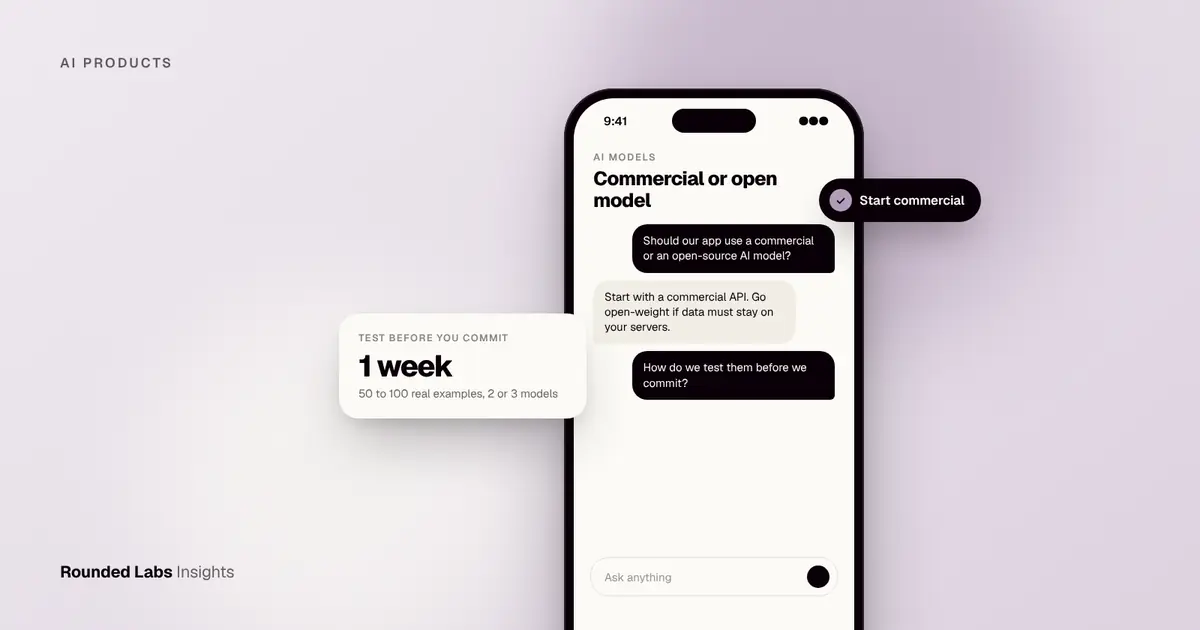
For most business apps, start with a commercial AI model used through an API: it is the fastest route to good quality. Choose an open-weight model when data must stay on your own servers, volume is high enough to make hosting cheaper, or you need deep control. Build the app so the model can be swapped later.
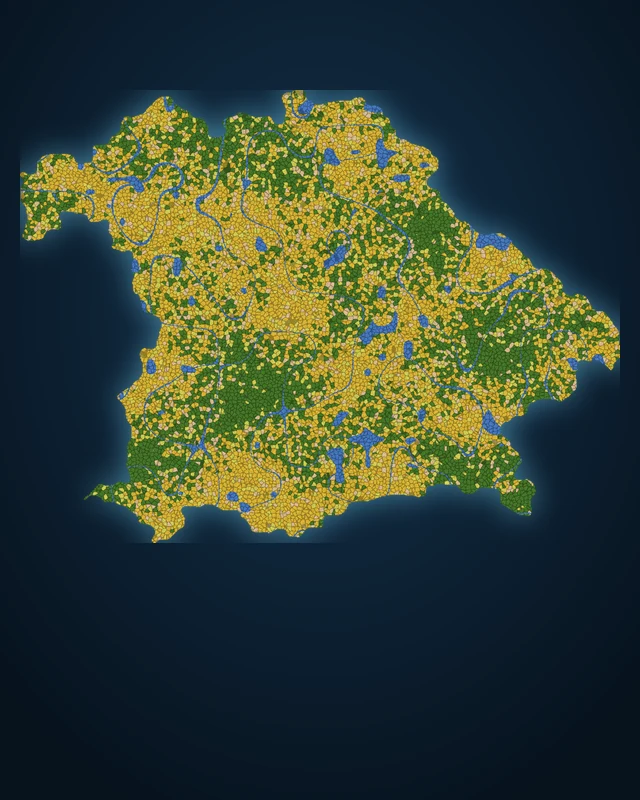
We built an AI land-classification prototype for the Bavarian government, where the data was processed and who controlled it mattered as much as accuracy. This guide covers the real differences between commercial and open-source models, a simple way to decide, and the mistakes we see founders make. It sits within our AI product development work.
Key facts
- Commercial models are paid for by usage and reached through an API. Open-weight models can be downloaded and run on infrastructure you control.
- Many “open source” models are really open-weight: the trained model is available, but the licence may limit commercial use or the training data is not shared. Read the licence.
- Quality gaps between the best commercial and best open models change every few months, so decide on your own test results, not on rankings.
- Running your own model adds hosting, monitoring and engineering work that an API hides from you.
- The model is rarely the hard part. Data, prompts, testing and safety checks decide whether the feature works.
What is the difference between commercial and open-source AI models?
A commercial model is run by a provider. Your app sends a request, the provider processes it on their servers, and you pay for what you use. You get strong quality, regular updates and little setup, but you depend on the provider’s prices, terms and uptime.
An open-weight model is one whose trained parameters are published, so you or your developer can run it on your own cloud account or hardware. You control where data goes and can tune the model, but you carry the hosting and maintenance. The Open Source Initiative maintains a formal definition of open-source AI, and many popular models do not meet it because of licence limits or undisclosed training data, so ask which kind you are being offered.
A third route sits between them: a commercial model hosted inside your own cloud region, with contractual limits on how your data is used. For many European and regulated businesses this meets the privacy need without self-hosting.
How do the two options compare?
| Question | Commercial API | Open-weight, self-hosted |
|---|---|---|
| Time to first working version | Days | Weeks |
| Upfront engineering | Low | Medium to high |
| Cost at low volume | Usually cheaper | Usually dearer (servers run even when idle) |
| Cost at very high volume | Can become large | Can be cheaper per request |
| Data control | Depends on provider terms and region | Full control |
| Quality on hard tasks | Often the strongest | Good, and improving, but test it |
| Customisation | Prompts, some fine-tuning | Deep, including full fine-tuning |
| Risk of price or terms changes | Yes | Low |
| Who maintains it | The provider | You |
Treat the table as a starting point. A small, well-chosen open model can beat a large commercial one on a narrow task, and a commercial model is often the better answer for a wide, messy one.
How do you decide? Five questions to ask
- Can this data leave our control? If the answer is no, because of contracts, health records or public-sector rules, lean towards self-hosting or a regional private deployment.
- How many requests a month will we have? A few thousand a day rarely justifies running your own servers. Millions might.
- How hard is the task? Summarising, drafting and extracting data are well served by smaller models. Open-ended reasoning across messy documents tends to favour the strongest commercial ones.
- Do we have people to run it? Self-hosting needs someone to monitor, patch and scale it. If you do not have that, the saving is imaginary.
- How bad is switching later? If your app is built around one provider’s special features, moving is expensive. Keep prompts and logic in your own code.
What does it cost in practice?
Model costs are usually the smaller part of an AI feature. The larger parts are design, integration, testing and ongoing monitoring. For a deeper look, read How to keep AI running costs under control.
As a worked example, imagine an app that summarises customer emails. At 2,000 emails a day, with each email and summary using a few thousand tokens, a commercial API might cost from tens to a few hundred pounds a month at the time of writing (check the provider’s pricing page, as these change often). A dedicated GPU server to host an open model can cost more than that every month on its own, before engineering time. The picture flips only when volume grows by an order of magnitude, or when privacy rules rule out the API.
These figures are illustrative market estimates, not a quote. Rounded Labs works to a fixed price agreed before development starts, with projects typically £30,000 to £250,000+; see the pricing page. Model usage fees are paid by you to the provider and are not part of that price, which is why we help you estimate them in advance.
Not sure which route fits your product? We can test two or three models against your real documents and give you a plain recommendation. Book a 30-minute call with a co-founder.
How should you test models before committing?
Rankings and demos do not tell you how a model handles your data. A fair test takes about a week:
- Collect 50 to 100 real examples of the task, with the answer you would want for each.
- Run the same examples through two or three candidate models with the same instructions.
- Score the results against your expected answers, ideally with someone who knows the subject.
- Record cost per request and the time each took to respond.
- Look at the failures, not the average. A model that is wrong in a harmful way is worse than one that is wrong more often but harmlessly.
This is the same discipline we use when scoping an AI MVP; see How to scope an AI MVP. Repeat the test when you think about switching, because the answer can change as new versions arrive.
How do privacy and regulation affect the choice?
Both options can be compliant, and neither is automatically safe. What matters is where data is processed, what the provider may do with it, and what you tell users.
- Check the provider’s data terms. Look for commitments that your inputs are not used to train their models, the retention period, and where processing happens.
- Know your regional rules. UK and EU GDPR apply to personal data sent to any model. The EU AI Act adds duties for some uses of AI, depending on risk, and its obligations are being phased in, so check the current official text and timetable. See The EU AI Act for app and SaaS owners and The EU AI Act and UK rules for AI apps.
- Minimise what you send. Strip names and identifiers before a request leaves your system where the task allows.
This is general information, not legal advice. For sensitive data, take legal advice before you choose.
How do you avoid getting locked in?
Lock-in is the real long-term risk in both directions. A few habits keep your options open:
- Put a thin layer in your code between the app and the model, so changing provider means changing one place.
- Keep your prompts, test examples and evaluation scores in your own repository.
- Avoid depending on features only one provider offers unless the benefit is clear.
- Re-run your tests every few months. New models appear often, and prices fall.
- Store your own data in your own database, not inside a provider’s tool.
Many mature products end up using more than one model: a small, cheap one for routine tasks and a stronger one for hard cases. That is easier to do if you designed for swapping from the start. If you are deciding between a bespoke build and a ready-made tool, read Custom AI vs off-the-shelf ChatGPT tools.
Where does the model fit in the whole project?
Founders often spend weeks on the model choice and days on everything around it. The surrounding work is where results come from: getting your documents into a usable form, as in RAG for business owners, writing and testing the instructions, and putting guardrails in place; see Making AI features safe. If you are adding AI to an app that already exists, start with How to add AI features to an existing app.
Frequently asked questions
Is an open-source model free?
The model files may cost nothing, but running them does not. You pay for servers, engineering time and monitoring. At low volume that usually exceeds what you would pay a commercial API.
Are open-source models less accurate?
Not always. The strongest commercial models often lead on hard, open-ended tasks, while smaller open models can match them on narrow, well-defined jobs. Test both on your own examples.
Is my data safe with a commercial AI provider?
It can be, if you choose a plan whose terms say your data is not used for training, set the right region and limit what you send. Read the data terms and ask your developer to check them.
Can I change models later?
Yes, if the app was built for it. Keep prompts and logic in your own code and keep a set of test examples so you can compare a new model quickly.
Should I fine-tune a model?
Usually not at first. Good instructions and supplying your own documents at request time solve most business needs at lower cost. Consider fine-tuning only when testing shows a clear gap that other methods cannot close.
Official sources and further reading
Talk it through with one of our co-founders. 30 minutes, no pressure.