A social commerce app that pays its users lets people post their own style content, tag products in it and earn a commission when someone buys through that content. The hard parts are not the feed or the camera. They are tracking sales back to the right creator, keeping payouts accurate, and proving the idea works before you spend a full build budget.
That is the problem the DRSR team brought to us. We worked with the founders to turn their idea for a creator-led social shopping app into a working mobile prototype that real users could try and give feedback on. This guide uses that project to explain how a social commerce app is shaped, what to build first, where the risks sit and how to budget. Cost ranges are market estimates, not quotes.
Key facts
- Social commerce combines three products in one: a content feed, a shop and a payments or commissions engine.
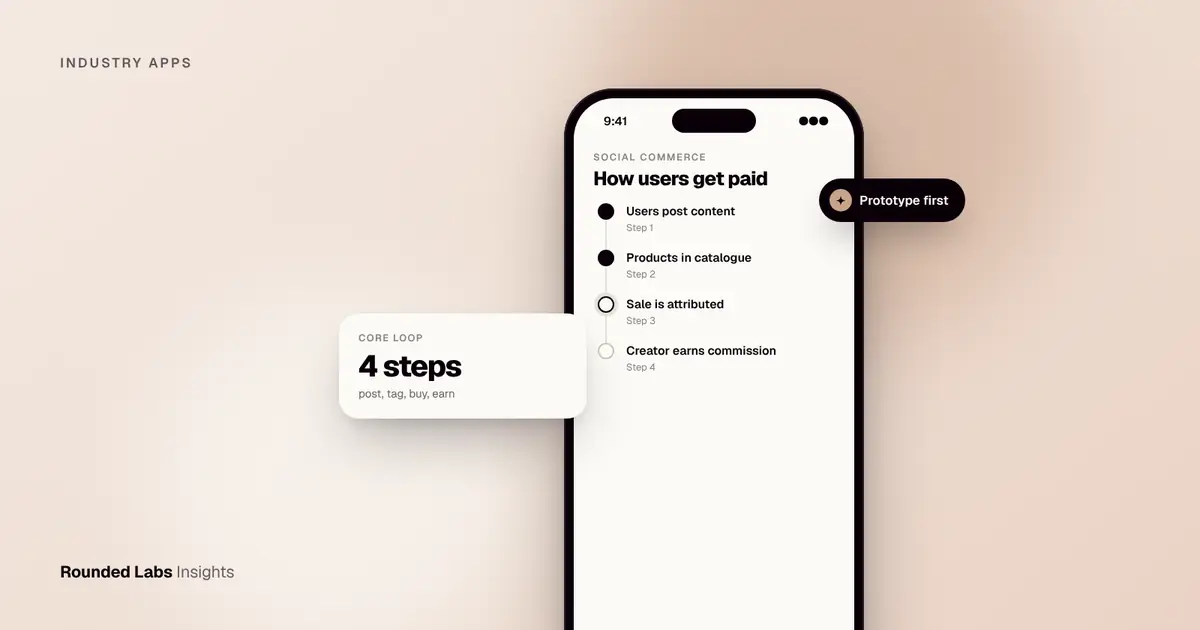
- The core loop is: post content, tag a product, a viewer buys, the creator earns a commission.
- A prototype that real users can touch is the cheapest way to test whether the loop works.
- Attribution (knowing which post drove which sale) and payout rules are the hardest technical and commercial parts.
- Rounded Labs prices every project at a fixed price agreed before development starts; see our pricing page.
What is a social commerce app?
A social commerce app lets people discover, discuss and buy products inside a social experience, rather than leaving a social network to shop on a separate site. Most people know the pattern from shopping tags on photos and videos.
DRSR took the idea one step further. Users show off their style, tag products directly in their content, and earn commissions from the purchases their influence drives. The people who create the content share in the value they create, instead of handing it all to a platform or a brand.
How does a platform that pays its users actually work?
Underneath, there are four moving parts:
- Content. Users post photos or short posts with a caption and tagged items.
- Catalogue. Products come from retailers or affiliate feeds, with price, image and a link to buy.
- Attribution. When a viewer taps a tag and buys, the system records which post and which creator sent them.
- Commission. The retailer pays a commission, the platform takes its share, and the creator is credited the rest.
Each part is simple on its own. The difficulty is that they must agree. A creator who sees a sale missing from their earnings stops trusting the app quickly, so the attribution and ledger design deserves more care than the feed.
What should you build first?
The temptation with a social app is to build everything: followers, comments, direct messages, notifications, stories, search. We would argue for the opposite. Build only what is needed to run the loop once, end to end, with a small group of users.
| Build now | Leave for later |
|---|---|
| Sign up and profile | Direct messaging |
| Post with photo and caption | Stories and live video |
| Tag a product from the catalogue | Advanced search and recommendations |
| Basic feed | Creator analytics dashboard |
| Tap through to buy | Tiered commission levels |
| Simple earnings view | Automated payouts at scale |
This is the same logic we describe in What is an MVP?: the smallest product that answers your riskiest question. For a social commerce idea, that question is whether people will post, whether others will buy, and whether creators care enough about the earnings to come back.
Why start with a prototype?
A prototype lets founders put something in front of real people early. For DRSR, the goal was to let users experience a working product and gather early feedback, and the beta feedback helped the team adjust the product through quick iterations.
That approach suits any idea where behaviour matters more than features. You can write a long specification for a social app, but you will not know whether people enjoy posting until they post. A working prototype turns opinions into evidence.
If you are unsure what to include, our Mobile Product Discovery Sprint (£9,500, fixed price) is designed for this stage: it turns an idea into a clear scope, a tested design and a costed plan before you commit to a full build.
Have a product idea that depends on user behaviour? A working prototype tells you more than a long spec. Book a 30-minute call with a co-founder and we will help you decide what to test first.
What are the risks of a pay-the-user model?
Paying users brings issues that a normal shopping app does not have:
- Disclosure rules. Creators who earn from the products they post usually have to make that clear. In the UK the Advertising Standards Authority and the CMA expect clear labelling of affiliate content, and in the US the Federal Trade Commission has endorsement guidance. Rules change, so check the current official guidance for each market you launch in.
- Payout accuracy. Returns, cancellations and late retailer payments all change what a creator is owed. Decide early when a commission becomes final.
- Fraud. Fake accounts and self-purchases to farm commission are predictable. Plan limits and review tools from the start.
- Tax and payments. Paying individuals can create reporting duties for the platform. Take advice before you promise payouts.
- Cold start. A feed with no content is dull, and creators will not post without an audience. Launch to a tight group first.
These are reasons to prototype with a small beta, not reasons to avoid the idea.
How does this compare with other retail and commerce apps?
A brand-led shopping app such as the ones we built for retailers has a different job. Its catalogue is its own, its customers already exist, and the main work is making buying fast. We cover those lessons in Retail app features that drive sales. A social commerce platform has to earn its audience as well as its sales, which is why the community loop matters more.
The business model also differs. Our guide to App monetisation compares subscriptions, in-app purchases and ads. A commission-share model is closer to affiliate marketing: you earn only when a sale happens, which keeps early costs low but makes growth dependent on conversion.
What does a social commerce app cost?
Rounded Labs works to a fixed price agreed before development starts, and projects typically run from £30,000 to £250,000+. A social commerce prototype sits at the lower end, because it deliberately leaves out most social features. A full platform with payouts, moderation, retailer integrations and analytics sits much higher.
As a market guide, a focused prototype from a UK studio often falls somewhere between £30,000 and £80,000, while a launch-ready social commerce product can be several times that. For US readers, see How much does an MVP cost in the US? and How much does it cost to build an app in the US?. At about £1 to $1.27, a £30,000 prototype is roughly $38,000.
Two choices affect the number most: whether you build for iOS and Android together, which we explain in What is a cross-platform app?, and how much of the payout system is automated at launch.
Frequently asked questions
What is social commerce?
It is shopping that happens inside a social experience, where people discover and buy products through posts, videos or recommendations from other users. The sale is linked to the content that prompted it.
How do users earn money in a social shopping app?
They earn a commission when someone buys a product through their tagged content. The retailer pays a commission, the platform keeps a share and the creator receives the rest.
Should I build a prototype or a full app first?
For a new social idea, a prototype. It lets you test posting, buying and earning with real users before committing a full budget, and the feedback shapes what you build next.
Do I need legal advice for a creator payment model?
Yes. Advertising disclosure, tax reporting and consumer rules vary by country, so get specialist advice before you launch payouts. This guide is general information, not legal advice.
Can Rounded Labs help with an early idea?
Yes. We often start with founders who have a concept and no specification. A discovery sprint or a call with a co-founder is the usual first step.
Official sources and further reading
Talk it through with one of our co-founders. 30 minutes, no pressure.