

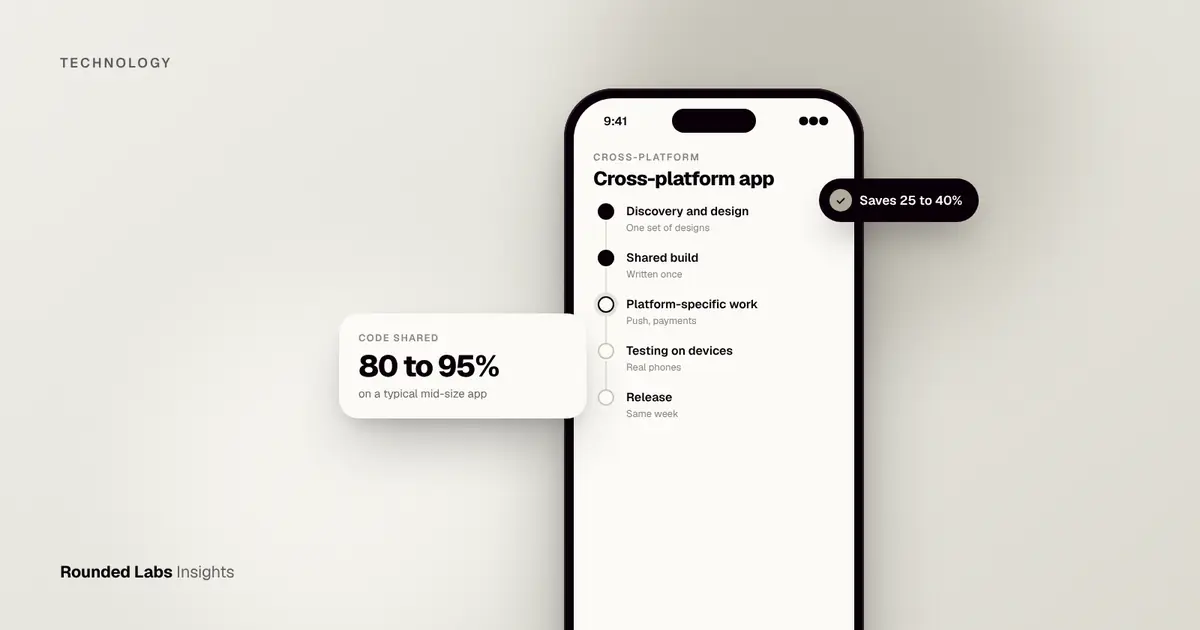
A cross-platform app is a mobile app built from one shared codebase that runs on both iOS and Android, instead of two separate apps written in Swift and Kotlin. Frameworks such as Flutter and React Native make this possible, typically saving 25 to 40% of mobile development cost while delivering performance close to native for most business and consumer apps.
We have built native and cross-platform apps since the earliest days of the App Store, including the cross-platform trading app Dabbl and native apps for brands like Waterstones. This page explains how cross-platform works and when it is the right choice.
Key facts
- One codebase for iOS and Android, sometimes web and desktop too.
- Main frameworks: Flutter (Google), React Native (Meta), Kotlin Multiplatform (JetBrains), .NET MAUI (Microsoft).
- Typical saving: 25 to 40% on mobile build and ongoing maintenance.
- Performance: close to native for most apps; native still leads for graphics-heavy or deeply device-specific apps.
- Major apps use cross-platform frameworks, including parts of Google, Microsoft and Meta products.
How does a cross-platform app work?
Each framework takes a slightly different approach:
| Framework | Language | How it draws the interface | Typical use |
|---|---|---|---|
| Flutter | Dart | Its own rendering engine, pixel-consistent across platforms | Consumer and business apps with custom design |
| React Native | JavaScript or TypeScript | Native platform components | Teams with web React skills, content and commerce apps |
| Kotlin Multiplatform | Kotlin | Shares business logic; UI can be native or shared (Compose Multiplatform) | Apps needing native UI with shared logic |
| .NET MAUI | C# | Native controls | Microsoft-focused enterprise teams |
The Flutter documentation and React Native documentation explain the architecture in depth. Flutter vs React Native in 2026: which should you choose compares Flutter and React Native, and Kotlin Multiplatform vs Flutter compares Kotlin Multiplatform with Flutter.
What are the advantages?
- Lower cost: one team and one codebase for two platforms.
- Faster delivery: features ship to iOS and Android at the same time.
- Consistency: the same behaviour and design on both platforms.
- Easier maintenance: fixes are made once.
What are the disadvantages?
- New platform features can take time to reach the framework.
- Deep device integrations (Bluetooth peripherals, advanced camera, widgets, watch apps) often still need native code.
- App size can be slightly larger.
- Framework dependency: you rely on the framework’s roadmap and community.
Cross-platform vs native: when to choose each
| Choose cross-platform when | Choose native when |
|---|---|
| You need iOS and Android on a budget | Performance is the product (games, AR, heavy graphics) |
| The app is mainly forms, lists, content, commerce or booking | You depend on the newest platform features on day one |
| You want one team to own the product | You need deep hardware or OS integration throughout |
| Speed to market matters | You already have strong separate iOS and Android teams |
What is a native app explains what a native app is, and Native vs cross-platform: what it does to your budget compares the cost impact.
Not sure which approach suits your app? We build both and will recommend the one that fits your product and budget. Book a 30-minute call with a co-founder.
How much does a cross-platform app cost?
Cross-platform typically costs 25 to 40% less than building two native apps of the same scope. As a rough guide (market estimates, not quotes):
| App size | Cross-platform (UK) | Two native apps (UK) |
|---|---|---|
| Simple | £15,000 to £35,000 | £25,000 to £55,000 |
| Mid-size | £35,000 to £90,000 | £55,000 to £140,000 |
| Complex | £90,000 to £250,000+ | £140,000 to £400,000+ |
See our app cost guide for more, or How much does it cost to build an app in the US? 2027 prices in dollars and App development cost in Europe for US and European prices.
What do cross-platform projects look like in practice?
A typical cross-platform project runs like this:
- Discovery and design: one set of designs, with small platform differences agreed up front, such as navigation patterns and date pickers.
- Shared build: most screens, business logic and API calls are written once.
- Platform-specific work: push notifications, payments, deep links and any native features are configured or written for each platform.
- Testing on real devices: a spread of iPhones and Android phones, because Android hardware varies widely.
- Release: both apps go through App Store and Google Play review, usually in the same week.
On a typical mid-size app, 80 to 95% of the code is shared. The remainder is where experience matters most, because platform details are what users notice when they are wrong.
Which apps are good candidates for cross-platform?
Booking and scheduling apps, ecommerce and loyalty apps, internal staff apps, marketplaces, fintech apps without heavy custom graphics, membership and community apps, and most MVPs. Retail app features that drive sales shows what retail apps need, and What is an MVP explains MVPs.
What are the risks, and how do you manage them?
- Plugin quality. Third-party plugins vary. Choose well-maintained ones and keep the number small.
- Framework upgrades. Plan time each year to move to new framework versions, alongside iOS and Android updates.
- Platform look and feel. Decide early whether the app should look identical on both platforms or follow each platform’s conventions.
- Team skills. Make sure the team has native iOS and Android experience for the parts that need it.
Frequently asked questions
Is Flutter a cross-platform framework?
Yes. Flutter, created by Google, builds iOS, Android, web and desktop apps from one Dart codebase, drawing its own interface for a consistent look on every platform.
Are cross-platform apps slower than native apps?
For most business and consumer apps users cannot tell the difference. Native code still has an edge for graphics-intensive apps, complex animations and heavy on-device processing.
Can a cross-platform app use phone features like the camera and GPS?
Yes. Frameworks provide plugins for common features, and developers can write native code for anything not covered.
Is a PWA a cross-platform app?
A progressive web app also runs on many platforms, but it runs in the browser rather than as an installed native app. It has more limits on device features and store presence. See PWA vs native app: which does your business need.
Can I switch from cross-platform to native later?
Yes, but it means rebuilding the app’s interface and often much of its logic. It is better to choose carefully at the start.
Official sources and further reading
Talk it through with one of our co-founders. 30 minutes, no pressure.