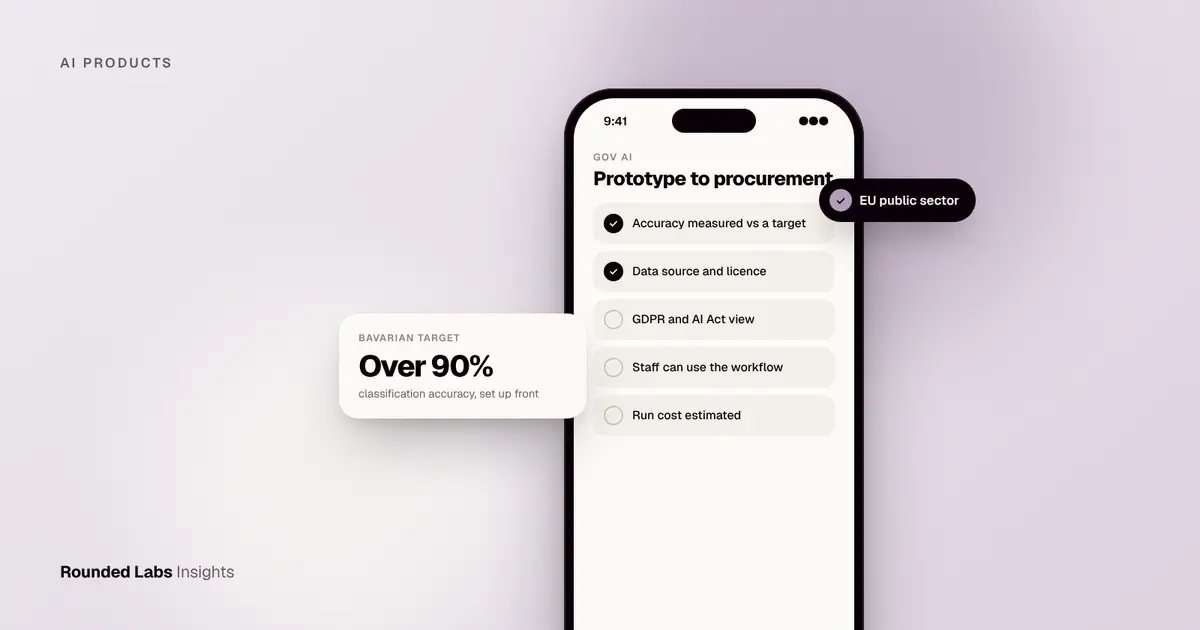
A government AI prototype becomes procurable when it proves three things: that the model meets a measurable target, that the data and legal basis are sound, and that a public body can run it and buy it under its own rules. Our Bavarian land classification prototype set a target of over 90% accuracy before building began. A prototype that hits its number but ignores procurement, data protection and operations rarely goes further.
In 2023, through our partnership with Cubeware, we led an R&D project for the Bavarian government: a prototype that classifies rural land from satellite imagery. This guide uses that work to explain how an AI prototype moves towards a purchasable product, and what suppliers and officials should plan at each step. It also touches on our AI product development approach. It is general information, not legal advice; procurement law, data protection law and the EU AI Act all change, so check the official sources listed at the end and take advice from your procurement and legal teams.
Key facts
- A prototype is evidence, not a product. Its job is to answer one question: does this work well enough to justify the next stage?
- Set a measurable target first. On the Bavarian project it was above 90% classification accuracy.
- No off-the-shelf model existed for the land types needed, so custom computer vision models were trained from scratch on open geospatial data.
- EU public bodies buy under public procurement rules, and AI systems also fall under the EU AI Act and GDPR. Check the current dates and thresholds on the official sites.
- Most of the cost and risk sits after the prototype: reliability, hosting, retraining, documentation and support.
- Rounded Labs works at a fixed price agreed before development starts; see the pricing page.
What does a government AI prototype need to prove?
Public bodies are cautious for good reasons: money is public, decisions affect citizens, and failures are visible to the press, to auditors and to elected members. A commercial pilot can often get away with a single success story and a hopeful demo. A government prototype has to answer a wider set of questions, because the people reviewing it will not be the people who asked for it.
| Question | Evidence a prototype should produce |
|---|---|
| Does it work? | Accuracy measured against a target agreed in advance, on data the model has not seen |
| Is the data usable? | A clear source, licence and quality check for training data |
| Is it lawful? | A view on GDPR, the AI Act risk level and any sector or state rules |
| Can staff use it? | A simple interface and a described workflow, not just a notebook |
| What would it cost to run? | Hosting, retraining and support estimates for a realistic year |
| Can it be bought? | A route through procurement, with a defined scope |
If a prototype only answers the first row, the second stage stalls at the first committee meeting. A committee member from finance asks what it will cost next year, a lawyer asks where the data came from, and an operations lead asks who answers the phone. None of those questions is hostile. They are the questions a responsible public body must ask, and a good prototype pack answers them before they are raised. We cover the commercial side of this market in AI for European public sector bodies.
Think of the prototype as a pack, not a demo
The most useful change of mindset is to treat the output of a prototype as a decision pack. The pack contains the working software, but also an evaluation report, a data note, a short risk and legal note, a draft operating model and a costed route to production. The software is the part people see. The pack is the part that lets a department head say yes.
A decision pack should be short enough to read in one sitting. Ten to twenty pages is plenty for most prototypes. Its structure can follow the table above, one section per question, with a one-line answer at the top of each section and the evidence behind it below. When an official reads the first line of each section and finds a clear answer, trust rises. When a section is missing, the missing section becomes the next meeting.
What happened on the Bavarian land classification project?
The Bavarian government wanted a prototype platform that could classify rural land and farmland from regularly updated satellite imagery. The aim was to give departments a scalable way to understand land use across large areas without slow manual analysis.
The first problem was that no off-the-shelf machine learning model could identify the specific land types needed. So we designed and trained custom computer vision models. The second problem was training data. We used open-source geospatial datasets released by the U.S. Geological Survey, published as labelled land-cover imagery for a research competition. They covered terrain such as barren land, shrubland, forest, waterlogged areas and agricultural fields.
The team built a pipeline that analyses satellite imagery and assigns a classification to individual land parcels, against a target of more than 90% accuracy. The prototype showed that AI-driven land classification at scale is viable, with possible uses in environmental monitoring, land management, biodiversity analysis and infrastructure planning. The full story is in How we built AI land classification for the Bavarian government, and the computer vision techniques are explained more generally in Computer vision in mobile apps.
Two lessons carry over to any public sector prototype. First, an open dataset with a clear licence removed a long data-sharing negotiation. Second, a numeric target agreed up front turned “does it work?” from an opinion into a test.
Why the target number mattered
A target such as “over 90% accuracy” does three jobs. It tells the data scientists when to stop tuning. It tells the department what “good enough” means in terms they can repeat to their own managers. And it gives a later procurement exercise a baseline: a supplier bidding for the production system can be asked to match or beat a figure that was measured in the open.
The number should be set with the end user, not by the supplier alone. Ask what an error costs. If a misclassified parcel sends an inspector to the wrong field, a few errors are an inconvenience. If a misclassified parcel affects a payment or an enforcement decision, the tolerance is far smaller and the system needs a human check on every result. That difference changes the legal analysis as well as the engineering, which is why the target and the risk note belong together.
What accuracy does not tell you
A single accuracy figure hides detail. A model can reach 90% overall while performing badly on a rare land type that matters to the department. A good evaluation report therefore shows results per class, shows where the model confuses one class for another, and states what kind of imagery was used for testing. It should also say how the test data was kept separate from the training data, because a model tested on images it has already seen will look better than it is.
For a non-technical reader, a short worked example helps. Imagine the test set holds 1,000 parcels and 900 are classified correctly. That is 90%. But if 100 of those parcels were wetland and the model got most of them wrong, the department’s wetland map would be poor even though the headline figure looks fine. The report should make that visible, in a table, not in a footnote. Our plain-English explainer on what an LLM is covers a different family of models, but the same principle of asking what a headline score hides applies to both.
How do you choose a scope that can become a purchase?
A prototype that tries to solve everything cannot be bought, because nobody can describe what they would be buying. A purchasable scope has four traits:
- One decision it supports. For example, “flag parcels whose land use has changed since the last survey”.
- One user group. A named team in a named department.
- A defined input and output. Satellite images in, classified parcels out.
- A boundary. What is not included, such as integration with every legacy register.
AI projects usually start with a data and feasibility review before any build. Our guide to scoping an AI MVP walks through the steps, and the principle of keeping a first release small is the same one described in What is an MVP?.
Have an AI idea for a public body or a regulated team? We will help you work out what a prototype should prove before anyone writes a tender. Book a 30-minute call with a co-founder.
A scope test you can run in ten minutes
Before committing to a prototype, put these five questions to the sponsor and write the answers down. If two or more answers are vague, the scope is not ready.
- Who will use the output on a Monday morning, and what will they do differently because of it?
- What decision does the output feed, and who makes that decision today?
- What data will the system see, who owns it and what licence or legal basis covers its use?
- What would a wrong answer cost, and who would notice?
- What is explicitly out of scope for this stage?
Teams that cannot answer question one usually have a technology looking for a problem. Teams that cannot answer question three have a hidden delay of months. The sooner these gaps appear, the cheaper they are to close.
Prototype, pilot and production are different things
People use these words loosely, and the looseness causes procurement problems. A useful working definition is below.
| Stage | Purpose | Typical audience | What it is not |
|---|---|---|---|
| Prototype | Prove the idea can work against a target | Sponsor and a few expert users | A system anyone should rely on |
| Pilot | Run the idea with real users on real work for a limited period | One team or region | A full rollout |
| Production | Run the service reliably, with support and change control | The whole organisation | A one-off project |
Mixing the stages is a common source of friction. If a prototype is described as a pilot, staff expect it to be dependable. If a pilot is expected to behave like production, nobody has budgeted for support. State the stage in every document and every meeting, and say what the next stage will add.
What changes between a prototype and a procured system?
Moving from prototype to production is where most of the cost and risk sit. The usual gaps are:
- Reliability. Prototype code is written to prove a point. Production code needs monitoring, error handling and repeatable deployments.
- Data pipelines. Training once on a clean dataset is different from ingesting new imagery or records every week.
- Retraining. Land use, language and behaviour change. Someone must own model updates and re-testing.
- Security and hosting. Government bodies often require specific hosting, certification or in-country data storage.
- Documentation. Procurement and audit teams expect records of how the system was built, tested and approved.
- Support. Who answers the phone when the output looks wrong?
Many buyers underestimate these. A realistic plan treats the prototype as a fraction of the total programme. For a plain-English overview of how AI projects are structured, see How to add AI features to an existing app.
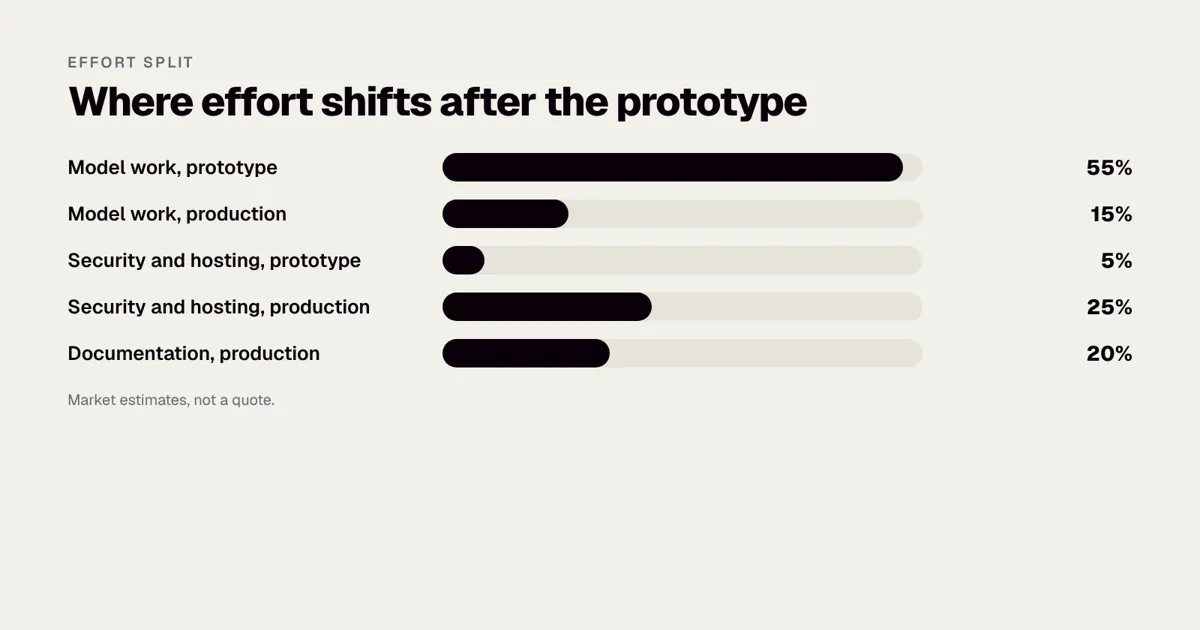
The table below shows how effort typically shifts. The shares are market estimates for an AI programme of this kind, not figures from our Bavarian project, and they vary with the data and the hosting rules.
| Work area | Share in a prototype | Share in a first production release |
|---|---|---|
| Model development and evaluation | 55% | 15% |
| Data pipelines and storage | 20% | 25% |
| User interface and workflow | 10% | 15% |
| Security, hosting and monitoring | 5% | 25% |
| Documentation and compliance | 10% | 20% |
The pattern to notice is that model work shrinks as a share while everything around it grows. Buyers who expect the production bill to resemble the prototype bill are usually surprised. Our guide on what technical debt is explains why code that was good enough to prove a point becomes expensive when it has to be relied upon.
Reliability: what “production” means in practice
A production service has an owner, a monitored uptime target and a way to roll back a bad release. For a land classification system, that might mean a scheduled job that ingests new imagery, a check that flags unusual results, a dashboard that shows when the last run succeeded and a documented procedure for rerunning a failed job. None of this is glamorous, and none of it appears in a prototype demo, but it is the difference between a tool that staff trust and a tool that sits unused after the sponsor moves on.
Testing also changes. A prototype is tested against a dataset. A production system is tested at every release, with regression checks that confirm accuracy has not dropped, and with load tests if many users will call it at once. Our overview of app testing sets out the vocabulary, and the same ideas apply to a model behind an interface.
Retraining and model drift
Models age. Land cover changes with seasons, farming practice and construction. The imagery source may change resolution or processing. A model trained on last year’s images may quietly lose accuracy this year. A responsible operating plan therefore includes a schedule for re-evaluating the model on fresh labelled samples, a threshold at which retraining is triggered and a named owner for the decision.
Budget for this explicitly. A model that is never retrained is a model that is slowly becoming wrong. Public bodies are particularly exposed, because the people who rely on the output often do not see the training data and cannot judge for themselves when quality has slipped. Our guide to keeping AI running costs under control covers the recurring costs that follow from this.
How do EU rules shape the path to procurement?
Three sets of rules matter for most European public bodies. This section is general information, not legal advice, and the details below were correct to the best of our knowledge at the time of writing. Check the official sources for current text, dates and thresholds.
- Public procurement. Contracts above national and EU thresholds usually need a formal, competitive process, with notices published on the EU’s Tenders Electronic Daily. Smaller contracts follow national rules. Thresholds are revised periodically, so check the current figures.
- GDPR. If the system processes personal data, you need a lawful basis, data protection by design and often a data protection impact assessment. Land imagery may be low risk, but parcel-level data can be linked to owners. The European Data Protection Board publishes guidelines.
- EU AI Act. The Act sorts systems by risk and applies in stages. Some uses relevant to public bodies are classed as high-risk, which brings duties on documentation, testing and human oversight. The timetable has been subject to discussion, so check the European Commission’s AI policy pages for current dates. Our guide, The EU AI Act for app and SaaS owners, explains the levels, and The EU AI Act and UK rules for AI apps compares the two regimes.
Bring these into the prototype early. Writing a short data and risk note during the prototype costs a few days; discovering a legal blocker after a tender costs months. For budget impact see What it costs to make an app GDPR and AI Act ready.
Public procurement routes at a glance
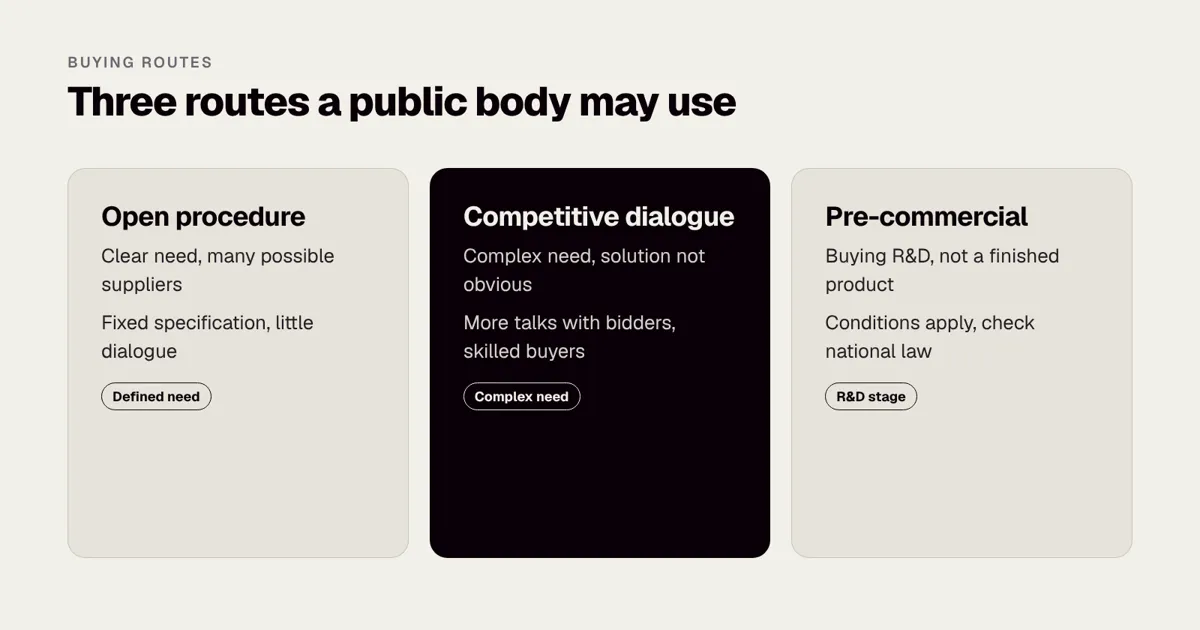
The EU public procurement directives offer several routes, and the right one depends on how well the buyer can describe what it wants. The table gives a plain summary. It is simplified, national law implements the directives in different ways, and your procurement team should confirm which routes are available to you.
| Route | Best when | Trade-off |
|---|---|---|
| Open procedure | The requirement is clear and many suppliers could meet it | Fixed specification, little room to talk to bidders |
| Restricted procedure | You want to shortlist suppliers first | Slower, more effort for the buyer |
| Competitive procedure with negotiation or competitive dialogue | The need is complex and the solution is not obvious | More dialogue, needs skilled buyers and clear rules |
| Innovation partnership | You want to develop and then buy a new solution that is not on the market | Longer commitment, structured stages |
| Pre-commercial procurement | You are buying research and development, not a finished product | Outside the standard directive rules in some cases, with conditions |
For AI, the interesting row is the last one, because a prototype is R&D by nature. Whether pre-commercial procurement or another route fits depends on who will own the results and how the benefits are shared. Official guidance is on the European Commission’s site, and our own overview of public tenders for software in the EU is a gentler starting point for suppliers.
How GDPR touches an AI prototype
Not every government AI system processes personal data, but many do indirectly. A land classification output may look harmless, yet a parcel layer joined to a land register can identify an owner. A good test is to ask what the output could be combined with, not only what it contains today.
If personal data is in scope, a data protection impact assessment is likely. Treat it as a design tool rather than a hurdle: it forces the team to write down what data is collected, why, who sees it, how long it is kept and what safeguards apply. Our guides on running a DPIA for a new app and the DPIA template lay out the steps, and Making AI features safe covers privacy and security risks specific to AI. State-level data protection law can add to GDPR in federal countries, so ask your data protection officer which rules apply.
The AI Act in practice
For a supplier, the practical questions are simple. First, does the intended use fall into a prohibited or high-risk category? Second, if it is high-risk, what documentation, testing and oversight duties follow? Third, who is the provider and who is the deployer, because duties differ between them? A land classification tool used for environmental monitoring is unlikely to be in the same category as a system used to decide on benefits or to assess individuals, but this is a judgement for your legal team on the specific use.
What we recommend at prototype stage is modest and cheap: write down the intended purpose, the data used, how accuracy was measured, the known limits and how a human can check or override the output. That record is useful whatever the final classification turns out to be. See also App compliance in 2027 for the common mistakes we see.
Security and wider European rules
Depending on the sector, other rules can apply to the supplier or to the body. Cyber security duties for essential entities and their suppliers are covered by the NIS2 regime, explained in NIS2 for software suppliers, and products with digital elements fall under the Cyber Resilience Act, explained in The EU Cyber Resilience Act and your app. The European Union Agency for Cybersecurity publishes guidance at ENISA. Whether these apply to your project depends on your sector and your contract, so confirm with your legal team before the tender.
What data work should a prototype include?
Data is where public sector AI most often slips. Models are the visible part, but a model is only as good as the examples it learned from and the test set that checked it.
| Data question | Why it matters | What to record |
|---|---|---|
| Source | A tender or audit will ask where the data came from | Name of the dataset or system, owner, date obtained |
| Licence | Some open data limits commercial or derivative use | Licence text and any attribution duty |
| Labels | Wrong labels teach wrong behaviour | Who labelled, how, and any known error rate |
| Representativeness | Training data from one region may not match another | Where and when the images were captured |
| Personal data | It triggers GDPR duties | Whether any is present or can be inferred |
| Test set | Accuracy claims depend on it | How it was separated from training data |
On the Bavarian project, the use of open geospatial data from the U.S. Geological Survey removed a long negotiation about sharing departmental records. It also made the work easier to describe to reviewers, because the dataset and its licence were public. You can find the publisher at the U.S. Geological Survey. If your own data is needed, plan the access agreement first, because it is the most common cause of delay.
Open data, licensed data and the body’s own data
Each source has a different profile.
- Open data is fast to start with and easy to explain, but may not match your region or your categories. Always read the licence.
- Licensed commercial data can be a better fit and better maintained, but adds a recurring cost and supplier dependency that should be visible in the production budget.
- The body’s own records are the best match for the real task, but access, quality and privacy work take time. Expect to clean and label before you can train.
Many projects combine all three: open data to get started, the body’s own samples to calibrate, and licensed data later if quality demands it. If satellite data is your starting point, the European Union’s Earth observation programme at Copernicus is one place to learn what public imagery exists, subject to each product’s terms.
Labelling and quality checks
If the project needs new labels, treat labelling as a small production process of its own. Write guidelines with examples of each class and of the awkward edge cases. Have two people label a sample independently and measure how often they agree. If experts disagree, the model has no hope of agreeing with all of them, and the target needs adjusting. Keep a log of corrections so the next round of labelling is faster.
How should you work with the supplier during a prototype?
The relationship during a prototype shapes what happens afterwards. Three habits make a large difference.
- Hold a short review every two weeks. Show results against the target, even when they are poor. Early bad news is cheap.
- Keep a decision log. Record choices about data, scope and method, with the reason and date. Auditors and later suppliers will thank you.
- Agree acceptance in advance. The prototype is accepted when the evaluation report shows the target met on the agreed test set, or when it explains why not and what that means.
Our approach is to agree a fixed price before development starts, so a department can plan its budget and defend it. The first step is often a scoping conversation; you can book a call with a co-founder if you want to talk through what a prototype should include. Our guide to what happens in a discovery phase describes how that early work saves money, and How to pilot AI with one team first shows how a limited rollout fits between prototype and production.
Who should build it: an agency or an in-house team?
Public bodies often lack machine learning staff, and hiring is slow. A specialist supplier can build the prototype while the body decides whether to grow a team. The risk is lock-in, so ask for:
- Full ownership of code, models and documentation.
- Training data and evaluation sets handed over, with their licences.
- Written explanation of how results were measured.
- A handover plan for whoever runs the system next.
When we work with Cubeware or a government client, these are agreed at the start. For other German enterprise lessons, read Delivering for German enterprise clients. Ownership questions are covered more widely in Who owns the code?.
A comparison of delivery options
| Option | Strengths | Risks | Suits |
|---|---|---|---|
| Specialist agency | Fast start, mixed skills, no hiring delay | Dependence if handover is weak | Prototypes and first releases |
| In-house team | Deep context, long-term ownership | Slow to hire, hard to retain AI skills | Mature programmes with continuing demand |
| Large systems integrator | Scale, existing framework contracts | Cost, distance from the technical work | Large rollouts across departments |
| University or research partner | Research depth, grant routes | Slower delivery, ownership terms vary | Early research with an open question |
| Hybrid: agency builds, staff learn | Knowledge transfer, shared ownership | Needs planning and staff time | Bodies that intend to own the system |
A hybrid approach often works well. The agency builds the prototype and the first release, while two or three staff members shadow the work and take over day-to-day operation. Our general guide to agency, freelancer or in-house sets out the trade-offs, and the question of how to choose a supplier is in How to choose an app development company.
Choosing between commercial and open source models
Another early choice is whether to use a commercial model through an interface, an open source model you host, or a custom model. For classification of satellite imagery, custom computer vision models trained on labelled data were needed because no off-the-shelf model recognised the specific classes. For text tasks the answer is often different. Our guide on choosing an AI model for a business app compares the options, and Custom AI vs off-the-shelf ChatGPT tools looks at the build or buy question in plain terms. For public bodies, hosting location and data handling usually carry as much weight as accuracy.
What does the operating model look like after the prototype?
A procurement committee will want to see who does what once the system is live. A simple operating model has five roles.
| Role | Responsibility |
|---|---|
| Business owner | Decides what the system is used for and accepts the risk |
| Product owner | Prioritises changes and speaks for users |
| Technical owner | Keeps the service running, patched and monitored |
| Data steward | Owns the quality, licence and lifecycle of the data |
| Model owner | Decides when to retrain and signs off new versions |
In a small body one person may hold two roles, but the roles should still be written down. Without a named model owner, nobody decides when accuracy has dropped far enough to act. Without a data steward, licences lapse unnoticed. The operating model also sets the size of the support contract that the supplier or an internal team must provide.
Human oversight
Most public sector AI should support a decision rather than make it. Design the interface so that a person can see the model’s output, see how confident it was, see the underlying image or record and record their own decision. Capture overrides, because they are valuable training data and also evidence that oversight is real and not nominal. This practice is relevant to the AI Act’s expectations for higher-risk systems, and it is good design for any system whose outputs affect people.
Explaining the system to staff and the public
Trust depends on understanding. A one-page explainer for staff should say what the system does, what it does not do, how accurate it is and who to contact when it looks wrong. If the output affects citizens, a plain-language public description is good practice. Our guide to explaining AI features to users offers wording patterns that apply well beyond consumer apps.
What can go wrong, and how do you reduce the risk?
These are the problems we see described most often when AI prototypes meet public procurement. The mitigations are practical and inexpensive when started early.
| Risk | How it shows up | Mitigation |
|---|---|---|
| Moving target | The sponsor adds goals mid-project | Written scope, change process, a “later” list |
| Data delay | Access agreements take months | Start with open data or agree access before the contract |
| Demo bias | The prototype looks good on chosen examples | Fixed test set, per-class results, independent review |
| Orphaned prototype | No budget or owner after the demo | Operating model and cost estimate in the decision pack |
| Legal surprise | A blocker appears at tender stage | Short data and risk note during the prototype |
| Supplier lock-in | Only the original team can run it | Ownership, documentation and handover terms |
| Overpromising | Claims go beyond the evidence | State limits plainly, avoid unmeasured claims |
The moving target problem deserves special mention, because AI projects attract enthusiasm. Once a department sees a working classification, ideas multiply: could it detect change over time, flag illegal building, estimate crop type? Each is a reasonable idea and each is a separate project with its own data and target. Capture them, rank them and keep the prototype focused. Our article on how to manage scope changes without blowing the budget shows a process that works under a fixed price.
Warning signs in your own project
- Nobody can say who will use the output.
- The accuracy figure has no test set behind it.
- The data licence has not been read by a lawyer.
- The supplier cannot describe what happens after the demo.
- The project plan ends at the demonstration date.
- No one has asked what it will cost to run next year.
Our guide to telling whether a project is off track offers further signals, and if a project has already stalled, how to rescue a failing app project lists your options.
What does a worked example look like?
The following scenario is illustrative and invented for teaching purposes. It is not a description of any real client. Imagine a regional environment agency that wants to map hedgerows from aerial imagery so inspectors can prioritise site visits.
Step 1: Frame the decision. The agency wants to flag stretches where hedgerow cover appears to have fallen since the last survey. The user is a small inspection team. The output is a ranked list of map tiles, not an automatic finding.
Step 2: Set the target. The team agrees that the model must find at least 85% of the known changes in a held-out sample, and that false alarms must not exceed a level the inspectors can handle in a week. Both numbers are written into the scope.
Step 3: Check data and law. Imagery is licensed by the agency. It contains no personal data, but joined with the land register it could identify owners, so a short data note is written and the data protection officer signs it off.
Step 4: Build and evaluate. The supplier trains models, reports results per class and shows examples of failure. The target is reached in some regions and missed in others, which is reported honestly.
Step 5: Prepare the decision pack. The pack includes the evaluation, the data note, a draft operating model and a costed route to production with options. It also lists what was learned about where more training data is needed.
Step 6: Choose the buying route. The procurement team decides, with advice, whether to run an open tender for a production system using the prototype’s evaluation as a specification, or to use another route available under national rules.
Notice that the technology is only one of the six steps. The rest is clarity about the decision, the target, the data, the law and the next purchase.
A budget view of the same example
The figures below are market estimates for a project of this size, not a quote, and not from the Bavarian project. They show how a body might think about a programme budget across stages. All amounts are in pounds for consistency with the rest of this site; convert at the current exchange rate.
| Stage | What is bought | Indicative range |
|---|---|---|
| Feasibility and data review | Scoping, data audit, target setting | £6,500 to £15,000 |
| Prototype | Models, pipeline, evaluation report, simple interface | £30,000 to £80,000 |
| Pilot | Hardening, integration with one team, training | £50,000 to £120,000 |
| Production release | Hosting, monitoring, security work, documentation | £100,000 to £250,000+ |
| Annual running and retraining | Support, updates, re-evaluation | Often a share of the build, agreed at contract |
Rounded Labs prices every project at a fixed price agreed before development starts, typically from £30,000 to £250,000+, and our productised services include the Tech Architecture Audit at £7,500 and the Digital Transformation Prep service at £7,000. See the pricing page for details. Public bodies will also compare suppliers through a tender, so treat any figure here as context, not as an offer.
How do you prepare a tender after the prototype?
A tender is easier to write, and easier to bid for, when the prototype has produced real evidence. Five documents make the biggest difference.
- The evaluation report. It gives bidders a measured baseline and a test set description.
- A requirements document. It turns the prototype’s learning into clear, testable requirements. Our app requirements template is a starting point, and How to write an app specification covers the method.
- A data and risk note. It tells bidders what data and legal conditions apply.
- An operating model. It tells bidders who will run the system and what support is expected.
- A scoring method. It says how price, quality, security and delivery risk will be weighed.
A supplier who bids against these documents can price with less risk, and a buyer who evaluates against them can compare like with like. Templates such as the project brief, the RFP template and the agency scoring matrix save time, and what a good proposal looks like helps suppliers present a clear offer.
Should the prototype supplier be allowed to bid?
This is a question for your procurement and legal teams, because rules on fairness and on conflicts of interest apply. In general, a body that wants to keep competition open will publish the prototype’s results so other bidders have the same information, and will avoid giving the prototype supplier an unfair advantage. Suppliers should expect this and should document the work so that it is easy to share. Writing for a reader who might be a competitor is a healthy discipline.
Evaluation criteria that reward real quality
Price alone is a poor way to choose an AI supplier. Reasonable criteria include the measured performance on a supplied test set, the clarity of the operating plan, security and hosting arrangements, data protection design, team experience and the quality of the handover plan. If price is weighted, make sure it covers the full lifecycle, including support and retraining, not only the first build. Otherwise a low build price can hide a high running cost.
How do funding routes fit in?
Prototypes are often funded differently from production systems. A body may use innovation budgets, digital transformation funds or EU programmes for the early stage, then move to operational budgets for production. Each source has its own rules about ownership, reporting and timing. Our overview of Horizon Europe for digital projects and the guide to German state digital funding are starting points, as are the EIC Accelerator for companies and App ideas for public sector for inspiration. Suppliers can sometimes reduce a buyer’s risk by working with the grant timetable, but a grant should never drive the technical scope.
What lessons come from long-running public and enterprise work?
We have been building software since 2007, and some patterns repeat regardless of technology. We built the UK’s first mobile banking app, MoBank, at a time when the sector doubted that people would use their phones for money. We have also delivered enterprise and government work with Cubeware, and the lessons are consistent.
- Regulated customers value evidence over enthusiasm. A clear test result is worth more than an impressive demo.
- Operations decide success. The best model is wasted if nobody owns the service.
- Documentation is part of the product. Auditors, successors and later suppliers will rely on it.
- Early legal and security thinking is cheap. Late thinking is expensive.
For a wider look at how the industry has changed, see 19 years of building apps. If you are comparing public sector AI with moving old systems to the cloud, Turning legacy software into SaaS describes a related journey.
Which questions should a procurement team ask a supplier?
Use the list below in a supplier meeting, an interview or a clarification round. A supplier with real experience will answer each plainly and will say so when the honest answer is “it depends”.
- How was accuracy measured, on which test set, and who chose it?
- What are the known weak spots of the model?
- Who will own the code, the models and the training data?
- What does the system need in order to run, and where can it be hosted?
- How will it be monitored, and who is alerted when quality falls?
- How often must the model be retrained, and what does that cost?
- What personal data does it touch, directly or by combination?
- How would a human check or override an output?
- What is the exit plan if we change supplier?
- What is the price, and what is excluded from it?
If you want a structured way to compare answers, the vendor due diligence checklist is a useful companion, and 20 questions to ask an app developer before you sign covers the wider contract questions.
What should you do next?
If you are a public body or a supplier thinking about an AI prototype, work through this checklist.
- Write one sentence that states the decision the system will support.
- Agree a numeric target and the test set it will be measured on.
- Check the data source, licence and any personal data.
- Write a short data and risk note and share it with your data protection officer.
- Decide who will own the system after the prototype.
- Ask for a decision pack, not only a demonstration.
- Plan the buying route before the prototype ends, with procurement advice.
- Estimate the cost of running and retraining for the first year.
If you would like to talk through a specific idea, book a call with a co-founder, or look at our AI product development page for how we work. A Tech Architecture Audit at £7,500 is a fixed-price way to review hosting, security and integration needs before a bigger commitment. As always, treat the legal points here as general information and check the official sources and your own advisers.
Frequently asked questions
Is a prototype enough to win a government contract?
Rarely on its own. It proves feasibility, but buyers also look at price, delivery risk, security and legal compliance. Treat the prototype as the evidence that supports a proposal, and include the evaluation report, the data note and an operating plan alongside it.
Do we need to build our own model?
Not always. On the Bavarian project no suitable off-the-shelf model existed for the land types needed, so custom models were trained. Often an existing model can be adapted, which is cheaper and faster. Test that option first and only build from scratch when the evidence says you must.
Where does training data come from?
Options include open datasets, the body’s own records and licensed commercial data. The Bavarian prototype used open U.S. Geological Survey land-cover imagery. Always check the licence, the region it covers and whether personal data is included or can be inferred.
Does the EU AI Act apply to a prototype?
Rules apply mainly to systems placed on the market or put into service, and research and testing have their own conditions. The details depend on the use and the stage, and the timetable has been under discussion. Check the Commission’s pages and take legal advice for your case.
How long does a prototype take?
It depends on data readiness and scope. Many take a few months, and data access is the most common delay. Agree the target and the dataset before you set a date, and treat any promise made before that point as a guess.
Who should own the model after the project?
The body that paid for it should normally own the code, trained models and documentation, unless a different arrangement is agreed and understood. Ownership affects your ability to change supplier. Write it into the contract at the start, and check any licence terms on third-party components.
How much does the production system cost compared with the prototype?
Usually several times more, because reliability, security, hosting, documentation and support are added. Treat any ratio as a market estimate, since it varies with the data and the hosting rules. Ask suppliers for a costed route to production in the decision pack.
Official sources and further reading
- European Commission: Regulatory framework for AI
- European Commission: Internal Market, Industry, Entrepreneurship and SMEs (public procurement)
- Tenders Electronic Daily (TED)
- European Data Protection Board
- U.S. Geological Survey
- EUR-Lex: EU law
- ENISA: European Union Agency for Cybersecurity
- Copernicus: European Earth observation programme
- European Commission
Talk it through with one of our co-founders. 30 minutes, no pressure.