

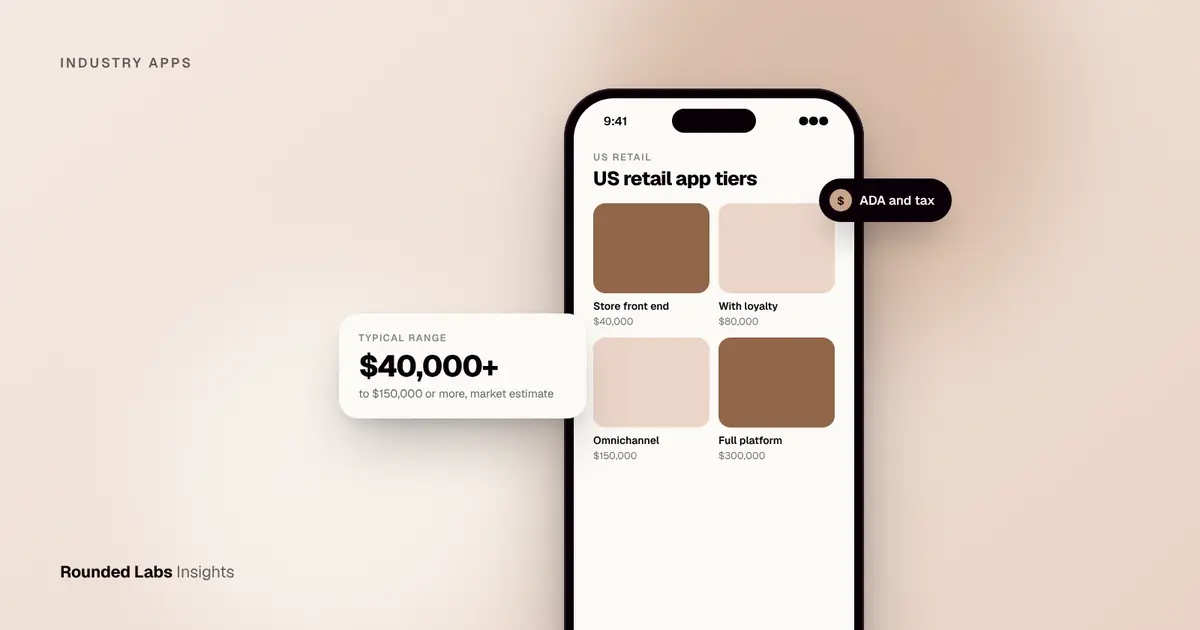
A retail app for a US brand typically costs $40,000 to $150,000 or more to build, depending on whether it is a shopping front end for an existing store or a full platform with loyalty, stock and store tools. The US adds its own requirements: card payments through Apple Pay and Google Pay, state-by-state sales tax, accessibility expectations under the ADA, and state privacy laws. Plan for them from the first sprint.
We modernized the app for Superdry in 2014, a brand that trades through 768 locations in over 100 countries, and we have built retail and ecommerce apps for Next, Waterstones and HMV. This guide covers what a US retailer should build first, what it costs, which rules apply, and how to scope the work. For the build side of the decision, see our mobile app development service. Legal points here are general information, not legal advice.
Key facts
- Typical range for a US retail app: $40,000 to $150,000+ (market estimate), against roughly £30,000 to £250,000+ for our own fixed-price projects.
- Rounded Labs prices every project at a fixed price agreed before development starts; see the pricing page.
- Physical goods are paid for outside Apple’s in-app purchase system, so you keep your own payment provider and margins.
- US retail needs sales tax handling in many states, PCI DSS compliance for card data and accessible design (WCAG).
- The apps that earn their place are the ones built around repeat customers: loyalty, order tracking, store stock and push messages.
Does a US retailer need an app, or is a mobile site enough?
Start with your customers, not the platform. If most orders are one-off and arrive from search or social ads, a fast mobile site often earns more per dollar. An app pays off when customers come back often, when you have a loyalty scheme, or when stores and online need to work together. We cover the trade-offs in Ecommerce app vs mobile website.
Questions to ask before committing:
- Do customers buy more than three or four times a year?
- Do you have a loyalty or rewards program worth surfacing?
- Do store staff or customers need live stock, pick-up or returns?
- Can you afford to promote the app through email, receipts and in-store signage?
If the answer to most is yes, an app is likely to pay back. If not, validate with a mobile site first. How to validate an app idea walks through a low-cost test.
Which features matter most in a retail app?
Retail features that move sales are usually the unglamorous ones: fast search, saved baskets, one-tap checkout and clear delivery information. Our write-up of work for Next, Superdry and HMV is in Retail app features that drive sales. For a US launch, we would prioritise:
| Priority | Feature | Why it matters |
|---|---|---|
| Must have | Search, filters, product pages with fast images | Most sessions start with finding something |
| Must have | Apple Pay and Google Pay | Cuts typing at checkout |
| Must have | Order tracking and returns | Reduces support contacts |
| Should have | Loyalty and saved payment methods | Drives repeat purchase |
| Should have | Push notifications for back-in-stock and delivery | Brings lapsed users back |
| Later | Store locator with live stock, click and collect | Joins online and in-store |
| Later | Personalized recommendations | Needs enough data to work |
Ship the must-haves first, measure, then add. The retention measures that tell you whether it is working are in App retention: the metrics that matter.
What does a US retail app cost?
These are market estimates for US supplier quotes; they vary widely with scope and with who builds it.
| Scope | Typical range | What you get |
|---|---|---|
| Shopping front end on an existing store platform | $40,000 to $80,000 | Catalog, basket, checkout, push, iOS and Android |
| Retail app with loyalty and account features | $80,000 to $150,000 | Plus rewards, saved lists, order history, integrations |
| Omnichannel platform | $150,000 to $300,000+ | Plus store stock, click and collect, staff tools, back-office |
At Rounded Labs, projects typically run from £30,000 to £250,000+ (about $38,000 to $320,000), agreed as a fixed price before development starts. Why quotes differ so much is explained in App development quotes compared, and the contract model in Fixed price vs time and materials.
What about running costs after launch?
Budget for hosting, payment fees, app store accounts, monitoring and updates every year. Apple and Google both take a share of digital sales, but for physical goods you use your own payment provider, so you pay that provider’s card fees instead. Maintenance is covered in App maintenance costs for the UK, and the same logic applies in the US.
Planning a retail app for the US market? We scope features, integrations and a fixed price before any code is written. Book a 30-minute call with a co-founder and we will tell you what your first release should include.
Which US rules affect a retail app?
How are payments and card data handled?
Use a payment provider and Apple Pay or Google Pay so card details never touch your servers. That keeps most of your PCI DSS burden small, though you should still confirm your obligations with your payment provider. The standard is published by the PCI Security Standards Council.
How does sales tax work across states?
Since the 2018 Supreme Court decision in South Dakota v. Wayfair, states can require remote sellers to collect sales tax once they pass an economic threshold, and many have. Thresholds and rules differ by state and change over time, so most retailers use a tax calculation service connected to the checkout rather than building rates themselves. Ask a tax adviser which states you are registered in, and build the app to call the tax service at checkout.
What about accessibility?
Accessibility lawsuits against retailers over websites and apps are common in the US. The usual yardstick is the Web Content Accessibility Guidelines (WCAG) from the W3C. Build in dynamic text sizes, screen reader labels, sufficient color contrast and touch targets that are large enough from the start; fixing them later costs more.
Which privacy laws apply?
There is no single US privacy law. California’s CCPA and CPRA and a growing list of other state laws, which differ in scope and dates, give shoppers rights to know, delete and opt out of the sale or sharing of their data. See US state privacy laws and your app. If you advertise to children, the FTC’s COPPA rules also apply; see the FTC’s guidance.
A worked example: a regional chain with 40 stores
Imagine a US specialty chain with 40 stores and an existing ecommerce site on a hosted platform. The brief: let loyalty members shop and collect in store.
- Phase 1 (about 12 to 16 weeks): shopping, Apple Pay and Google Pay, order history, push messages, loyalty balance. Built on the existing commerce platform’s APIs.
- Phase 2: store stock and click and collect, using the store inventory system.
- Estimated cost: $90,000 to $140,000 for phase 1 at US market rates, with phase 2 quoted separately once the stock system’s API is known.
- Measure: share of orders from the app, repeat purchase rate and checkout completion against the mobile site.
The key risk is almost always the integration with older stock or point-of-sale systems, which is why we scope that first. If you are unsure whether to patch or replace, Rebuild or refactor can help. Timelines for comparable work are in How long does it take to build an app?.
How do you choose a partner for a US launch?
Look for a partner who has shipped retail apps at scale, will quote a fixed price, and will explain how they handle payments, tax and accessibility. A UK studio can serve US brands well, with working hours that overlap the East Coast morning and a clear handover process. Ask for references and for the names of the people who will build your app.
Frequently asked questions
How much does a retail app cost in the US?
Most US retail apps cost between $40,000 and $150,000, with larger omnichannel builds going beyond $300,000. These are market estimates. Rounded Labs gives a fixed price before development starts.
Do Apple and Google take a cut of my retail sales?
For physical goods and services consumed outside the app, you use your own payment provider, so Apple and Google do not take a commission on those sales. Digital goods such as subscriptions are different, and store rules and commission rates change, so check Apple’s and Google’s current terms.
Do I need to collect sales tax in my app?
Probably in several states, depending on where you sell and your volume. Use a tax calculation service and get advice from a tax adviser on your registrations.
Can a UK company build an app for my US brand?
Yes. We have built apps for global brands, including Superdry across over 100 countries, and we work to US requirements for payments, privacy and accessibility.
Should I build for iOS and Android together?
Usually yes for retail, because US shoppers are split between the two. A cross-platform approach can reduce cost; see Native vs cross-platform.
Official sources and further reading
Talk it through with one of our co-founders. 30 minutes, no pressure.