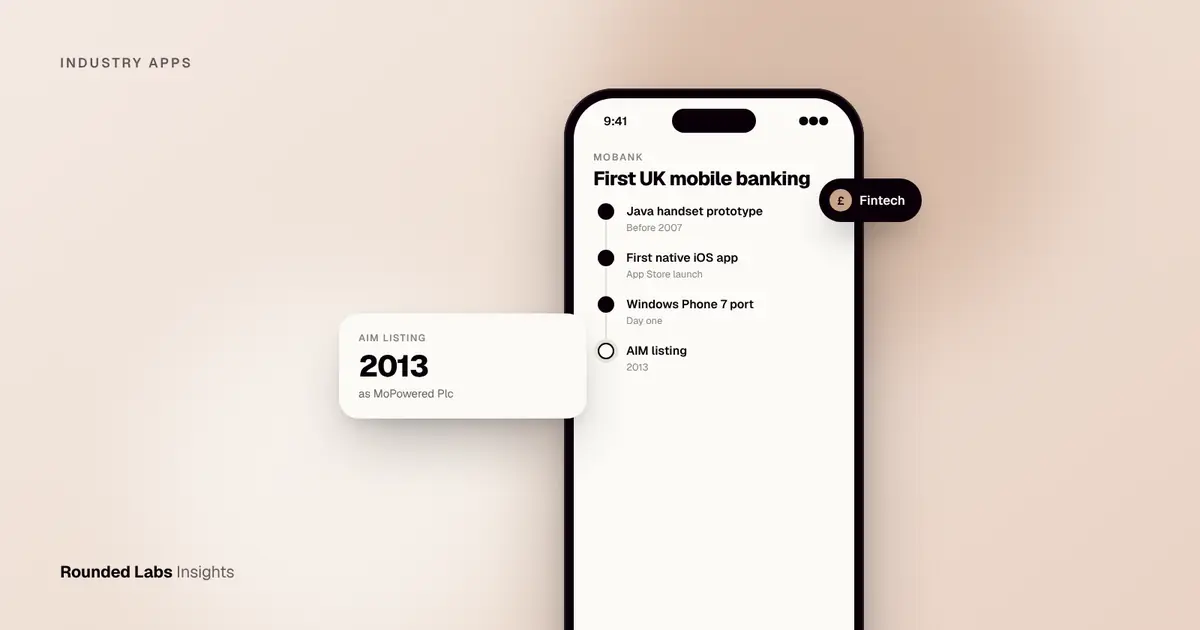
The first mobile banking app in the UK was MoBank, built by Rounded Labs with founder Dominic Keen as a prototype for Java-based handsets before the iPhone launched in 2007, with encrypted login and secure transaction processing on a server-side platform built to scale. It ran on small-screen phones over slow networks. MoBank later became our first native iOS app and floated on the AIM market in 2013.
MoBank is one of the projects we are proudest of, and the lessons carry straight into fintech work today. This guide covers what the original build involved, how the product moved from Java phones to iOS and Windows Phone, and what a founder planning a money app now can take from it. If you are planning a banking product today, our pricing page explains how fixed-price projects work.
Key facts
- MoBank was founded by Dominic Keen, then an executive at Egg Plc, with the aim of bringing banking to consumers’ mobile phones.
- Rounded Labs designed and built the original prototype for Java-based mobile devices.
- The backend handled encrypted login, transaction processing and communication protocols.
- The platform also linked to third-party commerce providers, so users could buy books, flowers, cinema tickets and flights in the app.
- With the launch of the App Store, MoBank became our first native iOS app. We also ported it to Windows Phone 7 for day-one availability.
- We were MoBank’s main development partner through to its AIM listing in 2013, when the company was known as MoPowered Plc.
Why was mobile banking so hard to build before the iPhone?
Before 2007, phones had no common app platform. Most handsets that ran software ran Java ME, a cut-down version of Java, and every manufacturer and model behaved slightly differently. Screens were small, keypads were physical, and mobile data was slow and often billed by the megabyte.
For a bank, that created three problems at once:
- Trust. People had to believe a phone could be a safe place to see their money. That meant visible, dependable security.
- Reach. There was no single store. The app had to work across many devices with different memory limits and screen sizes.
- Speed. Every request had to be small, because a slow or dropped connection was normal.
None of these problems has gone away. They have changed shape: today the trust problem is about fraud and consent, the reach problem is about two big platforms plus the web, and the speed problem shows up on patchy rural signal.
How did we build the original MoBank prototype?
We partnered with Dominic and his newly co-founded company, MoBank Ltd, to design and build a prototype for Java-based devices. The most important part was not the screens but the backend, which we architected to be secure and able to scale.
The core pieces were:
- Encrypted login, so that credentials were protected between the handset and the servers.
- Transaction processing, so that balances and payments stayed consistent even if a connection dropped halfway through.
- Communication protocols designed to be light on data, because handsets could not carry much and networks were slow.
Putting the logic on the server meant the phone could stay simple. That is still sound advice: keep sensitive rules on the server, and let the app focus on showing information clearly. It is also how a small team can support many different devices without rewriting the product each time.
Why did MoBank include shopping as well as banking?
Beyond core banking, we built a platform that integrated with third-party commerce providers. Users could browse and buy products such as books, flowers, cinema tickets and flights from inside the app.
The reasoning is still useful. A balance check is something people do occasionally. A product that lets them act on their money, by paying for something there and then, gives them a reason to return. Many of today’s fintech apps follow the same pattern, adding spending, rewards or investing around the account view. If you are shaping a feature list, our guide to validating an app idea shows how to test which features earn their place before you build them.
Building something in banking or fintech? We have been doing this since the days of Java handsets, and we agree a fixed price before development starts. Book a 30-minute call with a co-founder and we will talk through what your first version needs.
How did MoBank move from Java phones to iOS and Windows Phone?
When Apple launched the App Store, we moved MoBank from the prototype into our first native iOS app. That was the start of our journey into mobile app development, and it has shaped how we work ever since: a stable, well-built backend lets you add new front ends as platforms appear.
Later, we partnered with Microsoft ahead of the Windows Phone 7 launch. We worked to an extremely tight deadline to port MoBank to the new platform so it was available on day one. The table below shows how each stage differed.
| Stage | Platform | What mattered most |
|---|---|---|
| Prototype | Java-based handsets | Light protocols, server-side security, many device types |
| First native app | iOS, via the App Store | Native feel, a single consistent device family, store review |
| Platform port | Windows Phone 7 | A fixed launch date, reuse of the existing backend |
The lesson for founders is that the backend outlives the app screens. The platforms you target will change over a product’s life, so it pays to invest in the part that does not.
What happened to MoBank in the end?
We acted as MoBank’s primary development partner from its early startup days through to its IPO on the AIM market in 2013, by which time the company was known as MoPowered Plc. It was a long partnership rather than a single delivery, which is why we treat it as a reference for how a build team and a founder can grow together.
We have been building apps since 2007, and our 19 years of building apps post looks at how the work has changed since. Our work with Dabbl applies similar thinking to a modern trading app for first-time investors.
What should a banking or fintech founder take from this?
Whatever the decade, the same principles apply:
- Start with the regulated, risky parts. Security, identity and transaction handling should be designed first, not added later.
- Keep the app thin and the backend strong. It makes it far easier to support new platforms.
- Build one useful thing well. MoBank started as a prototype to prove the idea, not as a finished bank.
- Plan for review. Whether it is an app store, a regulator or a bank partner, someone will examine your product before launch.
The rules have grown more detailed since then. If you plan a UK product that holds or moves money, read Building a banking app in the UK: FCA, Open Banking and security and check the current rules with the FCA. For the costs, see App development rates 2027 for market benchmarks by country.
How much would a banking app cost to build today?
Market estimates for a serious UK banking or fintech app vary widely. A prototype to prove the idea may cost tens of thousands of pounds, while a regulated production product can run well into six figures, depending on integrations, security work and compliance. Treat any range as an estimate until a supplier has scoped your project.
At Rounded Labs, projects are fixed price, agreed before development starts, and typically range from £30,000 to £250,000+. Our Mobile Product Discovery Sprint is £9,500 and is a good way to define scope before committing to a build. To understand why we work this way, read Fixed price vs time and materials for app projects. If you are comparing suppliers, How to choose an app development company in the UK gives you a checklist.
Frequently asked questions
Was MoBank really the first mobile banking app in the UK?
That is how we describe it, and it is how the project has been presented in our case study. The prototype was built for Java-based handsets, before the iPhone launched in 2007. If you need to cite this publicly, check the claim against other sources first.
What did Rounded Labs build for MoBank?
We designed and built the original prototype and its secure backend, including encrypted login and transaction processing. We then built the first native iOS app, ported it to Windows Phone 7, and stayed on as the main development partner until the AIM listing in 2013.
Can a small team still build a banking app today?
Yes, though the regulatory side needs care. Many founders partner with a licensed institution or a banking-as-a-service provider rather than holding licences themselves. Speak to a lawyer and check the current FCA rules.
How long does it take to build a fintech MVP?
It depends on integrations and compliance, but a focused first version commonly takes a few months. Our guide to writing an app specification will help you scope it before you ask for quotes.
Official sources and further reading
Talk it through with one of our co-founders. 30 minutes, no pressure.