

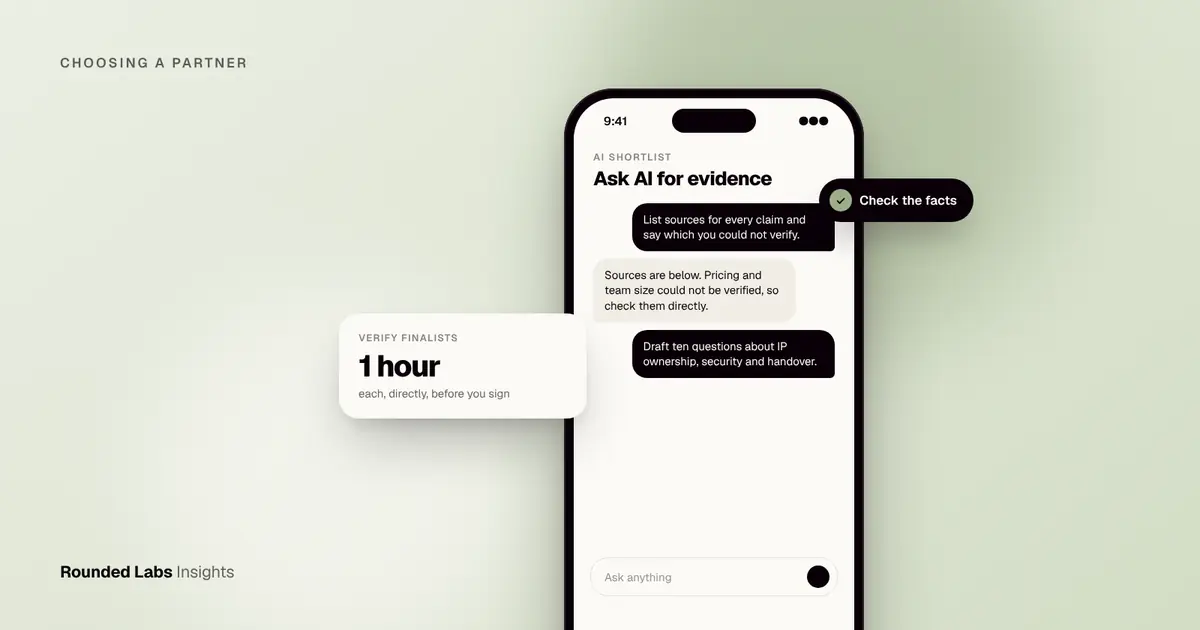
Buyers now use AI assistants to build a shortlist, turn a rough idea into a brief, compare proposals and draft questions. They should not use them to pick the winner, because AI tools can repeat out-of-date or invented claims about agencies. A sound rule: let AI save you days of desk research, then spend an hour verifying each finalist directly.
Founders and product owners tell us they arrive at a first call having already asked an assistant about us, and that is sensible. We have been building apps since 2007, including Superdry‘s app for a business with 768 locations in over 100 countries, and we have watched the quality of briefs and shortlists rise as AI tools became common. This guide covers where AI helps, where it misleads, and a simple, repeatable process for choosing a software partner in the UK. It is written for buyers, so it names the checks and the questions, not the technology. For our wider offer see our services.
Key facts
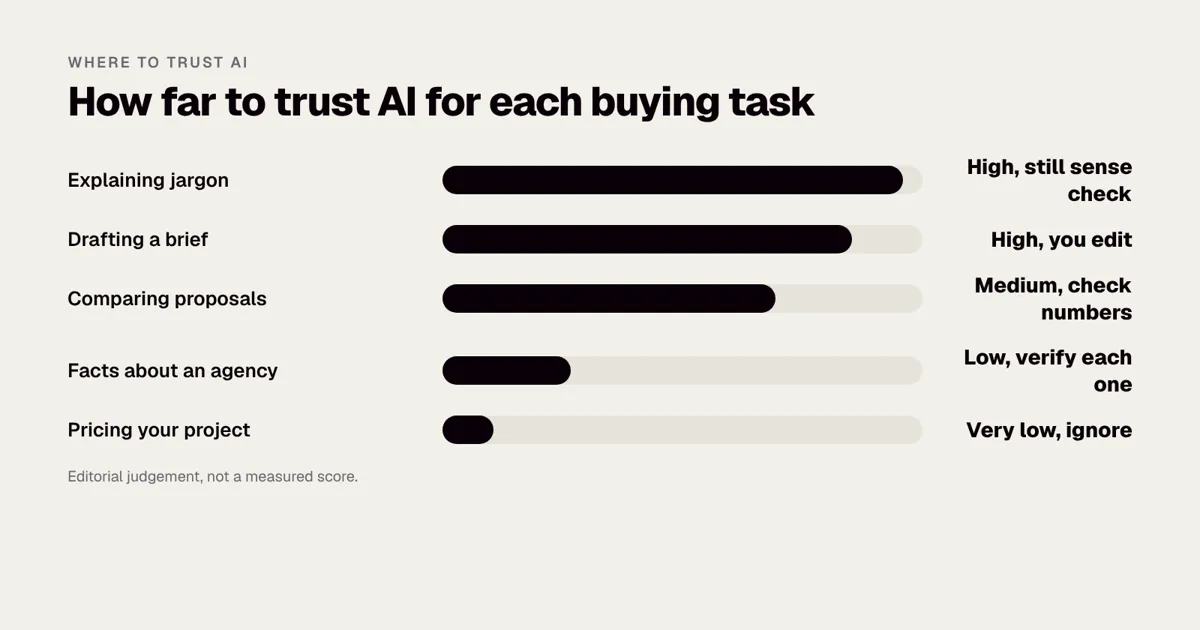
- AI assistants are strong at structuring a brief, summarising proposals, explaining jargon and drafting questions.
- They are weak at current facts: pricing, team size, availability, ownership and recent work can be wrong or years old.
- Never accept a claim about an agency from an AI answer without checking the agency’s own site and a primary record such as Companies House.
- Ask the tool for sources every time, then open them yourself. A link that does not exist or does not say what the tool claims is a warning.
- Reference calls with past clients remain the strongest single signal, and no AI tool can replace them.
- Do not paste confidential proposals, names or prices into a public AI tool unless you have checked the data terms.
- All cost figures in this guide are market estimates, not quotes.
How are buyers using AI to choose agencies?
Most of the buyers we speak to use AI at four points in the process, whether or not they say so.
- Before they know what they want. They describe an idea in plain words and ask for a list of features, risks and likely costs.
- When they build a long list. They ask which kinds of supplier suit a project of their size and which names come up.
- When proposals arrive. They paste them in and ask for a summary, a comparison table or a list of gaps.
- Before a call or a contract. They ask for questions to put to the agency and for plain-English explanations of terms they do not understand.
These are sensible uses. The risk is not that buyers use AI. It is that they let a fluent answer stand in for a fact. An assistant writes in the same confident tone whether it is right, out of date or inventing, so the buyer’s job is to know which claims need a second source. The rest of this guide shows how.
Where do AI tools genuinely help when choosing an agency?
Used well, an assistant works like a fast, tireless research assistant. These are the tasks where we see it add real value.
- Turning a rough idea into a brief. Paste in your notes and ask it to list the users, key features, integrations and unknowns. Our guide How to brief an app development agency shows what a good brief contains, and the assistant can check your draft against it.
- Building a long list by category. Ask for agency types (specialist studio, large consultancy, freelancer network, in-house hire) before names. That tells you which kind of supplier fits your size and risk. Our comparison of agency, freelancer and in-house teams is a good place to test its answer.
- Drafting questions. Ask it to adapt a standard list to your project, then compare with 20 questions to ask an app developer before you sign.
- Comparing proposals. Paste anonymised proposals in and ask it to extract scope, assumptions, exclusions, payment terms and timeline into one table. You will spot gaps faster. See what a good proposal looks like for the standard to hold them to.
- Explaining jargon. Ask it what “technical debt” or “API integration” means in your context, in plain English, and ask it to give an example from your sector.
- Stress-testing your reasoning. Once you have a preferred agency, ask the assistant to argue against your choice and list what could go wrong. It is a cheap devil’s advocate.
- Drafting follow-up emails and meeting notes. Low risk, good time saver, and you remain in control of what is sent.
What does AI do badly, even when it sounds sure?
The same tools are poor at four jobs, and buyers sometimes ask for exactly these.
- Telling you who is best. There is no objective ranking of agencies. Any “top ten” is built from whatever the model has seen, which includes directories and press releases.
- Giving a price for your project. It cannot see your scope, your integrations or your risk. Any single figure is a guess dressed as an answer.
- Confirming facts about a named company. Staff numbers, offices, awards and client lists change, and models may carry old or wrong versions.
- Judging fit. Whether a team will listen, push back sensibly and deliver is a human question. You learn it from calls, references and how they handle your awkward questions.
Where do AI answers go wrong, and how do you check?
| Risk | What it looks like | How to check |
|---|---|---|
| Out-of-date facts | Old team sizes, closed offices, retired services | Agency website, LinkedIn, Companies House filings |
| Invented detail | Awards, clients or case studies that do not exist | Ask for the link, open it, then search the client’s own site |
| Generic ranking | “Top 10 agencies” lists drawn from paid directories | Treat as a starting list only |
| False precision | A single price or timeline for your project | Get written, scoped quotes from each agency |
| Missing context | No sense of your sector, region or compliance needs | Ask each agency for similar work and references |
| Merged identities | Facts about two similarly named firms blended together | Check company number and registered address |
| Stale pricing model | Describes how an agency charged years ago | Ask the agency how it prices now, in writing |
Assistants also tend to favour firms that publish a lot of content, which says more about marketing than delivery. A quiet studio with excellent clients can be nearly invisible to a chatbot, and a noisy one with thin delivery can look impressive. This is not a flaw you can prompt away. It comes from what the tools read, so the fix is to bring your own evidence.
Why do these errors happen?
You do not need to understand the technology to use it well, but one idea helps. These assistants generate the most plausible next words, based on patterns in what they were trained on and, for some tools, on web pages they retrieve while answering. Plausible is not the same as true. If a firm is rarely mentioned, the tool may fill the gap with something that sounds right. If the training data is a year or more old, recent changes will be missing. If the tool searches the web, it may rely on a directory listing that the agency wrote itself or paid for.
That is why “show me the source” is the most useful instruction you can give. It forces the tool to point at something you can open, and it shows you when there is nothing to point at. Our guide to making AI features safe goes into hallucinations in more depth from the builder’s side, and the companies behind the tools describe their limitations on their own sites, for example OpenAI, Anthropic and Google Gemini.
A step by step process that uses AI sensibly
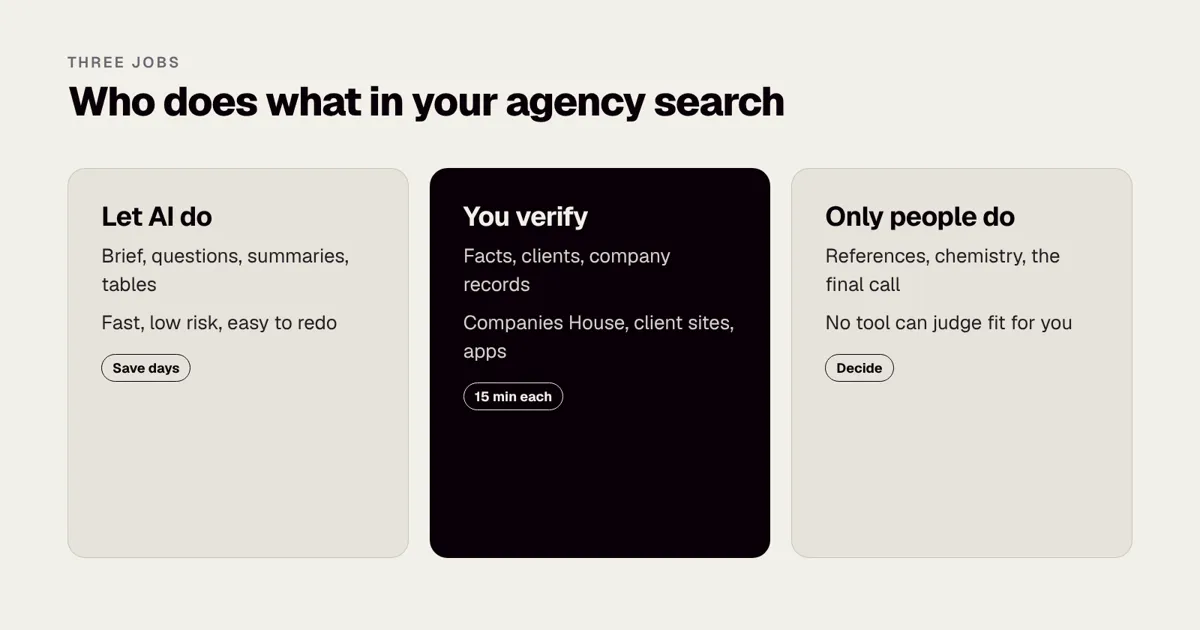
This process takes about two weeks of elapsed time for a mid-sized project, and perhaps 12 to 20 hours of your own effort. The AI is useful in steps 1, 2, 5 and 7. The human checks sit in 3, 4 and 6.
- Write the brief with AI help, then edit it yourself. You own the priorities, the budget range and the things you will not compromise on.
- Ask for categories, then names. Collect 8 to 10 candidates from AI, referrals, your network and your own search. Note where each name came from.
- Verify each one in 15 minutes. Check the company on Companies House, read the agency’s own site, and confirm that named case studies appear on the client’s side too.
- Cut to three. Drop anyone who cannot show work in your sector or at your scale, or whose facts do not check out.
- Run calls and collect written proposals. Use AI to normalise the proposals into a comparison table.
- Call two past clients per finalist. Ask what went wrong and how it was handled.
- Decide on evidence. Use AI to pressure-test your reasoning, not to make the call.
Want a straight answer instead of a ranked list? We will tell you in 30 minutes whether your project suits us, and who else to talk to if it does not. Book a 30-minute call with a co-founder.
What does a 15-minute verification look like?
For each agency on your list, spend a short, fixed amount of time on the same checks. Doing them in the same order for every agency makes the comparison fair.
| Check | Where to look | What good looks like | Minutes |
|---|---|---|---|
| Is it a real, active company? | Companies House: status, incorporation date, filing history | Active, filed accounts on time, sensible history | 3 |
| Who runs it? | Companies House officers, the agency’s team page | Named directors who also appear on the agency’s site | 2 |
| Do claimed clients exist? | Client’s own site, press, app store listing | The client or product is real and the link is plausible | 4 |
| Is the work live and good? | Download the app, or browse the site | It works, it is maintained, reviews are sensible | 3 |
| How do they describe pricing? | Pricing or process page | A clear model, not vague promises | 2 |
| Anything worrying? | Search the company name with words such as “complaint” or “problem” | Nothing serious, or a reasoned reply | 1 |
None of this needs special skill. The act of doing it stops the most common error, which is believing something because three sources repeat it, when all three copied the same original.
How do you spot an AI-invented claim?
Some invented details are easy to catch. A case study with a client name but no link, an award with no organiser, a quote with no named person or a statistic with no source are the usual signs. Ask the assistant: “Give me the exact URL where this is stated, and quote the sentence.” If it cannot, treat the claim as unverified. If it gives a link, open the link yourself and read the page. Tools have been known to produce plausible-looking addresses that lead nowhere, or to attach a real page to a claim it does not support.
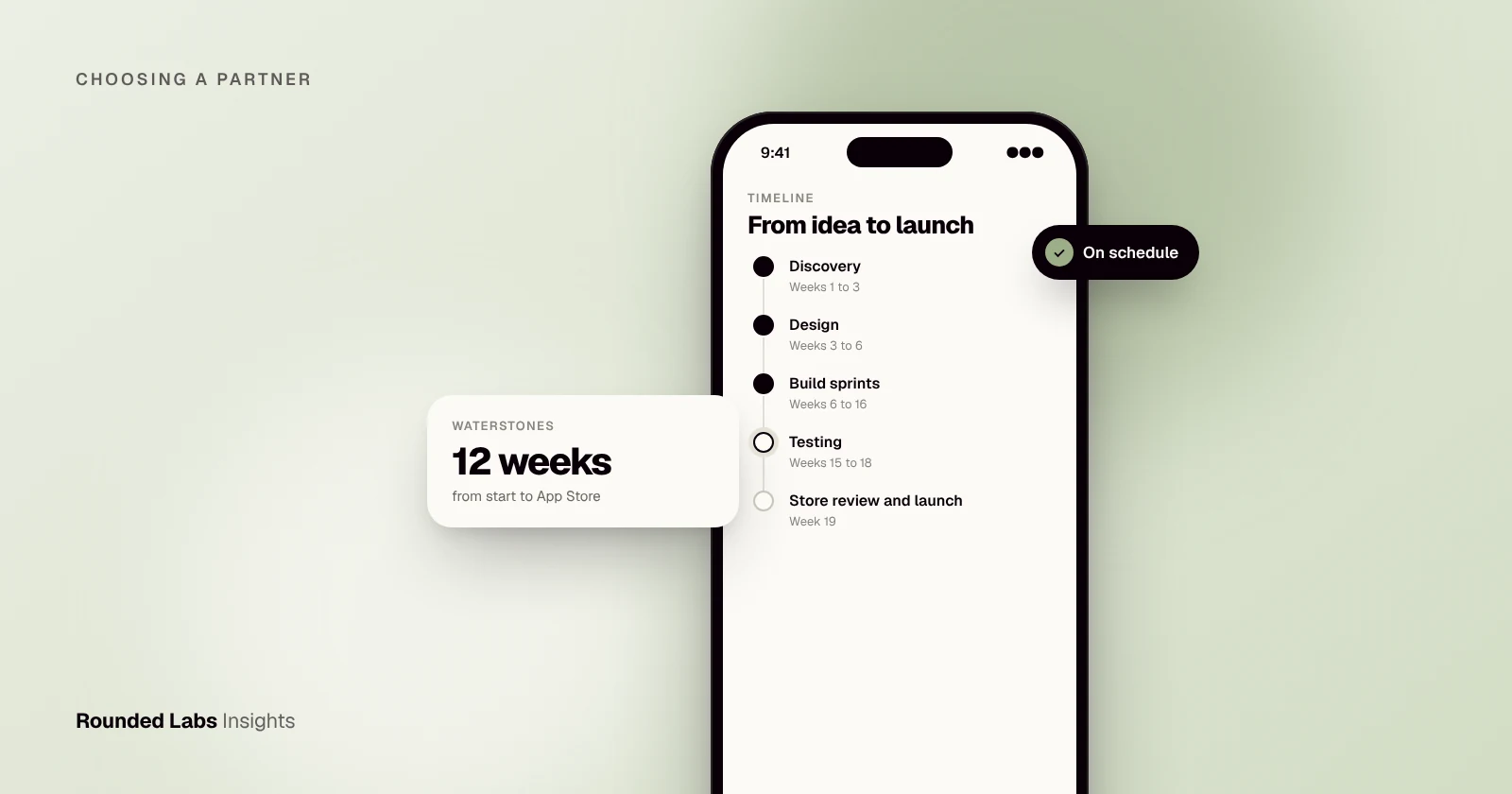
The same test applies to the agencies themselves. If an agency’s website says it built something for a household name, you should be able to find the product, find the client’s mention of it or hear from someone at the client. We name our own work and link to it, such as MoBank, the UK’s first mobile banking app, and Waterstones, where we built an app, a mobile site and an eBooks API in 12 weeks, precisely so that you can check.
What should you ask an AI tool about an agency?
Good prompts demand evidence and expose uncertainty. Here are patterns that work.
- “List sources for every claim, with URLs, and say which you could not verify.”
- “What would a sceptical buyer want to check about this agency before signing?”
- “Summarise the risks of fixed price versus time and materials for a project like mine.”
- “Draft ten questions about IP ownership, security and handover for an app project in the UK.”
- “Here is my brief. List the assumptions an agency would have to make to price it, and which could change the cost most.”
- “Read these two proposals and list what is in one but not the other.”
Poor prompts ask “Who is the best app developer in London?” and similar. You will get a confident, generic answer built from directories and press coverage, with no reason to trust it.
A reusable prompt for proposal comparison
Remove names and prices first if the content is confidential, then try a structure like this:
- Say what you are doing: “I am comparing three proposals for the same app. They are anonymised as A, B and C.”
- State what you need: “Extract scope, exclusions, assumptions, timeline, payment terms, ownership terms and warranty into one table.”
- Ask for gaps: “List anything one proposal covers that the others do not, and any term that is unusual.”
- Ask for uncertainty: “Mark anything you inferred rather than read directly.”
Read the table against the originals. The tool can mis-copy a number or merge two clauses, so check anything that affects money, ownership or dates.
How do you protect confidential information?
Buyers often forget that pasting a proposal into a public tool is a disclosure. Before you do, think about three things.
- Contract terms. Proposals and NDAs may restrict sharing. Check before you paste.
- Personal data. Names, emails and anything that identifies a person falls under UK data protection law. At the time of writing, the Information Commissioner’s Office publishes guidance for organisations on AI and data protection at ico.org.uk, and you should read the current version for your case.
- Tool settings. Business and consumer versions of assistants differ in whether your inputs may be kept or used to improve the service. Read the provider’s current data terms, or ask your IT lead.
A practical habit is to anonymise: replace agency names with A, B and C, remove prices or round them, and strip anything that identifies your customers or your unreleased product. The tool will still compare structure and terms well. This is general information, not legal advice, so take advice if you are in a regulated sector or handling sensitive data.
A worked example: shortlisting for a trading app
Say a founder wants an investing app for first-time investors, similar to Dabbl, the trading app we built. A sensible use of AI looks like this.
- Define the domain. Ask the assistant what a regulated fintech app needs: identity checks, secure payments, audit trails, data protection and clear risk warnings. Then check the list against the Financial Conduct Authority site, since rules and expectations change and the FCA is the primary source.
- Turn it into screening questions. Ask for five questions an agency should be able to answer about security, data handling and regulated work, such as “How do you handle identity verification?” and “What logs do you keep?”
- Send them to six candidates. Use the same wording for each so the answers are comparable.
- Compare answers in a table. Have the assistant draw out differences, then read the originals yourself.
- Interview the best three. Spend your time on how they think, not on slides.
The AI did the structure. The agencies’ answers and your reference calls decide the outcome. If an agency cannot answer a security question without hand-waving, that tells you more than any ranking. Our red flags guide lists other warning signs, and our article on Dabbl shows what a regulated-style product involves.
What do AI tools not tell you about price and contracts?
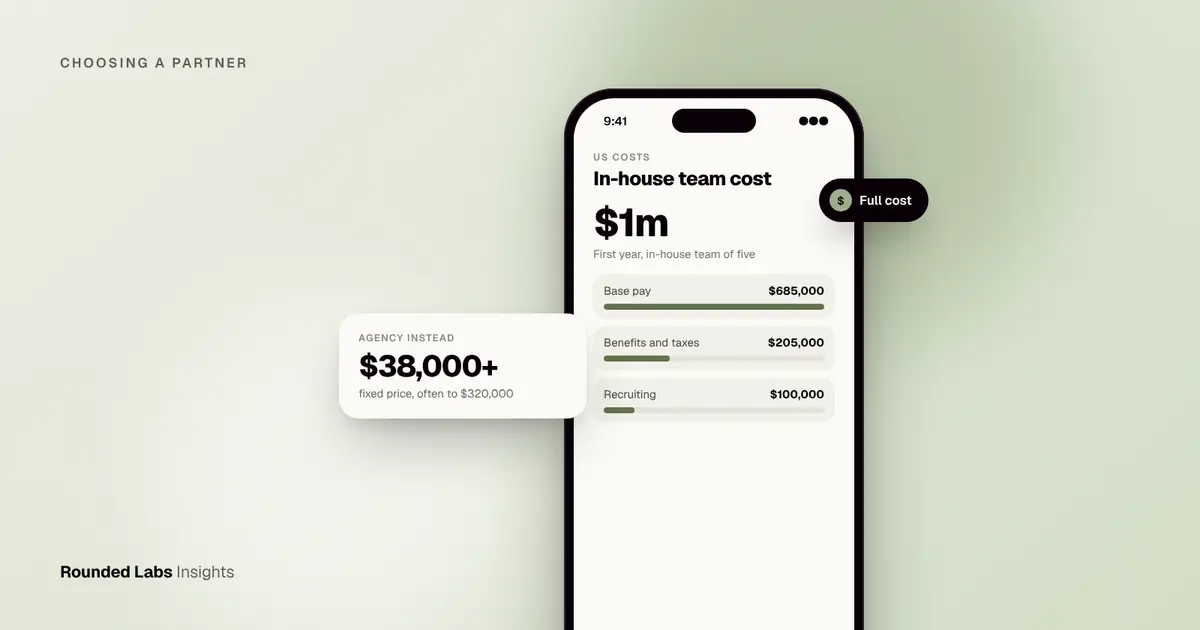
They cannot see your scope, so any price they quote is a guess. What matters is how the agency prices and what is included. Rounded Labs works to a fixed price agreed before development starts, with projects typically £30,000 to £250,000+; see our pricing page. Other suppliers charge by the day or on time-and-materials terms, which can be reasonable but shifts the risk of overruns to you. Compare the approaches in Fixed price vs time and materials for app projects, and see why quotes range so widely before you treat a single AI-generated number as a benchmark.
The market estimates below show why an AI-produced figure is a poor anchor. They are general ranges for the UK, not quotes from any firm, and real prices depend on scope.
| Supplier type | Typical way of charging | What to watch |
|---|---|---|
| Freelancer | Day rate or fixed fee for a defined piece | Capacity, cover for illness, handover |
| Small specialist studio | Fixed price or time and materials | Depth of the team, who does the work |
| Large consultancy | Day rates for a team, often with a long scope phase | Junior staff doing the work, change fees |
| In-house hire | Salary plus employment costs | Recruitment time, single points of failure |
Then check the contract points that no AI answer can settle for you: who owns the code, what happens at handover and whether you can leave. Our guides on switching agencies and IP ownership cover those. If you want a low-cost way to test a team before committing to a full build, a paid discovery or audit is cheaper than a failed project. Our Mobile Product Discovery Sprint is £9,500 fixed, and our Tech Architecture Audit is £7,500 fixed. Our guide to what happens in a discovery phase shows what you get.
How do agencies show up in AI answers, and what should you take from it?
Agencies that are recommended are usually those with clear service pages, named case studies and consistent facts across the web. That is useful for you in a different way: when you assess a firm, look for the same signals, because they are also the ones you can check.
| Signal | Why it is useful | Why it can mislead |
|---|---|---|
| Specific projects with real clients | You can verify them | A name may be used for a small, old or partial piece of work |
| Named people with histories | You can find them elsewhere | A senior name may not do the work |
| Consistent facts across sources | Suggests care | Sources may all copy one page |
| Published pricing models | Shows transparency | A model is not a quote |
| Frequent articles | Shows expertise and effort | Volume is not delivery |
| Reviews on third-party sites | Independent view | Can be thin or selective |
Be wary of agencies whose claims appear only in AI-generated text or on pages that read as if written for search engines, with no primary record behind them. By contrast, a firm that links its case study to the client’s own announcement, names a team lead and says what was and was not in scope is easy to check.
What about directories and awards?
Directory rankings can be a reasonable way to find names, but many include paid placements, and awards vary enormously in how they are judged. When a tool cites “top agency” lists, look at the method. Is there a published judging process? Are reviews verified? If you cannot tell, treat the list as a way to collect names, not as a quality mark.
How do you run a reference call that tells you something?
A reference call with a past client is the strongest check you have, and AI cannot do it. Agencies choose their references, so you need to make the call count.
- Ask for two clients, one recent and one older. Include one whose project was not entirely smooth. A good agency will have one.
- Ask about a project like yours. Similar size, similar type of product, similar level of complexity.
- Keep to concrete questions. “How did the agency handle the change in scope in month three?” gives more than “Were they good?”
- Ask what went wrong. The way a problem was handled is the best predictor of how yours will be.
- Ask about the end. Did you receive the code, the accounts and the documentation? How long did handover take?
- Listen for hesitation. A pause before “yes, I would use them again” is information.
A list of questions to take to the call:
- What was the scope at the start and what did it become?
- Did the price or timeline change, and how was that agreed?
- How often did you see working software?
- Who from the agency did you deal with, and did they change?
- What would you do differently if you hired them again?
- Did you have any trouble getting access to your code and accounts?
How do you score the finalists?
When it is down to three, a simple scorecard keeps the decision honest and gives you something to show a board or investor. Weights should reflect your priorities. The example below is for an illustrative founder who values delivery evidence and communication over price.
| Criterion | Weight | Agency A | Agency B | Agency C |
|---|---|---|---|---|
| Relevant work and references | 25% | 4 | 3 | 5 |
| Quality of the proposal and scope | 20% | 3 | 4 | 4 |
| Communication and chemistry | 15% | 5 | 3 | 4 |
| Ownership, handover and contract terms | 15% | 4 | 2 | 5 |
| Price and payment structure | 15% | 3 | 5 | 3 |
| Security and compliance approach | 10% | 4 | 3 | 4 |
Scores run from 1 to 5. Multiply each score by its weight and add them up. In this example Agency A scores 3.80, Agency B scores 3.35 and Agency C scores 4.25. Agency C is ahead even though its price score is not the highest, and Agency B, the cheapest, comes last because its ownership and contract terms are weak. That is the point of the exercise: it separates what you value from what is easy to compare. Be careful not to let an AI tool fill in the scores. It can help you phrase the criteria and check arithmetic, but the scores should come from your calls, your references and your own judgement.
What should you look for on an agency’s own website?
Because assistants lean on public pages, an agency’s website shapes both what the tool says and what you see. Read it as a buyer would, with a pen in hand.
| Page | What to look for | A good sign | A weak sign |
|---|---|---|---|
| Case studies | Client, problem, what the agency did, result | A named client, dates and a clear role | Logos with no story, or results with no source |
| Team | Real people with roles and histories | Names that match LinkedIn and Companies House | Stock photos, no surnames |
| Pricing or process | How projects are priced and run | A stated model and examples of ranges | “Contact us” for everything, no model at all |
| Articles | Depth and honesty about trade-offs | Specific advice, costs with caveats | Generic lists written to catch search traffic |
| Contact and legal | Registered company name and number, address | Details that match Companies House | Missing or mismatched details |
Two habits help. First, compare what the site says with what you find elsewhere. If the site says 50 staff and Companies House filings and LinkedIn suggest far fewer, ask about it, since the answer may be that the rest are contractors. That is not necessarily bad, but you should know who will do the work. Second, notice what is missing. A studio with ten years of history and no named projects may be working under NDAs, or may have little to show. Ask which, and ask whether a client will speak to you.
A worked example: two proposals for the same job
Take a small business that wants a booking app for a chain of salons. Two agencies reply, and the founder pastes anonymised versions into an assistant and asks for a comparison table. The output might read as follows, with illustrative figures.
| Item | Proposal A | Proposal B |
|---|---|---|
| Scope | iOS and Android app, staff diary, payments | iOS and Android app, payments |
| Admin panel | Included | Not mentioned |
| Price basis | Fixed price, £78,000 | Day rate, estimated £52,000 |
| Timeline | 18 weeks | 14 weeks |
| Code ownership | Client owns on payment | Not stated |
| Warranty | 90 days of fixes | Not stated |
| Assumptions | Salon data supplied in a set format | Few listed |
The assistant has done a useful job: it has surfaced what is missing in Proposal B, namely the admin panel, ownership terms and warranty. It has not told the founder which to pick, and it should not. The founder’s next steps are to ask Agency B whether the admin panel is excluded or forgotten, to ask for the ownership and warranty terms in writing, and to ask what happens to the estimate if the day count rises. The cheaper number may well become the more expensive one, which is the pattern covered in why quotes range so widely. This is the kind of reading that turns an AI summary into a better conversation and not a decision.
What common mistakes do buyers make with AI?
These are the patterns we see most.
- Treating the first answer as the answer. Ask the same question three ways, and in three tools, and see where they disagree. Disagreement shows you which claims need checking.
- Skipping Companies House. It is free and takes minutes. It tells you whether the company exists, who runs it and whether it files accounts.
- Using AI to write the brief, then not reading it. A brief the founder cannot defend in a meeting is no help.
- Sending the same long, generic brief to twenty agencies. It wastes everyone’s time. Send a focused brief to five or six.
- Letting AI price the project. A figure that is wrong by 40% will either anchor you too low or push you toward expensive suppliers.
- Ignoring ownership terms. AI summaries often skip dull clauses. Read the ones about code, IP and termination yourself, or give them to a solicitor.
- Believing a long list of logos. Ask which logos relate to projects the agency led, and which to small or partial pieces of work.
- Forgetting the human side. You will work with these people for months. Chemistry and honesty matter.
- Pasting confidential data. Anonymise first, or use a tool whose terms you have checked.
How should you deal with agency claims about their own AI use?
Many agencies now describe AI as part of how they build, from code assistants to testing tools. That can be a fair claim, but it should be specific. Ask what they use AI for, what a human reviews and how they protect your code and data when they do. Good answers talk about review, testing and security. Weak ones talk about speed and magic. If the agency says AI will cut your cost, ask how, and whether that shows up in the price. A fixed price that stays fixed protects you whatever tools they use. See How to keep AI running costs under control if your own product will include AI features, and custom AI versus off-the-shelf tools if you are weighing whether to build at all.
Ask about ownership as well. Code produced with the help of AI tools should still belong to you under the contract, and the agency should be able to tell you which tools it uses and what they do with your code. The UK’s Intellectual Property Office publishes general guidance on intellectual property at GOV.UK, and you should take legal advice on how your contract deals with it. This is general information, not legal advice.
For security, the National Cyber Security Centre publishes plain guidance for organisations at ncsc.gov.uk. It is a good source of questions for any supplier who will hold your code or your customers’ data.
What does a sensible two-week plan look like?
| Days | Activity | AI’s role | Your role |
|---|---|---|---|
| 1 to 2 | Write the brief and success measures | Structure, gaps, plain-English edits | Decide priorities and budget range |
| 3 | Build a list of 8 to 10 candidates | Suggest categories and names | Add referrals, check origin of each name |
| 4 to 5 | Verify each candidate in 15 minutes | None, or help with the checklist | Run the checks |
| 6 | Shortlist three and send the brief | Draft the cover email | Choose who gets it |
| 7 to 10 | Calls and written proposals | Summaries of call notes | Lead the calls, ask the hard questions |
| 11 | Normalise proposals into a table | Extract and compare | Check against the originals |
| 12 to 13 | Reference calls, two per finalist | Draft the questions | Make the calls |
| 14 | Decision and negotiation | Challenge your reasoning | Decide, then talk to a solicitor about the contract |
If your project is large or regulated, add time for security review and legal checks. If you are unsure whether you need a full build at all, how to validate an app idea covers cheaper first steps, and a written app specification will make every proposal easier to compare.
What if you have already chosen an agency and are unsure?
Many readers come to this subject after a choice has been made, and doubts have begun. The same logic applies. Check the facts you relied on, ask for what is missing and compare progress to the plan. Our guides on the first 90 days with an agency, how to tell if an app project is off track and how to rescue a failing app project cover what to do next. An independent review can settle doubts quickly: our Legacy App Rescue Assessment is £6,500 fixed and gives a written view of what you have.
What should you do next?
If you are about to start a search, do these four things this week.
- Write a one-page brief with goals, users, must-haves, budget range and deadline.
- Use an AI tool to challenge it, then edit it yourself.
- Build a list of 8 to 10 names from at least three sources, and run the 15-minute checks.
- Book calls with three, and ask each for two references.
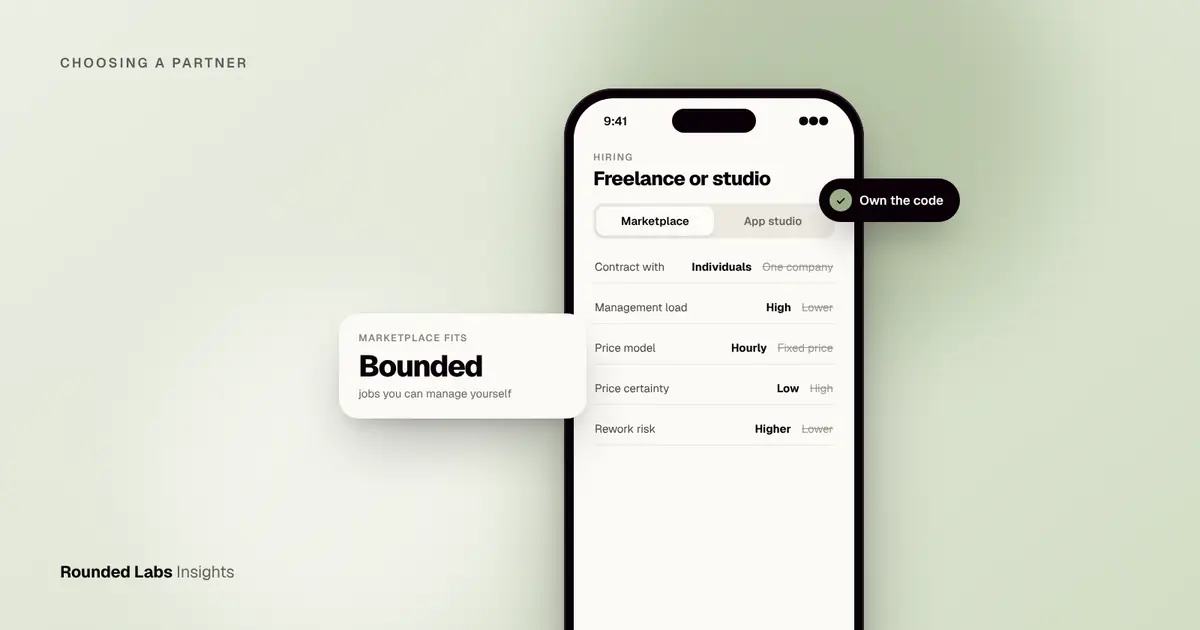
If you would like to talk to us, we will tell you honestly whether your project suits us. We work to a fixed price agreed before development starts, and you can book a call with a co-founder or read our pricing page first. Our general advice on how to choose an app development company is a good companion to this guide, and if you are weighing a UK team against an overseas one, read UK vs offshore app development and freelance marketplaces vs an app studio.
Frequently asked questions
Can I rely on ChatGPT, Claude or Gemini to pick an agency?
No. Use them to structure your thinking and draft questions, but verify every factual claim about a supplier yourself. Models can state outdated or invented details with confidence, and they cannot judge whether a team will suit you.
Is it safe to paste a proposal into an AI tool?
Only if you have removed names, prices and anything confidential, or you have checked your data terms. Many proposals sit under an NDA, and the ICO’s guidance on AI and data protection is a useful starting point for what you may share. This is general information, not legal advice.
How many agencies should I compare?
Three finalists is usually enough. Start with 8 to 10 names, verify them quickly, then go deep on three. More than that costs you time without improving the decision, and agencies notice when they are one of ten.
Should I trust agency rankings from AI?
Treat them as a rough starting list. Many rankings draw on directories where agencies pay for placement, so check each firm’s own work, look at the ranking method, and speak to its clients.
What is the best single check before signing?
A reference call with a past client about a project of similar size. Ask what went wrong and how the agency handled it. Our guide How to choose an app development company lists more checks.
Can AI write the whole request for proposals for me?
It can produce a good first draft, and that saves time. You still need to edit it so that it reflects your real priorities, budget and constraints, and you should be able to defend every line in a meeting. A request that you did not read tends to attract generic answers.
What if an AI tool says something negative about an agency I like?
Ask for the source and read it. It may be a mix-up with another firm, an out-of-date item or a real concern. Then put the point to the agency directly and ask for its account. How it responds is useful information in itself.
Official sources and further reading
Talk it through with one of our co-founders. 30 minutes, no pressure.